
When a fault strikes a high-voltage transmission network, the fault current can rise to tens of thousands of amperes in milliseconds. Interrupting that current safely is one of the toughest jobs in electrical engineering — and for the last sixty years, the device most trusted to do it has been the SF6 circuit breaker.
SF6 (sulphur hexafluoride) circuit breakers use a special insulating gas to quench the electric arc that forms when contacts separate under load. They dominate high-voltage switchgear worldwide, from 33 kV substations to 765 kV transmission lines. If you already know the basics of a circuit breaker, this guide will take you deeper into the SF6 circuit breaker working principle, its construction, the different types, and its honest advantages and disadvantages.
What Is an SF6 Circuit Breaker?
An SF6 circuit breaker is a type of circuit breaker in which sulphur hexafluoride gas is used as both the arc-quenching medium and the insulating medium. The contacts of the breaker open and close inside a sealed chamber filled with SF6 gas at a pressure of roughly 2–6 bar (depending on design and voltage class).
SF6 is an ideal gas for this job because it is:
- Highly electronegative — its molecules eagerly capture free electrons, which is exactly what an arc needs to sustain itself. Removing electrons kills the arc.
- An excellent insulator — about 2.5 times better than air at the same pressure, allowing compact designs.
- Chemically inert and non-flammable — it does not react with contact materials under normal conditions and cannot catch fire.
- Thermally stable — it can absorb the intense heat of an arc and quickly recover its insulating strength.
Construction of SF6 Circuit Breaker
A typical SF6 breaker consists of:
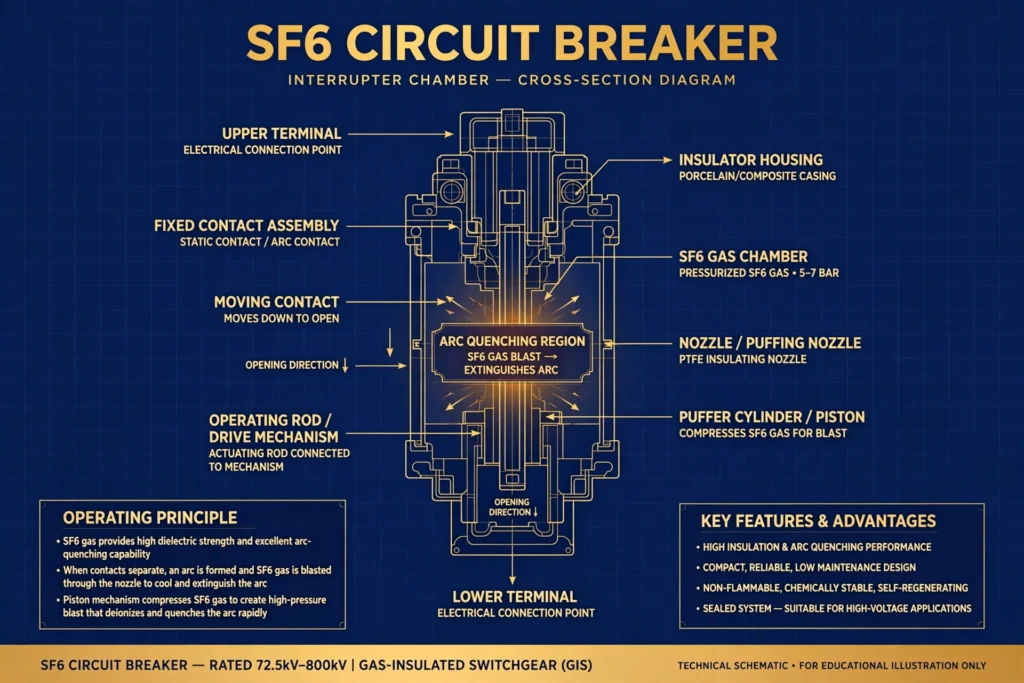
- Sealed interrupter chamber: A gas-tight enclosure (usually of porcelain or composite insulator) housing the fixed and moving contacts, filled with SF6 gas.
- Fixed and moving contacts: The main current-carrying contacts plus a pair of arcing contacts designed to take the damage of the arc, protecting the main contacts.
- Puffer cylinder and piston: In the common “puffer” design, a cylinder attached to the moving contact compresses SF6 gas during opening, creating the blast that quenches the arc.
- Operating mechanism: Usually a spring-charged or hydraulic mechanism that drives the contacts open and closed at high speed.
- Gas monitoring system: Density monitors and pressure gauges that raise an alarm if SF6 leaks, since low gas pressure reduces breaking capacity.
- Support insulators and frame: Hold the interrupter chambers at the correct height and provide external insulation to ground.
- Control cabinet: Contains the trip/close coils, auxiliary switches, heaters (to prevent moisture condensation), and wiring.
In switchgear systems, three such interrupter chambers (one per phase) are mounted on a common frame for outdoor substations, or packed into compact metal-enclosed modules for gas-insulated switchgear (GIS).
SF6 Circuit Breaker Working Principle
The SF6 circuit breaker working principle can be understood in three steps:
Step 1 — Contacts separate, arc forms
When a trip signal arrives, the operating mechanism pulls the moving contact away from the fixed contact at high speed. As the contacts part while carrying current, the current keeps flowing through the ionized air gap — an electric arc strikes between them. This arc is extremely hot (several thousand degrees) and would destroy the contacts if allowed to persist.
Step 2 — SF6 gas blast quenches the arc
Simultaneously, the puffer cylinder compresses SF6 gas. This high-pressure gas is directed as a blast across the arc. Two things happen: the gas cools the arc channel, and — more importantly — the electronegative SF6 molecules capture the free electrons in the arc plasma. Without free electrons, the arc cannot sustain itself, so it collapses. Because AC current passes through zero 100 times per second (in a 50 Hz system), the breaker times the quenching to coincide with a current zero, when the arc is weakest.
Step 3 — Dielectric recovery
After the arc is extinguished, the fresh SF6 gas rushing into the gap rapidly rebuilds its insulating strength. Within microseconds, the gap can withstand the full system voltage again, so the arc does not re-strike. The decomposed gas byproducts (small amounts of fluorides formed by the arc’s heat) are absorbed by filters containing activated alumina inside the chamber.
This is why SF6 breakers can interrupt huge fault currents — up to 63 kA — in just 2–3 cycles: the gas both kills the arc and instantly re-insulates the gap.
Types of SF6 Circuit Breakers
- Puffer-type SF6 breaker: The most common design. A piston compresses SF6 during the opening stroke and blasts it across the arc. Simple, reliable, and widely used from 36 kV to 245 kV.
- Self-blast (thermal) SF6 breaker: Uses the arc’s own heat to build up gas pressure in an expansion chamber, so less mechanical energy is needed. More energy-efficient; common in modern high-voltage designs.
- Rotating-arc SF6 breaker: Magnetic coils spin the arc around in a ring of SF6 gas, stretching and cooling it until it dies. Used mainly in medium-voltage applications.
- Dead-tank SF6 breaker: The interrupter chamber sits at ground potential inside an earthed metal tank (popular in North America). Easy to maintain and seismically sturdy.
- Live-tank SF6 breaker: The interrupter is at line potential, supported on an insulator column (common in Europe and Asia). Lighter and cheaper for high voltages.
Advantages of SF6 Circuit Breakers
- Excellent arc-quenching: Interrupts very high fault currents quickly (2–3 cycles).
- Compact size: SF6’s superior insulation allows much smaller substations — the basis of gas-insulated switchgear (GIS).
- Quiet, clean operation: No loud explosion like old bulk-oil breakers, no oil fire risk.
- Low maintenance: Sealed chambers need little attention; many units run 15–20 years between major overhauls.
- Suitable for all voltages: From medium voltage up to extra-high voltage transmission (765 kV and above).
- Consistent performance: Breaking capacity does not degrade much with the number of operations.
Disadvantages of SF6 Circuit Breakers
- Greenhouse gas: SF6 is one of the most potent greenhouse gases known — about 23,500 times more potent than CO2. Leaks must be strictly controlled, and the industry is actively developing SF6-free alternatives.
- Gas handling: Filling, evacuating, and recycling SF6 needs trained staff and special equipment.
- Toxic byproducts: Arcing decomposes small amounts of SF6 into fluorides that are toxic; chambers must be handled carefully during maintenance.
- Higher cost: More expensive than vacuum breakers at medium voltage, which is why vacuum dominates below 36 kV.
- Moisture sensitivity: Moisture inside the chamber degrades performance, so heaters and desiccants are needed.
SF6 vs Vacuum Circuit Breaker
A common exam question: why use SF6 at high voltage but vacuum at medium voltage? Vacuum breakers are cheaper, simpler, and eco-friendly — but their breaking capacity and voltage withstand are limited. Above about 36–72 kV, SF6’s superior insulation and arc control win decisively. That said, environmental pressure is pushing manufacturers toward SF6-free designs using dry air or fluorinated alternatives for the highest voltages.
Applications
- High-voltage transmission substations (132 kV, 220 kV, 400 kV, 765 kV).
- Gas-insulated switchgear (GIS) in cities where land is expensive.
- Power plant switchyards and large industrial installations.
- Grid interconnections and power transmission systems requiring reliable fault clearing.
FAQs
Why is SF6 gas used in circuit breakers?
SF6 is strongly electronegative, meaning it absorbs the free electrons that sustain an electric arc. It is also an excellent insulator — about 2.5 times better than air — chemically inert, and non-flammable, making it ideal for quenching arcs in high-voltage breakers.
What happens if SF6 gas leaks from the breaker?
Low gas pressure reduces the breaker’s ability to quench arcs and insulate. Density monitors detect the drop and raise an alarm; at a second, lower threshold the breaker is blocked from operating and the feeder is taken out of service until the gas is refilled.
Is SF6 dangerous to humans?
Pure SF6 is non-toxic, but it is heavier than air and can displace oxygen in confined spaces. The arc byproducts (metal fluorides) are toxic, so maintenance staff follow strict handling procedures and use protective equipment.
What is the difference between puffer type and self-blast SF6 breakers?
In puffer breakers, a mechanical piston compresses SF6 to blast the arc. In self-blast breakers, the arc’s own heat pressurizes the gas, so the operating mechanism needs less energy — making them more efficient, especially at high voltages.
Are SF6 breakers being phased out?
Not immediately, but the direction is clear. Because SF6 is an extremely potent greenhouse gas, utilities and manufacturers are developing SF6-free alternatives using clean air and vacuum technology, especially for new installations in environmentally strict regions.
How often does an SF6 breaker need maintenance?
Routine inspection (gas pressure, mechanism, heaters) is typically annual, while major overhauls are needed only after 15–20 years or a specified number of fault interruptions — far less frequent than older oil breaker designs.
Conclusion
The SF6 circuit breaker earned its place as the workhorse of high-voltage protection through a simple physical advantage: a gas that eats the electrons an arc needs to live. Its fast interruption, compact size, and reliability made modern switchgear possible at voltages that oil and air-blast breakers could never handle economically.
The honest caveat is environmental — SF6’s greenhouse impact means tomorrow’s breakers will likely use different gases. But the SF6 circuit breaker working principle you have learned here — arc formation, gas-blast quenching at current zero, and rapid dielectric recovery — applies to nearly all modern high-voltage interruption technology. For further reading, the Wikipedia article on SF6 circuit breakers covers the history and chemistry in more depth.