
Large power transformers are among the most expensive pieces of equipment in any electrical network, and protecting them from internal damage is a top priority for every utility. One of the simplest yet most effective protection devices ever invented for this job is the Buchholz relay — a small gas-and-oil-operated device that has been guarding oil-filled transformers for nearly a century.
Named after its inventor Max Buchholz, who developed it in 1921, this relay detects faults inside the transformer tank long before they become catastrophic. Unlike electrical relays that measure current or voltage, the Buchholz relay works on a purely mechanical principle: it senses the gases and oil surges produced when something goes wrong inside the transformer.
In this guide, you will learn what a Buchholz relay is, how it is constructed, the buchholz relay working principle in simple steps, the types of faults it can detect, and where it is used. If you are an electrical engineering student or a technician preparing for an exam or an interview, this article covers everything you need to know.
What Is a Buchholz Relay?
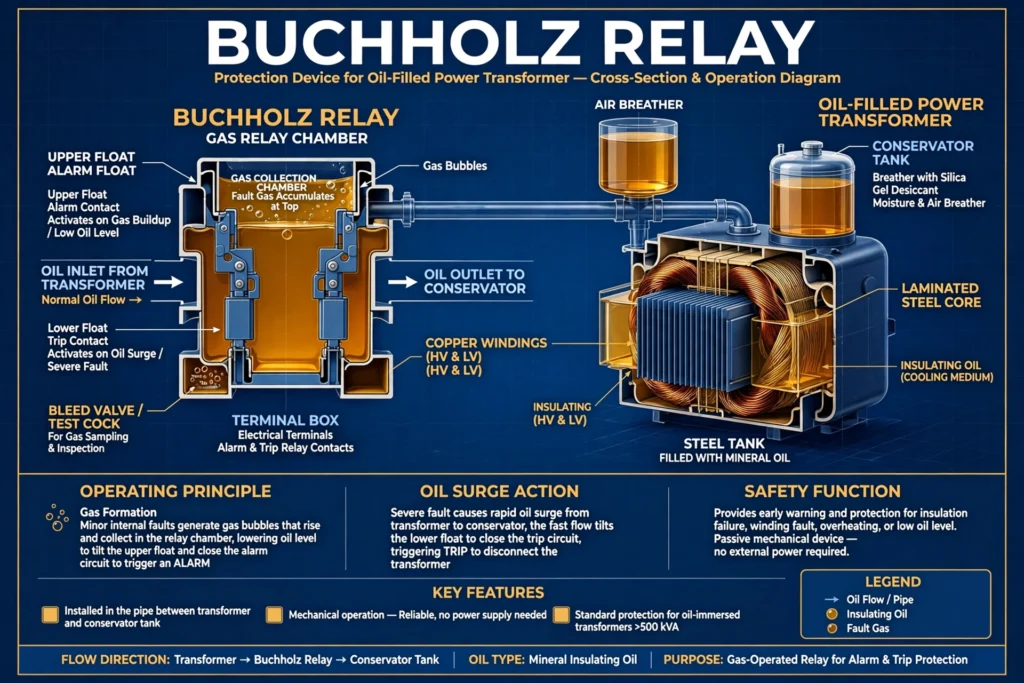
A Buchholz relay is a protective device used in oil-immersed transformers. It is installed in the pipe connecting the transformer’s main tank to the conservator tank (the small expansion tank mounted above the main tank). Its job is to detect internal faults — such as winding short circuits, core faults, or insulation breakdown — by sensing the gas bubbles and oil movement these faults produce.
The relay is sometimes called a “gas relay” or “gas-and-oil relay” because it responds to two things: the slow accumulation of gas from minor faults, and the sudden rush of oil caused by major faults. It is typically used on transformers rated above 800 kVA, where the cost of the transformer justifies this extra layer of protection. To understand where it fits in, it helps to first know what a transformer is and how its oil insulation system works.
Construction of a Buchholz Relay
The Buchholz relay has a simple, rugged construction with no complex electronics. Its main parts are:
- Cast housing (relay chamber): A rectangular metal box with glass windows on both sides so that the oil level and gas accumulation inside can be seen. The housing is connected in series with the pipe between the main tank and the conservator.
- Upper float: A hinged float positioned in the upper part of the chamber. It drops down when gas collects at the top of the chamber and displaces the oil.
- Lower float (or flap): A hinged flap or vane positioned near the bottom, in the path of oil flow. It swings when a sudden surge of oil rushes from the main tank toward the conservator.
- Mercury switches: Each float carries a mercury tilt switch. When a float moves beyond a set angle, the switch closes and completes an electrical circuit.
- Gas release cock: A small valve on top of the housing used to release collected gas for testing — the gas can be analyzed to identify the type of fault.
- Terminal box: Houses the wiring connections for the alarm and trip circuits.
- Test cock and drain plug: Used during commissioning to fill the relay with oil and to test the floats.
Under normal conditions the entire relay chamber is filled with transformer oil, and both floats sit in their raised (normal) positions with their switches open.
Working Principle of Buchholz Relay
The buchholz relay working principle is based on a simple fact: almost every internal fault in an oil-filled transformer produces gas, heat, or both. When insulation breaks down or an arc strikes inside the tank, the transformer oil decomposes and releases gases such as hydrogen, methane, ethylene, and acetylene. These gases rise through the oil toward the conservator — and the Buchholz relay sits directly in their path.
The relay operates in two stages:
Stage 1 — Alarm (minor or incipient faults)
When a slow-developing fault occurs — for example, a small leakage current heating the oil, an overloaded core, or a loose connection — a small amount of gas is produced. The gas bubbles rise into the relay chamber and collect at the top, pushing the oil level down. As the oil level falls, the upper float drops, closing its mercury switch. This completes the alarm circuit, warning the operator that something abnormal is happening inside the transformer. The transformer keeps running, giving engineers time to investigate, sample the gas, and plan a shutdown.
Stage 2 — Trip (major faults)
When a serious fault occurs — such as a short circuit between winding turns or a phase-to-earth fault — a large volume of gas is generated almost instantly. The pressure wave pushes a surge of oil violently from the main tank toward the conservator. This oil surge strikes the lower flap, swinging it hard enough to close its mercury switch. This completes the trip circuit, which immediately opens the transformer’s circuit breakers and takes the transformer out of service before the fault can destroy it.
In short: slow gas = alarm, fast oil surge = trip. This two-stage action is what makes the Buchholz relay so valuable — it gives an early warning for developing problems while still providing instant protection against severe faults.
Types of Faults Detected by Buchholz Relay
The Buchholz relay is sensitive to a wide range of internal problems, including:
- Inter-turn faults: short circuits between adjacent turns of a winding, which generate heat and gas.
- Core faults: shorted core laminations or loose core bolts causing localized overheating.
- Insulation failure: breakdown of oil or solid insulation between windings or between winding and tank.
- Oil leakage: a falling oil level lets air into the tank, which the relay detects as the upper float drops.
- Overheating: sustained overloading that decomposes oil and releases gas.
- Loose connections: poor contacts inside the tank that arc and generate gas.
- Phase-to-earth faults inside the tank that produce violent oil surges.
These belong to the broader family of faults in electrical machines, and the Buchholz relay is specifically designed for the ones that occur inside oil-filled transformer tanks.
Types of Buchholz Relays
Buchholz relays are classified mainly by the number of floats and the pipe size:
- Single-float (single-element) relay: Contains only one float and is used on smaller transformers. It provides an alarm for gas accumulation but has no separate trip element.
- Double-float (double-element) relay: The standard type described above, with separate alarm and trip elements. Used on all large power transformers.
- Relays are also sized by pipe diameter — common sizes are 25 mm, 50 mm, and 80 mm — chosen to match the connecting pipe between the main tank and the conservator.
Advantages and Limitations
Advantages
- Early fault detection: It can detect developing (incipient) faults that electrical relays cannot see, giving time for planned maintenance.
- Simple and reliable: No electronics, no external power needed for sensing — it works purely mechanically.
- Gas sampling: The collected gas can be analyzed to diagnose the exact nature of the fault (dissolved gas analysis).
- Detects non-electrical faults: It responds to oil leakage and overheating, which current-based relays miss entirely.
- Low cost: Compared to the price of a large transformer, the relay is inexpensive protection.
Limitations
- Only for oil-filled transformers: It cannot be used on dry-type transformers.
- Slow for external faults: It does not respond to faults outside the tank, such as bushing flashovers on the external side.
- Minimum oil level required: It needs the conservator pipe arrangement, so it suits only transformers with conservators.
- Possible false operation: Air trapped during oil filling or severe external short circuits can occasionally cause unwanted alarms.
Applications of Buchholz Relay
Buchholz relays are standard equipment on:
- Power transformers above 800 kVA in transmission and distribution substations.
- Generator transformers in power plants, where an undetected fault could damage both the transformer and the generator.
- Furnace and rectifier transformers in industrial plants.
- On-load tap changer (OLTC) compartments, which sometimes have their own smaller Buchholz-type relay to detect tap-changer faults.
Different types of transformers use different protection schemes, but for large oil-immersed units, the Buchholz relay is almost always part of the package alongside differential and overcurrent protection.
Testing and Maintenance
During commissioning, the relay is tested by injecting air through the test cock to lower the oil level — the alarm float should operate. The trip element is tested by forcing oil through the chamber to swing the lower flap. In service, operators periodically check the gas collection through the glass windows; any gas is released and tested. A common field practice is the gas color test: colorless, odorless gas suggests air (harmless), while a yellowish gas with a sharp smell indicates insulation breakdown and demands immediate investigation.
FAQs
Why is the Buchholz relay only used in oil-filled transformers?
Because its working principle depends on oil: faults decompose the oil into gas, and the relay senses that gas and the resulting oil movement. Dry-type transformers have no oil, so there is nothing for the relay to sense.
What is the difference between the alarm and trip contacts of a Buchholz relay?
The alarm contact (upper float) closes when gas slowly accumulates from minor faults — it only warns the operator. The trip contact (lower flap) closes when a violent oil surge from a major fault swings it — it immediately disconnects the transformer.
Can a Buchholz relay detect a transformer oil leak?
Yes. If oil leaks from the tank, the oil level in the relay chamber falls, the upper float drops, and the alarm operates — even though no electrical fault has occurred.
What gases are produced during a transformer fault?
Overheated oil mainly produces hydrogen and methane; arcing produces acetylene and ethylene as well. Gas analysis of these products helps engineers identify whether the fault is thermal or electrical in nature.
Where is the Buchholz relay installed?
It is installed in the inclined pipe connecting the transformer’s main tank to the conservator tank, typically at a slight angle (about 3–7 degrees) so that gas naturally flows upward into the relay chamber.
Does the Buchholz relay need an external power supply?
The sensing mechanism is purely mechanical and needs no power. However, the alarm and trip circuits it switches do use the station’s DC auxiliary supply to sound the alarm and open the circuit breakers.
Conclusion
The Buchholz relay remains one of the most elegant protection devices in electrical engineering: a simple mechanical device that watches over multi-million-dollar transformers by listening to what the oil tells it. Its two-stage action — alarm for slow-developing faults, trip for severe ones — gives operators both an early warning system and a last line of defense.
For students, the key points to remember are the buchholz relay working principle (gas accumulation operates the upper float for alarm; oil surge operates the lower flap for trip), its location between the main tank and conservator, and its limitation to oil-immersed transformers above about 800 kVA. For working engineers, regular gas inspection and testing keep this century-old device doing its quiet, critical job. You can read more about transformer protection concepts in our guide to the Buchholz relay on Wikipedia.