
Imagine a large manufacturing plant operating hundreds of motors, transformers, and production machines. Suddenly, a short circuit occurs in one section of the electrical network. Without proper protection, the fault could damage expensive equipment, cause fire hazards, and shut down the entire facility. Fortunately, the switchgear system detects the fault and quickly isolates the affected section, allowing the rest of the plant to continue operating safely.
This real-life example highlights the importance of a switchgear system in modern electrical power networks. Whether in power plants, substations, commercial buildings, or industrial facilities, switchgear plays a critical role in controlling, protecting, and isolating electrical equipment. It acts as the safety guard of an electrical system by preventing damage caused by faults, overloads, and abnormal operating conditions.
For electrical students, engineers, technicians, and beginners, understanding switchgear systems is essential because they are a fundamental part of power generation, transmission, and distribution networks. Learning how switchgear works helps in designing safer electrical systems and improving operational reliability.
In this article, you will learn the switchgear system working principle, types, components, applications, advantages and disadvantages, troubleshooting methods, selection guidelines, and future trends in simple and practical language.
What is a Switchgear System?
A switchgear system is a combination of electrical switching devices, protection equipment, and control devices used to control, protect, and isolate electrical circuits and equipment.
In simple words, switchgear acts as the safety and control center of an electrical power system.
Its primary functions include:
- Switching electrical circuits ON and OFF
- Detecting faults
- Protecting equipment
- Isolating faulty sections
Practical Example
In an electrical substation, switchgear automatically disconnects a faulty feeder during a short circuit, preventing damage to transformers and other connected equipment.
Without switchgear, electrical systems would be highly vulnerable to faults and accidents.
Switchgear System Working Principle
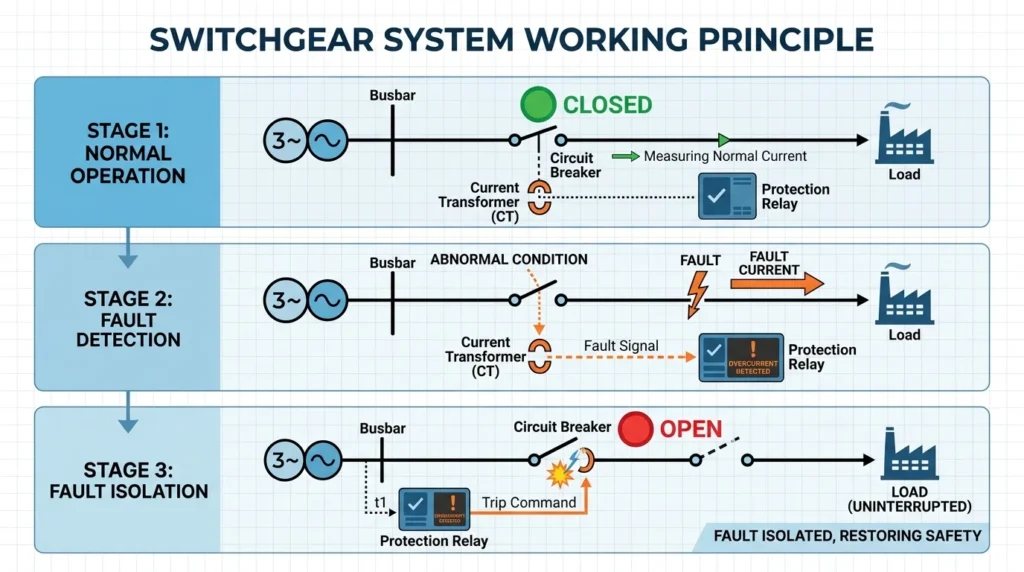
The Switchgear System working principle is based on monitoring, controlling, protecting, and isolating electrical circuits to ensure the safe and reliable operation of power systems. Under normal operating conditions, switchgear allows electricity to flow continuously from the power source to the connected loads through components such as circuit breakers, busbars, and switches. Protection devices, including current transformers (CTs), voltage transformers (VTs), and protective relays, continuously monitor electrical parameters such as current, voltage, and frequency. If an abnormal condition such as an overload, short circuit, or earth fault occurs, the protective relay quickly detects the fault and sends a trip signal to the circuit breaker. The circuit breaker then opens its contacts and interrupts the flow of current, isolating the faulty section from the rest of the electrical system. After the fault is identified and repaired, the circuit breaker can be safely reclosed to restore power. This automatic fault detection and isolation process protects electrical equipment, prevents damage, minimizes power outages, and ensures the safe operation of residential, commercial, industrial, and utility power distribution systems.The switchgear system working principle is based on monitoring electrical conditions and disconnecting circuits whenever abnormal conditions occur.
Simple Analogy
Think of a security guard in a building.
- Under normal conditions, people can move freely.
- If danger occurs, the guard isolates the affected area.
Similarly, switchgear allows normal power flow and isolates faulty sections during problems.
Step-by-Step Working Principle
Normal Power Flow
Electrical energy flows through the system normally.
Continuous Monitoring
Protective devices continuously monitor:
- Current
- Voltage
- Frequency
- Fault conditions
Fault Detection
When abnormal conditions occur, protective relays detect the problem.
Examples include:
- Short circuits
- Overloads
- Earth faults
Relay Operation
The relay sends a trip signal to the circuit breaker.
Circuit Breaker Action
The circuit breaker opens and interrupts current flow.
Fault Isolation
The faulty section is disconnected from the healthy system.
System Protection
The remaining network continues operating safely.
Key Features of Switchgear System Working Principle
- Automatic fault detection
- Fast fault isolation
- Equipment protection
- Improved safety
- Reliable operation
Types / Classification
Switchgear systems are classified according to voltage level and insulation medium.
Low Voltage Switchgear (LV)
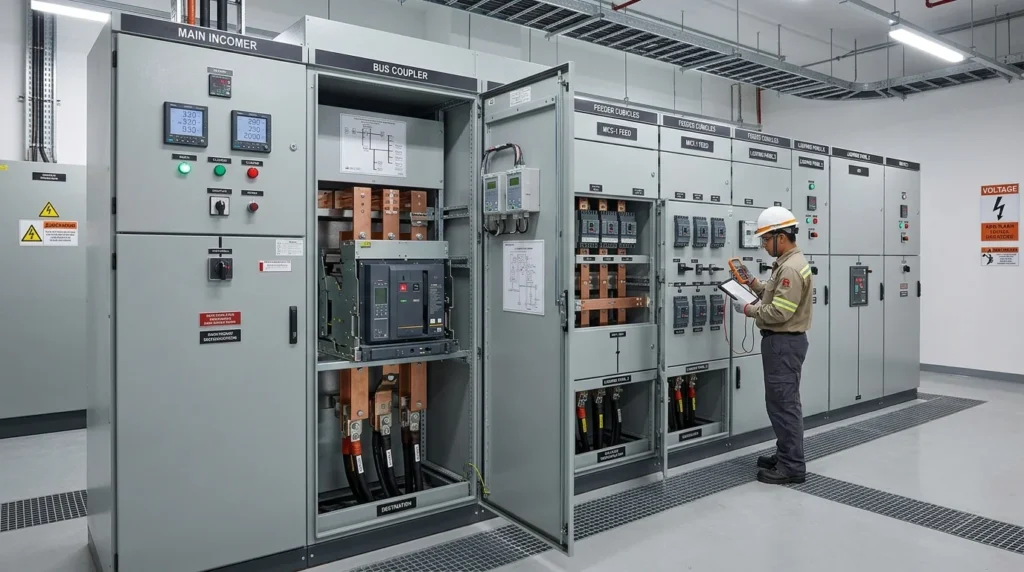
Low Voltage (LV) Switchgear is an electrical distribution and protection system used to control, protect, and isolate electrical circuits operating at voltages up to 1,000 volts AC or 1,500 volts DC. It consists of devices such as circuit breakers, switches, fuses, contactors, relays, and busbars, all housed within a safe enclosure. The primary purpose of LV switchgear is to ensure the reliable distribution of electrical power while protecting equipment and personnel from faults such as overloads, short circuits, and earth faults. It is widely used in residential buildings, commercial complexes, industrial plants, hospitals, and data centers to maintain a continuous and safe power supply. Modern LV switchgear also includes intelligent monitoring and automation features, allowing operators to remotely monitor system performance, detect faults quickly, and improve overall electrical system efficiency and reliability.
Used for systems up to 1 kV.
Features
- Compact design
- Widely used in buildings
Applications
- Homes
- Commercial buildings
- Small industries
Medium Voltage Switchgear (MV)
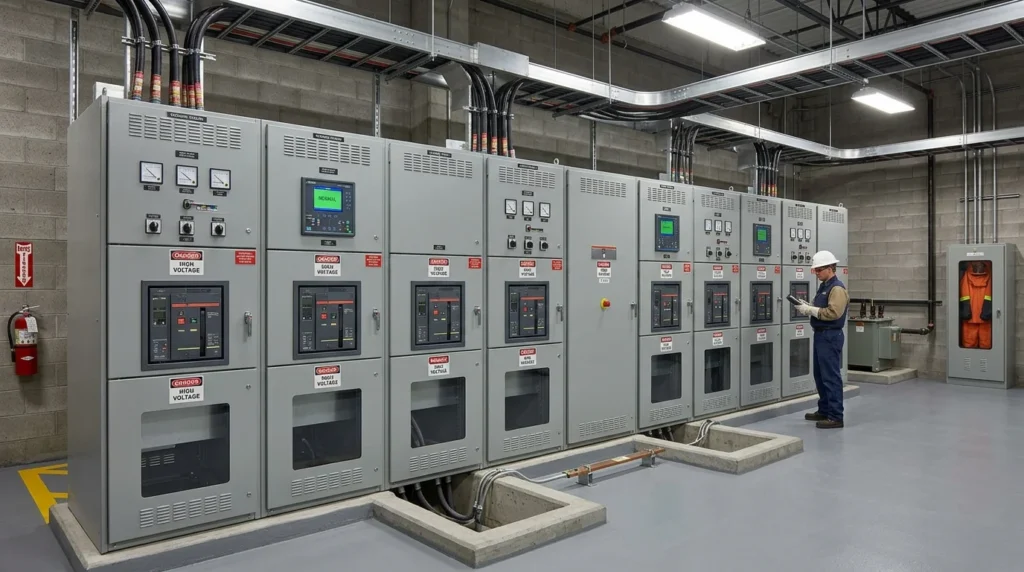
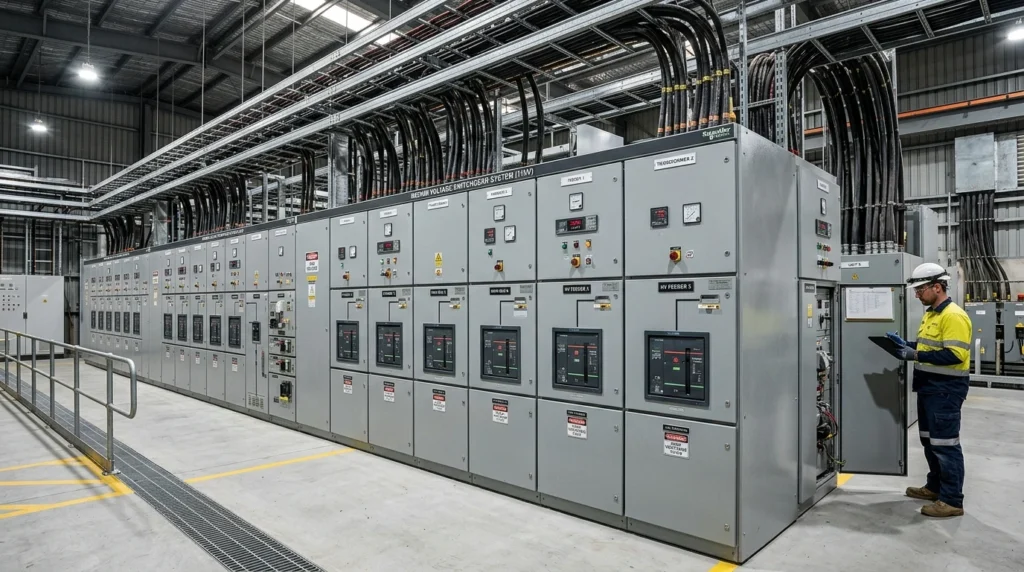
Medium Voltage (MV) Switchgear is an electrical power distribution and protection system designed to control, protect, and isolate electrical circuits operating at voltages typically ranging from 1 kV to 36 kV. It consists of components such as circuit breakers, disconnect switches, protection relays, busbars, current transformers (CTs), voltage transformers (VTs), and protective enclosures. The primary function of MV switchgear is to ensure the safe and reliable distribution of electrical power while protecting equipment from faults such as overloads, short circuits, and earth faults. It is widely used in power substations, industrial plants, commercial buildings, renewable energy systems, mining operations, and utility distribution networks. Modern MV switchgear incorporates advanced digital protection relays, automation, and remote monitoring capabilities, enabling faster fault detection, improved system reliability, reduced maintenance, and enhanced operational safety.
Used for voltages from 1 kV to 36 kV.
Features
- Higher fault handling capability
Applications
- Distribution systems
- Industrial plants
High Voltage Switchgear (HV)
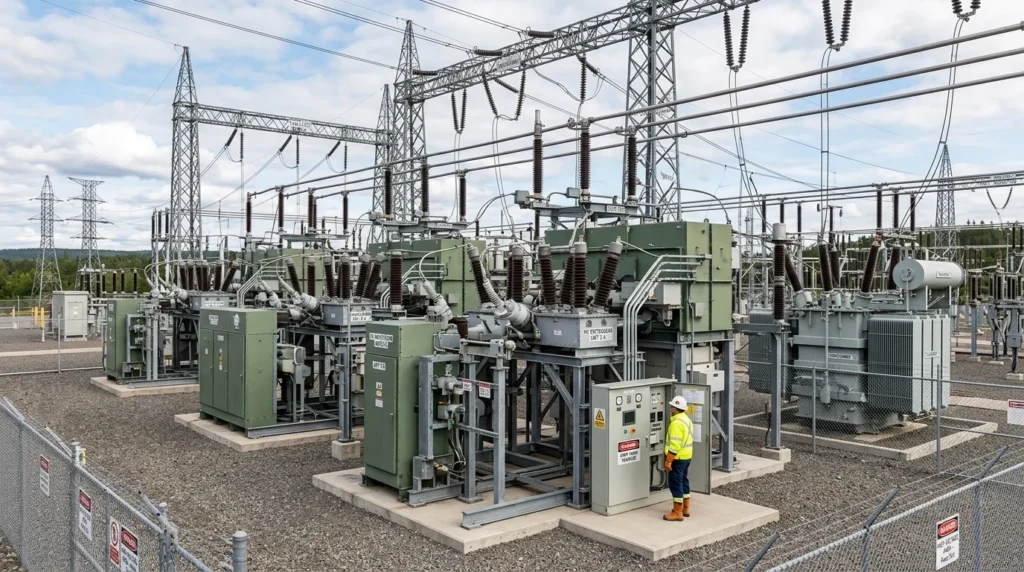
High Voltage (HV) Switchgear is an electrical power control and protection system designed to operate at voltages above 36 kV. It is used to safely switch, protect, and isolate high-voltage electrical equipment in power transmission and distribution networks. HV switchgear includes components such as circuit breakers, disconnectors (isolators), earthing switches, current transformers (CTs), voltage transformers (VTs), protection relays, and busbars, all housed within robust insulated enclosures. Its primary function is to detect and interrupt faults such as short circuits, overloads, and earth faults, preventing damage to expensive electrical equipment and ensuring the continuous and reliable supply of electricity. High Voltage Switchgear is widely used in transmission substations, power generation plants, utility grids, large industrial facilities, and renewable energy installations. Modern HV switchgear utilizes advanced insulation technologies such as SF₆ gas, vacuum, or hybrid insulation, along with digital protection, automation, and remote monitoring systems to improve operational safety, reliability, and overall power system performance.
Used above 36 kV.
Features
- Heavy-duty construction
Applications
- Power transmission systems
- Substations
Air Insulated Switchgear (AIS)
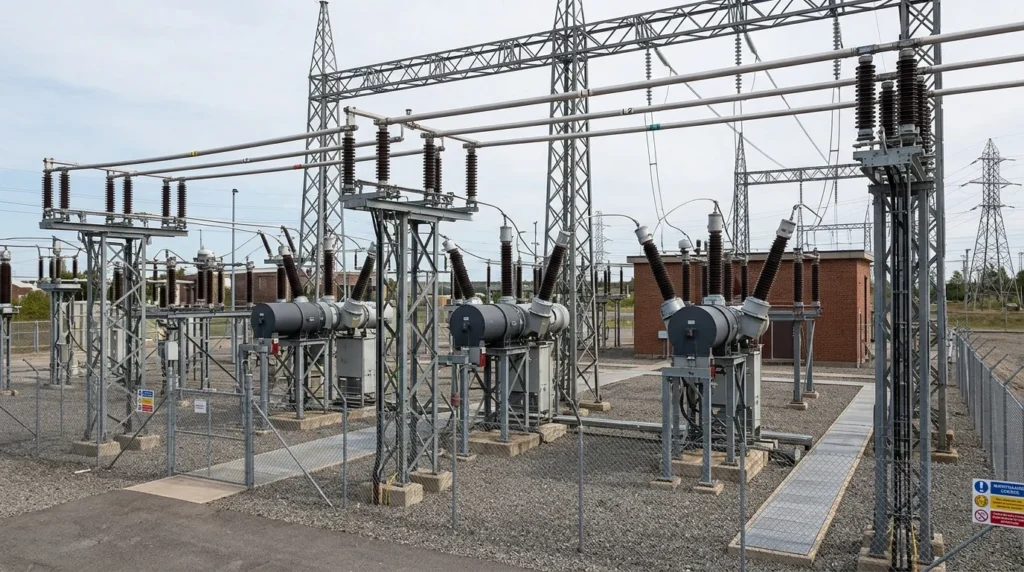
Air Insulated Switchgear (AIS) is a type of electrical switchgear in which air is used as the primary insulating medium between live electrical components and grounded parts. It is designed to control, protect, and isolate electrical circuits while ensuring the safe and reliable distribution of power. AIS consists of components such as circuit breakers, disconnectors (isolators), busbars, current transformers (CTs), voltage transformers (VTs), protection relays, and protective enclosures. Since air provides the insulation, the equipment requires adequate spacing between conductors, making AIS larger than gas-insulated alternatives. Air Insulated Switchgear is widely used in low-, medium-, and high-voltage substations, industrial plants, commercial buildings, and power distribution networks due to its simple design, lower installation cost, and ease of maintenance. Although it requires more installation space and is more exposed to environmental conditions such as dust, humidity, and pollution, AIS remains a reliable and cost-effective solution for electrical power systems where sufficient space is available.
Uses air as the insulation medium.
Features
- Lower cost
- Easy maintenance
Applications
- Outdoor substations
Gas Insulated Switchgear (GIS)
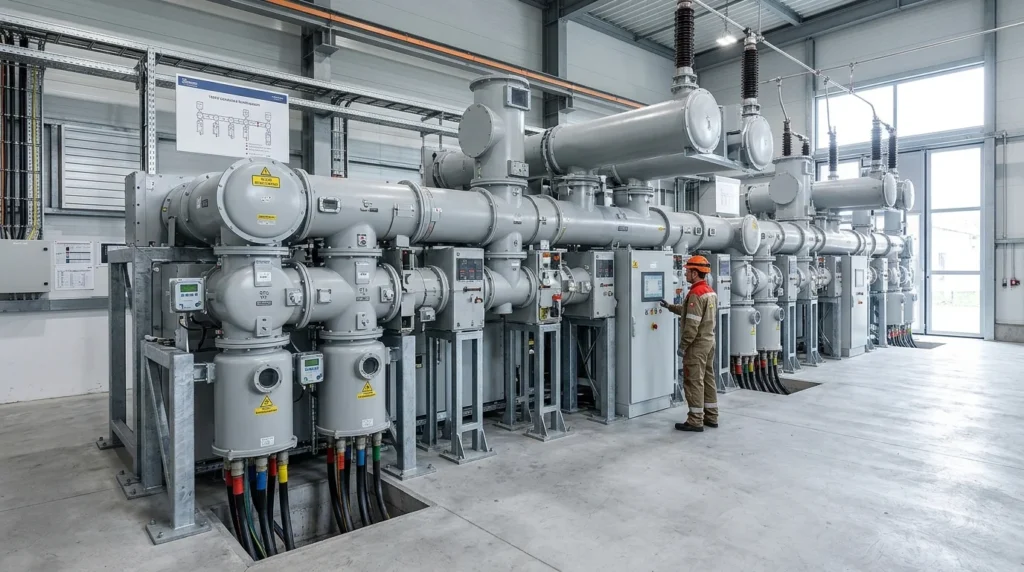
Gas Insulated Switchgear (GIS) is a type of electrical switchgear that uses sulfur hexafluoride (SF₆) gas, or in some newer designs alternative insulating gases, as the primary insulating and arc-quenching medium. It is designed to control, protect, and isolate electrical circuits in medium- and high-voltage power systems while occupying significantly less space than conventional air-insulated switchgear. GIS consists of components such as circuit breakers, disconnectors (isolators), earthing switches, busbars, current transformers (CTs), voltage transformers (VTs), and protection relays, all enclosed within sealed metal compartments filled with insulating gas. The excellent dielectric strength of the gas allows components to be placed much closer together, resulting in a compact, reliable, and highly protected system. Gas Insulated Switchgear is widely used in urban substations, underground power stations, industrial facilities, renewable energy projects, and locations where space is limited or environmental conditions are harsh. Although GIS has a higher initial cost and requires specialized maintenance, it offers outstanding reliability, reduced maintenance requirements, excellent protection against dust, moisture, and pollution, and a long operational life, making it a preferred choice for modern high-voltage power networks.
Uses sulfur hexafluoride (SF₆) gas for insulation.
Features
- Compact size
- High reliability
Applications
- Urban substations
- Space-limited installations
Hybrid Switchgear
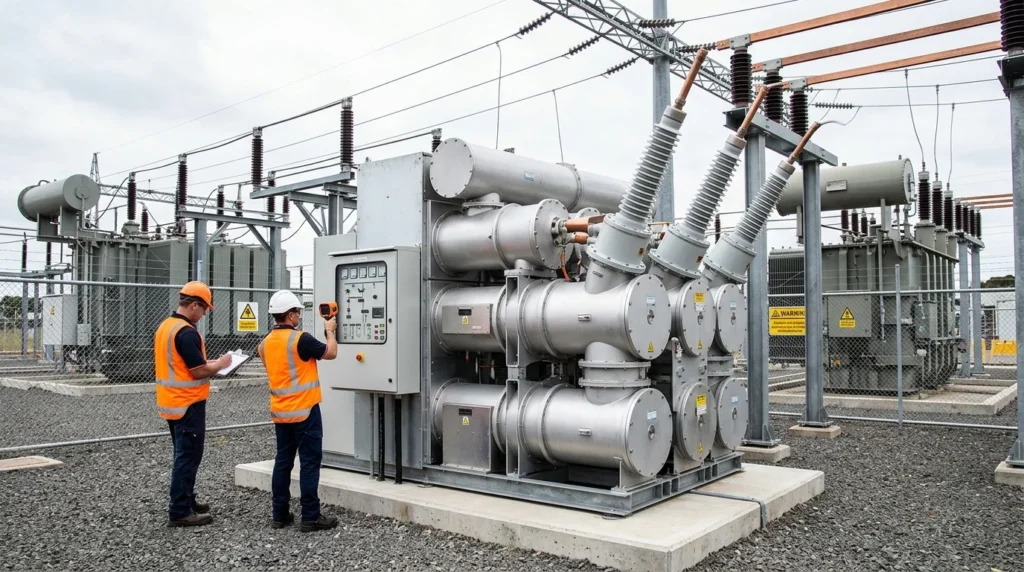
Hybrid Switchgear is a modern type of electrical switchgear that combines the features of Air Insulated Switchgear (AIS) and Gas Insulated Switchgear (GIS) into a single compact system. It uses SF₆ gas (or alternative insulating gases in newer designs) to insulate and protect critical components such as circuit breakers and disconnectors, while other parts, such as busbars or external connections, remain air-insulated. This combination reduces the overall installation space while maintaining easier access for maintenance compared to a fully gas-insulated system. Hybrid Switchgear includes components such as circuit breakers, disconnectors (isolators), earthing switches, current transformers (CTs), voltage transformers (VTs), busbars, and protection relays. It is widely used in power transmission substations, renewable energy plants, industrial facilities, and utility networks where space is limited but flexibility and cost-effectiveness are also important. Hybrid Switchgear offers advantages such as a compact design, high reliability, reduced maintenance, improved safety, and faster installation compared to conventional AIS, while being more economical than a complete GIS installation. It provides an excellent balance between performance, space savings, and overall project cost for modern electrical power systems.
Combines AIS and GIS technologies.
Features
- Balanced performance
Applications
- Modern substations
Main Components
Understanding switchgear components is essential for proper operation and maintenance.
Circuit Breaker
The main switching device.
Function
- Interrupts fault current
Protective Relay
Monitors electrical conditions.
Function
- Detects faults
Isolator
Disconnects equipment for maintenance.
Function
- Provides visible isolation
Busbar
Conducts electrical power within the switchgear.
Function
- Distributes power
Current Transformer (CT)
Measures current.
Function
- Provides current signals to relays
Voltage Transformer (VT)
Measures voltage.
Function
- Supplies voltage signals for monitoring
Control Panel
Contains monitoring and control devices.
Function
- Supervises system operation
Protection System
Provides overall fault protection.
Function
- Ensures safe operation
Advantages
Understanding switchgear system advantages and disadvantages helps engineers evaluate its importance.
Advantages of Switchgear System
- Enhanced electrical safety
- Fast fault clearing
- Improved system reliability
- Equipment protection
- Reduced downtime
- Flexible operation
- Easy maintenance
- Increased power system stability
Real-World Benefits
Better Equipment Protection
Prevents costly damage to electrical assets.
Improved Personnel Safety
Reduces risk of electrical accidents.
Reliable Power Supply
Minimizes service interruptions.
Efficient Maintenance
Allows safe isolation of equipment.
Disadvantages / Limitations
Although essential, switchgear systems have some limitations.
Switchgear System Advantages and Disadvantages
Disadvantages
- High installation cost
- Maintenance requirements
- Space requirements for large systems
- Complexity of operation
- Specialized training required
Practical Limitations
Initial Investment
Advanced switchgear can be expensive.
Technical Expertise
Operation requires trained personnel.
Environmental Considerations
Some insulation gases require careful handling.
Switchgear System Applications
Switchgear system applications exist throughout the electrical industry.
Residential Applications
- Building distribution panels
- Emergency systems
Commercial Applications
- Shopping centers
- Office complexes
- Hospitals
Industrial Applications
- Manufacturing plants
- Oil and gas facilities
- Process industries
Utility Applications
- Electrical substations
- Distribution networks
Renewable Energy Applications
- Solar power plants
- Wind farms
Transportation Applications
- Railway power systems
- Metro networks
Switchgear system applications continue expanding as electrical networks become more advanced.
Comparison Section
Difference Between Switchgear and Distribution Board
| Feature | Switchgear System | Distribution Board |
| Main Purpose | Protection and control | Power distribution |
| Voltage Range | Low to high voltage | Mainly low voltage |
| Fault Handling | High capability | Limited capability |
| Protection Level | Advanced | Basic |
| Industrial Use | Extensive | Moderate |
| Cost | Higher | Lower |
| Components | Breakers, relays, isolators | Breakers and busbars |
| Applications | Power systems | Building wiring |
Understanding the difference between switchgear and distribution board helps engineers select the proper equipment.
Selection Guide
Choosing the right switchgear system depends on several technical factors.
Voltage Level
Determine system operating voltage.
Current Rating
Calculate expected load current.
Fault Level
Evaluate potential short-circuit current.
Installation Environment
Consider:
- Indoor installation
- Outdoor installation
- Environmental conditions
Safety Requirements
Select appropriate protection features.
Tips for Beginners
- Always follow applicable standards.
- Consider future expansion.
- Verify fault current ratings.
- Choose reliable manufacturers.
- Plan maintenance access.
Common Problems & Solutions
Circuit Breaker Failure
Causes
- Mechanical wear
- Faulty trip mechanism
Solution
- Perform maintenance
- Replace defective parts
Relay Malfunction
Causes
- Incorrect settings
- Hardware failure
Solution
- Verify relay settings
- Test relay operation
Busbar Overheating
Causes
- Loose connections
- Excessive load
Solution
- Tighten connections
- Reduce loading
Insulation Deterioration
Causes
- Aging
- Moisture
Solution
- Inspect insulation
- Replace damaged parts
Frequent Tripping
Causes
- System faults
- Incorrect protection settings
Solution
- Investigate fault source
- Adjust settings properly
Future Trends
Switchgear technology continues to evolve rapidly.
Digital Switchgear
Modern systems increasingly use digital monitoring and control.
Smart Grid Integration
Switchgear is becoming a key component of smart power networks.
IoT-Based Monitoring
Real-time monitoring improves reliability and maintenance planning.
Predictive Maintenance
Advanced analytics help identify failures before they occur.
Environmentally Friendly Insulation
Manufacturers are developing alternatives to traditional SF₆ gas.
Artificial Intelligence Integration
AI systems will improve fault diagnosis and system management.
The future of switchgear system applications is closely connected with smart grids, digital substations, renewable energy integration, and intelligent power management systems.
Conclusion
A switchgear system is one of the most important components of modern electrical power networks. It protects equipment, isolates faults, and ensures safe and reliable operation of electrical systems. From residential buildings to industrial plants and utility substations, switchgear plays a critical role in maintaining power system stability and safety.
This article explained the switchgear system working principle, types, components, applications, advantages and disadvantages, troubleshooting methods, and future developments in simple and practical language. You also learned the difference between switchgear and distribution board and how to select the right switchgear system for different applications.
For electrical students, engineers, technicians, and beginners, understanding switchgear systems is essential for building strong knowledge of power system protection and electrical network operation. As power systems continue evolving, switchgear will remain a key technology in ensuring safe and reliable electricity delivery.