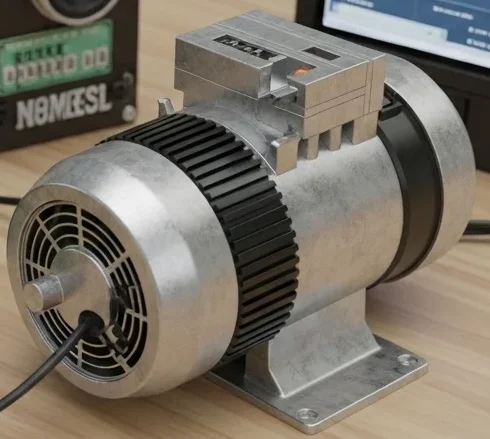

Imagine an electrical engineer troubleshooting a large industrial motor that is consuming more electricity than expected. The voltage and current values appear normal, but the energy bill continues to rise. To find the actual power being consumed, the engineer connects a wattmeter to the circuit. Within seconds, the wattmeter displays the real electrical power being used, helping identify inefficiencies and reduce operating costs.
This practical example shows why understanding the wattmeter working principle is important. In electrical systems, measuring voltage and current alone is not enough. Engineers and technicians must know the actual power consumed by equipment to evaluate performance, efficiency, and energy usage. Wattmeters provide this essential information and are widely used in laboratories, industries, power plants, and maintenance work.
For electrical students, engineers, technicians, and beginners, learning about wattmeters is a fundamental part of electrical measurements. These instruments help monitor power consumption, test electrical equipment, and improve energy management.
In this article, you will learn what a wattmeter is, the wattmeter working principle, types, components, applications, advantages and disadvantages, selection methods, troubleshooting techniques, and future developments in power measurement technology.
What is a Wattmeter?
A wattmeter is an electrical measuring instrument used to measure the real power consumed by a circuit or electrical device.
In simple words, a wattmeter tells us how much electrical power is actually being used by equipment.
The unit of power measured by a wattmeter is the watt (W).
Practical Example
If an electric heater consumes 2000 watts of power, the wattmeter will display approximately 2000 W while the heater is operating.
Unlike a voltmeter or ammeter, a wattmeter considers both voltage and current simultaneously to determine actual power consumption.
Wattmeter Working Principle
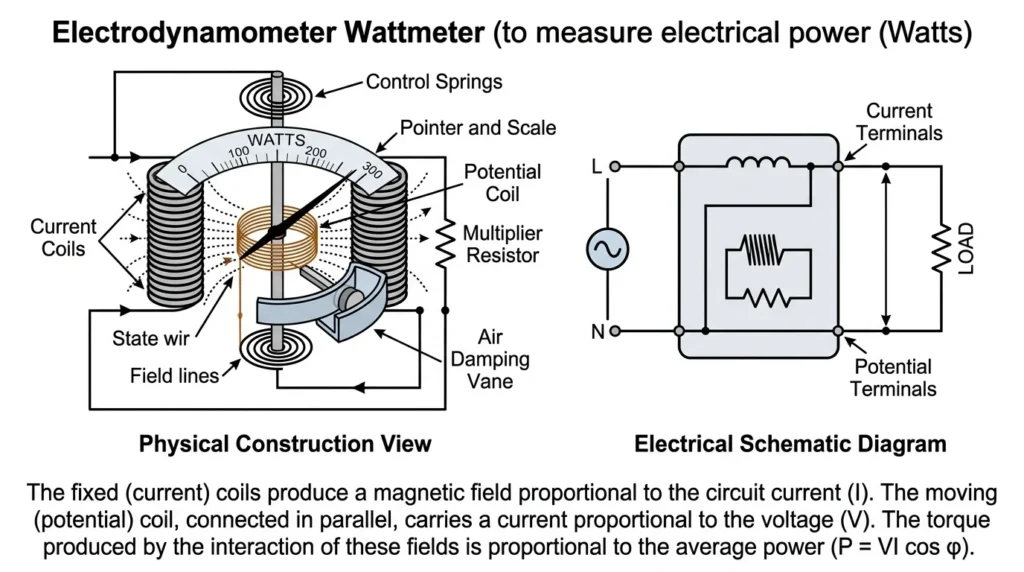
The wattmeter working principle is based on the interaction between magnetic fields produced by current and voltage within the instrument.
The wattmeter measures real power by multiplying voltage, current, and power factor.
Basic Power Equation
P = VI\cos\phi
Where:
- P = Power (Watts)
- V = Voltage
- I = Current
- cosφ = Power Factor
Simple Analogy
Think of moving a heavy box.
- Voltage is the pushing force.
- Current is the movement of the box.
- Power is the actual work done.
The wattmeter measures the actual useful work being performed.
Step-by-Step Wattmeter Working Principle
The wattmeter working principle is based on the interaction of the magnetic fields produced by its current coil and voltage (pressure) coil. These magnetic fields create a deflecting torque that moves the pointer, allowing the wattmeter to measure the real electrical power consumed by the load. The working process can be understood in the following steps:
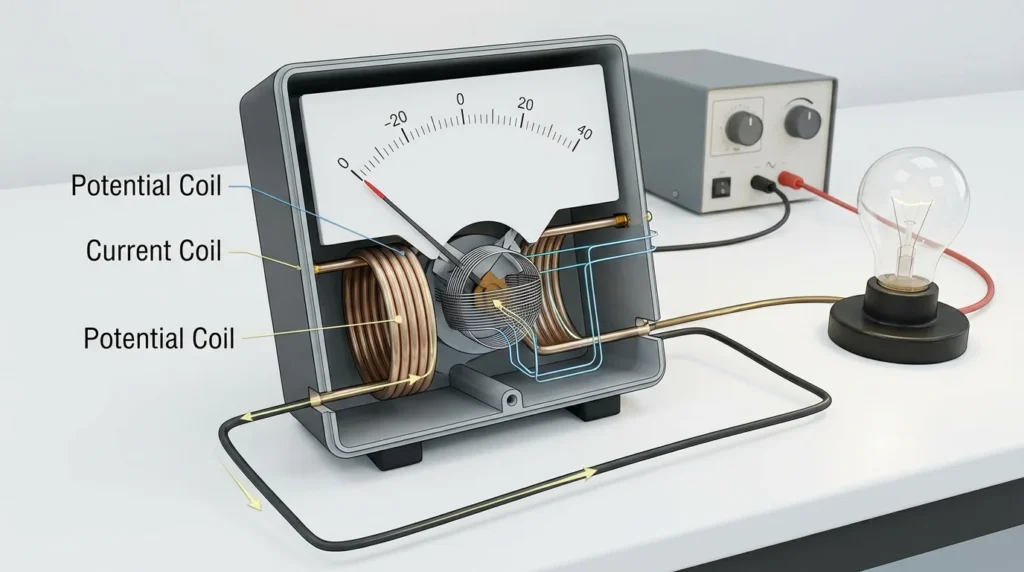
Current Flows Through the Current Coil: The current coil is connected in series with the load, so the entire load current flows through it. This current produces a magnetic field proportional to the load current.
Voltage is Applied to the Voltage Coil: The voltage coil is connected in parallel with the load. It draws a very small current because of its high resistance and generates a magnetic field proportional to the supply voltage.
Magnetic Fields Interact: The magnetic fields produced by the current coil and voltage coil interact with each other, creating a deflecting torque on the moving system.
Pointer Deflects: The deflecting torque causes the moving coil and attached pointer to rotate over the calibrated scale, indicating the measured power.
Control Spring Balances the Torque: A control spring produces an opposing torque. The pointer comes to rest when the deflecting torque equals the controlling torque.
Power is Displayed: Since the deflecting torque is proportional to the product of voltage, current, and power factor (V × I × cos φ), the pointer directly indicates the real power consumed by the electrical load in watts.
Current Coil Connection
The current coil is connected in series with the load.
It carries load current.
Voltage Coil Connection
The voltage coil is connected across the load.
It experiences the supply voltage.
Magnetic Field Creation
Both coils create magnetic fields.
- Current coil field depends on current.
- Voltage coil field depends on voltage.
Interaction of Fields
The two magnetic fields interact with each other.
This interaction creates a mechanical force.
Pointer Deflection
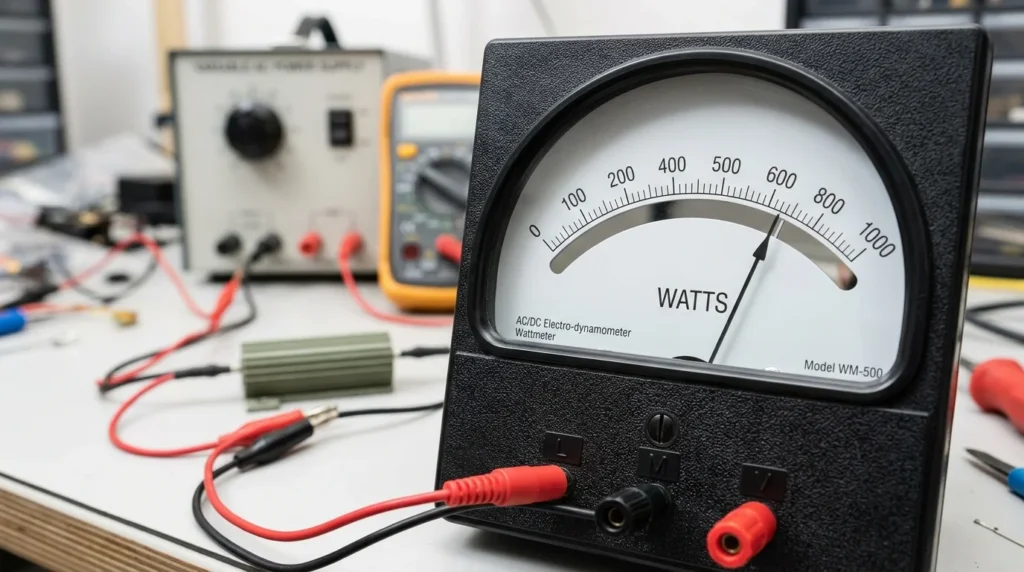
The pointer deflection in a wattmeter occurs due to the interaction of the magnetic fields produced by the current coil and the voltage (pressure) coil. The current coil, connected in series with the load, carries the load current and produces a magnetic field proportional to the current. At the same time, the voltage coil, connected in parallel with the load, carries a small current proportional to the supply voltage and creates another magnetic field. The interaction of these two magnetic fields generates a deflecting torque that rotates the moving system and causes the pointer to move across the calibrated scale. A control spring provides an opposing torque, and the pointer stops when the deflecting torque equals the controlling torque. Since the deflecting torque is proportional to the product of voltage, current, and power factor (V × I × cos φ), the pointer deflection directly indicates the real electrical power consumed by the load. Greater power results in a larger pointer deflection, while lower power produces a smaller deflection.
The force causes the moving system to rotate.
The pointer moves across the calibrated scale.
Power Measurement
The pointer position corresponds to the actual power consumed.
Key Features of Wattmeter Working Principle
- Measures true power
- Uses voltage and current simultaneously
- Suitable for AC and DC circuits
- Provides direct power reading
Types / Classification
Different wattmeters are available for various applications.
Electrodynamometer Wattmeter
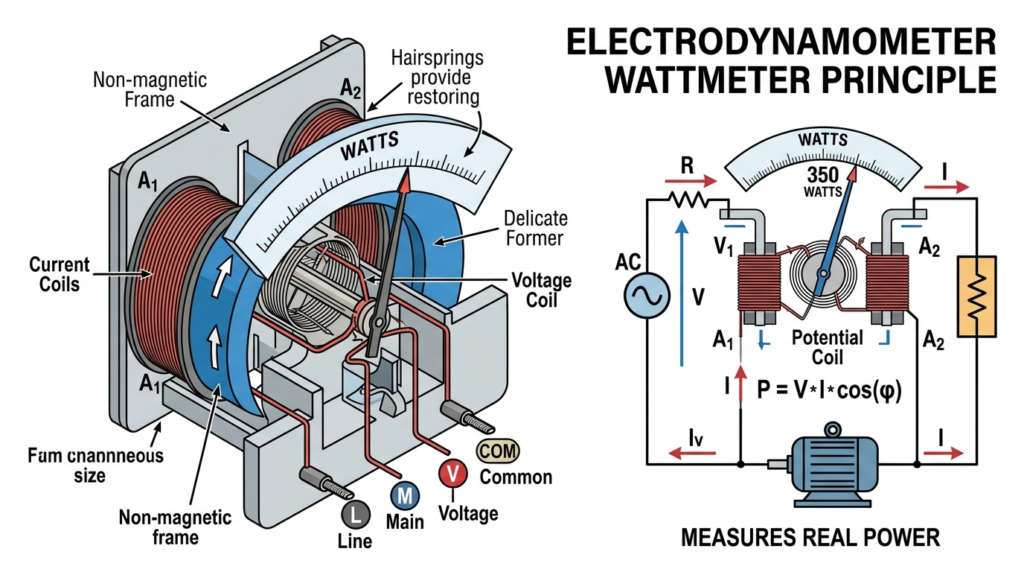
An electrodynamometer wattmeter is an electrical measuring instrument used to accurately measure true (active) power in both AC and DC circuits. It operates on the principle of the interaction between the magnetic fields produced by a fixed current coil and a moving voltage coil. When current flows through the current coil and voltage is applied to the pressure (voltage) coil, the interaction of their magnetic fields produces a deflecting torque that moves the pointer. The amount of pointer deflection is directly proportional to the actual power consumed by the load. Electrodynamometer wattmeters are highly accurate and are commonly used in laboratories, power systems, industrial testing, and electrical measurements where precise power readings are required.
The most commonly used analog wattmeter.
Features
- High accuracy
- Measures AC and DC power
Applications
- Laboratories
- Testing facilities
Induction Wattmeter
Works only on AC circuits.
Features
- Simple operation
- Durable construction
Applications
- AC power measurement
Digital Wattmeter
Modern electronic wattmeter.
Features
- High accuracy
- Digital display
- Fast measurement
Applications
- Industrial monitoring
- Energy audits
Single-Phase Wattmeter
Designed for single-phase systems.
Applications
- Residential systems
- Small commercial installations
Three-Phase Wattmeter
Measures power in three-phase circuits.
Applications
- Industries
- Power plants
Smart Wattmeter
Advanced digital measurement device.
Features
- Communication capability
- Data logging
Applications
- Smart grids
- Energy management systems
Main Components
Understanding wattmeter components helps in learning its operation.
Current Coil
Connected in series with the load.
Function
- Carries load current
Voltage Coil
Connected across the load.
Function
- Measures circuit voltage
Moving System
Produces pointer movement.
Function
- Converts electrical interaction into mechanical motion
Pointer
Displays measured value.
Function
- Indicates power reading
Scale
Calibrated measurement range.
Function
- Provides readable output
Damping System
Reduces oscillations.
Function
- Stabilizes pointer movement
Control Springs
Provide restoring force.
Function
- Maintains measurement accuracy
Digital Processor (Digital Wattmeters)
Processes electrical signals.
Function
- Calculates power electronically
Advantages
Understanding wattmeter advantages and disadvantages helps in selecting the right instrument.
Advantages of Wattmeter
- Direct power measurement
- High accuracy
- Suitable for AC and DC
- Easy operation
- Reliable performance
- Energy monitoring capability
- Useful for efficiency testing
- Supports industrial applications
Real-World Benefits
Energy Savings
Helps identify excessive power consumption.
Equipment Monitoring
Improves maintenance planning.
Efficiency Evaluation
Assists in optimizing electrical systems.
Accurate Billing
Provides reliable power measurements.
Disadvantages / Limitations
Like all instruments, wattmeters have some limitations.
Wattmeter Advantages and Disadvantages
Disadvantages
- Analog models may require calibration
- Sensitive to mechanical shock
- Digital models require auxiliary power
- Higher cost than simple meters
- Measurement errors can occur under certain conditions
Practical Limitations
Environmental Effects
Temperature and humidity can affect accuracy.
Range Limitations
Improper range selection may cause errors.
Installation Requirements
Correct connections are essential.
Wattmeter Applications
Wattmeter applications are found throughout electrical engineering.
Residential Applications
- Home energy monitoring
- Appliance testing
Commercial Applications
- Building power management
- Energy audits
Industrial Applications
- Motor testing
- Machine monitoring
- Production equipment analysis
Utility Applications
- Power station measurements
- Distribution system monitoring
Laboratory Applications
- Electrical experiments
- Educational training
Renewable Energy Applications
- Solar systems
- Wind power systems
Wattmeter applications continue expanding as energy efficiency becomes increasingly important.
Comparison Section
Difference Between Wattmeter and Energy Meter
| Feature | Wattmeter | Energy Meter |
| Measures | Instantaneous Power | Total Energy |
| Unit | Watt (W) | kWh |
| Purpose | Power measurement | Energy consumption |
| Reading Type | Real-time | Accumulated |
| Installation | Temporary or permanent | Permanent |
| Industrial Use | High | High |
| Testing Applications | Common | Limited |
| Cost | Moderate | Higher |
Understanding the difference between energy meter and wattmeter helps engineers choose the correct measuring instrument.
Selection Guide
Choosing the right wattmeter depends on several factors.
Voltage Rating
Select according to circuit voltage.
Current Rating
Choose based on expected load current.
AC or DC Measurement
Verify compatibility.
Accuracy Requirement
Higher accuracy is needed for laboratories.
Digital or Analog Type
Choose based on application needs.
Tips for Beginners
- Verify measurement range.
- Follow proper connection methods.
- Select adequate safety ratings.
- Use calibrated instruments.
- Avoid overloading the meter.
Common Problems & Solutions
No Reading on Display
Causes
- Loose connections
- Power supply issues
Solution
- Check wiring
- Verify supply voltage
Incorrect Readings
Causes
- Calibration error
- Wrong connections
Solution
- Recalibrate instrument
- Inspect connections
Pointer Not Moving
Causes
- Mechanical damage
Solution
- Inspect moving system
Display Flickering
Causes
- Electrical noise
- Power instability
Solution
- Improve grounding
- Check power quality
Overheating
Causes
- Excessive current
Solution
- Operate within rated limits
Future Trends
Power measurement technology is evolving rapidly.
Smart Energy Monitoring
Modern wattmeters include advanced monitoring features.
IoT Integration
Remote monitoring improves system management.
Wireless Communication
Data can be transmitted without physical connections.
Cloud-Based Analytics
Energy consumption can be analyzed remotely.
AI-Based Diagnostics
Artificial intelligence helps identify abnormal power patterns.
Smart Grid Compatibility
Future wattmeters will support advanced power systems.
The future of wattmeter applications is closely linked with smart grids, energy efficiency programs, renewable energy systems, and digital electrical infrastructure.
Conclusion
Understanding the wattmeter working principle is essential for anyone involved in electrical engineering, maintenance, or power system analysis. A wattmeter measures the real power consumed by electrical equipment by considering voltage, current, and power factor simultaneously. This makes it one of the most important instruments for evaluating electrical performance and energy usage.
This article explained the wattmeter working principle, types, components, applications, advantages and disadvantages, troubleshooting methods, and future developments in clear and practical language. You also learned the difference between energy meter and wattmeter and how to select the right wattmeter for specific applications.
For electrical students, engineers, technicians, and beginners, mastering wattmeter operation builds a strong foundation in electrical measurements and power analysis. As industries continue focusing on efficiency and energy management, wattmeters will remain essential tools in modern electrical systems.