
Imagine a large manufacturing plant where dozens of electric motors are running continuously. The plant manager notices that electricity bills are increasing even though production remains the same. After an electrical inspection, engineers discover that the power factor of the facility is low. To monitor and improve it, they install a Power Factor Meter.
A power factor meter is an important instrument in electrical systems because it helps measure how efficiently electrical power is being used. Poor power factor can lead to higher electricity costs, energy losses, voltage drops, and reduced system performance. For industries, commercial buildings, and power distribution systems, maintaining a good power factor is essential for efficient operation.
Understanding the power factor meter is important for electrical students, technicians, engineers, and anyone working with electrical equipment. In this article, you will learn the power factor meter working principle, its types, components, applications, advantages and disadvantages, common problems, selection tips, and future developments in this field.
What is a Power Factor Meter?
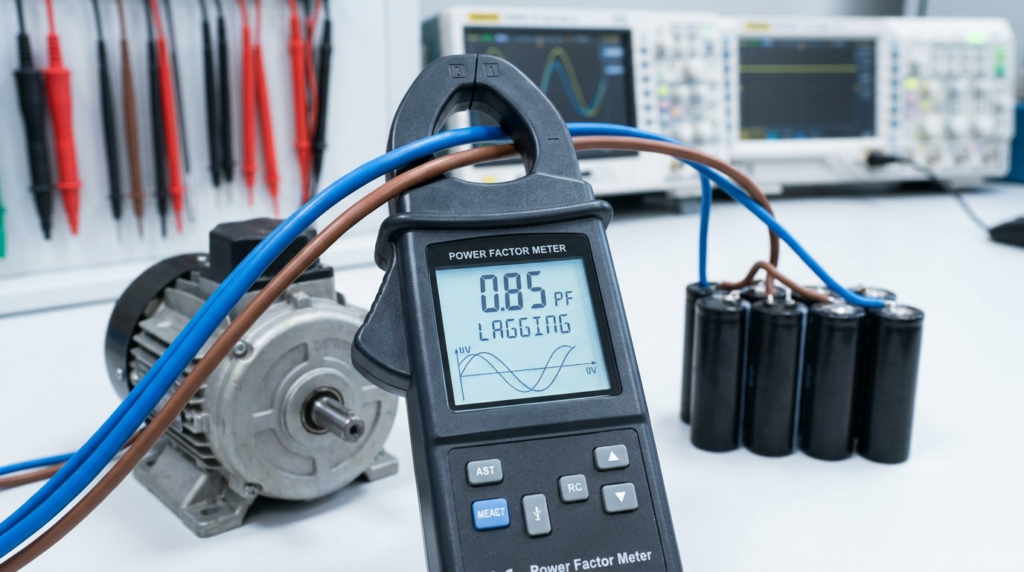
A power factor meter is an electrical measuring instrument used to determine and display the power factor of an AC electrical system. It measures the phase relationship between voltage and current and indicates how efficiently electrical power is being used. The power factor value ranges from 0 to 1 (or may be shown as leading or lagging), where a value closer to 1 indicates better energy efficiency and lower power losses. Power factor meters help engineers and technicians monitor the performance of electrical systems, identify poor power factor conditions, and determine when power factor correction equipment, such as capacitor banks, is required. These meters are widely used in industrial plants, commercial buildings, substations, generators, and power distribution systems to improve efficiency, reduce electricity costs, and maintain reliable operation.
A Power Factor Meter is an electrical measuring instrument used to determine the power factor of an AC electrical circuit.
Power factor is the ratio between real power (useful power) and apparent power (total supplied power). It indicates how effectively electrical energy is being converted into useful work.
In simple terms, a power factor meter tells us whether electricity is being used efficiently or wasted due to reactive loads such as motors, transformers, and inductors.
Practical Example
Consider an industrial motor that consumes electrical power. If the motor has a power factor of 1.0, almost all supplied power is converted into useful work. However, if the power factor drops to 0.7, a significant amount of power is wasted. A power factor meter continuously displays this value, allowing operators to take corrective actions.
Power Factor Meter Working Principle
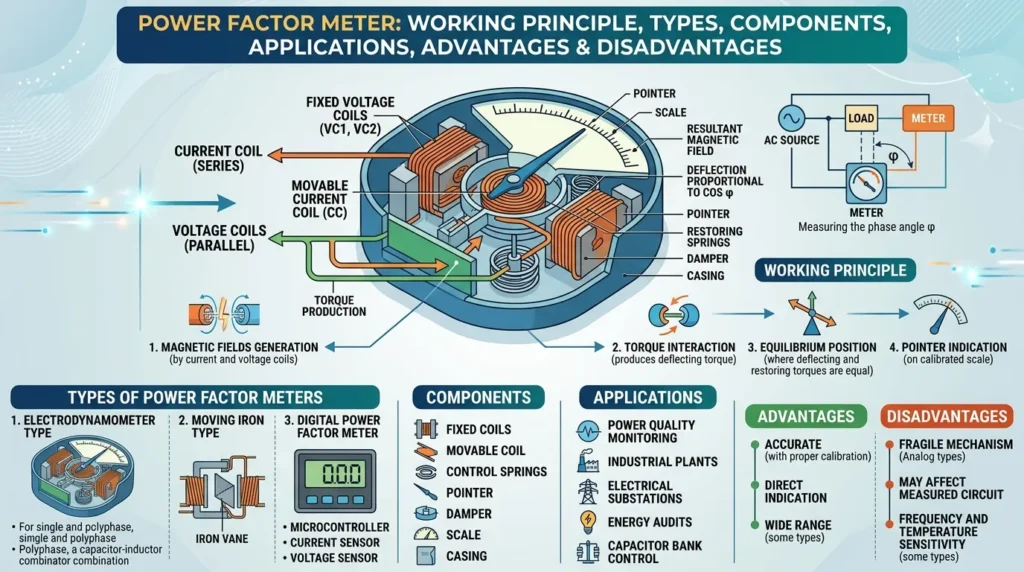
The power factor meter working principle is based on measuring the phase difference between voltage and current in an AC circuit.
In alternating current systems, voltage and current may not always rise and fall together. The angle between them determines the power factor.
Step-by-Step Working Process
- The meter receives voltage from the electrical system.
- It also receives current through a current transformer or direct connection.
- Internal circuits compare the phase relationship between voltage and current.
- The meter calculates the cosine of the phase angle.
- The resulting value is displayed as the power factor.
Simple Analogy
Imagine two runners on a track.
- If both runners move together at the same speed, they are perfectly synchronized.
- If one runner lags behind, synchronization decreases.
Similarly, when voltage and current move together, power factor is high. When current lags or leads, power factor decreases.
Power Factor Values
- 1.0 = Perfect power factor
- 0.95 = Very good
- 0.80 = Acceptable
- Below 0.80 = Needs improvement
The meter helps operators monitor these values continuously.
Types / Classification of Power Factor Meters
Different types of power factor meters are available depending on the application and measurement method.
Analog Power Factor Meter
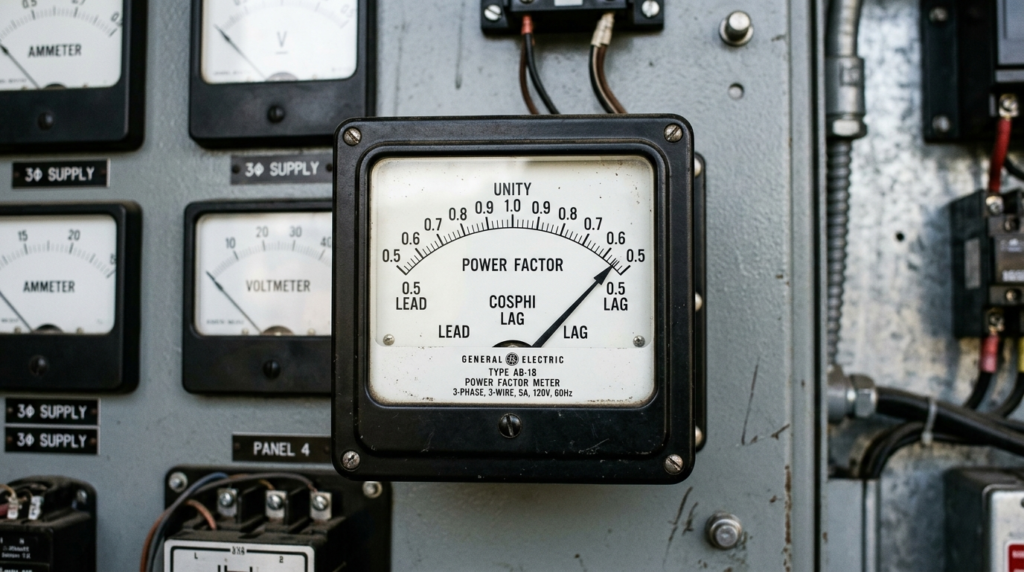
An analog power factor meter is an electrical measuring instrument used to indicate the power factor of an AC electrical system using a moving pointer and a calibrated scale. It measures the phase difference between voltage and current and displays the power factor value, typically ranging from 0 to 1, indicating either lagging or leading power factor. Analog power factor meters are commonly installed on switchboards, distribution panels, generators, and industrial power systems to continuously monitor power factor. By providing a real-time indication of power factor, these meters help operators determine when power factor correction, such as connecting capacitor banks, is required to improve system efficiency, reduce energy losses, and avoid utility penalties.
Analog meters use moving coil or electrodynamic mechanisms.
Features
- Pointer-based display
- Simple construction
- No external power required in many cases
- Common in older installations
Applications
- Industrial panels
- Educational laboratories
- Traditional electrical systems
Digital Power Factor Meter
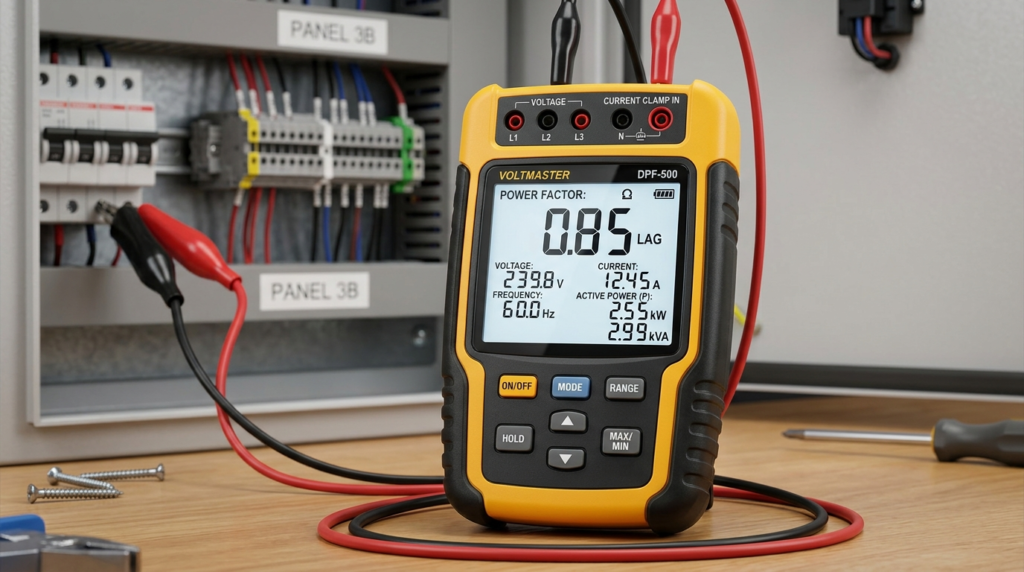
A digital power factor meter is an electronic instrument used to accurately measure and display the power factor of an AC electrical system on a digital screen. It continuously monitors the voltage and current, calculates the phase difference between them, and displays the power factor as a numerical value. Many digital power factor meters also measure additional electrical parameters such as voltage, current, frequency, active power, reactive power, and apparent power. They offer higher accuracy, faster response, and easier readability than analog meters. Digital power factor meters are widely used in industrial plants, commercial buildings, substations, and power distribution systems to monitor power quality, improve energy efficiency, and support effective power factor correction.
Digital power factor meters use electronic circuits and microprocessors.
Features
- Digital display
- High accuracy
- Fast response
- Easy reading
Applications
- Modern industries
- Commercial buildings
- Power monitoring systems
Portable Power Factor Meter
Portable models are designed for temporary measurements.
Features
- Lightweight
- Battery operated
- Easy transportation
Applications
- Field inspections
- Maintenance work
- Energy audits
Panel Mounted Power Factor Meter
These meters are permanently installed in switchboards and control panels.
Features
- Continuous monitoring
- Durable construction
- Suitable for industrial environments
Applications
- Factories
- Power plants
- Distribution panels
Smart Power Factor Meter
Smart meters integrate with digital monitoring systems.
Features
- Remote monitoring
- Data logging
- Network connectivity
- Real-time analysis
Applications
- Smart grids
- Modern industries
- Building automation systems
Main Components of a Power Factor Meter
A power factor meter consists of several important components.
Voltage Coil
The voltage coil receives voltage from the electrical circuit.
Function
- Detects system voltage
- Provides reference signal
Current Coil
The current coil measures current flowing through the circuit.
Function
- Senses load current
- Provides current information for calculations
Measuring Mechanism
This section determines the phase relationship between voltage and current.
Function
- Calculates power factor
- Generates output reading
Pointer and Scale (Analog Meters)
Analog models contain a pointer and calibrated scale.
Function
- Displays power factor value
Display Unit (Digital Meters)
Digital meters use LCD or LED displays.
Function
- Shows numerical readings
- Improves readability
Microprocessor
Modern digital meters contain microprocessors.
Function
- Signal processing
- Data analysis
- Communication support
Housing and Enclosure
The enclosure protects internal components.
Function
- Mechanical protection
- Environmental protection
- Safe operation
Advantages of Power Factor Meter
Power factor meters provide many benefits in electrical systems.
Key Advantages
- Continuous monitoring of power factor
- Helps reduce electricity costs
- Improves energy efficiency
- Supports preventive maintenance
- Helps avoid utility penalties
- Easy identification of power factor problems
- Enhances system reliability
- Suitable for industrial and commercial use
- Assists in capacitor bank control
- Improves overall power management
Real-World Benefits
Industries can save significant amounts on energy bills by maintaining an improved power factor using data from power factor meters.
Disadvantages / Limitations
Although useful, power factor meters also have some limitations.
Common Limitations
- Initial installation cost
- Calibration may be required
- Analog meters have lower accuracy
- Readings can be affected by harmonic distortion
- Requires proper wiring connections
- Smart meters may need communication infrastructure
- Maintenance is necessary for long-term accuracy
Understanding these limitations helps users make informed decisions.
Applications of Power Factor Meter
The power factor meter applications are found in almost every area of electrical engineering.
Residential Applications
In homes, power factor monitoring is limited but becoming more common with smart energy systems.
Examples include:
- Smart home energy monitoring
- Solar power installations
- Energy management systems
Commercial Applications
Commercial facilities use power factor meters to improve efficiency.
Examples include:
- Shopping malls
- Office buildings
- Hospitals
- Hotels
Industrial Applications
Industries are the largest users of power factor meters.
Examples include:
- Manufacturing plants
- Steel industries
- Chemical factories
- Textile mills
- Automotive production facilities
Power Generation Stations
Power plants monitor power factor to maintain efficient operation.
Applications include:
- Generator monitoring
- Load balancing
- Grid synchronization
Renewable Energy Systems
Modern renewable systems also use power factor monitoring.
Examples include:
- Solar farms
- Wind farms
- Hybrid energy systems
Smart Grid Systems
Advanced grids require continuous power quality monitoring.
Power factor meters play a key role in:
- Real-time monitoring
- Data collection
- Energy optimization
Comparison: Power Factor Meter vs Energy Meter vs Wattmeter
Many beginners confuse these instruments. Understanding the difference between power factor meter and wattmeter helps select the correct device.
| Feature | Power Factor Meter | Wattmeter | Energy Meter |
|---|---|---|---|
| Main Purpose | Measures power factor | Measures power | Measures energy consumption |
| Unit | PF (0 to 1) | Watts (W) | kWh |
| Continuous Monitoring | Yes | Yes | Yes |
| Efficiency Analysis | Excellent | Limited | Limited |
| Cost Savings Analysis | Yes | Partial | Partial |
| Used in Power Factor Correction | Yes | No | No |
| Industrial Usage | Very Common | Common | Common |
Selection Guide
Choosing the right power factor meter depends on several factors.
Determine Application Type
Consider where the meter will be used.
- Home
- Commercial building
- Industrial facility
- Power station
Check Accuracy Requirements
Higher accuracy is important for:
- Energy audits
- Industrial monitoring
- Research applications
Select Analog or Digital
Analog meters are suitable for basic applications.
Digital meters provide:
- Better accuracy
- Easier reading
- More features
Consider Communication Features
Modern systems may require:
- Modbus communication
- Ethernet connectivity
- Remote monitoring
Environmental Conditions
Ensure the meter can operate under:
- High temperatures
- Dusty environments
- Humid conditions
Future Expansion
Choose a meter that supports future upgrades and system expansion.
Common Problems & Solutions
Why is the power factor reading unstable?
Possible Causes
- Fluctuating loads
- Harmonics
- Loose wiring
Solution
- Check connections
- Install harmonic filters
- Stabilize load conditions
Why is the meter showing incorrect values?
Possible Causes
- Calibration error
- Incorrect wiring
- Faulty sensors
Solution
- Recalibrate the meter
- Verify wiring diagram
- Replace defective components
Why is the power factor always low?
Possible Causes
- Excessive inductive loads
- Faulty capacitor banks
Solution
- Add power factor correction capacitors
- Inspect capacitor bank operation
Why is the display blank?
Possible Causes
- Power supply failure
- Internal circuit fault
Solution
- Check supply voltage
- Inspect fuse and wiring
- Contact technical support
Can harmonics affect readings?
Yes.
Harmonic distortion can reduce measurement accuracy, especially in older analog meters. Modern digital meters usually handle harmonics more effectively.
Future Trends
Power factor measurement technology continues to evolve.
Smart Monitoring Systems
Modern meters now connect to cloud-based monitoring platforms.
Benefits include:
- Remote access
- Real-time alerts
- Better energy management
IoT Integration
Internet of Things technology enables continuous monitoring from anywhere.
Advantages include:
- Predictive maintenance
- Data analytics
- Improved reliability
Artificial Intelligence
AI-based systems can analyze power factor trends and recommend corrective actions automatically.
Advanced Power Quality Monitoring
Future devices will measure:
- Power factor
- Harmonics
- Voltage quality
- Energy consumption
Using a single integrated platform.
Renewable Energy Integration
As renewable energy systems expand, advanced power factor meters will become even more important for maintaining grid stability.
Conclusion
A Power Factor Meter is an essential instrument for monitoring electrical system efficiency. It measures the relationship between voltage and current and helps determine how effectively electrical power is being used. Understanding the power factor meter working principle allows engineers, technicians, and students to identify energy losses and improve system performance. These instruments are widely used in industries, commercial buildings, power plants, and modern smart grids. While they have some limitations, their benefits far outweigh the disadvantages. By selecting the right meter and using it correctly, organizations can reduce electricity costs, improve equipment performance, and maintain better power quality. As smart technologies, IoT, and AI continue to develop, power factor meters will play an even greater role in efficient energy management and modern electrical systems.