
Imagine a hospital during a severe storm. Suddenly, the utility power supply fails, and the entire area goes dark. Critical medical equipment, operating rooms, and life-support systems cannot afford even a few seconds of downtime. Within moments, a backup generator system automatically starts and restores power, ensuring that essential operations continue without interruption.
This real-life scenario highlights the importance of a backup generator system in modern society. Power outages can occur due to storms, equipment failures, grid disturbances, maintenance work, or natural disasters. For homes, businesses, industries, and critical facilities, losing power can lead to financial losses, safety risks, and operational disruptions.
For electrical students, engineers, technicians, and beginners, understanding backup generator systems is essential because they are widely used in power reliability and emergency power applications. These systems ensure continuous operation when the main electrical supply becomes unavailable.
In this article, you will learn what a backup generator system is, its working principle, types, components, applications, advantages and disadvantages, troubleshooting methods, selection criteria, and future technological developments. The explanations are practical, easy to understand, and based on real-world engineering practices.
What is a Backup Generator System?
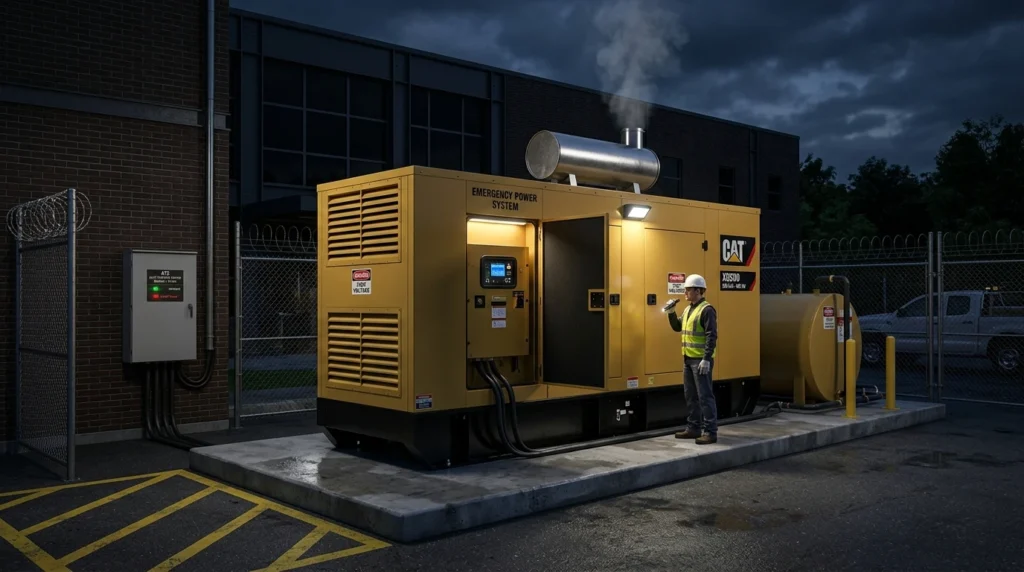
A backup generator system is an emergency power system designed to provide electricity when the main utility supply fails.
In simple words, it acts as a secondary source of electrical power that automatically or manually supplies electricity during a power outage.
The system converts mechanical energy into electrical energy using an engine-driven generator.
Practical Example
Consider a data center that stores important business information. If utility power fails unexpectedly, servers may shut down and valuable data could be lost. A backup generator system starts automatically and supplies electricity until the main power returns.
This makes backup generators an essential part of modern power infrastructure.
Backup Generator System Working Principle
The backup generator system working principle is based on detecting a power failure and automatically generating electricity using an engine-driven alternator.
Simple Analogy
Think of a spare tire in a vehicle.
- The main tire performs normal operation.
- If it fails, the spare tire takes over temporarily.
Similarly, the backup generator operates when the main electrical supply becomes unavailable.
Step-by-Step Working Principle
Utility Power Monitoring
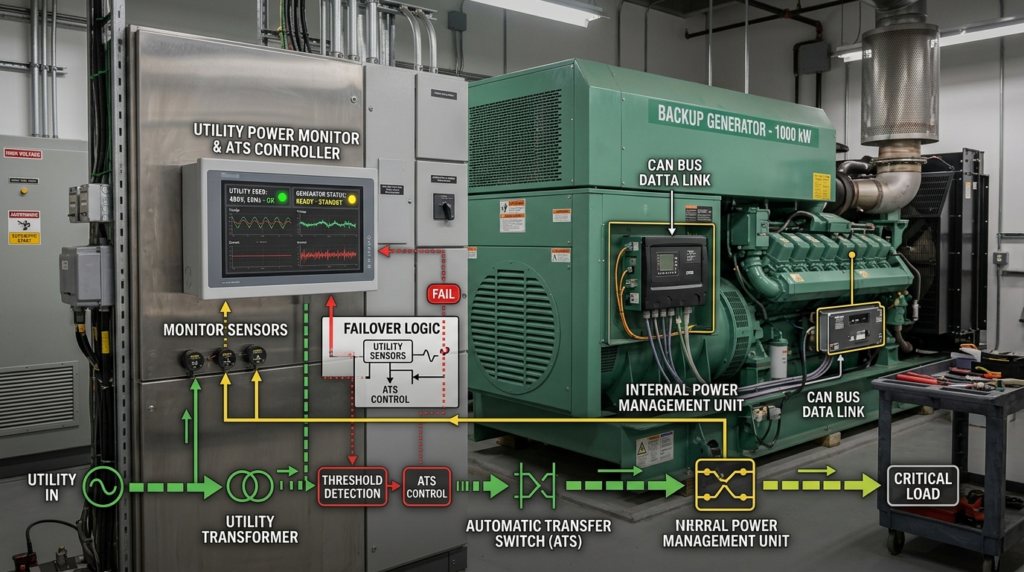
Utility Power Monitoring is the continuous process of measuring and supervising the electrical power supplied by the utility grid to ensure a stable, reliable, and efficient power supply. It involves monitoring important electrical parameters such as voltage, current, frequency, power factor, energy consumption, and power quality using devices like energy meters, sensors, protection relays, and monitoring systems. The primary purpose of utility power monitoring is to detect abnormalities such as voltage fluctuations, power outages, overloads, frequency variations, and electrical faults before they affect connected equipment. Modern monitoring systems can also provide real-time data, alarms, remote access, and historical reports, enabling operators to quickly identify issues and improve system performance. Utility power monitoring is widely used in residential buildings, commercial facilities, industrial plants, data centers, hospitals, and electrical substations to enhance energy management, protect valuable equipment, reduce downtime, and ensure the safe and reliable operation of electrical power systems.
The system continuously monitors incoming utility voltage.
Power Failure Detection
When voltage disappears or drops below a safe level, the control system detects the fault.
Generator Start Command
The controller sends a signal to start the generator engine.
Engine Starts Running
The engine begins rotating the generator alternator.
Common fuel types include:
- Diesel
- Natural gas
- Petrol
- Biogas
Electricity Generation
Electricity generation in a Backup Generator System begins automatically when the main utility power supply fails. An Automatic Transfer Switch (ATS) continuously monitors the utility power, and when it detects a power outage, it sends a start signal to the backup generator. The generator’s engine, powered by diesel, natural gas, or gasoline, starts and rotates the alternator (generator). As the alternator rotates, it converts mechanical energy into electrical energy through the principle of electromagnetic induction, producing alternating current (AC) electricity. Once the generator reaches the required voltage and frequency, the ATS disconnects the building from the utility supply and transfers the electrical load to the generator. The backup generator then supplies reliable power to essential equipment such as lighting, HVAC systems, medical devices, servers, and industrial machinery. When utility power is restored, the ATS automatically switches the load back to the main power source, and the generator continues to run for a short cooling period before shutting down. This automatic process ensures a continuous and dependable power supply during electrical outages, minimizing downtime and protecting critical operations.
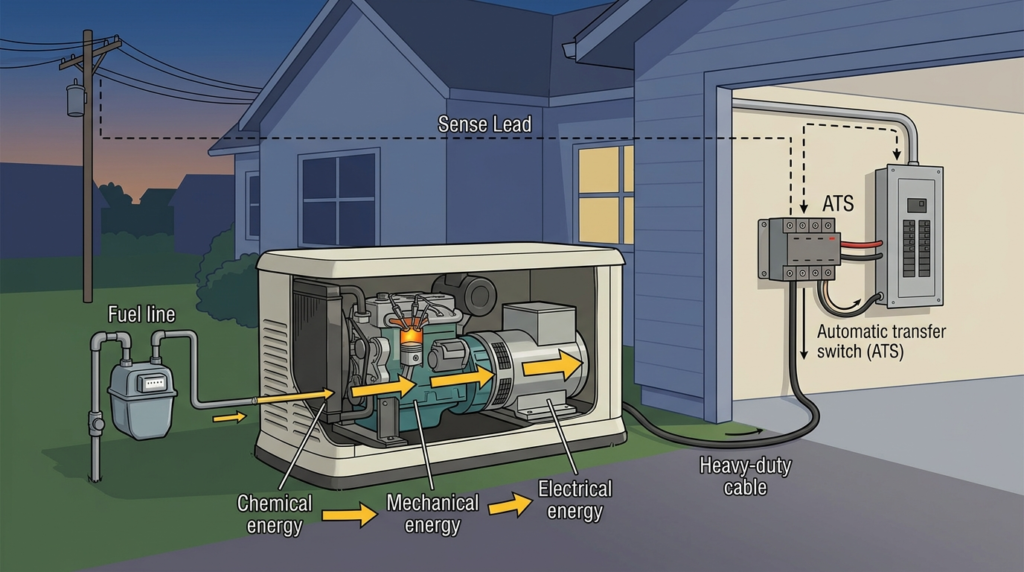
The alternator converts mechanical energy into electrical energy.
Transfer Switch Operation
An Automatic Transfer Switch (ATS) disconnects the load from utility power and connects it to generator power.
Load Supply
The generator supplies electrical power to connected equipment.
Utility Power Restoration
When normal power returns, the ATS reconnects the load to the utility supply.
Generator Shutdown
The generator operates for a short cooling period before stopping automatically.
Key Features of Backup Generator System Working Principle
- Automatic operation
- Fast response
- Reliable power restoration
- Continuous monitoring
- Emergency power support
Types / Classification
Backup generator systems are available in several configurations.
Diesel Generator System
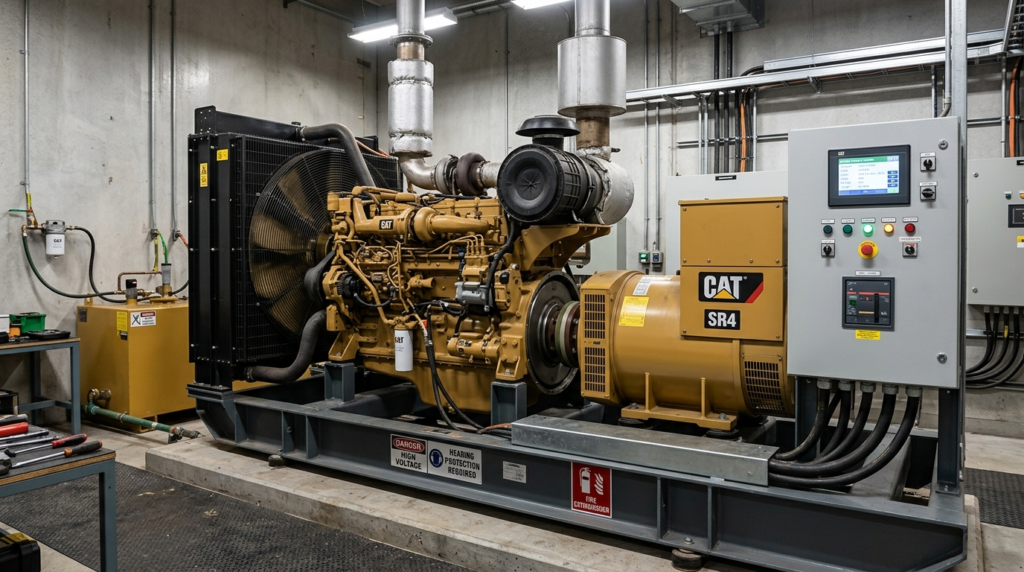
A Diesel Generator System is a backup or primary power generation system that converts the chemical energy of diesel fuel into electrical energy. It consists of a diesel engine, an alternator (generator), a fuel system, a cooling system, a lubrication system, a control panel, a battery, and an exhaust system. When the generator is started, the diesel engine burns fuel to produce mechanical power, which rotates the alternator. The alternator then converts this mechanical energy into alternating current (AC) electricity through the principle of electromagnetic induction. Diesel generator systems are widely used to provide reliable power during utility outages or in locations where grid electricity is unavailable. They are commonly installed in hospitals, data centers, industrial plants, commercial buildings, construction sites, telecommunications facilities, and emergency backup systems. Known for their durability, fuel efficiency, and ability to deliver high power output, diesel generator systems play a vital role in ensuring an uninterrupted power supply for critical operations and essential electrical equipment.The most common industrial backup power solution.
Features
- High reliability
- Long operating life
- Suitable for heavy loads
Applications
- Factories
- Hospitals
- Data centers
Gas Generator System
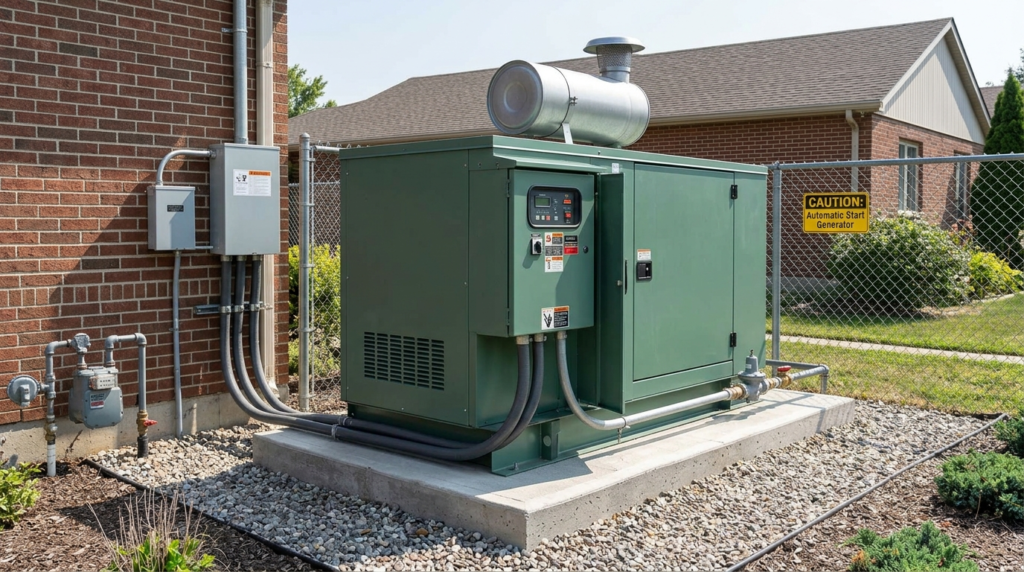
A Gas Generator System is a power generation system that converts the chemical energy of natural gas, biogas, liquefied petroleum gas (LPG), or other gaseous fuels into electrical energy. It consists of a gas engine, an alternator (generator), a fuel supply system, a cooling system, a lubrication system, a control panel, a starting battery, and an exhaust system. When the generator starts, the gas engine burns the fuel to produce mechanical power, which rotates the alternator. The alternator then converts this mechanical energy into alternating current (AC) electricity through the principle of electromagnetic induction. Gas generator systems are widely used for standby, prime, and continuous power applications in hospitals, commercial buildings, industrial plants, data centers, hotels, farms, and utility facilities. Compared to diesel generators, they generally produce lower emissions, operate more quietly, and require a continuous gas supply. Their high efficiency, cleaner operation, and reliable performance make gas generator systems an excellent choice for both backup power and long-duration electricity generation.
Uses natural gas as fuel.
Features
- Cleaner operation
- Lower emissions
Applications
- Commercial buildings
- Residential communities
Portable Generator System
Small and movable backup generators.
Features
- Easy transportation
- Lower cost
Applications
- Homes
- Outdoor events
Standby Generator System
Permanently installed emergency power system.
Features
- Automatic operation
- Fast startup
Applications
- Hospitals
- Offices
- Industrial facilities
Inverter Generator System
Uses advanced electronic control technology.
Features
- Stable output voltage
- Low noise
Applications
- Sensitive electronics
- Residential use
Main Components
Understanding system components helps users understand generator operation.
Engine
The prime mover of the generator.
Function
- Produces mechanical power
Alternator
Converts mechanical energy into electrical energy.
Function
- Generates AC electricity
Fuel System
Stores and supplies fuel.
Function
- Supports engine operation
Automatic Transfer Switch (ATS)
Controls power source switching.
Function
- Transfers load automatically
Battery System
Provides starting power.
Function
- Starts the generator engine
Control Panel
Monitors generator operation.
Function
- Controls startup and shutdown
Cooling System
Removes excess heat.
Function
- Maintains safe operating temperature
Exhaust System
Removes combustion gases.
Function
- Improves safety and efficiency
Advantages
Understanding backup generator system advantages and disadvantages helps users evaluate system performance.
Advantages of Backup Generator System
- Reliable emergency power
- Automatic operation
- Supports critical loads
- Reduces downtime
- Improves safety
- Protects sensitive equipment
- Suitable for various applications
- Long service life
Real-World Benefits
Business Continuity
Operations continue during power failures.
Improved Safety
Emergency systems remain operational.
Equipment Protection
Prevents sudden shutdown damage.
Increased Productivity
Industrial processes continue running.
Disadvantages / Limitations
Although highly beneficial, backup generators have some limitations.
Backup Generator System Advantages and Disadvantages
Disadvantages
- Initial installation cost
- Fuel consumption
- Noise generation
- Regular maintenance requirements
- Environmental emissions
Practical Limitations
Fuel Availability
Extended outages require fuel replenishment.
Space Requirements
Large systems require dedicated installation areas.
Maintenance Needs
Periodic testing is essential.
Backup Generator System Applications
Backup generator system applications are widespread across modern infrastructure.
Residential Applications
- Home emergency power
- Security systems
- Essential appliances
Commercial Applications
- Shopping centers
- Office buildings
- Hotels
Industrial Applications
- Manufacturing plants
- Process industries
- Warehouses
Healthcare Applications
- Hospitals
- Laboratories
- Medical facilities
Telecommunications
- Mobile communication towers
- Data centers
Government Facilities
- Emergency response centers
- Public service buildings
Backup generator system applications continue expanding as power reliability becomes increasingly important.
Comparison Section
Difference Between Backup Generator System and UPS
| Feature | Backup Generator System | UPS System |
| Power Source | Engine-driven generator | Battery |
| Runtime | Hours or days | Minutes to hours |
| Startup Time | Seconds | Instant |
| Load Capacity | High | Moderate |
| Fuel Required | Yes | No |
| Maintenance | Moderate | Low |
| Initial Cost | Higher | Lower |
| Best Use | Long outages | Short interruptions |
Understanding the difference between UPS and backup generator system helps engineers choose the appropriate backup solution.
Selection Guide
Choosing the right backup generator system depends on several factors.
Load Requirement
Calculate total connected load.
Fuel Type
Select based on availability.
Options include:
- Diesel
- Natural gas
- Petrol
Runtime Requirement
Estimate expected outage duration.
Automatic or Manual Operation
Critical facilities should use ATS-equipped systems.
Installation Environment
- Indoor installation
- Outdoor installation
- Ventilation requirements
Tips for Beginners
- Always include future load growth.
- Select a reputable manufacturer.
- Consider fuel storage requirements.
- Follow local electrical regulations.
- Schedule regular maintenance.
Common Problems & Solutions
Generator Fails to Start
Causes
- Weak battery
- Fuel shortage
Solution
- Check battery condition
- Refill fuel tank
Low Output Voltage
Causes
- AVR fault
- Alternator problem
Solution
- Inspect voltage regulator
Excessive Noise
Causes
- Loose components
- Exhaust issues
Solution
- Tighten connections
- Inspect exhaust system
Overheating
Causes
- Cooling system failure
Solution
- Check coolant level
- Clean radiator
Frequent Shutdowns
Causes
- Overload condition
Solution
- Reduce connected load
Future Trends
Backup power technology continues to evolve rapidly.
Smart Generator Systems
Modern systems include:
- Remote monitoring
- Mobile applications
- Cloud connectivity
Hybrid Power Systems
Future installations will combine:
- Generators
- Solar energy
- Battery storage
Cleaner Fuels
Alternative fuels are becoming increasingly popular.
Examples include:
- Hydrogen
- Renewable natural gas
- Biodiesel
Predictive Maintenance
Advanced monitoring systems can predict faults before failures occur.
IoT Integration
Real-time performance monitoring improves reliability.
Higher Efficiency Designs
Manufacturers continue developing fuel-efficient generators with lower emissions.
The future of backup generator system applications is closely linked with smart grids, renewable energy integration, and advanced power management technologies.
Conclusion
A backup generator system is one of the most reliable solutions for maintaining electrical power during utility outages. By automatically detecting power failures and generating electricity when needed, it helps protect critical equipment, maintain safety, and ensure uninterrupted operations. From homes and offices to hospitals, industries, and data centers, backup generators play an essential role in modern power systems.
This article explained the backup generator system working principle, types, components, applications, advantages and disadvantages, troubleshooting methods, and future developments in simple and practical language. You also learned the difference between UPS and backup generator system and how to select the right solution for specific power requirements.
For electrical students, engineers, technicians, and beginners, understanding backup generator systems is an important step toward mastering emergency power systems and ensuring reliable electrical infrastructure.