
Imagine using an electric iron and suddenly touching a wet surface while the appliance has a hidden wiring fault. In that moment, electricity may try to pass through your body to the ground, creating a dangerous situation. This is called a ground fault, and it can lead to serious electric shocks or even fatal accidents.
This is where Ground Fault Protection becomes essential. It is designed to detect unsafe current leakage and quickly disconnect the power supply, protecting both people and equipment. Whether in homes, industries, or modern electrical systems, this protection plays a critical safety role.
In this article, you will learn everything about Ground Fault Protection, including its working principle, types, components, applications, advantages and disadvantages, and how to select the right system. The concepts are explained in simple and clear language, making it easy for students, technicians, and beginners to understand and apply in real-world situations.
2. What is Ground Fault Protection?
Ground Fault Protection is a safety system that detects unwanted current flowing from a live conductor to the ground and disconnects the circuit immediately.
Simple Explanation
Normally, electric current flows through a proper path (from phase to neutral). But if there is insulation failure or leakage, some current may flow to the ground. This is called a ground fault.
Ground Fault Protection senses this leakage and cuts off the power to prevent harm.
Practical Example
If a damaged wire inside a washing machine touches its metal body, the body can become live. A ground fault protection device will detect this and trip the circuit instantly, preventing electric shock.
3. Working Principle of Ground Fault Protection
The ground fault protection working principle is based on detecting imbalance in current flow.
Step-by-step explanation:
- Current flows through the live (phase) wire
- It returns through the neutral wire
- In a healthy system, both currents are equal
- If leakage occurs, some current flows to the ground
- The returning current becomes less than the outgoing current
- The protection device detects this difference
- If the difference exceeds a safe limit, it trips the circuit
Simple Analogy
Think of water flowing in a pipe system:
- Water entering = Water leaving → Normal condition
- Water leaking somewhere → Fault detected
Ground Fault Protection works in a similar way by identifying leakage.
4. Types / Classification
Types of Ground Fault Protection
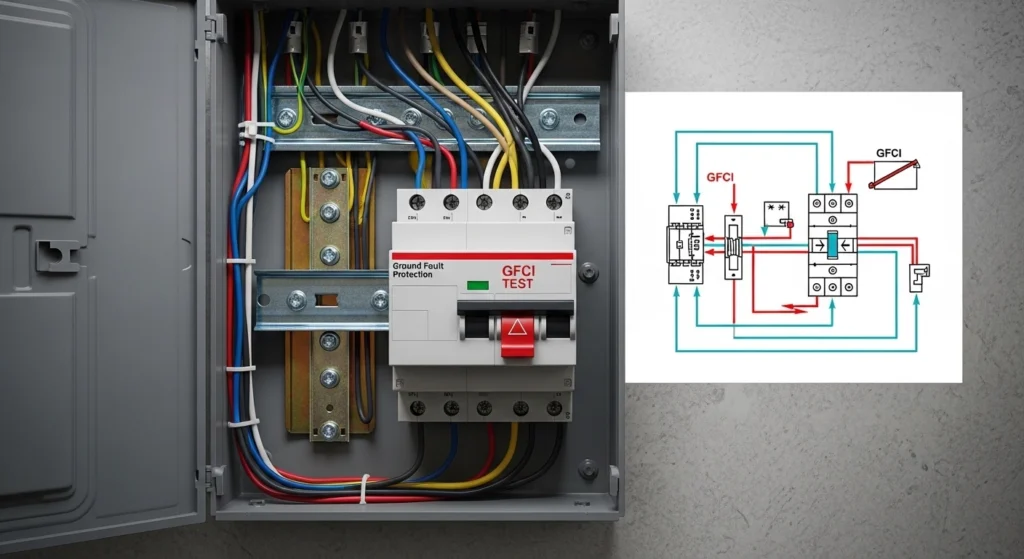
GFCI (Ground Fault Circuit Interrupter)
- Common in homes
- Protects against electric shock
- Trips quickly when leakage is detected
- Used in bathrooms, kitchens, and outdoor areas
RCCB (Residual Current Circuit Breaker)
- Detects current imbalance
- Provides protection against leakage current
- Widely used in residential and commercial buildings
ELCB (Earth Leakage Circuit Breaker)
- Older type of protection device
- Detects voltage on the earth conductor
- Less commonly used today
RCBO (Residual Current Breaker with Overcurrent Protection)
- Combines ground fault protection and overcurrent protection
- Protects against short circuits and leakage
- Used in modern electrical systems
Ground Fault Relay Systems
- Used in industrial applications
- Provides advanced monitoring
- Can detect small leakage currents
5. Main Components
Key Components of Ground Fault Protection Systems
Current Transformer (CT)
- Measures current in live and neutral wires
- Detects imbalance
Relay
- Processes the signal from CT
- Decides when to trip
Trip Mechanism
- Disconnects the circuit during fault
- Acts instantly for safety
Test Button
- Used to check device operation
- Ensures proper functioning
Circuit Breaker
- Opens the circuit when fault is detected
- Protects system from damage
6. Advantages
Ground Fault Protection Advantages and Disadvantages (Advantages Section)
- Protects human life from electric shock
- Prevents electrical fires
- Detects small leakage currents quickly
- Improves overall system safety
- Reduces equipment damage
- Essential for wet and hazardous locations
- Meets electrical safety standards
7. Disadvantages / Limitations
- May trip unnecessarily due to minor leakage
- Requires proper installation
- Sensitive devices can be costly
- Needs regular testing and maintenance
- Cannot detect all types of faults (like line-to-line faults)
8. Applications
Ground Fault Protection Applications
Home Applications
- Bathrooms and kitchens
- Washing machines and water heaters
- Outdoor sockets
Industrial Applications
- Motors and heavy machinery
- Control panels
- Power distribution systems
Commercial Applications
- Offices and buildings
- Hospitals and schools
- Shopping malls
Modern Technology
- Electric vehicle charging systems
- Solar power systems
- Smart homes and automation systems
9. Comparison Section
Difference Between Ground Fault Protection and Overcurrent Protection
| Feature | Ground Fault Protection | Overcurrent Protection |
| Purpose | Detects leakage current | Detects excess current |
| Protection Type | Electric shock safety | Equipment protection |
| Response | Very fast (milliseconds) | Slower compared to GFCI |
| Application | Safety-critical areas | General circuit protection |
| Fault Type | Ground leakage | Short circuit & overload |
10. Selection Guide
Choosing the right Ground Fault Protection depends on your application.
Consider the following:
- Environment: Use GFCI in wet areas
- Load type: Use RCBO for combined protection
- Sensitivity: Select proper leakage current rating
- System size: Industrial systems need relay-based protection
Tips for Beginners
- Always choose certified devices
- Match rating with load requirements
- Install protection in high-risk areas first
- Regularly test devices
11. Common Problems & Solutions
Why does the device trip frequently?
Solution:
Check for leakage in appliances or moisture in wiring.
Why is Ground Fault Protection not working?
Solution:
Test using the test button. Replace if faulty.
Can it protect from overload?
Solution:
No, unless you use RCBO which includes overcurrent protection.
Is grounding necessary for this protection?
Solution:
Yes, proper grounding improves safety and performance.
How often should it be tested?
Solution:
Test monthly using the test button.
12. Future Trends
Ground Fault Protection is evolving with new technologies.
- Smart Protection Devices: Remote monitoring and control
- IoT Integration: Real-time fault detection
- Improved Sensitivity: Detecting very small leakage currents
- Integration with Renewable Energy: Solar and EV systems
- Advanced Industrial Protection: AI-based fault detection
These innovations are making systems safer, smarter, and more efficient.
13. Conclusion
Ground Fault Protection is a critical safety system in modern electrical engineering. It protects human life, prevents electrical hazards, and ensures safe operation of equipment. By understanding the ground fault protection working principle, types, applications, and advantages and disadvantages, you can make informed decisions for any electrical system.
From homes to industries, this protection is essential and often mandatory. As technology advances, Ground Fault Protection systems are becoming smarter and more reliable. Learning and applying these concepts not only improves safety but also builds strong technical knowledge for real-world applications.