
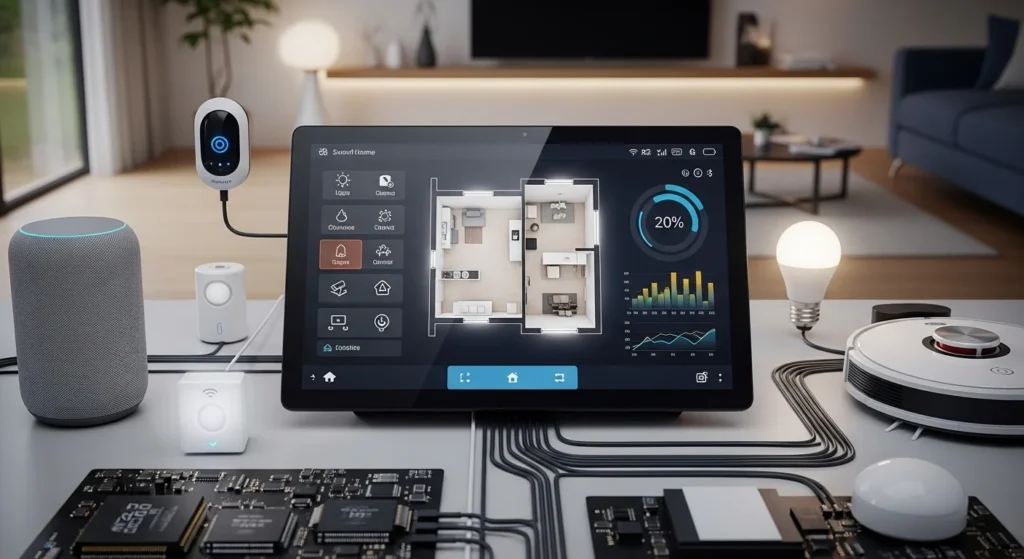

Imagine coming home after a long day and your lights automatically turn on, the fan starts running, and the security system activates without touching a single switch. This is not science fiction. It is the practical use of a Home Automation Project.
Today, smart homes are becoming more common because people want convenience, safety, and energy efficiency. Electrical engineers and students play an important role in designing and installing these systems. Understanding how a home automation system works is an essential skill in modern electrical engineering.
A Home Automation Project allows you to control electrical appliances such as lights, fans, air conditioners, and security devices automatically or remotely. These systems can be controlled through smartphones, sensors, or programmable controllers.
In this article, you will learn the home automation project working principle, its types, components, advantages, disadvantages, and real-world home automation project applications. This guide is written in simple and clear language so beginners, technicians, and engineering students can easily understand the concepts.
By the end of this article, you will have a strong practical understanding of how to design and implement a home automation system.
What is a Home Automation Project?
A Home Automation Project is a system that automatically controls home electrical devices using electronic controllers, sensors, and communication technologies.
In simple words, home automation allows you to control appliances such as lights, fans, doors, security cameras, and temperature systems automatically or remotely.
The main goal of home automation is to make homes smarter, safer, and more energy efficient.
Simple Explanation
A home automation system connects electrical devices to a central control unit. The system receives commands from users or sensors and then operates devices accordingly.
For example:
A motion sensor detects movement in a room.
The controller receives the signal.
The lights turn on automatically.
Practical Example
Consider a smart lighting system:
You install motion sensors in a hallway.
When someone walks through the hallway, the sensor detects motion.
The controller switches the lights ON automatically.
After a few minutes with no movement, the lights turn OFF.
This is a simple but powerful example of a Home Automation Project.
Home Automation Project Working Principle
Understanding the home automation project working principle is very important for electrical students and engineers.
The system works by combining sensors, controllers, and actuators to automate electrical devices.
Step-by-Step Working
Input Detection
Sensors detect physical conditions such as:
Motion
Light
Temperature
Door opening
Signal Processing
The sensor sends a signal to a controller such as:
Microcontroller
PLC
Smart hub
Decision Making
The controller processes the signal based on programmed instructions.
Example:
If motion is detected → Turn ON lights
Output Action
The controller sends a command to an actuator like:
Relay
Smart switch
Motor driver
Device Operation
The appliance performs the required action such as turning ON lights or locking doors.
Easy Analogy
Think of a home automation system like the human nervous system:
Sensors = Eyes and ears
Controller = Brain
Actuators = Muscles
The sensors detect information, the brain decides what to do, and the muscles perform the action.
Types of Home Automation Systems
Home automation systems can be classified into several types depending on their technology and control method.
Wired Home Automation
In this system, all devices are connected using physical cables.
Features
Very reliable communication
High security
Less signal interference
Limitations
Complex installation
Higher cost
Difficult to upgrade
This type is commonly used in large buildings and commercial projects.
Wireless Home Automation
Wireless systems communicate using technologies such as:
Wi-Fi
Bluetooth
Zigbee
RF
Features
Easy installation
Flexible expansion
Remote control using mobile phones
Wireless systems are widely used in modern smart homes.
Centralized Home Automation
In centralized systems, a single controller manages all devices.
Characteristics
Easy control from one interface
Suitable for large automation systems
Simple system management
However, if the central controller fails, the entire system may stop working.
Distributed Home Automation
In distributed systems, multiple controllers manage different parts of the home.
Benefits
Higher reliability
Better system flexibility
Easier system expansion
Many modern smart home systems use this architecture.
Main Components of a Home Automation Project
A Home Automation Project requires several key components to function properly.
Sensors
Sensors detect environmental conditions.
Common sensors include:
Motion sensors
Temperature sensors
Light sensors
Smoke detectors
They provide input signals to the controller.
Microcontroller or Controller
The controller is the brain of the system.
Examples include:
Arduino
Raspberry Pi
PLC
Smart home hub
The controller processes sensor signals and controls devices.
Relays or Smart Switches
Relays act as electrical switches.
They allow low-power controllers to operate high-power appliances like:
Lights
Fans
Pumps
Air conditioners
Communication Module
Communication modules allow remote control.
Common technologies include:
Wi-Fi modules
Bluetooth modules
Zigbee modules
GSM modules
Actuators
Actuators perform physical actions such as:
Opening doors
Turning lights ON/OFF
Adjusting window curtains
User Interface
Users control the system through:
Mobile apps
Voice assistants
Control panels
Remote controllers
Home Automation Project Advantages
There are many home automation project advantages and disadvantages, but the benefits are significant.
Key Advantages
Convenience
Control devices from smartphones or voice commands.
Energy Efficiency
Lights and appliances turn off automatically when not needed.
Improved Security
Smart locks, cameras, and alarms improve home safety.
Remote Monitoring
You can monitor your home from anywhere.
Comfort
Temperature, lighting, and appliances adjust automatically.
Time Saving
Automated routines reduce manual work.
Disadvantages / Limitations
Despite its benefits, a Home Automation Project has some limitations.
Common Disadvantages
Initial Cost
Smart devices and installation can be expensive.
Internet Dependency
Some systems require internet connectivity.
Technical Complexity
Installation and configuration require technical knowledge.
Security Risks
Poorly designed systems may face hacking risks.
Maintenance Requirements
Devices may require updates and maintenance.
Home Automation Project Applications
The home automation project applications are expanding rapidly across many sectors.
Residential Homes
Common smart home features include:
Smart lighting
Automated curtains
Climate control
Smart security systems
Industrial Buildings
Automation is used for:
Energy management
Access control
Equipment monitoring
Smart Cities
Modern cities integrate home automation with:
Smart grids
Smart security systems
Energy optimization networks
Healthcare Homes
Automation helps elderly and disabled people by providing:
Emergency alerts
Automatic lighting
Remote health monitoring
Comparison: Wired vs Wireless Home Automation
Understanding the difference between wired and wireless home automation systems helps engineers select the right system.
Feature
Wired Automation
Wireless Automation
Installation
Complex
Easy
Cost
Higher
Moderate
Reliability
Very high
Moderate
Flexibility
Limited
High
Expansion
Difficult
Easy
Maintenance
Low
Moderate
Wireless systems are more popular in modern smart homes because of their flexibility.
Selection Guide for Beginners
Choosing the right Home Automation Project depends on several factors.
Important Selection Tips
- Define Your Purpose
Decide whether the system is for:
Security
Energy saving
Comfort - Choose the Right Controller
Beginners often use:
Arduino
Raspberry Pi
These platforms are easy to program and affordable. - Consider Communication Technology
Choose between:
Wi-Fi
Bluetooth
Zigbee
Based on range and reliability. - Check Compatibility
Ensure all devices can communicate with the controller. - Plan for Future Expansion
Select systems that allow adding more devices later.
Common Problems and Solutions
Devices Not Responding
Possible Cause
Communication failure
Power supply issues
Solution
Check wiring and power supply
Restart the controller
Sensor Not Detecting Motion
Possible Cause
Wrong sensor placement
Solution
Install sensors at correct angles and height.
Wi-Fi Connection Failure
Possible Cause
Weak signal
Router issues
Solution
Improve signal strength or use signal extenders.
Relay Not Switching
Possible Cause
Incorrect wiring
Controller output problem
Solution
Verify relay wiring and controller configuration.
Future Trends in Home Automation
The future of Home Automation Projects is very exciting.
Artificial Intelligence Integration
Smart systems will learn user habits and automatically adjust lighting, temperature, and appliances.
Voice-Controlled Homes
Voice assistants will become the primary interface for controlling devices.
Energy Smart Homes
Automation systems will optimize energy consumption using smart grid technologies.
Internet of Things (IoT)
More devices will connect to a single network, creating highly intelligent homes.
Advanced Security Systems
Future homes will include:
Facial recognition
AI surveillance
Automated emergency response systems
Conclusion
A Home Automation Project is an important technology in modern electrical engineering. It combines electronics, sensors, controllers, and communication systems to create smarter and more efficient homes.
In this article, we explored the home automation project working principle, system types, components, advantages, and limitations. We also discussed real-world home automation project applications and how beginners can start designing their own systems.
For electrical students and engineers, learning home automation provides valuable practical experience in embedded systems, control engineering, and IoT technologies. These skills are highly demanded in modern industries.
As technology continues to evolve, smart homes will become more intelligent, energy-efficient, and secure. Engineers who understand home automation systems today will play a major role in shaping the smart cities of tomorrow.