
Imagine receiving your monthly electricity bill and wondering how the energy was actually used in your home. Maybe your air conditioner consumes more power than expected, or perhaps certain appliances run longer than necessary. Traditional electricity meters only show total energy consumption, but they do not provide detailed information about how electricity is being used.
This is where a Smart Energy Meter Project becomes very useful.
Smart energy meters are modern devices that measure electricity usage in real time and provide detailed information about energy consumption. These meters can send data automatically to users or utility companies, helping people manage electricity more efficiently.
For electrical students and engineers, building a Smart Energy Meter Project is an excellent way to understand modern power monitoring systems, microcontrollers, sensors, and smart grid technology.
In this article, you will learn:
- What a Smart Energy Meter Project is
- Smart energy meter project working principle
- Types of smart energy meters
- Important components used in the project
- Smart energy meter project advantages and disadvantages
- Smart energy meter project applications in real life
This guide explains the project in simple language so beginners and students can easily understand the concept and implement it in their academic or practical projects.
What is Smart Energy Meter Project?
A Smart Energy Meter Project is an electrical and electronics project that measures electricity consumption digitally and sends the data to users or monitoring systems.
Unlike traditional electricity meters, smart meters provide real-time information about energy usage.
Definition
A Smart Energy Meter Project is a system that monitors, measures, and reports electricity consumption using digital technology and communication systems.
Simple Explanation
Traditional meters record total energy usage but require manual reading by technicians.
Smart energy meters solve this problem by:
- Measuring electricity consumption automatically
- Sending data digitally
- Allowing remote monitoring
Practical Example
Consider a smart energy meter installed in a house. The system measures how much electricity is used by appliances like refrigerators, lights, and air conditioners. The meter then sends the information to a mobile app or monitoring system.
Users can easily see their daily electricity consumption and reduce unnecessary energy usage.
This makes the Smart Energy Meter Project an important technology in modern energy management systems.
Smart Energy Meter Project Working Principle
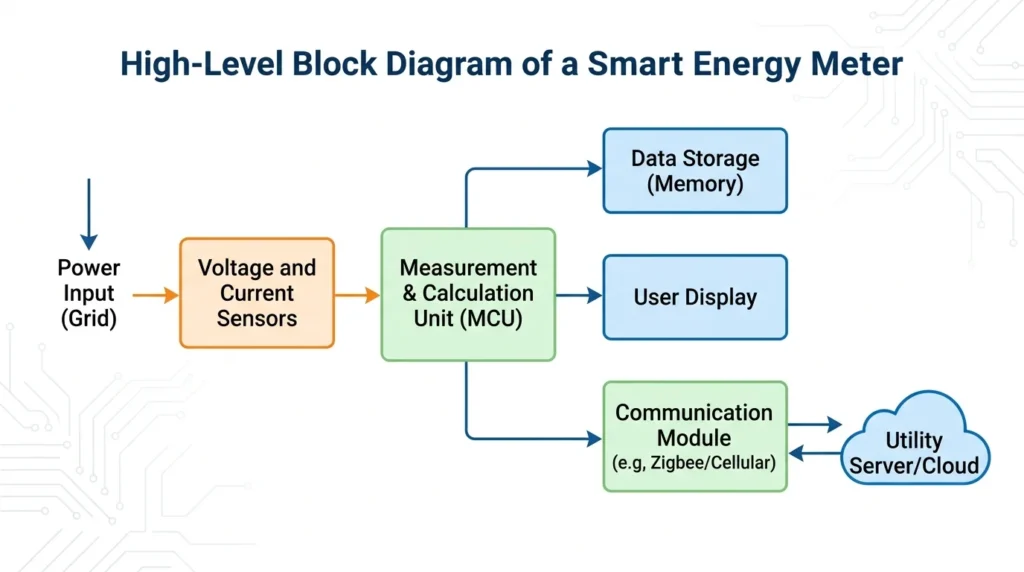
The smart energy meter project working principle is based on measuring voltage and current, calculating power consumption, and transmitting the data digitally.The smart energy meter project working principle is based on measuring electrical energy consumption digitally and transmitting the data automatically for monitoring, billing, and energy management purposes. A smart energy meter continuously measures important electrical parameters such as voltage, current, power, and energy usage using sensors and electronic measurement circuits. The measured signals are processed by a microcontroller or digital processing unit, which calculates the total power consumption in kilowatt-hours (kWh). This information is then displayed on an LCD screen and can also be sent wirelessly through communication technologies such as Wi-Fi, GSM, Bluetooth, or IoT platforms for remote monitoring and data analysis. Smart energy meters can detect overload conditions, power theft, abnormal consumption, and voltage fluctuations, helping improve energy efficiency and system reliability. These systems are widely used in homes, industries, smart grids, commercial buildings, and renewable energy systems because they provide accurate billing, real-time monitoring, and automated energy management. Understanding the smart energy meter project working principle is important for electrical students, engineers, and technicians because it combines electrical measurement, sensors, microcontrollers, communication systems, and smart automation technologies used in modern power management systems.
In simple terms, the system measures how much electricity flows through a circuit and converts that information into energy consumption data.
Think of it like a digital electricity accountant that records every unit of energy used.
Step-by-Step Working Process
The smart energy meter project operates through several steps.
.Voltage and Current Measurement
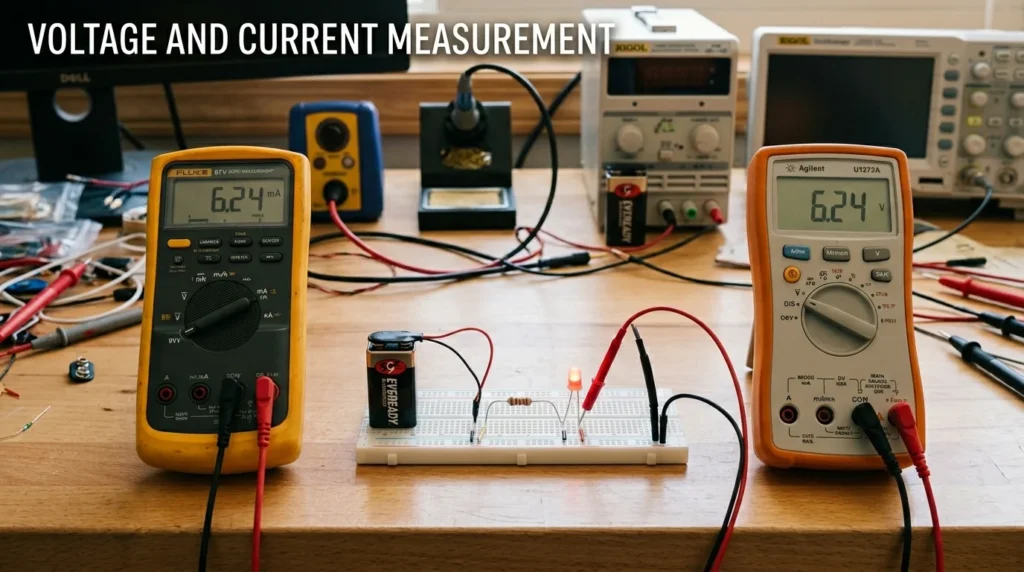
Voltage and current measurement is the process of determining the electrical potential difference and the flow of electric charge in a circuit using suitable measuring instruments. Voltage measurement shows the difference in electrical energy between two points in a circuit, while current measurement indicates how much electric current is flowing through a conductor. Instruments such as multimeters, voltmeters, ammeters, clamp meters, and digital panel meters are commonly used for these measurements. In voltage measurement, the measuring device is connected in parallel with the circuit component, whereas current measurement requires the device to be connected in series or measured using a clamp meter around the conductor. Accurate voltage and current measurement is very important in electrical systems because it helps monitor circuit performance, detect faults, prevent overloads, and ensure safe operation of equipment. These measurements are widely used in homes, industries, laboratories, power plants, automation systems, and electronic devices for testing, troubleshooting, maintenance, and energy management. Understanding voltage and current measurement is important for electrical students, engineers, and technicians because it forms the foundation of electrical testing, circuit analysis, and safe electrical system operation.
Sensors measure the electrical parameters of the system:
- Voltage level
- Current flow
These measurements are the foundation for energy calculation.
.Signal Processing
The measured electrical signals are sent to a microcontroller or processing unit.
The controller processes the signals and calculates:
- Power consumption
- Energy usage (kWh)
. Energy Calculation
The system calculates energy using the formula:
Energy = Power × Time
This allows the system to track total electricity consumption.
. Data Display
The calculated energy data is displayed on a digital display such as an LCD screen.
Users can see their energy consumption in real time.
. Data Transmission
Some smart energy meters send data to remote systems using communication technologies such as:
- Wi-Fi
- GSM
- Internet networks
This allows remote monitoring of electricity usage.
. Energy Monitoring
The system continuously monitors energy consumption and updates the data regularly.
This real-time monitoring helps users control electricity usage efficiently.
Types / Classification of Smart Energy Meter Projects
Smart energy meter projects can be classified based on communication technology and system design.
GSM-Based Smart Energy Meter
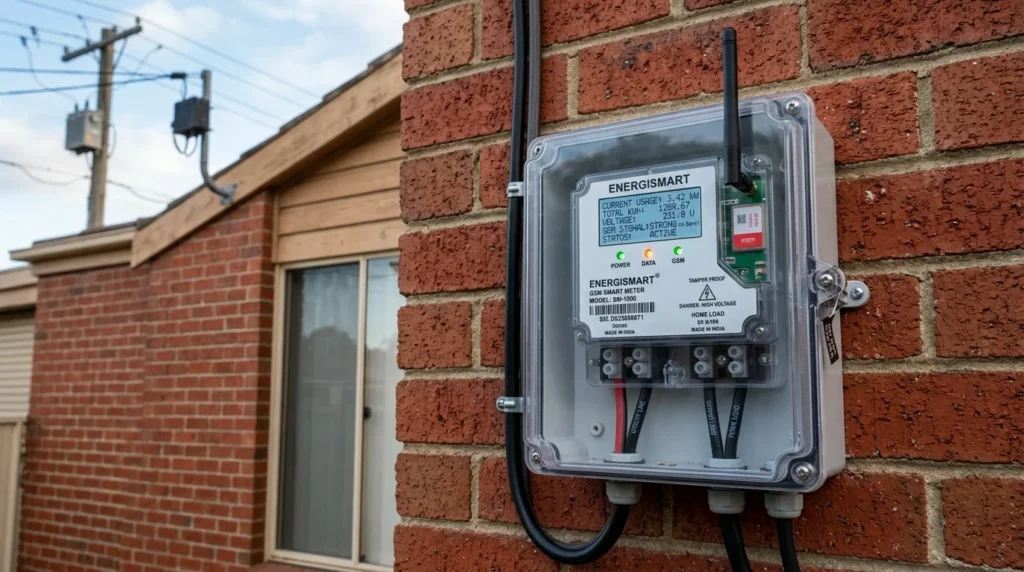
This type uses GSM communication to send energy data through mobile networks.A GSM-Based Smart Energy Meter is an advanced digital energy measurement system that uses GSM (Global System for Mobile Communication) technology to monitor and transmit electricity consumption data remotely. It measures important electrical parameters such as voltage, current, power, and energy consumption in kilowatt-hours (kWh) using electronic sensing and processing circuits. The collected data is processed by a microcontroller and sent automatically through a GSM module using mobile communication networks to utility providers or users via SMS or online monitoring systems. This system eliminates the need for manual meter reading and allows real-time energy monitoring, accurate billing, fault detection, and energy management. GSM-Based Smart Energy Meters are widely used in homes, industries, commercial buildings, and smart grid systems because they improve efficiency, reduce human errors, detect electricity theft, and support automated billing systems. Some advanced models can also send alerts for overload conditions, power failures, or abnormal energy usage. Understanding the GSM-Based Smart Energy Meter is important for electrical students, engineers, and technicians because it combines electrical measurement, microcontrollers, wireless communication, and smart automation technologies used in modern power management systems.
Features include:
- Remote meter reading
- Automatic billing information
- SMS notifications
These systems are widely used in smart grid applications.
Wi-Fi Based Smart Energy Meter
Wi-Fi smart meters send energy data through wireless internet networks.
Users can monitor electricity consumption through mobile apps or web dashboards.
This type is commonly used in smart homes.
IoT-Based Smart Energy Meter
IoT-based meters connect to cloud platforms and allow advanced energy monitoring.
Advantages include:
- Real-time data access
- Remote monitoring
- Data analytics
These systems are widely used in modern smart grid systems.
Prepaid Smart Energy Meter
Prepaid meters allow users to pay for electricity before using it.
The system automatically disconnects power when the balance reaches zero.
This method is commonly used in rental properties and energy management programs.
Main Components of a Smart Energy Meter Project
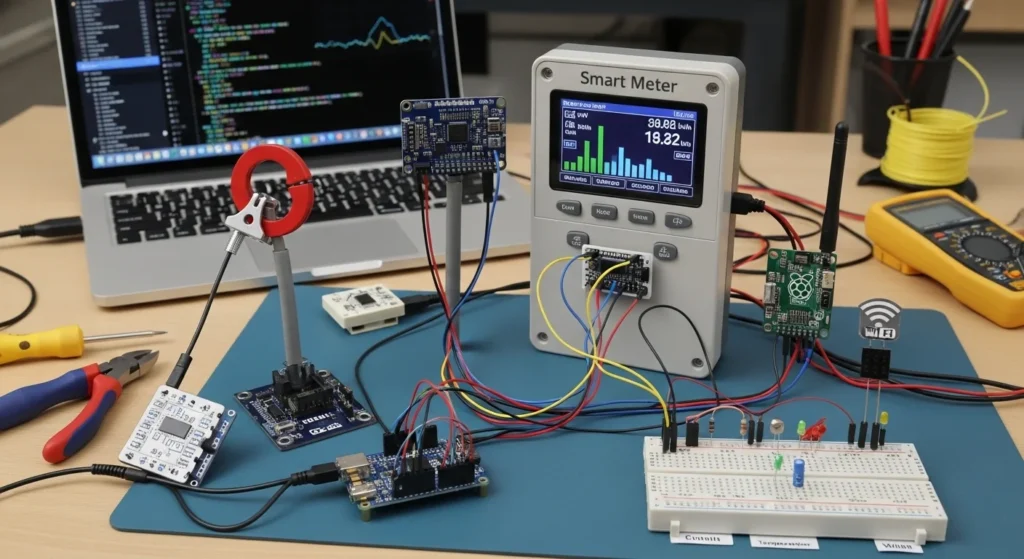
A smart energy meter project combines electrical sensing components, a microcontroller, communication technology, and a user interface to measure and monitor electricity consumption. Unlike a basic energy meter, a smart energy meter can collect electrical data, process it electronically, display important readings, and transmit information to a remote monitoring system.
The exact components used can vary depending on the project design, measurement accuracy, communication method, and required features. A basic student project may use an Arduino, voltage and current sensors, an LCD, and a Wi-Fi or GSM module, while an advanced system may include dedicated energy-measurement ICs, real-time clocks, data storage, protection circuits, and IoT connectivity.
1. Microcontroller
The microcontroller is the main processing unit of a smart energy meter project. It receives electrical measurements from the sensing circuits, processes the data, calculates important electrical parameters, and controls other parts of the system.
The microcontroller can continuously collect voltage and current readings and use them to estimate power and energy consumption. It can also communicate with a display module and send measurement data to a remote server or mobile application.
Main functions include:
- Processing voltage and current sensor signals
- Calculating electrical power and energy consumption
- Recording measurement data
- Controlling the display unit
- Managing communication modules
- Monitoring system conditions
- Sending data to an IoT platform or remote server
Common development platforms for educational projects include Arduino, ESP32, and similar microcontroller boards. The choice depends on the project’s processing requirements and communication features.
2. Current Sensor
The current sensor measures the amount of electrical current flowing through the load or circuit. Current measurement is one of the most important functions of a smart energy meter because current is required to determine electrical power and energy consumption.
Different sensing technologies can be used depending on the design. For example, a project may use a current transformer, Hall-effect current sensor, or another suitable current-sensing circuit.
Main functions include:
- Measuring load current
- Providing a signal to the microcontroller
- Detecting changes in electrical load
- Supporting power calculations
- Helping monitor abnormal current conditions
For AC systems, the sensor and measurement circuit should be properly selected and designed for the expected current range and electrical safety requirements.
3. Voltage Sensor
The voltage sensor measures the voltage supplied to the electrical load. The measured voltage is processed by the microcontroller or energy-measurement circuit and used along with current measurements to determine electrical power.
In practical AC measurement systems, the voltage-sensing circuit must be designed to safely reduce and isolate the mains voltage before it reaches low-voltage electronic circuits.
Main functions include:
- Measuring supply voltage
- Providing a safe measurement signal
- Supporting power calculations
- Monitoring voltage variations
- Helping identify abnormal supply conditions
Accurate voltage measurement improves the reliability of the energy calculations and helps the system provide more useful information to the user.
4. Energy Measurement Circuit or Metering IC
An advanced smart energy meter may use a dedicated energy measurement IC instead of relying entirely on a general-purpose microcontroller.
A metering IC is designed to measure electrical parameters such as voltage, current, active power, and accumulated energy with high accuracy. It can process sampled voltage and current signals and provide measurement data to the microcontroller.
Its functions may include:
- Measuring active power
- Calculating accumulated energy
- Processing voltage and current signals
- Improving measurement accuracy
- Providing digital measurement data to the controller
This component is particularly useful when building a more accurate smart energy meter rather than a simple educational demonstration.
5. Display Unit
The display unit provides a local interface for viewing the electrical measurements. An LCD, OLED, or other suitable display can be connected to the microcontroller.
The display allows users to see important information without requiring a mobile application or computer.
A display may show:
- Supply voltage
- Load current
- Instantaneous power
- Total energy consumption
- Power factor
- Meter status
- Communication status
For example, the display can show energy consumption in kWh, which is the commonly used unit for electrical energy billing.
6. Communication Module
The communication module allows the smart energy meter to transmit measurement data to another device or remote monitoring platform.
Depending on the project requirements, communication can be provided through Wi-Fi, GSM, Bluetooth, or other networking technologies.
Common communication options include:
- Wi-Fi: Suitable for internet-connected IoT applications.
- GSM: Useful where cellular network communication is required.
- Bluetooth: Suitable for short-range communication with a smartphone or nearby device.
- IoT Connectivity: Allows energy data to be transmitted to cloud-based monitoring platforms.
The communication system can allow users to monitor electricity consumption remotely instead of checking the meter physically.
7. Power Supply Circuit
The electronic components of the smart energy meter require a stable and suitable low-voltage power supply.
The power supply circuit converts the available input power into the voltage levels required by the microcontroller, sensors, communication modules, and display.
Main functions include:
- Supplying stable power to electronic components
- Providing appropriate voltage levels
- Reducing electrical noise where required
- Supporting reliable system operation
- Providing suitable protection for the electronics
The power supply section is especially important in mains-connected projects because the low-voltage control electronics must be properly separated and protected from hazardous mains voltage.
8. Data Storage Module
Some smart energy meter projects include a data storage module for recording electricity consumption over time.
Storage allows the system to maintain historical measurements even when an internet connection is unavailable.
Stored information may include:
- Daily energy consumption
- Monthly energy consumption
- Voltage readings
- Current readings
- Power measurements
- Time-based usage data
An SD card, EEPROM, flash memory, or other suitable storage technology can be used depending on the project design.
9. Real-Time Clock (RTC) Module
A Real-Time Clock (RTC) keeps track of the date and time. It can be useful when the smart energy meter needs to record electricity consumption according to specific time periods.
For example, the system can store energy consumption with a timestamp, making it possible to analyze electricity usage throughout the day.
The RTC can help with:
- Recording time-based energy consumption
- Creating daily usage records
- Creating monthly energy reports
- Maintaining accurate timestamps
- Supporting time-based monitoring functions
10. Protection Circuit
A smart energy meter should include appropriate electrical and electronic protection according to its design and installation requirements.
Protection components can help protect the sensing circuits and low-voltage electronics from abnormal electrical conditions.
Depending on the design, protection may include:
- Fuses
- Surge protection
- Overvoltage protection
- Overcurrent protection
- Input protection components
- Isolation barriers
Protection is particularly important when the project interfaces directly with AC mains electricity.
11. Load
The load is the electrical equipment or circuit whose energy consumption is being measured.
Examples include:
- Lamps
- Fans
- Motors
- Heaters
- Household appliances
- Other electrical equipment
The current drawn by the load passes through the current-sensing section, while the supply voltage is measured by the voltage-sensing circuit. These measurements allow the system to determine electrical power and energy consumption.
12. IoT or Cloud Monitoring Platform
An advanced smart energy meter can connect to an IoT or cloud platform to store and display energy data remotely.
The microcontroller can transmit measurement data through a suitable communication network. The data can then be displayed through a web dashboard, mobile application, or other monitoring interface.
Possible functions include:
- Remote energy monitoring
- Historical data analysis
- Energy consumption graphs
- Usage alerts
- Remote access to meter information
- Data logging and reporting
This feature makes the system more useful for smart-home, industrial, and energy-management applications.
13. Connecting Wires and Communication Interfaces
Connecting wires, terminals, connectors, and communication interfaces provide electrical and data connections between the different components.
Proper wiring is essential because loose or incorrect connections can cause inaccurate readings, communication failures, or unsafe operating conditions.
The project should use appropriate wiring, terminals, insulation, and connectors for the expected voltage and current levels.
How the Components of a Smart Energy Meter Work Together
A smart energy meter works by combining electrical sensing, data processing, display, communication, and data storage components into a single monitoring system. Each component performs a specific function, but all components work together to measure and manage electricity consumption.
The voltage-sensing circuit measures the supply voltage, while the current-sensing circuit measures the current flowing through the connected load. These signals are sent to an energy-measurement circuit or microcontroller for processing. Based on the measured electrical parameters, the system can determine values such as voltage, current, power, and accumulated energy consumption.
The microcontroller processes the measurement data and sends the results to the display unit. If the system includes Wi-Fi, GSM, or another communication technology, the measured data can also be transmitted to a remote monitoring platform, mobile application, or cloud server.
A data-storage system can record historical energy information, allowing users to analyze consumption over different periods. Protection and power-supply circuits support safe and reliable operation of the electronic components.
Basic Working Flow
Electrical Supply → Voltage & Current Sensing → Energy Measurement → Microcontroller → Display / Data Storage → Communication Module → Remote Monitoring Platform
This integrated arrangement allows a smart energy meter to provide real-time monitoring, automated data collection, remote access, and improved energy-management capabilities compared with a conventional meter.
Advantages and Disadvantages of a Smart Energy Meter Project
Understanding the advantages and disadvantages of a smart energy meter project helps students, engineers, and users evaluate its practical benefits and limitations.
Advantages of a Smart Energy Meter
Smart energy meters offer several benefits because they can measure, process, store, and communicate electricity consumption data electronically.
1. Real-Time Energy Monitoring
A smart energy meter can provide current information about electricity consumption. Users can monitor voltage, current, power, and energy usage depending on the capabilities of the system.
2. Automated Meter Reading
Smart meters reduce the need for manual meter readings. Measurement data can be collected electronically and, when communication features are available, transmitted automatically to a remote system.
3. Helps Reduce Energy Waste
By providing detailed information about electricity consumption, smart meters help users identify high-energy-consuming appliances and equipment. This information can encourage more efficient energy use.
4. Remote Monitoring
A connected smart energy meter can send data through Wi-Fi, GSM, or another communication network. Users can therefore monitor electricity consumption remotely without physically checking the meter.
5. Energy Data Logging
Smart meters can store historical energy data. This makes it possible to compare electricity consumption between different days, weeks, or months.
6. Supports Energy Management
The collected data can help homeowners, businesses, and industries understand their electricity usage and make better decisions about energy management.
7. Supports Smart Grid Applications
Smart energy meters can provide useful consumption information to modern electricity networks. When integrated with suitable utility systems, they can support demand monitoring, automated data collection, and other smart-grid functions.
8. Improved System Monitoring
Advanced smart meters can monitor electrical parameters and identify unusual changes in voltage, current, or power consumption. This can help users investigate potential electrical problems.
Limitations of a Smart Energy Meter Project
Although smart energy meters provide many benefits, they also have certain technical and practical limitations.
1. Higher Initial Cost
A smart energy meter generally requires more electronic components than a basic energy meter. Sensors, microcontrollers, communication modules, displays, and protection circuits can increase the initial cost.
2. Communication Dependency
Remote-monitoring features depend on a suitable communication network. Wi-Fi, GSM, or other communication systems may become unavailable because of network problems or signal limitations.
3. Cybersecurity and Data Privacy
Connected energy meters can transmit electricity consumption data over communication networks. Therefore, appropriate cybersecurity measures are important to protect the system from unauthorized access and data-related risks.
4. More Complex Maintenance
A smart meter contains electronic and communication components in addition to the measurement system. Troubleshooting can therefore be more complex than with a simple conventional meter.
5. Power Supply Requirements
The electronic control and communication circuits require a suitable power supply. A reliable power-supply design is important for continuous operation.
6. Installation and Configuration
Proper installation, calibration, communication configuration, and electrical safety practices may be required, particularly for systems connected directly to mains electricity.
Despite these limitations, improvements in electronics, communication technologies, cybersecurity, and energy-management systems continue to make smart energy meters more practical and reliable.
Applications of a Smart Energy Meter Project
Smart energy meter technology is used in residential, commercial, industrial, and utility applications. Its ability to measure and communicate electricity-consumption data makes it useful for modern energy-management systems.
1. Residential Applications
Smart energy meters can be used in homes to monitor electricity consumption and understand how much energy different appliances use.
Common Uses
- Monitoring household electricity consumption
- Tracking daily and monthly energy usage
- Identifying high-energy-consuming appliances
- Reducing unnecessary energy consumption
- Supporting energy-saving decisions
- Providing remote access to meter information
For example, a homeowner can use smart-meter data to determine when electricity consumption is highest and take steps to reduce unnecessary usage.
2. Industrial Applications
Industries use energy-monitoring systems to measure electricity consumption from machines, production equipment, motors, and other electrical loads.
Industrial Benefits
- Monitoring machine energy consumption
- Identifying inefficient equipment
- Improving energy management
- Supporting maintenance decisions
- Reducing unnecessary energy losses
- Analyzing production-related energy usage
Smart metering can be especially useful in facilities where many machines operate simultaneously and energy consumption needs to be monitored continuously.
3. Commercial Building Applications
Smart energy meters can be installed in commercial facilities to monitor electricity consumption across different areas or systems.
Examples Include
- Office buildings
- Shopping centers
- Hotels
- Hospitals
- Educational facilities
- Retail stores
Building managers can use energy data to monitor lighting, HVAC systems, elevators, equipment, and other electrical loads.
4. Smart Home Applications
Smart energy meters can form part of a smart-home system. Energy information can be combined with connected appliances and automation systems to improve energy management.
For example, users may monitor electricity consumption through a mobile application and identify appliances that consume excessive energy.
5. Smart Grid Applications
Smart energy meters are an important part of modern smart grid systems. They can provide electricity-consumption data to utility and energy-management systems.
Depending on the overall system design, smart meters can support:
- Automated meter data collection
- Demand monitoring
- Energy consumption analysis
- Remote communication
- Load-management strategies
- Grid performance monitoring
This information can help utilities better understand electricity demand and manage the distribution network.
6. Renewable Energy Systems
Smart energy meters can also be used with renewable energy systems such as solar photovoltaic installations.
They can help monitor:
- Energy generated by solar panels
- Energy consumed by loads
- Energy supplied to the grid
- Energy imported from the grid
- Overall energy balance
This makes smart metering useful for homes and facilities that combine renewable energy with conventional grid power.
7. Energy Management Systems
Smart energy meters can provide measurement data to broader Energy Management Systems (EMS). These systems analyze electricity consumption and help organizations identify opportunities to improve efficiency and reduce energy costs.
By combining real-time measurements with historical data, an energy-management system can provide a clearer picture of how and when electricity is being consumed.
Overall Application
The wide range of applications makes smart energy meters useful for homes, industries, commercial buildings, renewable-energy installations, and modern smart-grid networks. Their ability to measure and communicate electricity data makes them an important technology for efficient and data-driven energy management.
Comparison of Smart Energy Meter and Traditional Energy Meter
Understanding the difference between a smart energy meter and a traditional energy meter helps explain how modern metering systems improve electricity monitoring, data collection, and energy management.
| Feature | Smart Energy Meter | Traditional Energy Meter |
|---|---|---|
| Energy Monitoring | Can provide detailed and, depending on the system, near-real-time data | Primarily records accumulated energy consumption |
| Meter Reading | Can support automatic data collection | Usually requires manual reading |
| Communication | Supports remote communication through suitable networks | Normally has no built-in remote communication |
| Data Storage | Can store historical consumption data | Usually provides limited or no historical data storage |
| Remote Monitoring | Possible through communication and IoT systems | Generally not available |
| Energy Management | Provides more information for energy analysis | Provides limited information |
| Installation Cost | Generally higher | Generally lower |
| System Complexity | More electronic components and communication features | Simpler construction |
| Fault Monitoring | Can support advanced monitoring features | Limited monitoring capability |
| Smart Grid Integration | Suitable for smart-grid applications | Limited integration capabilities |
Key Difference
The main difference is that a traditional energy meter mainly records electricity consumption, while a smart energy meter can measure, process, store, and communicate energy-related data. This makes smart meters more suitable for modern energy-management and smart-grid applications.
Smart Energy Meter Project Selection Guide
Selecting components for a smart energy meter project requires careful consideration of the project’s purpose, measurement requirements, communication method, accuracy, cost, and complexity.
Define the Project Requirements
First, determine what the smart energy meter is expected to measure and monitor.
Possible applications include:
- Residential electricity monitoring
- Commercial building monitoring
- Industrial energy monitoring
- Smart-home applications
- Renewable energy monitoring
- Smart-grid demonstration projects
A simple student project may only need voltage, current, power, and energy measurement, while an advanced project may require remote monitoring, data logging, and cloud connectivity.
Select the Required Electrical Measurements
Decide which electrical parameters the project needs to measure.
Common parameters include:
- Voltage
- Current
- Active power
- Energy consumption
- Power factor
- Frequency
The required measurements determine the type of sensors and energy-measurement circuit needed.
Choose Suitable Sensors
Voltage and current sensors should be selected according to the expected electrical range and required accuracy.
Consider:
- Measurement range
- Accuracy
- Electrical isolation
- Sensor response
- Compatibility with the controller
- Safety requirements
Proper sensor selection is essential for obtaining reliable energy measurements.
Choose the Microcontroller
Select a microcontroller based on processing requirements and communication features.
For example:
- Arduino: Suitable for basic educational projects.
- ESP32: Useful when Wi-Fi and more advanced processing are required.
- Other controllers: Can be selected for industrial or specialized applications.
The controller should have sufficient input/output connections and processing capability for the project’s requirements.
Select the Communication Technology
If remote monitoring is required, choose a suitable communication method.
- Wi-Fi: Suitable for connected homes and internet-based monitoring.
- GSM: Useful where cellular communication is required.
- Bluetooth: Suitable for short-range communication.
- IoT connectivity: Suitable for cloud-based monitoring and data analysis.
The choice should depend on network availability, communication range, data requirements, and project cost.
Consider Measurement Accuracy
Measurement accuracy is one of the most important factors when designing an energy meter.
Use appropriately rated and calibrated sensors and measurement circuits. Sensor calibration should be performed according to the project design so that measured values are as close as practical to the reference values.
Consider Safety Requirements
When a project is connected to AC mains, electrical safety must be a major consideration.
The design should include appropriate:
- Insulation
- Electrical isolation
- Fusing and protection
- Enclosures
- Properly rated wiring and terminals
Mains-voltage work should be performed using appropriate safety procedures and by qualified personnel where required.
Balance Cost and Project Complexity
Beginners should generally start with a basic measurement system before adding advanced features such as cloud monitoring, data logging, or AI-based analysis.
A modular approach makes the project easier to build, test, troubleshoot, and upgrade.
Common Smart Energy Meter Project Problems and Solutions
Smart energy meter projects can experience problems related to sensors, programming, wiring, power supplies, displays, or communication modules.
Why Is the Energy Reading Incorrect?
Incorrect energy readings can result from several factors, including:
- Incorrect sensor calibration
- Incorrect sensor installation
- Wrong measurement scaling in the program
- Faulty or unsuitable sensors
- Incorrect voltage or current reference values
- Wiring errors
Solutions:
- Recheck sensor connections.
- Calibrate the voltage and current measurement circuits.
- Verify the measurement calculations in the program.
- Compare readings with a suitable reference meter.
- Replace damaged or incorrectly rated components.
Why Is the Display Not Showing Data?
A blank or incorrect display may be caused by:
- Loose wiring
- Incorrect power supply
- Incorrect display configuration
- Communication problems between the controller and display
- Damaged display module
Solutions:
- Check all display connections.
- Verify the display’s supply voltage.
- Check the controller program and display settings.
- Test the display with a basic test program.
- Inspect the module for physical damage.
Why Is Remote Data Transmission Not Working?
Communication problems may occur because of:
- Incorrect communication settings
- Weak or unavailable network signal
- Incorrect wiring
- Software configuration errors
- Incorrect credentials or network parameters
- Faulty communication hardware
Solutions:
- Check the communication module connections.
- Verify network availability and signal strength.
- Confirm communication settings in the program.
- Test the module separately.
- Check the data-transmission code and configuration.
Why Is the Microcontroller Resetting Frequently?
Unexpected resets may be caused by:
- Unstable power supply
- Excessive current demand from communication modules
- Electrical noise
- Incorrect wiring
- Poor power-supply design
Solutions:
- Check the power supply voltage and stability.
- Ensure the power supply can provide sufficient current.
- Separate sensitive signal circuits from noisy electrical wiring where appropriate.
- Inspect grounding and connections.
- Check the microcontroller and communication-module power requirements.
Why Is the Smart Meter Showing Unstable Readings?
Unstable readings can result from electrical noise, poor sensor connections, incorrect calibration, or unsuitable measurement circuits.
Solutions:
- Check sensor wiring.
- Inspect connections for looseness.
- Verify calibration.
- Improve signal conditioning where appropriate.
- Confirm that the sensors are suitable for the measured electrical range.
Future Trends in Smart Energy Meter Technology
Smart energy meter technology is developing alongside IoT, artificial intelligence, renewable energy, and smart-grid systems. Future meters are expected to provide more detailed information, better communication, and improved energy-management capabilities.
IoT-Based Energy Monitoring
IoT technology allows smart meters to communicate with connected platforms and monitoring systems.
Future systems can provide:
- Remote energy monitoring
- Real-time data dashboards
- Historical consumption analysis
- Automated alerts
- Connected energy-management systems
Artificial Intelligence for Energy Management
AI can analyze large amounts of energy-consumption data to identify usage patterns and unusual behavior.
Potential applications include:
- Energy-consumption forecasting
- Anomaly detection
- Load analysis
- Energy-saving recommendations
- Predictive maintenance support
Expansion of Smart Grid Systems
Smart energy meters are expected to play an increasingly important role in smart-grid infrastructure. Communication between meters, utilities, and energy-management systems can support better monitoring of electricity demand and network operation.
Integration with Renewable Energy
The increasing use of solar and other renewable-energy systems creates a greater need for advanced energy measurement.
Smart meters can help monitor:
- Renewable energy generation
- Household or facility consumption
- Energy imported from the grid
- Energy exported to the grid
- Overall energy balance
Advanced Data Analytics
Future smart energy meters will increasingly use data analytics to provide more useful information about electricity consumption. Users and energy managers can analyze historical data to identify inefficient equipment, peak consumption periods, and opportunities for reducing energy use.
Improved Communication and Cybersecurity
As smart meters become more connected, reliable communication and cybersecurity will become increasingly important. Future systems will focus on secure data transmission, stronger authentication, and better protection against unauthorized access.
Overall Future Direction
The future of smart energy metering is moving toward connected, intelligent, accurate, and automated energy-management systems. IoT connectivity, AI-based analytics, renewable-energy integration, advanced communication, and smart-grid technology will continue to expand the capabilities of smart energy meters.
Conclusion
The Smart Energy Meter Project is an important innovation in modern electrical systems. It allows real-time monitoring of electricity consumption and provides detailed information about energy usage.
Understanding the smart energy meter project working principle helps electrical students and engineers learn how voltage and current measurements can be converted into energy data. Using microcontrollers, sensors, and communication modules, smart meters provide advanced energy monitoring features.
The smart energy meter project advantages and disadvantages show that although these systems may have higher initial costs, they provide significant benefits such as accurate monitoring, remote access, and improved energy management.
Smart energy meter project applications are growing rapidly in homes, industries, and smart grid systems. As technology advances, smart meters will play an even bigger role in energy efficiency and sustainable power management.
For students and beginners, building a smart energy meter project is an excellent way to understand modern electrical monitoring technology and prepare for future smart energy systems.