
Imagine a water pump in a home suddenly stops working during summer. Or a factory conveyor motor burns out, stopping production for hours. In both cases, the problem is often not the motor itself—but the lack of proper protection.
Electric motors are the backbone of modern life. They are used in fans, pumps, compressors, machines, and industrial systems. However, motors are sensitive to faults like overload, short circuit, overheating, and voltage issues. Without proper protection, these faults can cause costly damage, downtime, and safety risks.
This is why Motor Protection Techniques are extremely important for electrical students, engineers, and technicians. They ensure motor safety, improve lifespan, and reduce maintenance costs.
In this article, you will learn the complete motor protection techniques working principle, types, components, advantages, disadvantages, applications, and how to choose the right protection system. By the end, you will have a strong practical understanding of how to protect motors effectively.
2. What is Motor Protection Techniques?
Motor Protection Techniques refer to methods and devices used to protect electric motors from damage caused by electrical and mechanical faults.
Simple Explanation
Motor protection is like a safety guard. Just as a fuse protects a home from electrical damage, protection systems safeguard motors from harmful conditions.
Practical Example
If a motor draws more current than normal (overload), a protection device like a thermal relay will detect it and disconnect the motor before damage occurs.
3. Working Principle
The motor protection techniques working principle is based on monitoring motor conditions and disconnecting power when abnormal conditions occur.
Step-by-Step Process
- Sensors or relays monitor parameters like:
- Current
- Voltage
- Temperature
- The system compares values with safe limits
- If limits are exceeded:
- Protection device activates
- Power supply is cut off
- Motor stops safely, preventing damage
Easy Analogy
Think of it like a circuit breaker in your home:
- Normal condition → Power flows
- Fault condition → Breaker trips → Power stops
Key Monitoring Conditions
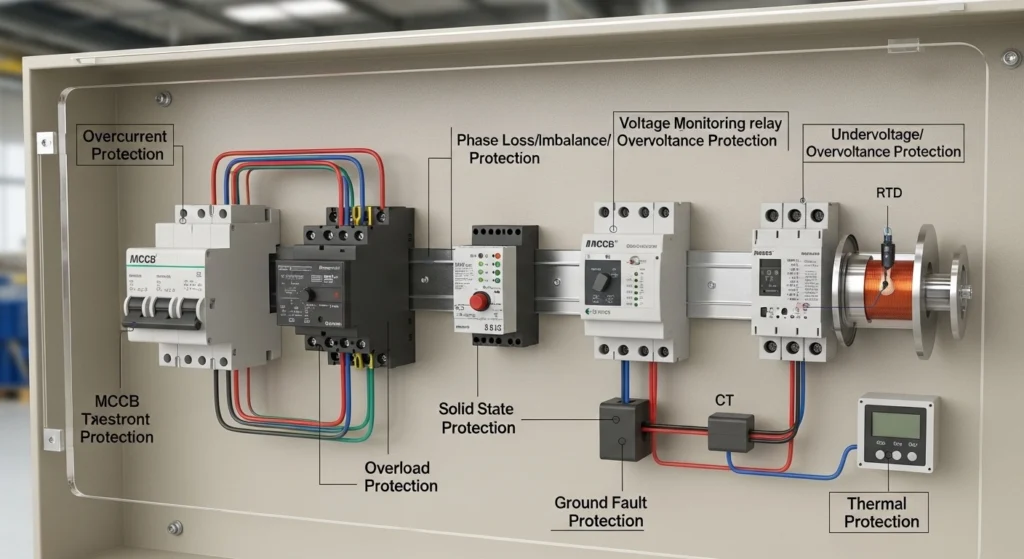
- Overcurrent
- Overvoltage / Undervoltage
- Overheating
- Phase failure
- Short circuit
4. Types / Classification
Overload Protection
Protects motors from excess current over time.
- Uses thermal relays or electronic relays
- Trips when current exceeds rated value
Short Circuit Protection
Protects against sudden high current due to faults.
- Uses fuses or circuit breakers
- Acts instantly to prevent severe damage
Thermal Protection
Protects against overheating.
- Uses temperature sensors
- Trips when motor temperature rises beyond safe limit
Phase Failure Protection
Protects three-phase motors from phase loss.
- Detects missing phase
- Stops motor to avoid damage
Under Voltage Protection
Stops motor when voltage drops below safe level.
- Prevents inefficient operation
- Avoids overheating
Over Voltage Protection
Protects motor from excessive voltage.
- Prevents insulation damage
- Maintains safe operation
Earth Fault Protection
Detects leakage current to ground.
- Prevents electric shock
- Protects insulation
Locked Rotor Protection
Protects motor when rotor is stuck.
- Detects high current condition
- Trips immediately
5. Main Components1. Circuit Breaker
- Disconnects power during faults
- Protects against short circuits
Thermal Overload Relay
- Protects against overload
- Works based on heat generated by current
Contactor
- Controls motor switching
- Works with relays for protection
Fuses
- Simple protection device
- Melts when current exceeds limit
Protection Relay
- Advanced monitoring device
- Detects multiple faults
Temperature Sensors
- Installed inside motor windings
- Monitor heat levels
6. Advantages
Motor Protection Techniques Advantages
- Prevents costly motor damage
- Increases motor lifespan
- Reduces maintenance costs
- Improves system reliability
- Ensures operator safety
- Minimizes downtime in industries
- Protects against multiple fault conditions
7. Disadvantages / Limitations
Motor Protection Techniques Disadvantages
- Initial installation cost can be high
- Requires proper setting and calibration
- Complex systems need skilled technicians
- Incorrect settings may cause nuisance tripping
- Regular maintenance is required
8. Applications
Motor Protection Techniques Applications
Home Use
- Water pumps
- Air conditioners
- Refrigerators
Industrial Use
- Conveyor systems
- Compressors
- Manufacturing machines
Modern Technology
- Electric vehicles
- Renewable energy systems
- Smart motor control systems
Motor protection is essential wherever motors are used.
9. Comparison Section
Difference Between Basic Protection and Advanced Protection Systems
| Feature | Basic Protection | Advanced Protection |
| Devices Used | Fuses, thermal relays | Digital relays, sensors |
| Accuracy | Moderate | High |
| Fault Detection | Limited | Multiple fault detection |
| Cost | Low | High |
| Application | Small systems | Industrial systems |
| Monitoring Capability | Minimal | Real-time monitoring |
10. Selection Guide
Choosing the right motor protection techniques depends on your application.
Tips for Beginners
- For small motors → Use thermal overload relay + fuse
- For medium motors → Use circuit breaker + relay
- For large motors → Use advanced digital protection
Key Factors to Consider
- Motor rating (power, voltage)
- Type of load
- Operating environment
- Cost vs reliability
- Safety requirements
Practical Advice
- Always follow manufacturer recommendations
- Avoid under-sizing protection devices
- Test protection system regularly
11. Common Problems & Solutions
Why does a motor trip frequently?
:
Possible causes:
- Overload
- Voltage fluctuation
- Incorrect relay settings
Check load conditions and adjust settings properly.
Why does a motor overheat?
- Overloading
- Poor ventilation
- Phase imbalance
Improve cooling and ensure balanced supply.
What is nuisance tripping?
Unnecessary tripping without actual fault.
Adjust protection settings correctly.
How to protect a motor from voltage fluctuations?
Use voltage protection relays and stabilizers.
What happens if protection is not used?
Motor may burn out, causing expensive repairs and downtime.
12. Future Trends
Motor protection is evolving with technology.
Key Trends
- Smart Relays: Digital and programmable protection devices
- IoT Integration: Remote monitoring of motor health
- Predictive Maintenance: Detect faults before failure
- AI-Based Systems: Intelligent fault detection
- Energy-Efficient Protection: Optimized performance
Modern systems are moving toward automation and real-time monitoring for better reliability.
13. Conclusion
Motor protection techniques are essential for ensuring safe and efficient motor operation. From simple fuses to advanced digital relays, each method plays a critical role in preventing damage caused by electrical and mechanical faults.
Understanding the motor protection techniques working principle, types, and applications helps engineers and technicians design reliable systems. While these techniques have some limitations, their benefits far outweigh the drawbacks.
As industries move toward automation and smart systems, motor protection will become even more advanced and important. For anyone working with motors, mastering these techniques is not optional—it is a necessity.
Keep learning, practicing, and applying these concepts to build strong expertise in electrical systems.