
Think about opening a tight jar lid. If you push at the center, it barely moves. But when you apply force at the edge, the lid turns easily. This turning effect is called torque. The same concept is used in electric motors to rotate shafts and drive machines.
In real life, torque is what allows a fan to spin, a pump to move water, and an electric vehicle to accelerate. Without torque, a motor cannot perform any useful mechanical work.
Understanding what is torque in motors is very important for electrical students, engineers, and technicians. It helps in selecting the right motor, analyzing performance, and solving practical problems in machines.
In this article, you will learn the torque in motors working principle, types, components, applications, advantages and disadvantages, and how to choose the right torque for your system. By the end, you will have a clear and practical understanding of how torque affects motor performance.
2. What is Torque in Motors?
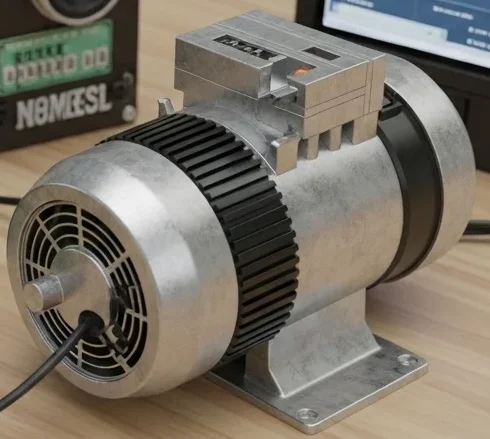
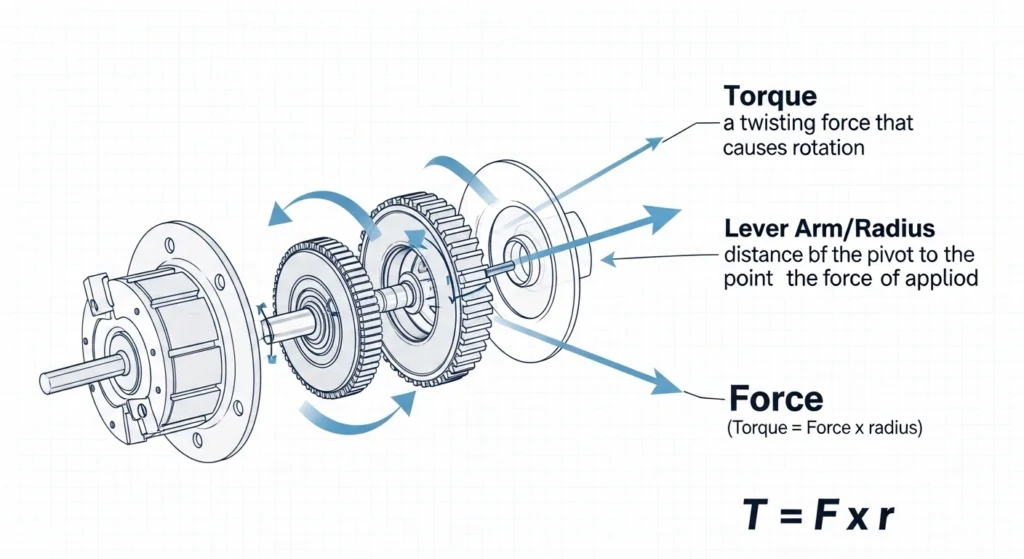
Torque in motors is the rotational force produced by a motor that causes an object to turn or rotate.
Simple Explanation
Torque is the “twisting force” that makes a motor shaft rotate. The higher the torque, the stronger the turning ability of the motor.
Mathematical Expression
\tau = F \times r \times \sin(\theta)
Where:
- τ = Torque
- F = Force applied
- r = Distance from the center (radius)
- θ = Angle between force and lever arm
Practical Example
- A ceiling fan needs torque to rotate its blades
- A water pump needs torque to push water
- An electric car motor uses torque to move the wheels
3. Working Principle
The torque in motors working principle is based on the interaction between magnetic fields and electric current.
Step-by-Step Explanation
- Electric current flows through the motor windings
- This creates a magnetic field
- The magnetic field interacts with another magnetic field (stator or rotor)
- A force is generated
- This force produces rotation (torque)
Easy Analogy
Imagine two magnets:
- If you try to rotate one near another, it experiences a push or pull
- This force causes rotation, similar to torque in motors
Key Points
- More current → More magnetic force → More torque
- Larger motor size → Higher torque capability
- Load increases → Motor draws more current to maintain torque
4. Types / Classification
Starting Torque
- Torque produced at the start of the motor
- Important for heavy loads like pumps and compressors
Running Torque
- Torque required to keep the motor running
- Usually lower than starting torque
Maximum Torque (Breakdown Torque)
- Highest torque a motor can produce
- Occurs before motor loses stability
Full Load Torque
- Torque at rated load condition
- Used for normal operation
Pull-Up Torque
- Minimum torque during acceleration
- Important for smooth starting
5. Main Components
Torque production depends on several motor components.
Stator
- Stationary part of motor
- Produces magnetic field
Rotor
- Rotating part
- Experiences force and produces torque
Windings
- Carry electric current
- Generate magnetic field
Shaft
- Transfers torque to load
- Connects motor to machine
Bearings
- Reduce friction
- Help smooth rotation
6. Advantages
Torque in Motors Advantages
- Enables mechanical movement
- Essential for all rotating machines
- Allows control of speed and load
- Supports heavy-duty applications
- Improves machine efficiency
- Provides smooth operation
7. Disadvantages / Limitations
Torque in Motors Disadvantages
- High torque requires more power
- Can cause overheating if overloaded
- Sudden torque changes may damage equipment
- Requires proper control systems
- Mechanical wear due to continuous rotation
8. Applications
Torque in Motors Applications
Home Applications
- Fans
- Washing machines
- Mixers and grinders
Industrial Applications
- Conveyor belts
- Pumps and compressors
- CNC machines
Modern Technology
- Electric vehicles
- Robotics
- Drones
- Renewable energy systems
Torque is used everywhere motors are involved.
9. Comparison Section
Difference Between Torque and Speed
| Feature | Torque | Speed |
| Definition | Rotational force | Rate of rotation |
| Unit | Newton-meter (Nm) | RPM (Revolutions per minute) |
| Function | Moves load | Determines how fast it moves |
| Relation | Inversely related in many motors | Inversely related to torque |
| Importance | Starting and load handling | Performance and efficiency |
Key Insight
- High torque → Strong force, lower speed
- High speed → Less torque in many cases
10. Selection Guide
Choosing the right torque is critical for motor performance.
Tips for Beginners
- For heavy loads → Choose high torque motors
- For fast rotation → Choose moderate torque motors
- For precision work → Choose controlled torque motors
Key Factors to Consider
- Load type (light or heavy)
- Starting conditions
- Speed requirements
- Duty cycle
- Power supply
Practical Advice
- Always check motor torque rating
- Do not overload motor beyond its capacity
- Use safety margin (20–30%)
11. Common Problems & Solutions
Why does a motor fail to start?
Answer:
Insufficient starting torque.
Solution:
Use a motor with higher starting torque.
Why does motor slow down under load?
Answer:
Load torque exceeds motor torque.
Solution:
Reduce load or use a higher torque motor.
What causes overheating?
Answer:
Excess torque demand.
Solution:
Check load and improve cooling.
What is torque drop?
Answer:
Reduction in torque due to voltage or current issues.
Solution:
Ensure proper power supply.
How to increase torque?
Answer:
- Increase current
- Use gear systems
- Select larger motor
12. Future Trends
Torque control is becoming more advanced with modern technology.
Key Trends
- Smart Motor Controllers: Precise torque control
- Electric Vehicles: High torque at low speeds
- Robotics: Accurate torque for precision tasks
- AI-Based Systems: Intelligent torque management
- Energy Efficiency: Optimized torque usage
Future systems will focus on efficient and controlled torque delivery.
13. Conclusion
Understanding what is torque in motors is essential for anyone working with electrical systems. Torque is the key factor that determines how effectively a motor can perform work.
From starting heavy loads to maintaining smooth operation, torque plays a critical role in every application. By learning the torque in motors working principle, types, and applications, you can select the right motor and avoid common problems.
While torque has some limitations, proper design and control can maximize its benefits. As technology advances, torque control will become even more precise and efficient.
Keep practicing and applying these concepts to build strong expertise in motor systems.