
Imagine a technician working inside an industrial panel. A damaged cable insulation allows a live conductor to touch the metal body of the equipment. The outer body becomes energized. If someone touches it, they may receive a severe electric shock.
This dangerous situation is called an earth fault. Without proper protection, it can lead to equipment damage, fire hazards, and even loss of life.
This is why Earth Fault Protection is one of the most important safety systems in electrical engineering. Whether you are working in a small house wiring system or a large power substation, protecting against earth faults is critical.
As a junior engineer, you must clearly understand how earth faults occur, how protection systems detect them, and how they isolate the fault quickly.
In this article, you will learn:
- What Earth Fault Protection is
- Earth Fault Protection working principle
- Types of protection methods
- Earth Fault Protection applications
- Earth Fault Protection advantages and disadvantages
- The difference between earth fault and short circuit
Let us study this topic step by step in simple and practical language.
2. What is Earth Fault Protection?
Clear Definition
Earth Fault Protection is a safety system that detects unwanted current flowing from a live conductor to earth (ground) and disconnects the power supply to prevent damage or injury.
Simple Explanation
In a healthy electrical system, current flows from phase to neutral.
If insulation fails and current flows from phase to earth through metal parts or ground, it is called an earth fault.
Earth Fault Protection senses this abnormal condition and trips the circuit breaker.
Practical Example
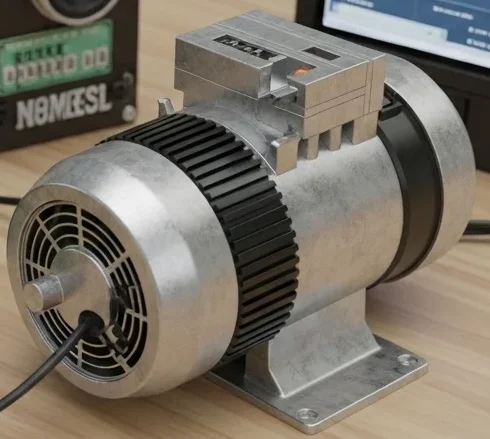
Suppose a motor winding touches its metal frame due to insulation damage.
The frame becomes live. When someone touches it, current may pass through their body to earth.
An earth fault relay detects leakage current and trips the breaker instantly.
3. Earth Fault Protection Working Principle
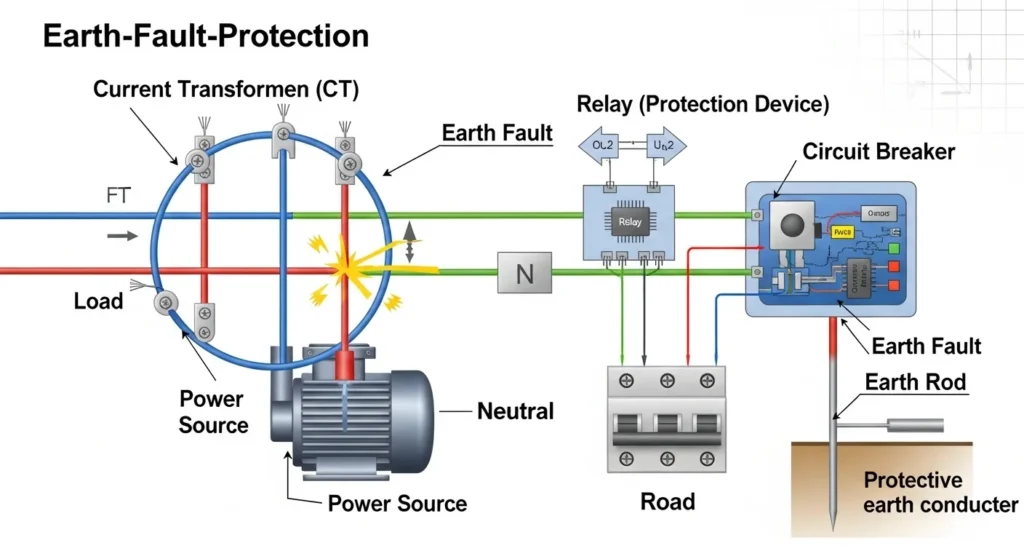
The Earth Fault Protection working principle is based on detecting imbalance or leakage current.
In a normal system:
- Current going through phase = Current returning through neutral.
In an earth fault:
- Some current leaks to earth.
- Phase current becomes higher than neutral current.
Step-by-Step Explanation
Current transformers (CTs) measure phase and neutral currents.
Under normal conditions, their sum is zero.
If leakage occurs, imbalance appears.
Relay detects this difference.
Circuit breaker trips to isolate the fault.
Easy Analogy
Think of a water pipe system.
If water entering a tank equals water leaving, everything is fine.
If some water leaks from a hole, the output becomes less than input.
The protection system detects this leakage and shuts the valve.
4. Types / Classification
Residual Current Device (RCD)
Commonly used in homes.
It trips when leakage current exceeds a safe limit (e.g., 30 mA).
Earth Fault Relay (EFR)
Used in industrial and power systems.
Works with current transformers to detect earth fault current.
Restricted Earth Fault (REF) Protection
Used for transformers and generators.
Provides sensitive protection for internal earth faults.
Directional Earth Fault Protection
Used in complex power networks.
Detects direction of fault current.
5. Main Components
Current Transformer (CT)
Measures current flowing in conductors.
Earth Fault Relay
Detects imbalance or leakage current.
Circuit Breaker
Disconnects faulty section.
Earthing System
Provides safe path for fault current.
Wiring and Sensors
Carry signals for monitoring and control.
All components must work properly to ensure effective Earth Fault Protection.
6. Earth Fault Protection Advantages and Disadvantages
Advantages
- Prevents electric shock
- Reduces fire risk
- Protects equipment from damage
- Improves system safety
- Quick fault isolation
Real-World Benefits
- Saves human life
- Reduces downtime
- Maintains electrical reliability
7. Disadvantages / Limitations
- Sensitive settings may cause nuisance tripping
- Requires proper earthing system
- Incorrect installation reduces effectiveness
- Additional cost in large systems
Proper design and testing are essential to avoid these limitations.
8. Earth Fault Protection Applications
Home Applications
- Protection in distribution boards
- Used in bathrooms and kitchens
Industrial Applications
- Motor protection
- Transformer protection
- Generator protection
Modern Technology
- Data centers
- Solar power plants
- EV charging stations
These Earth Fault Protection applications are critical for safety and reliability.
9. Difference Between Earth Fault and Short Circuit
Many students confuse these faults. Let us compare.
| Parameter | Earth Fault | Short Circuit |
| Fault Path | Phase to earth | Phase to phase or phase to neutral |
| Current Level | Moderate to high | Very high |
| Cause | Insulation failure to ground | Direct conductor contact |
| Protection Used | Earth fault relay | Overcurrent relay |
| Risk | Shock hazard | Equipment damage |
This table clearly explains the difference between earth fault and short circuit.
10. Selection Guide
Choosing the right Earth Fault Protection system depends on:
Voltage Level
Low voltage uses RCD.
High voltage uses EFR or REF.
System Type
Solidly grounded systems need sensitive protection.
Fault Current Level
Higher systems need adjustable relays.
Tips for Beginners
- Always check earthing resistance.
- Select proper CT ratio.
- Set correct pickup current.
- Test protection regularly.
Correct selection ensures safety and reliability.
11. Common Problems & Solutions (FAQs Style)
Why does RCD trip frequently?
Possible leakage in wiring or faulty appliance.
Check insulation and connections.
What happens if earthing is poor?
Protection may not operate correctly.
Improve grounding system.
Can Earth Fault Protection prevent all accidents?
It reduces risk greatly but cannot replace safe work practices.
How to test Earth Fault Protection?
Use leakage current testing equipment and verify trip time.
12. Future Trends
The future of Earth Fault Protection is becoming smarter.
Smart Digital Relays
Provide accurate detection and remote monitoring.
IoT-Based Monitoring
Real-time fault alerts via cloud systems.
Improved Sensitivity
Advanced sensors detect very small leakage currents.
Integration with Smart Grids
Automated fault isolation improves reliability.
Modern systems focus on safety, speed, and intelligence.
13. Conclusion
Earth Fault Protection is a fundamental safety system in electrical engineering. It protects human life, equipment, and electrical installations from dangerous leakage currents.
Understanding the Earth Fault Protection working principle helps engineers design safe and reliable systems. By selecting proper relays, ensuring good earthing, and performing regular testing, faults can be detected and cleared quickly.
Always remember, electrical safety is not optional — it is mandatory. As a junior engineer, never ignore grounding systems or protection settings. A small leakage current can cause serious consequences if left unprotected.
Mastering Earth Fault Protection will strengthen your knowledge in power system protection and help you build safer electrical systems.