
Imagine a technician working inside an industrial panel. A damaged cable insulation allows a live conductor to touch the metal body of the equipment. The outer body becomes energized. If someone touches it, they may receive a severe electric shock.
This dangerous situation is called an earth fault. Without proper protection, it can lead to equipment damage, fire hazards, and even loss of life.
This is why Earth Fault Protection is one of the most important safety systems in electrical engineering. Whether you are working in a small house wiring system or a large power substation, protecting against earth faults is critical.
As a junior engineer, you must clearly understand how earth faults occur, how protection systems detect them, and how they isolate the fault quickly.
In this article, you will learn:
- What Earth Fault Protection is
- Earth Fault Protection working principle
- Types of protection methods
- Earth Fault Protection applications
- Earth Fault Protection advantages and disadvantages
- The difference between earth fault and short circuit
Let us study this topic step by step in simple and practical language.
2. What is Earth Fault Protection?
Definition
Earth Fault Protection is a safety system that detects unwanted current flowing from a live conductor to earth (ground) and disconnects the power supply to prevent damage or injury.Earth fault protection is a safety system used in electrical installations to detect leakage current flowing from electrical conductors to the earth. This type of fault usually occurs when damaged insulation, moisture, or faulty equipment allows current to escape from the normal circuit path. Earth fault protection devices continuously monitor the current balance between phase and neutral wires. If leakage current is detected beyond a safe limit, the protection system quickly disconnects the power supply to prevent electric shock, equipment damage, and fire hazards. Common earth fault protection devices include Earth Leakage Circuit Breakers (ELCBs) and Residual Current Devices (RCDs). These systems are widely used in homes, industries, power distribution systems, and commercial buildings to improve electrical safety and ensure reliable operation of equipment.
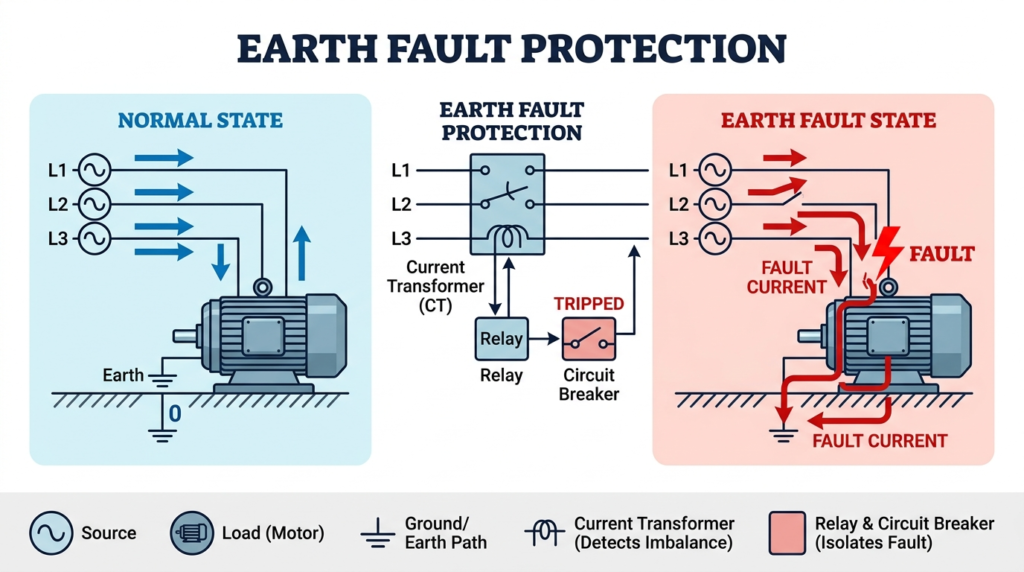
Simple Explanation
In a healthy electrical system, current flows from phase to neutral.
If insulation fails and current flows from phase to earth through metal parts or ground, it is called an earth fault.
Earth Fault Protection senses this abnormal condition and trips the circuit breaker.
Practical Example
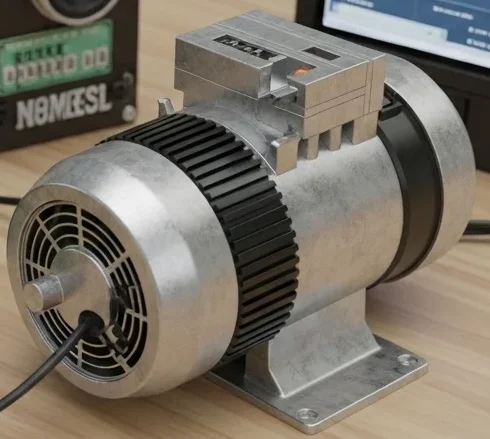
Suppose a motor winding touches its metal frame due to insulation damage.
The frame becomes live. When someone touches it, current may pass through their body to earth.
An earth fault relay detects leakage current and trips the breaker instantly.
3. Earth Fault Protection Working Principle
The Earth Fault Protection working principle is based on detecting imbalance or leakage current.
In a normal system:
- Current going through phase = Current returning through neutral.
In an earth fault:
- Some current leaks to earth.
- Phase current becomes higher than neutral current.
Step-by-Step Explanation
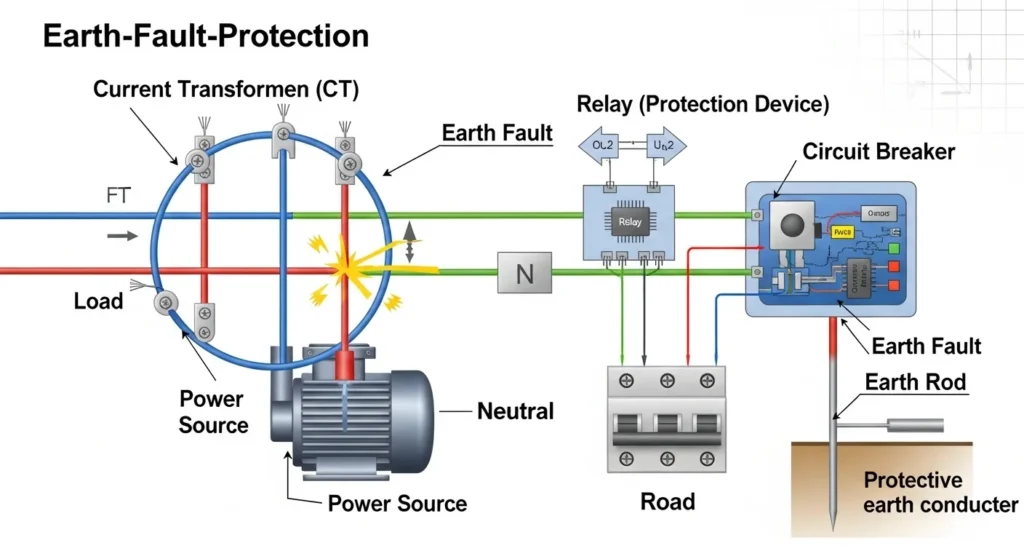
Current transformers (CTs) measure phase and neutral currents.
Under normal conditions, their sum is zero.
If leakage occurs, imbalance appears.
Relay detects this difference.
Circuit breaker trips to isolate the fault.
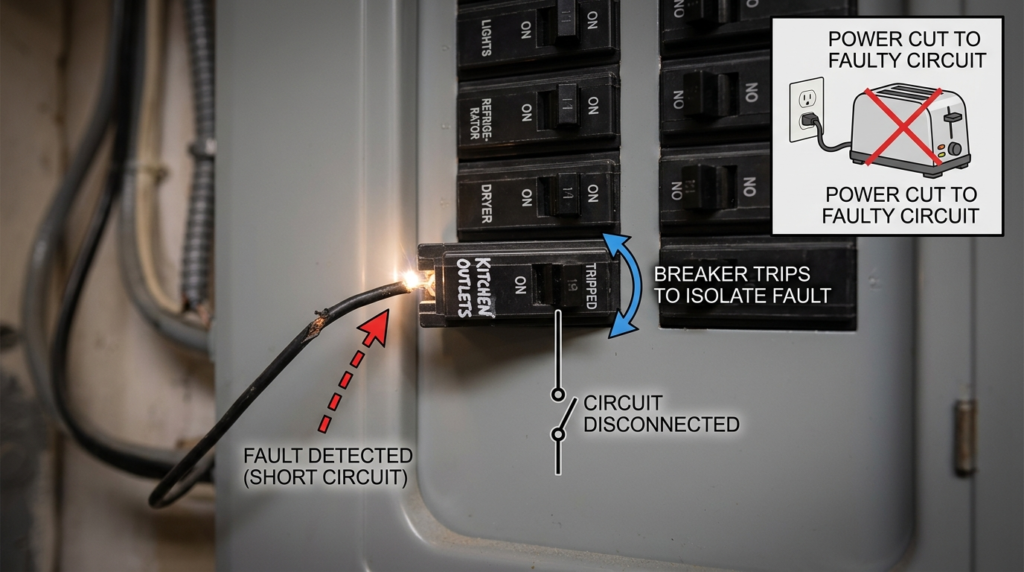
A circuit breaker trips to isolate the fault when an abnormal electrical condition such as a short circuit, overload, or earth fault occurs in the power system. The main purpose of tripping is to quickly disconnect the faulty section from the healthy electrical network to prevent damage to equipment, reduce fire risks, and maintain system safety. During a fault condition, excessive current flows through the circuit, and protective devices such as relays detect the abnormal current or voltage levels. The relay then sends a signal to the circuit breaker, causing its contacts to open automatically and interrupt the flow of current. By isolating the faulted area, the circuit breaker protects transformers, motors, generators, cables, and other electrical equipment from severe damage. Circuit breakers are widely used in homes, industries, substations, and power distribution systems because they provide fast, reliable, and reusable electrical protection. Understanding how a circuit breaker trips to isolate faults is important for electrical students, engineers, and technicians because it is a fundamental concept in electrical protection and power system stability.
Easy Analogy
Think of a water pipe system.
If water entering a tank equals water leaving, everything is fine.
If some water leaks from a hole, the output becomes less than input.
The protection system detects this leakage and shuts the valve.
4. Types / Classification
Residual Current Device (RCD)
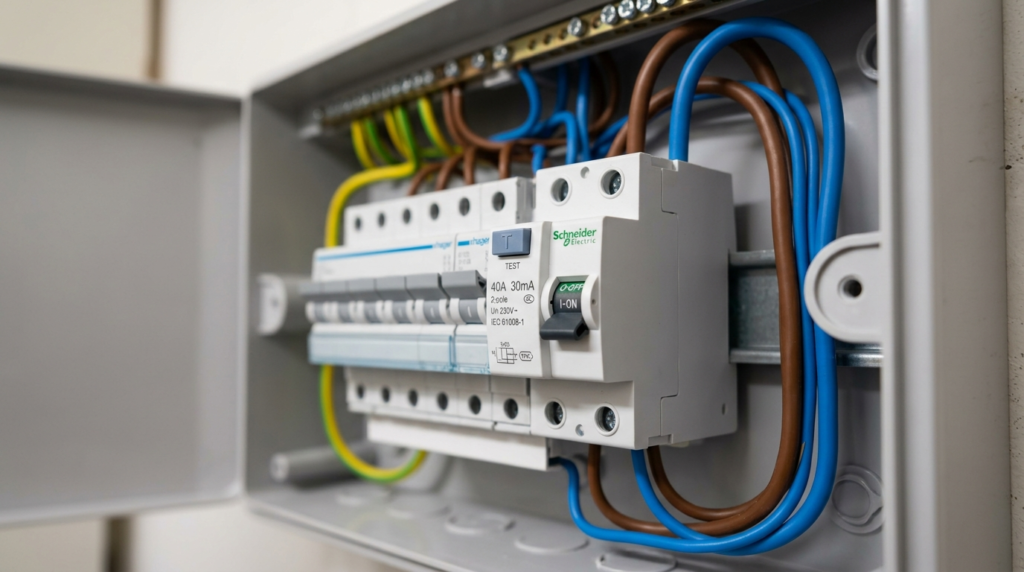
A Residual Current Device (RCD) is an electrical safety device used to protect people from electric shock and prevent electrical fires caused by leakage currents in electrical systems. It continuously monitors the current flowing through the live and neutral conductors of a circuit. Under normal conditions, the current entering through the live wire is equal to the current returning through the neutral wire. If a leakage current occurs due to damaged insulation, faulty appliances, or accidental human contact, the current becomes unbalanced. The RCD quickly detects this difference and automatically disconnects the power supply within milliseconds to reduce the risk of electric shock and equipment damage. Residual Current Devices are widely used in homes, industries, hospitals, construction sites, and commercial buildings because they provide high levels of electrical safety and protection. They are commonly installed in distribution boards along with circuit breakers and fuses. Understanding the Residual Current Device (RCD) is important for electrical students, engineers, and technicians because it plays a major role in modern electrical protection systems and human safety.
Commonly used in homes.
It trips when leakage current exceeds a safe limit (e.g., 30 mA).
Types of Earth Fault Protection Systems
Earth fault protection is an essential part of electrical power systems, designed to detect leakage current flowing from live conductors to earth. Different types of earth fault protection are used depending on the application, equipment, and level of protection required.
Earth Fault Relay (EFR)
An Earth Fault Relay (EFR) is widely used in industrial plants, commercial buildings, and electrical power systems to detect earth leakage or ground faults. It continuously monitors the residual current through current transformers (CTs) and operates the circuit breaker when the earth fault current exceeds a preset value. Earth fault relays help protect electrical equipment, prevent insulation damage, and reduce the risk of electric shock and fire hazards.
Applications
- Industrial power distribution systems
- Electrical substations
- Motor protection
- Distribution transformers
- Commercial electrical installations
Key Features
- Detects low-level earth fault currents.
- Works with current transformers (CTs).
- Provides fast and reliable fault detection.
- Improves personnel and equipment safety.
- Reduces the risk of electrical fires.
Restricted Earth Fault (REF) Protection
Restricted Earth Fault (REF) Protection is a highly sensitive protection scheme used mainly for power transformers, generators, and large motors. It detects earth faults only within a defined protection zone, such as the transformer winding between the current transformers and the neutral grounding point. Because REF protection is highly selective, it can identify small internal earth faults that may not be detected by conventional overcurrent protection.
Applications
- Power transformers
- Generator stator windings
- Large induction and synchronous motors
- Industrial power systems
Key Features
- Provides highly sensitive internal earth fault protection.
- Operates only for faults within the protected zone.
- Offers fast fault clearance to minimize equipment damage.
- Reduces the likelihood of transformer winding failures.
- Improves the reliability of critical electrical equipment.
Directional Earth Fault Protection
Directional Earth Fault Protection is used in interconnected and complex electrical power networks where fault current can flow in multiple directions. Unlike standard earth fault protection, this system determines both the magnitude and direction of the earth fault current. This enables protection relays to isolate only the faulty section while keeping the remaining network in service, improving overall system reliability.
Applications
- Ring main distribution systems
- Transmission networks
- Industrial power plants
- Utility substations
- Renewable energy power systems
Key Features
- Detects the direction of earth fault current.
- Improves protection coordination in interconnected networks.
- Prevents unnecessary tripping of healthy feeders.
- Enhances system stability and reliability.
- Suitable for complex and multi-source power systems.
Together, Earth Fault Relays (EFR), Restricted Earth Fault (REF) Protection, and Directional Earth Fault Protection provide comprehensive protection against earth faults in modern electrical installations. Selecting the appropriate protection method depends on the type of equipment, network configuration, and the level of sensitivity required to ensure safe and reliable system operation.
5. Main Components
Current Transformer (CT)
A Current Transformer (CT) is an essential component of an Earth Fault Protection system. Its main function is to measure the amount of current flowing through electrical conductors and provide a reduced current value that can be safely monitored by protection devices. Since power systems often carry very high currents, it is not practical or safe to connect relays and measuring instruments directly to the main conductors. The CT solves this problem by stepping down the current to a manageable level while maintaining an accurate relationship with the primary current.
In Earth Fault Protection systems, the CT continuously monitors the current flowing through the phase conductors. Under normal operating conditions, the currents remain balanced. However, if leakage current flows to the earth because of insulation failure or equipment damage, the CT detects this imbalance and sends a signal to the protection relay. This enables the system to respond quickly before the fault causes severe damage.
Functions of a Current Transformer (CT)
- Measures current flowing in electrical conductors.
- Reduces high current to a safe value for relays and meters.
- Detects abnormal current conditions.
- Supplies signals to protection devices.
- Improves the accuracy of fault detection.
- Enhances the safety of electrical systems.
Earth Fault Relay
The Earth Fault Relay is the main decision-making component in an Earth Fault Protection system. It receives signals from the current transformer and continuously compares the measured values with its preset settings. If the relay detects leakage current above the permissible limit, it interprets the condition as an earth fault and immediately initiates protective action.
Modern earth fault relays are highly sensitive and can detect even small leakage currents that might otherwise go unnoticed. This sensitivity protects equipment, prevents electrical fires, and reduces the risk of electric shock. The relay operates within milliseconds, ensuring fast fault clearance and minimizing damage to the system.
Functions of an Earth Fault Relay
- Detects earth leakage or current imbalance.
- Monitors the electrical system continuously.
- Compares measured values with preset limits.
- Sends a trip signal during fault conditions.
- Protects equipment from damage.
- Enhances personnel safety.
Circuit Breaker
A Circuit Breaker is the protective switching device that physically disconnects the faulty section of the electrical system. When the earth fault relay detects an abnormal condition, it sends a signal to the circuit breaker. The breaker then opens its contacts, interrupting the flow of electricity and isolating the affected circuit.
Unlike ordinary switches, circuit breakers are specifically designed to interrupt fault currents safely and repeatedly without damage. Their fast operation prevents overheating, equipment failure, and the spread of faults to healthy parts of the installation. Once the fault has been corrected, the breaker can usually be reset to restore power.
Functions of a Circuit Breaker
- Disconnects the faulty circuit automatically.
- Interrupts dangerous fault currents.
- Prevents damage to electrical equipment.
- Reduces the risk of electrical fires.
- Protects healthy sections of the system.
- Allows safe restoration of power after repairs.
Earthing System
The Earthing System provides a low-resistance path for fault current to flow safely into the ground. It is one of the most important safety features in any electrical installation. During an earth fault, the earthing system prevents exposed metal parts from reaching dangerous voltages that could cause electric shock.
A properly designed earthing system consists of earth electrodes, conductors, and bonding arrangements that connect equipment frames and metallic structures to the ground. This ensures that fault currents are directed away from people and equipment. Effective earthing also improves the operation of protection devices by allowing faults to be detected quickly.
Functions of an Earthing System
- Provides a safe path for fault current.
- Reduces the risk of electric shock.
- Maintains equipment at earth potential.
- Improves protective device performance.
- Prevents dangerous touch voltages.
- Enhances overall electrical safety.
Wiring and Sensors
Wiring and Sensors form the communication network of the Earth Fault Protection system. The wiring carries signals between current transformers, relays, circuit breakers, and monitoring equipment. High-quality wiring ensures that protection signals are transmitted accurately and without interruption.
Sensors provide additional information about system conditions and support advanced monitoring functions. In modern installations, sensors can track parameters such as current levels, temperature, insulation status, and fault conditions. These devices enable early fault detection and help maintenance teams respond before major failures occur.
Functions of Wiring and Sensors
- Carry control and monitoring signals.
- Connect all protection components together.
- Support accurate fault detection.
- Enable real-time system monitoring.
- Improve reliability and response time.
- Assist in preventive maintenance.
Importance of Proper Coordination
All of these components must work together correctly to ensure effective Earth Fault Protection. The current transformer detects abnormal current, the earth fault relay analyzes the condition, the circuit breaker isolates the faulty section, the earthing system safely diverts fault current, and the wiring and sensors ensure smooth communication between devices.
If any component fails to operate properly, the protection system may not respond as intended, increasing the risk of equipment damage, electrical fires, and personal injury. Therefore, regular inspection, testing, and maintenance are essential to ensure that the entire Earth Fault Protection system remains reliable, efficient, and capable of providing maximum safety.
6. Earth Fault Protection Advantages and Disadvantages
Advantages
- Prevents electric shock
- Reduces fire risk
- Protects equipment from damage
- Improves system safety
- Quick fault isolation
Real-World Benefits
- Saves human life
- Reduces downtime
- Maintains electrical reliability
7. Disadvantages / Limitations
- Sensitive settings may cause nuisance tripping
- Requires proper earthing system
- Incorrect installation reduces effectiveness
- Additional cost in large systems
Proper design and testing are essential to avoid these limitations.
8. Earth Fault Protection Applications
Home Applications
- Protection in distribution boards
- Used in bathrooms and kitchens
Industrial Applications
- Motor protection
- Transformer protection
- Generator protection
Modern Technology
- Data centers
- Solar power plants
- EV charging stations
These Earth Fault Protection applications are critical for safety and reliability.
9. Difference Between Earth Fault and Short Circuit
Many students confuse these faults. Let us compare.
| Parameter | Earth Fault | Short Circuit |
| Fault Path | Phase to earth | Phase to phase or phase to neutral |
| Current Level | Moderate to high | Very high |
| Cause | Insulation failure to ground | Direct conductor contact |
| Protection Used | Earth fault relay | Overcurrent relay |
| Risk | Shock hazard | Equipment damage |
This table clearly explains the difference between earth fault and short circuit.
10. Selection Guide for Earth Fault Protection Systems
Selecting the appropriate Earth Fault Protection system is essential for ensuring electrical safety, equipment protection, and reliable power system operation. The right protection method depends on several technical factors, including system voltage, grounding method, fault current level, and application requirements.
Voltage Level
The operating voltage of the electrical system is one of the primary factors in selecting earth fault protection.
- Low-voltage (LV) systems typically use Residual Current Devices (RCDs) or Residual Current Circuit Breakers (RCCBs) for personnel and equipment protection.
- Medium- and high-voltage (MV/HV) systems commonly use Earth Fault Relays (EFR), Restricted Earth Fault (REF) Protection, or Directional Earth Fault Protection for accurate fault detection and selective tripping.
System Grounding Method
The grounding (earthing) arrangement significantly affects the type of protection required.
- Solidly grounded systems require highly sensitive earth fault protection because fault currents are relatively high.
- Resistance-grounded or impedance-grounded systems require relays with carefully adjusted settings to detect lower fault currents.
- Ungrounded systems often require specialized earth fault monitoring equipment to detect insulation failures before severe faults occur.
Fault Current Level
The expected earth fault current determines the relay sensitivity and current transformer (CT) selection.
- Low fault current systems require high-sensitivity protection.
- High fault current systems require adjustable earth fault relays capable of handling larger current levels.
- Proper relay coordination helps isolate only the faulty section of the electrical network.
Equipment and Application
Different electrical equipment requires different protection schemes.
- RCDs/RCCBs – Residential and commercial installations.
- Earth Fault Relays (EFR) – Industrial distribution systems and substations.
- Restricted Earth Fault (REF) Protection – Power transformers and generators.
- Directional Earth Fault Protection – Ring networks, transmission systems, and interconnected power grids.
Tips for Beginners
When selecting and installing an earth fault protection system, follow these best practices:
- Measure and verify the earthing resistance before commissioning.
- Select the correct current transformer (CT) ratio for accurate fault detection.
- Set the relay pickup current according to system requirements.
- Coordinate relay settings with other protection devices.
- Perform routine testing and maintenance to ensure reliable operation.
- Follow applicable electrical standards and manufacturer recommendations.
Importance of Proper Selection
Choosing the correct Earth Fault Protection system improves both electrical safety and system performance. Proper selection helps:
- Protect personnel from electric shock.
- Prevent equipment damage caused by earth faults.
- Minimize fire hazards due to leakage currents.
- Improve system reliability and operational continuity.
- Reduce downtime and maintenance costs.
- Ensure compliance with electrical safety standards.
A well-designed earth fault protection system provides fast, accurate, and selective fault detection, ensuring safe and reliable operation of residential, commercial, industrial, and utility electrical installations.
11. Common Problems & Solutions (FAQs)
Understanding common issues related to Earth Fault Protection helps ensure the safe and reliable operation of electrical systems. The following frequently asked questions explain typical problems, their causes, and practical solutions.
Why Does an RCD Trip Frequently?
Frequent tripping of a Residual Current Device (RCD) usually indicates an earth leakage problem rather than a faulty RCD.
Possible Causes
- Damaged or deteriorated wiring insulation.
- Faulty electrical appliances.
- Moisture entering electrical equipment.
- Loose or damaged wiring connections.
- Excessive leakage current from multiple connected devices.
Solution
- Inspect wiring insulation for damage.
- Disconnect appliances one by one to identify the faulty device.
- Tighten loose electrical connections.
- Replace damaged cables or defective equipment.
- Test the RCD using appropriate electrical testing instruments.
What Happens If the Earthing System Is Poor?
A poor earthing system reduces the effectiveness of earth fault protection and increases electrical hazards.
Possible Effects
- Earth fault protection may fail to operate correctly.
- Increased risk of electric shock.
- Higher chance of equipment damage.
- Greater possibility of electrical fires.
- Unstable system voltage during fault conditions.
Solution
- Improve the grounding (earthing) system.
- Measure earth resistance regularly.
- Repair damaged earth conductors.
- Ensure compliance with local electrical standards.
Can Earth Fault Protection Prevent All Electrical Accidents?
Earth fault protection significantly improves electrical safety, but it cannot eliminate every type of electrical hazard.
What It Protects Against
- Earth leakage currents.
- Electric shock caused by insulation failure.
- Equipment damage from ground faults.
- Fire hazards due to leakage currents.
Important Reminder
Earth fault protection should always be used together with:
- Safe working procedures.
- Proper personal protective equipment (PPE).
- Regular electrical inspections.
- Preventive maintenance programs.
How Can Earth Fault Protection Be Tested?
Regular testing ensures that the protection system operates correctly during an actual fault.
Common Testing Methods
- Use an RCD or earth fault relay tester.
- Inject a simulated leakage current.
- Verify relay pickup settings.
- Measure circuit breaker trip time.
- Check current transformer (CT) connections.
- Perform routine maintenance and calibration.
Routine testing improves system reliability and ensures compliance with electrical safety regulations.
12. Future Trends in Earth Fault Protection
Modern Earth Fault Protection systems are becoming more intelligent, faster, and highly connected. Advances in digital technology are improving fault detection accuracy, reducing downtime, and enhancing electrical safety across residential, commercial, industrial, and utility power systems.
Smart Digital Protection Relays
Modern digital relays provide highly accurate earth fault detection while offering advanced monitoring and communication capabilities.
Key Benefits
- Faster fault detection and isolation.
- Programmable protection settings.
- Remote monitoring and diagnostics.
- Event recording and fault analysis.
- Improved system reliability.
IoT-Based Monitoring Systems
The Internet of Things (IoT) enables continuous monitoring of electrical systems through connected sensors and cloud platforms.
Features
- Real-time earth fault alerts.
- Remote monitoring using mobile devices.
- Predictive maintenance based on equipment condition.
- Cloud-based data storage and analysis.
- Reduced maintenance costs and downtime.
Advanced High-Sensitivity Detection
New sensor technologies can detect extremely small leakage currents before they develop into serious electrical faults.
Advantages
- Earlier fault detection.
- Improved protection for sensitive equipment.
- Reduced fire and shock risks.
- Better protection for renewable energy installations.
- Increased operational reliability.
Integration with Smart Grids
Smart grids combine automation, digital communication, and intelligent protection systems to improve overall power system performance.
Benefits
- Automatic fault detection and isolation.
- Faster restoration of electricity supply.
- Improved power quality and grid stability.
- Better coordination between protection devices.
- Enhanced integration of renewable energy resources.
Artificial Intelligence and Predictive Protection
Artificial intelligence (AI) is increasingly being incorporated into protection systems to analyze electrical data, predict equipment failures, and optimize relay performance.
Future Advantages
- Predictive fault detection.
- Automated protection setting optimization.
- Reduced false tripping.
- Improved asset management.
- Greater operational efficiency.
Future Outlook
The future of Earth Fault Protection lies in the integration of digital relays, IoT monitoring, artificial intelligence, advanced sensors, and smart grid technologies. These innovations will provide faster fault detection, higher protection accuracy, remote diagnostics, and improved electrical safety, creating more reliable and intelligent power systems for the future.
13. Conclusion
Earth Fault Protection is a fundamental safety system in electrical engineering. It protects human life, equipment, and electrical installations from dangerous leakage currents.
Understanding the Earth Fault Protection working principle helps engineers design safe and reliable systems. By selecting proper relays, ensuring good earthing, and performing regular testing, faults can be detected and cleared quickly.
Always remember, electrical safety is not optional — it is mandatory. As a junior engineer, never ignore grounding systems or protection settings. A small leakage current can cause serious consequences if left unprotected.
Mastering Earth Fault Protection will strengthen your knowledge in power system protection and help you build safer electrical systems.