
Imagine a power station supplying electricity to thousands of homes. The entire system must maintain a stable frequency—usually 50 Hz in many countries. If the frequency changes significantly, electrical equipment such as motors, transformers, and electronic devices may not operate correctly. In severe cases, the power grid can become unstable.
This is where a frequency meter becomes extremely important. A frequency meter is an instrument used to measure the frequency of electrical signals. Engineers and technicians rely on this device to ensure that electrical systems operate at the correct frequency level.
Frequency measurement is essential in power systems, communication networks, electronic circuits, and industrial automation. Without accurate frequency monitoring, electrical equipment could malfunction, overheat, or fail.
In this guide, you will learn the Frequency Meter working principle, types, main components, and real-world Frequency Meter applications. We will also discuss the Frequency Meter advantages and disadvantages, practical troubleshooting tips, and how to select the right frequency meter for different electrical systems.
The explanations are simple and practical so that beginners, technicians, and students can clearly understand this important electrical measuring instrument.
2. What is a Frequency Meter?
A Frequency Meter is an electrical instrument used to measure the frequency of alternating current (AC) signals or periodic waveforms.
Frequency is usually measured in Hertz (Hz), which represents the number of cycles per second.
Simple Definition
A frequency meter is a device that measures how many times an electrical signal repeats itself in one second.
Simple Explanation
Electrical signals often repeat in a regular pattern called a cycle. The number of cycles occurring every second is known as frequency.
For example:
- 50 cycles per second = 50 Hz
- 60 cycles per second = 60 Hz
A frequency meter detects this repeating pattern and displays the frequency value.
Practical Example
Consider a power generator in a power plant. The generator must operate at 50 Hz to match the electrical grid.
A frequency meter continuously measures the output frequency. If the generator frequency changes, engineers adjust the turbine speed to restore the correct value.
This simple measurement helps maintain stable power system operation.
3. Frequency Meter Working Principle
The Frequency Meter working principle is based on detecting the number of cycles in an electrical signal during a specific time period.
The meter converts these cycles into a frequency value and displays it on the screen.
Step-by-Step Working Process
Signal Input
The electrical signal enters the frequency meter through input terminals.
Signal Conditioning
The signal is filtered and shaped to remove noise and irregularities.
Pulse Generation
The signal waveform is converted into pulses representing each cycle.
Counting Circuit
An electronic counter counts the number of pulses within a fixed time period.
Frequency Calculation
The meter calculates frequency using the formula:
Frequency = Number of cycles / Time
Display Output
The calculated frequency is shown on the display.
Simple Analogy
Think of frequency measurement like counting how many times a clock pendulum swings in one second.
The more swings per second, the higher the frequency.
A frequency meter simply counts these electrical “swings.”
4. Types of Frequency Meters
Frequency meters are available in several types depending on their measurement method and technology.
Mechanical Frequency Meter
Mechanical frequency meters use moving parts to measure frequency.
Features
- Simple construction
- Mechanical indication
- Limited accuracy
Applications
- Power distribution panels
- Older electrical systems
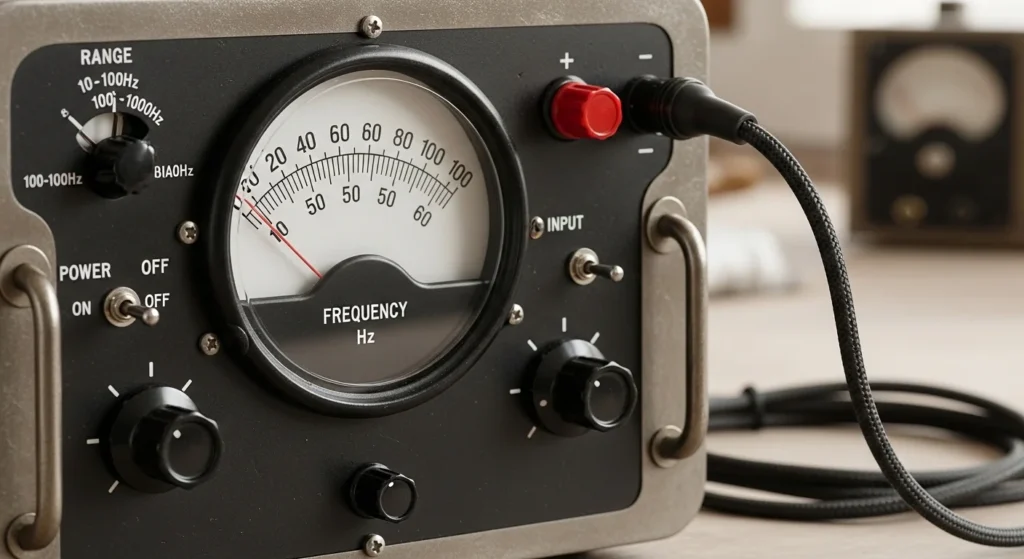
Analog Frequency Meter
Analog frequency meters use electromagnetic principles and moving pointer displays.
Features
- Dial scale display
- Continuous measurement
- Moderate accuracy
Applications
- Industrial control panels
- Generator monitoring
Digital Frequency Meter
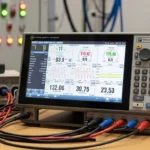
Digital frequency meters use electronic circuits and digital displays.
Features
- High accuracy
- Easy reading
- Fast response
Applications
- Electronics testing
- Communication systems
- Laboratory measurements
Resonance Frequency Meter
This type uses a resonant circuit to determine frequency.
Features
- Tuned circuits
- Accurate for specific ranges
Applications
- Radio frequency measurements
- Signal analysis
5. Main Components of a Frequency Meter
A frequency meter contains several components that work together to measure frequency accurately.
Input Terminal
The input terminal receives the electrical signal from the circuit under test.
Signal Conditioning Circuit
This circuit prepares the signal for measurement.
Functions include:
- Filtering noise
- Amplifying weak signals
- Converting waveforms into pulses
Counter Circuit
The counter circuit counts the number of signal cycles during a fixed time interval.
This is the main measurement unit of the frequency meter.
Time Base Generator
The time base generator provides a precise reference time interval for accurate measurement.
Display Unit
The display unit shows the frequency value.
Types include:
- Analog dial display
- Digital LED or LCD display
Power Supply
The power supply provides electrical energy for internal circuits.
6. Frequency Meter Advantages
Frequency meters provide many benefits for electrical measurements.
Frequency Meter Advantages and Disadvantages
Advantages
- Accurate measurement of signal frequency
- Easy to operate and read
- Essential for power system monitoring
- Useful for electronic circuit testing
- Helps maintain stable electrical systems
- Available in portable digital models
These advantages make frequency meters widely used in electrical engineering.
7. Frequency Meter Disadvantages
Although frequency meters are very useful, they also have some limitations.
Disadvantages
- Some models measure only a limited frequency range
- Mechanical meters have lower accuracy
- Sensitive to electrical noise
- Digital meters require power supply
- High-precision models can be expensive
Understanding these limitations helps engineers choose the correct measuring instrument.
8. Frequency Meter Applications
Frequency meters are used in many electrical and electronic systems.
Power Generation
Frequency meters monitor generator frequency in power plants.
They help maintain stable grid frequency.
Industrial Electrical Systems
Industries use frequency meters in control panels to monitor equipment performance.
Examples include:
- Motors
- Drives
- Transformers
Communication Systems
Frequency measurement is critical for radio and communication signals.
Frequency meters help verify signal accuracy.
Electronics Laboratories
Students and engineers use frequency meters to test oscillators, signal generators, and digital circuits.
Renewable Energy Systems
Wind turbines and solar inverters require frequency monitoring for stable operation.
These examples demonstrate the wide range of Frequency Meter applications.
9. Comparison: Frequency Meter vs Multimeter
Students often ask about the difference between frequency meter and multimeter.
| Feature | Frequency Meter | Multimeter |
| Primary Function | Measures frequency | Measures voltage, current, resistance |
| Accuracy | High for frequency measurement | Limited frequency measurement |
| Applications | Power systems, electronics | General electrical testing |
| Display | Dedicated frequency display | Multi-function display |
| Complexity | Specialized instrument | Multi-purpose tool |
Both tools are useful, but a frequency meter provides more precise frequency measurement.
10. Selection Guide
Choosing the right frequency meter depends on several factors.
Frequency Range
Ensure the meter supports the frequency range you need.
For example:
- Power systems: 45–65 Hz
- Electronics: kHz to MHz range
Accuracy
Higher accuracy is required for laboratory measurements.
Display Type
Digital displays are easier to read than analog meters.
Portability
Portable frequency meters are useful for field work.
Beginner Tip
A digital frequency meter with moderate range and accuracy is usually the best choice for students.
11. Common Problems & Solutions
Incorrect Frequency Reading
Cause:
Electrical noise or poor signal quality.
Solution:
Use proper shielding and filtering.
No Display
Cause:
Power supply failure.
Solution:
Check power connections or replace batteries.
Unstable Readings
Cause:
Weak or fluctuating signal.
Solution:
Improve signal connection or use signal conditioning.
Overload Error
Cause:
Signal frequency exceeds meter range.
Solution:
Use a meter with a higher frequency range.
12. Future Trends in Frequency Meter Technology
Frequency measurement technology continues to improve with modern electronics.
Smart Digital Frequency Meters
New meters include advanced digital signal processing for higher accuracy.
Portable Wireless Instruments
Wireless frequency meters allow remote monitoring of electrical systems.
Integration with Smart Grids
Future power systems will use frequency meters integrated with smart grid technology.
AI-Based Monitoring
Advanced monitoring systems will automatically detect frequency abnormalities and prevent system failures.
Cloud Data Analysis
Frequency data can be stored and analyzed remotely using cloud systems.
These developments will expand Frequency Meter applications in modern electrical engineering.
13. Conclusion
A Frequency Meter is an essential instrument for measuring the frequency of electrical signals in power systems, electronics, and communication networks. Maintaining correct frequency levels is critical for the safe and efficient operation of electrical equipment.
In this article, we discussed the Frequency Meter working principle, different types, and the main components that allow accurate frequency measurement. We also explored practical Frequency Meter applications in power plants, industrial systems, communication networks, and electronic laboratories.
Understanding the Frequency Meter advantages and disadvantages helps engineers and technicians choose the right instrument for their measurement needs. Whether used in a power station, laboratory, or industrial plant, frequency meters play a key role in maintaining stable and reliable electrical systems.
For students and beginners, learning how frequency meters work provides a strong foundation for studying electrical measurements and signal analysis in modern engineering.