
Imagine a power station supplying electricity to thousands of homes. The entire system must maintain a stable frequency—usually 50 Hz in many countries. If the frequency changes significantly, electrical equipment such as motors, transformers, and electronic devices may not operate correctly. In severe cases, the power grid can become unstable.
This is where a frequency meter becomes extremely important. A frequency meter is an instrument used to measure the frequency of electrical signals. Engineers and technicians rely on this device to ensure that electrical systems operate at the correct frequency level.
Frequency measurement is essential in power systems, communication networks, electronic circuits, and industrial automation. Without accurate frequency monitoring, electrical equipment could malfunction, overheat, or fail.
In this guide, you will learn the Frequency Meter working principle, types, main components, and real-world Frequency Meter applications. We will also discuss the Frequency Meter advantages and disadvantages, practical troubleshooting tips, and how to select the right frequency meter for different electrical systems.
The explanations are simple and practical so that beginners, technicians, and students can clearly understand this important electrical measuring instrument.
2. What is a Frequency Meter?
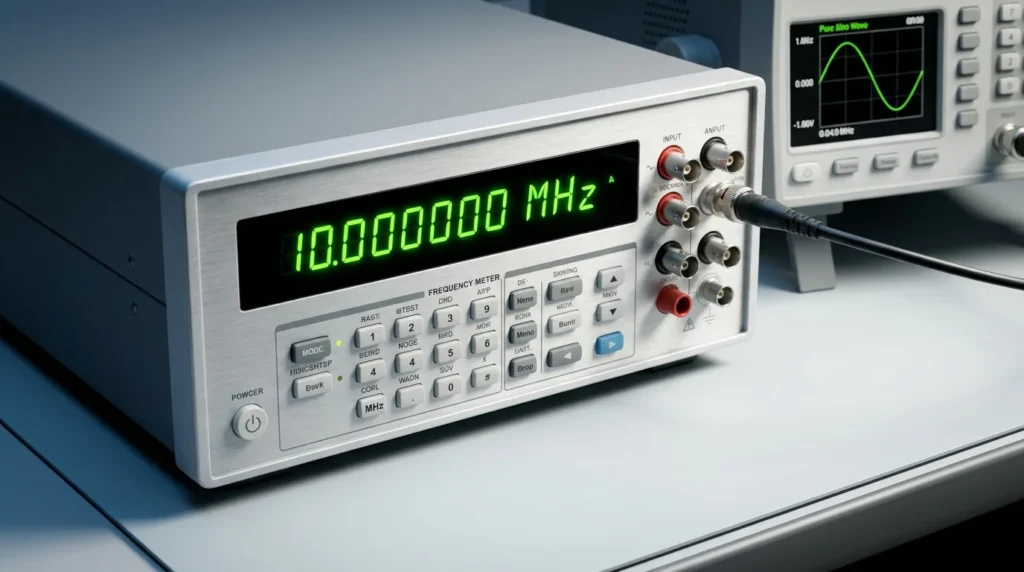
A Frequency Meter is an electrical instrument used to measure the frequency of alternating current (AC) signals or periodic waveforms.
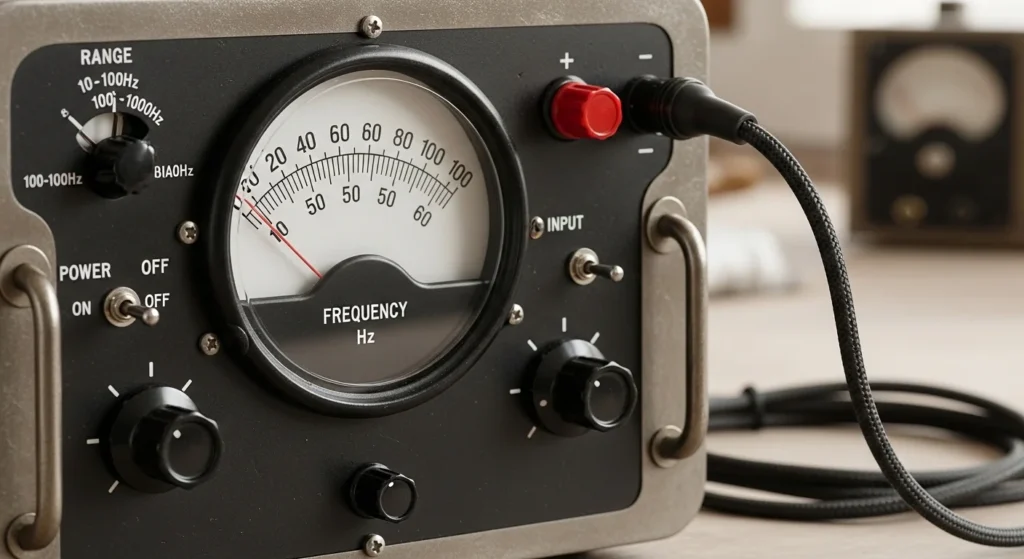
Frequency is usually measured in Hertz (Hz), which represents the number of cycles per secondA frequency meter is an electrical measuring instrument used to measure the frequency of an AC signal or electrical supply. Frequency is measured in Hertz (Hz), which indicates how many cycles occur in one second. In electrical systems, maintaining the correct frequency is very important because many machines and electronic devices are designed to operate at specific frequencies such as 50 Hz or 60 Hz. The frequency meter works by detecting the alternating cycles of the input signal and displaying the frequency value either through an analog pointer or a digital screen. These meters are widely used in power plants, electrical laboratories, industries, generators, and communication systems to monitor the stability and performance of electrical equipment. Modern digital frequency meters provide highly accurate readings and fast response, making them essential tools for engineers, technicians, and electricians..
Simple Definition
A frequency meter is a device that measures how many times an electrical signal repeats itself in one second.
Simple Explanation
Electrical signals often repeat in a regular pattern called a cycle. The number of cycles occurring every second is known as frequency.
For example:
- 50 cycles per second = 50 Hz
- 60 cycles per second = 60 Hz
A frequency meter detects this repeating pattern and displays the frequency value.
Practical Example
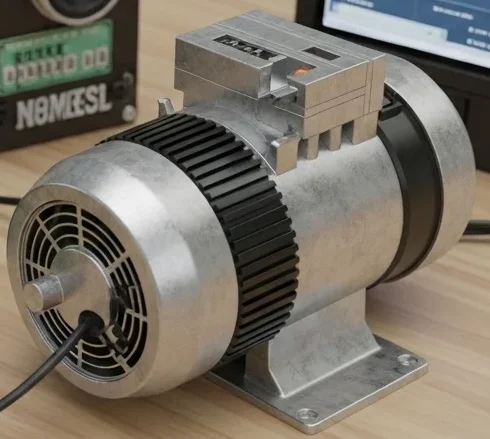
Consider a power generator in a power plant. The generator must operate at 50 Hz to match the electrical grid.
A frequency meter continuously measures the output frequency. If the generator frequency changes, engineers adjust the turbine speed to restore the correct value.
This simple measurement helps maintain stable power system operation.
3. Frequency Meter Working Principle
The working principle of a Frequency Meter is based on measuring the number of complete cycles of an electrical signal that occur within a specific period of time. Since frequency is defined as the number of cycles per second, the meter counts these cycles, calculates the frequency, and displays the result in Hertz (Hz). Modern digital frequency meters perform this process electronically with high speed and accuracy, while analog frequency meters use mechanical or electrical resonance methods.
Step-by-Step Working Process
1. Signal Input
The electrical signal whose frequency is to be measured is applied to the input terminals of the frequency meter. The signal may originate from an AC power supply, electronic circuit, generator, inverter, or communication system.
2. Signal Conditioning
Before measurement, the input signal passes through a signal conditioning circuit. This stage filters unwanted noise, limits excessive voltage, and shapes the waveform into a clean and stable signal suitable for accurate measurement.
3. Pulse Generation
The conditioned waveform is converted into a series of digital pulses. Each pulse represents one complete cycle of the input signal, allowing the electronic circuit to count the cycles accurately regardless of the original waveform shape.
4. Counting Circuit
An internal electronic counter counts the number of pulses received during a precisely controlled time interval generated by a highly accurate clock circuit. The longer the counting interval, the higher the measurement accuracy.
5. Frequency Calculation
The frequency meter calculates the frequency using the standard equation:
[
\textbf{Frequency (Hz) = \frac{\text{Number of Cycles}}{\text{Time (Seconds)}}}
]
For example, if 500 cycles are counted in 10 seconds, the frequency is:
Frequency = 500 ÷ 10 = 50 Hz
This calculation is performed automatically by the meter’s electronic circuitry or microprocessor.
6. Display Output
After completing the calculation, the measured frequency is displayed on the screen.
- Digital frequency meters show the value on an LCD or LED display with high precision.
- Analog frequency meters indicate the frequency using a moving pointer over a calibrated scale.
Key Features of the Working Principle
- Measures the number of electrical cycles per second.
- Uses signal conditioning to improve measurement accuracy.
- Converts AC waveforms into digital pulses for counting.
- Employs a precise timing circuit for accurate frequency measurement.
- Calculates frequency automatically using electronic circuitry or a microprocessor.
- Displays results in Hertz (Hz), kilohertz (kHz), or megahertz (MHz) depending on the measurement range.
The Frequency Meter working principle enables fast, accurate, and reliable frequency measurement, making these instruments essential in electrical engineering, power systems, telecommunications, industrial automation, laboratories, and electronic testing applications.
Simple Analogy
Think of frequency measurement like counting how many times a clock pendulum swings in one second.
The more swings per second, the higher the frequency.
A frequency meter simply counts these electrical “swings.”
for more detilas click Frequency Meter
4. Types of Frequency Meters
Frequency meters are available in different types based on their operating principle, measuring technology, and display method. Each type is designed for specific applications ranging from traditional power systems to modern electronic and communication equipment.
Mechanical Frequency Meter
A Mechanical Frequency Meter uses mechanical moving parts and vibration or resonance principles to measure the frequency of an alternating current (AC) supply. Although these meters have largely been replaced by electronic instruments, they are still found in some older electrical installations.
Features
- Simple and rugged construction.
- Operates without complex electronic circuits.
- Mechanical pointer or vibrating reed indication.
- Requires minimal maintenance.
- Limited measurement accuracy compared to digital meters.
Applications
- Power distribution panels.
- Older industrial electrical systems.
- Educational laboratories.
- Legacy power generation equipment.
Analog Frequency Meter
An Analog Frequency Meter measures frequency using electromagnetic principles and displays the result with a moving pointer on a calibrated dial. It provides continuous indication of frequency variations and is commonly used in industrial power systems.
Features
- Easy-to-read dial and pointer display.
- Continuous monitoring of frequency changes.
- Moderate measurement accuracy.
- Durable and reliable for industrial environments.
- Suitable for AC power frequency measurement.
Applications
- Industrial control panels.
- Generator monitoring systems.
- Electrical substations.
- Power plants.
- Motor control centers (MCCs).
Digital Frequency Meter
A Digital Frequency Meter uses electronic circuits, microprocessors, and high-precision timing systems to count electrical cycles and display the frequency digitally. It offers excellent accuracy, fast response, and easy readability, making it the most widely used type today.
Features
- High measurement accuracy.
- Digital LCD or LED display.
- Fast response and automatic calculation.
- Wide frequency measurement range.
- Low maintenance and high reliability.
- Suitable for both low- and high-frequency signals.
Applications
- Electronics testing and troubleshooting.
- Communication and telecommunication systems.
- Laboratory measurements.
- Industrial automation.
- Power system monitoring.
- Electrical maintenance and calibration.
Vibrating Reed Frequency Meter
A Vibrating Reed Frequency Meter consists of multiple metal reeds, each tuned to vibrate at a specific frequency. When connected to an AC supply, the reed matching the supply frequency vibrates with the greatest amplitude, indicating the system frequency.
Features
- Simple operating principle.
- No external power source required.
- Easy visual frequency indication.
- Highly reliable for fixed-frequency AC systems.
- Limited measurement range.
Applications
- Electrical switchboards.
- Power stations.
- Educational laboratories.
- Generator control panels.
Electronic Frequency Meter
An Electronic Frequency Meter is an advanced instrument that measures frequency using electronic counting circuits, crystal oscillators, and digital signal processing. It provides greater precision than traditional analog instruments and is suitable for a wide variety of electrical and electronic applications.
Features
- Very high measurement accuracy.
- Wide frequency range from a few hertz to several gigahertz.
- Automatic frequency calculation.
- Compact and lightweight design.
- Capable of measuring multiple signal types.
Applications
- RF and communication systems.
- Electronic circuit testing.
- Telecommunications.
- Research laboratories.
- Industrial instrumentation.
- Calibration and maintenance work.
Comparison of Frequency Meter Types
| Type | Display | Accuracy | Best Applications |
|---|---|---|---|
| Mechanical Frequency Meter | Mechanical indicator | Low | Older electrical systems |
| Analog Frequency Meter | Pointer and dial | Moderate | Industrial power monitoring |
| Digital Frequency Meter | LCD/LED display | High | Electronics, laboratories, and automation |
| Vibrating Reed Frequency Meter | Vibrating reeds | Moderate | AC power systems and switchboards |
| Electronic Frequency Meter | Digital display | Very High | Telecommunications, research, and precision testing |
Each type of Frequency Meter has its own advantages depending on the required accuracy, operating environment, and application. While mechanical and analog frequency meters are still used in some traditional power systems, digital and electronic frequency meters have become the preferred choice because of their superior accuracy, faster response, wider measurement range, and advanced diagnostic capabilities.
Resonance Frequency Meter
This type uses a resonant circuit to determine frequency.
Features
- Tuned circuits
- Accurate for specific ranges
Applications
- Radio frequency measurements
- Signal analysis
5. Main Components of a Frequency Meter
A Frequency Meter consists of several electronic and electrical components that work together to measure the frequency of an input signal accurately. Each component performs a specific function, ensuring precise counting, calculation, and display of the measured frequency.
Input Terminal
The input terminal is the point where the electrical signal is connected to the frequency meter. It receives the AC or electronic signal from the circuit, generator, power system, or electronic device being tested and passes it to the internal measurement circuitry.
Functions
- Receives the input electrical signal.
- Provides a secure connection to the circuit under test.
- Transfers the signal to the signal conditioning stage.
- Supports various voltage and frequency ranges depending on the meter design.
Signal Conditioning Circuit
The signal conditioning circuit prepares the incoming signal for accurate measurement. It removes unwanted noise, adjusts the signal level, and converts different waveform shapes into clean digital pulses that can be counted reliably.
Functions
- Filters electrical noise and interference.
- Amplifies weak input signals.
- Limits excessive input voltage.
- Converts sine, square, or triangular waveforms into digital pulses.
- Improves measurement accuracy and stability.
Counter Circuit
The counter circuit is the primary measuring section of the frequency meter. It counts the number of pulses generated from the input signal during a fixed time interval provided by the time base generator. The counted value is then used to calculate the signal frequency.
Functions
- Counts signal cycles accurately.
- Processes digital pulse inputs.
- Forms the basis of frequency calculation.
- Works with high-speed electronic counting circuits.
Time Base Generator
The time base generator provides a highly accurate reference time interval, usually generated by a crystal oscillator. Since frequency is calculated based on the number of cycles counted within a known period, the accuracy of the time base directly affects the overall accuracy of the frequency meter.
Functions
- Generates a stable timing reference.
- Controls the counting period.
- Ensures precise frequency calculations.
- Improves long-term measurement accuracy.
Frequency Calculation Circuit
After the counting process is complete, the frequency calculation circuit or microprocessor determines the frequency using the standard relationship between the number of counted cycles and the measurement time.
Functions
- Calculates the measured frequency automatically.
- Converts counted pulses into frequency values.
- Processes measurement data rapidly.
- Supports multiple frequency units such as Hz, kHz, and MHz.
Display Unit
The display unit presents the measured frequency to the user in an easy-to-read format. Modern frequency meters typically use digital displays, while older models may use analog pointer displays.
Types of Displays
- Analog dial display.
- Digital LED display.
- Digital LCD display.
- Multi-function graphical display (advanced instruments).
Functions
- Displays the measured frequency value.
- Provides clear and accurate readings.
- May show additional information such as measurement range and units.
Power Supply
The power supply provides the electrical energy required to operate the internal electronic circuits of the frequency meter. Depending on the instrument type, it may be powered by batteries, AC mains, or an external DC supply.
Functions
- Powers all internal circuits.
- Ensures stable operation.
- Maintains accurate measurements.
- Supports portable or bench-top operation depending on the meter design.
Importance of Component Integration
All the components of a Frequency Meter work together to ensure fast, accurate, and reliable frequency measurement. The input terminal receives the signal, the signal conditioning circuit cleans and prepares it, the counter circuit counts the cycles, the time base generator provides precise timing, the frequency calculation circuit computes the result, the display unit shows the measured frequency, and the power supply powers the entire system. This coordinated operation makes frequency meters indispensable instruments for electrical engineering, industrial maintenance, telecommunications, laboratory testing, and power system monitoring.
6. Frequency Meter Advantages
Frequency meters provide many benefits for electrical measurements.
Frequency Meter Advantages and Disadvantages
Advantages
- Accurate measurement of signal frequency
- Easy to operate and read
- Essential for power system monitoring
- Useful for electronic circuit testing
- Helps maintain stable electrical systems
- Available in portable digital models
These advantages make frequency meters widely used in electrical engineering.
7. Frequency Meter Disadvantages
Although frequency meters are very useful, they also have some limitations.
Disadvantages
- Some models measure only a limited frequency range
- Mechanical meters have lower accuracy
- Sensitive to electrical noise
- Digital meters require power supply
- High-precision models can be expensive
Understanding these limitations helps engineers choose the correct measuring instrument.
8. Applications of Frequency Meters
A Frequency Meter is an essential measuring instrument used in electrical, electronic, industrial, and communication systems to monitor the frequency of AC power and electronic signals. Accurate frequency measurement ensures the safe, reliable, and efficient operation of equipment across various industries.
Power Generation
Frequency meters play a vital role in power plants by continuously monitoring the frequency of electricity generated by alternators and generators. Maintaining the correct frequency is essential for synchronizing generators with the electrical grid and ensuring stable power system operation.
Applications
- Thermal power plants
- Hydroelectric power stations
- Nuclear power plants
- Diesel generator systems
- Gas turbine power plants
Benefits
- Maintains stable grid frequency.
- Prevents generator synchronization problems.
- Improves power quality and system reliability.
- Protects generators from abnormal operating conditions.
Industrial Electrical Systems
Industries use frequency meters to monitor electrical equipment and ensure that machinery operates at the correct frequency. Stable frequency improves equipment performance, efficiency, and service life.
Applications
- Electric motors
- Variable Frequency Drives (VFDs)
- Industrial transformers
- Motor control centers (MCCs)
- Manufacturing and automation systems
Benefits
- Monitors equipment performance.
- Detects abnormal frequency variations.
- Supports preventive maintenance.
- Improves production reliability.
Communication Systems
Accurate frequency measurement is critical in radio frequency (RF) and telecommunication systems, where even small frequency deviations can affect signal quality and communication reliability.
Applications
- Radio transmitters and receivers
- Wireless communication systems
- Television broadcasting
- Mobile communication networks
- Satellite communication equipment
Benefits
- Verifies signal frequency accuracy.
- Ensures reliable communication.
- Supports equipment calibration.
- Reduces signal interference.
Electronics Laboratories
Frequency meters are widely used in educational institutions, research laboratories, and electronic testing facilities to measure and verify the output frequency of various electronic circuits and instruments.
Applications
- Oscillator testing
- Signal generator calibration
- Digital circuit analysis
- Electronic troubleshooting
- Research and development
Benefits
- Provides accurate laboratory measurements.
- Supports electronic circuit design.
- Assists in equipment calibration.
- Improves testing accuracy.
Renewable Energy Systems
Renewable energy installations require continuous frequency monitoring to ensure stable power generation and smooth integration with the electrical grid.
Applications
- Wind turbines
- Solar inverters
- Hybrid renewable energy systems
- Battery energy storage systems
- Grid-connected renewable power plants
Benefits
- Maintains stable output frequency.
- Improves synchronization with the power grid.
- Enhances renewable energy reliability.
- Protects inverters and electrical equipment.
Electrical Maintenance and Troubleshooting
Maintenance engineers use frequency meters during inspection and troubleshooting to identify abnormal operating conditions in electrical systems.
Applications
- Preventive maintenance
- Equipment diagnostics
- Generator servicing
- Electrical commissioning
- Power quality analysis
Benefits
- Detects frequency-related faults quickly.
- Reduces equipment downtime.
- Improves maintenance efficiency.
- Enhances overall system reliability.
Importance of Frequency Meter Applications
The wide range of Frequency Meter applications demonstrates its importance in modern electrical and electronic engineering. Whether used in power generation, industrial automation, communication systems, electronics laboratories, renewable energy installations, or maintenance activities, frequency meters ensure accurate frequency measurement, stable equipment operation, improved power quality, and enhanced system reliability. As electrical and electronic technologies continue to advance, frequency meters remain indispensable instruments for monitoring, testing, and maintaining efficient and dependable systems.
9. Comparison: Frequency Meter vs Multimeter
Students often ask about the difference between frequency meter and multimeter.
| Feature | Frequency Meter | Multimeter |
| Primary Function | Measures frequency | Measures voltage, current, resistance |
| Accuracy | High for frequency measurement | Limited frequency measurement |
| Applications | Power systems, electronics | General electrical testing |
| Display | Dedicated frequency display | Multi-function display |
| Complexity | Specialized instrument | Multi-purpose tool |
Both tools are useful, but a frequency meter provides more precise frequency measurement.
10. Frequency Meter Selection Guide
Selecting the right Frequency Meter is essential for obtaining accurate and reliable frequency measurements. The ideal instrument depends on the application, measurement range, required accuracy, and operating environment. Considering these factors helps ensure efficient testing, troubleshooting, and system monitoring.
Frequency Range
The first factor to consider is the frequency range the meter can measure. Choose a frequency meter that covers the expected operating frequency of your application.
Typical Frequency Ranges
- Power systems: 45–65 Hz (commonly 50 Hz or 60 Hz)
- Industrial equipment: 10 Hz to several kHz
- Electronics and communication systems: kHz to MHz or even GHz
- RF and wireless applications: MHz to GHz
Selecting a meter with an appropriate measurement range ensures accurate readings without overloading the instrument.
Measurement Accuracy
Accuracy is one of the most important selection criteria.
- High-precision laboratories require frequency meters with very low measurement error.
- Industrial maintenance applications generally require moderate to high accuracy.
- Educational and training purposes can often be served by standard-accuracy instruments.
Higher accuracy provides more reliable measurements, especially during equipment calibration and research applications.
Display Type
The display should be easy to read and suitable for the working environment.
Common Display Options
- Digital LCD display
- Digital LED display
- Analog pointer display
Digital frequency meters are generally preferred because they provide precise numerical readings, reduce reading errors, and often include additional measurement functions.
Portability
Consider where the instrument will be used.
- Portable frequency meters are lightweight and ideal for field maintenance, electrical inspections, and on-site troubleshooting.
- Bench-top frequency meters offer higher precision and are better suited for laboratories, calibration centers, and research facilities.
Input Signal Compatibility
Ensure the frequency meter is compatible with the type of signal you intend to measure.
Examples include:
- AC voltage signals
- Pulse signals
- Square waves
- Sine waves
- Digital logic signals
- Radio frequency (RF) signals
Using a compatible meter improves measurement accuracy and prevents instrument damage.
Additional Features
Modern digital frequency meters often include advanced functions that improve convenience and measurement capability.
Useful features include:
- Auto-ranging
- Data hold function
- Backlit display
- Frequency and period measurement
- Min/Max recording
- USB or computer connectivity
- Automatic calibration support
These features make testing faster and improve productivity in professional applications.
Tips for Beginners
If you are purchasing your first frequency meter, keep these recommendations in mind:
- Choose a digital frequency meter for easier operation and better readability.
- Select a model with a measurement range suitable for both power systems and basic electronics.
- Look for good accuracy without paying for unnecessary advanced features.
- Prefer a portable and durable instrument for learning and field work.
- Purchase from a reputable manufacturer with proper calibration support and safety certifications.
Importance of Proper Selection
Choosing the correct Frequency Meter improves measurement accuracy, equipment reliability, and testing efficiency. The right instrument helps engineers, technicians, and students perform precise frequency measurements in power systems, industrial automation, electronics laboratories, communication networks, and renewable energy applications, ensuring safe and dependable system operation.
11. Common Problems & Solutions
Incorrect Frequency Reading
Cause:
Electrical noise or poor signal quality.
Solution:
Use proper shielding and filtering.
No Display
Cause:
Power supply failure.
Solution:
Check power connections or replace batteries.
Unstable Readings
Cause:
Weak or fluctuating signal.
Solution:
Improve signal connection or use signal conditioning.
Overload Error
Cause:
Signal frequency exceeds meter range.
Solution:
Use a meter with a higher frequency range.
12. Future Trends in Frequency Meter Technology
Advancements in digital electronics, communication technologies, and intelligent automation are transforming the capabilities of Frequency Meters. Modern instruments are becoming more accurate, compact, and connected, enabling real-time monitoring and predictive analysis across electrical and electronic systems. These innovations are expanding the role of frequency meters in industrial automation, renewable energy, telecommunications, and smart power networks.
Smart Digital Frequency Meters
Modern digital frequency meters use advanced microprocessors and digital signal processing (DSP) techniques to deliver faster and more accurate measurements than conventional instruments.
Key Features
- High-speed digital signal processing.
- Improved measurement accuracy and resolution.
- Automatic range selection.
- Multi-parameter measurement capabilities.
- Built-in data logging and storage.
Benefits
- Faster response time.
- Reduced measurement errors.
- Greater reliability in industrial applications.
- Enhanced user interface and diagnostics.
Portable Wireless Frequency Meters
Wireless communication technology is making frequency measurement more flexible and convenient. Portable frequency meters can transmit measurement data to smartphones, tablets, or computers without physical connections.
Key Features
- Bluetooth and Wi-Fi connectivity.
- Remote monitoring capabilities.
- Lightweight and portable design.
- Battery-powered operation.
- Mobile application integration.
Benefits
- Increased mobility for field engineers.
- Safer measurements in hazardous locations.
- Faster equipment inspections.
- Improved maintenance efficiency.
Integration with Smart Grids
Future smart grids will incorporate intelligent frequency meters that continuously monitor grid frequency and communicate with control centers in real time. This integration improves the stability and efficiency of modern electrical power systems.
Benefits
- Real-time frequency monitoring.
- Automatic fault detection.
- Improved grid stability.
- Better load balancing.
- Faster restoration after disturbances.
AI-Based Frequency Monitoring
Artificial Intelligence (AI) is becoming an important tool for analyzing frequency data and identifying abnormal operating conditions before they lead to equipment failures.
Advantages
- Predictive fault detection.
- Automated frequency trend analysis.
- Early warning of system abnormalities.
- Reduced equipment downtime.
- Improved preventive maintenance planning.
Cloud-Based Data Analysis
Cloud computing enables frequency measurement data to be stored, accessed, and analyzed from anywhere. Engineers can monitor electrical systems remotely and use historical data to improve system performance.
Features
- Secure cloud data storage.
- Remote access to measurement records.
- Historical trend analysis.
- Automatic report generation.
- Multi-site monitoring from a central location.
Benefits
- Improved maintenance planning.
- Better decision-making using real-time data.
- Reduced operating costs.
- Enhanced collaboration between maintenance teams.
Internet of Things (IoT) Integration
IoT technology is enabling frequency meters to communicate directly with other smart devices and industrial control systems. Connected sensors provide continuous monitoring and support automated maintenance strategies.
Applications
- Industrial automation systems.
- Smart manufacturing plants.
- Renewable energy monitoring.
- Building energy management systems.
- Remote electrical substations.
Future Outlook
The future of Frequency Meter technology is moving toward smart digital instruments, wireless communication, artificial intelligence, cloud computing, IoT connectivity, and smart grid integration. These innovations will provide more accurate measurements, real-time monitoring, predictive maintenance, and automated fault detection, making frequency meters even more valuable in electrical engineering, industrial automation, telecommunications, renewable energy systems, and modern power networks. As technology continues to evolve, the applications of frequency meters will expand further, supporting safer, more efficient, and more intelligent electrical systems.
13. Conclusion
A Frequency Meter is an essential instrument for measuring the frequency of electrical signals in power systems, electronics, and communication networks. Maintaining correct frequency levels is critical for the safe and efficient operation of electrical equipment.
In this article, we discussed the Frequency Meter working principle, different types, and the main components that allow accurate frequency measurement. We also explored practical Frequency Meter applications in power plants, industrial systems, communication networks, and electronic laboratories.
Understanding the Frequency Meter advantages and disadvantages helps engineers and technicians choose the right instrument for their measurement needs. Whether used in a power station, laboratory, or industrial plant, frequency meters play a key role in maintaining stable and reliable electrical systems.
For students and beginners, learning how frequency meters work provides a strong foundation for studying electrical measurements and signal analysis in modern engineering.