
When you switch on a ceiling fan or plug in a charger, you probably don’t think about how often the electricity changes direction inside the wires. Yet, this hidden factor—electrical frequency—plays a critical role in how your devices operate.
For example, if a machine designed for 50 Hz is connected to a 60 Hz supply, it may run faster, overheat, or even fail. This shows how important frequency is in electrical systems.
Understanding what is electrical frequency is essential for students, engineers, and technicians. It helps in designing circuits, selecting equipment, and maintaining system stability. Frequency affects motors, transformers, power systems, and even communication technologies.
In this article, you will learn electrical frequency in a simple and practical way. We will cover its definition, working principle, types, applications, advantages and disadvantages, and troubleshooting tips. By the end, you will clearly understand how frequency influences electrical systems and why it matters in real-world applications.
2. What Is Electrical Frequency? Definition, Unit, Working Principle, and Practical Example
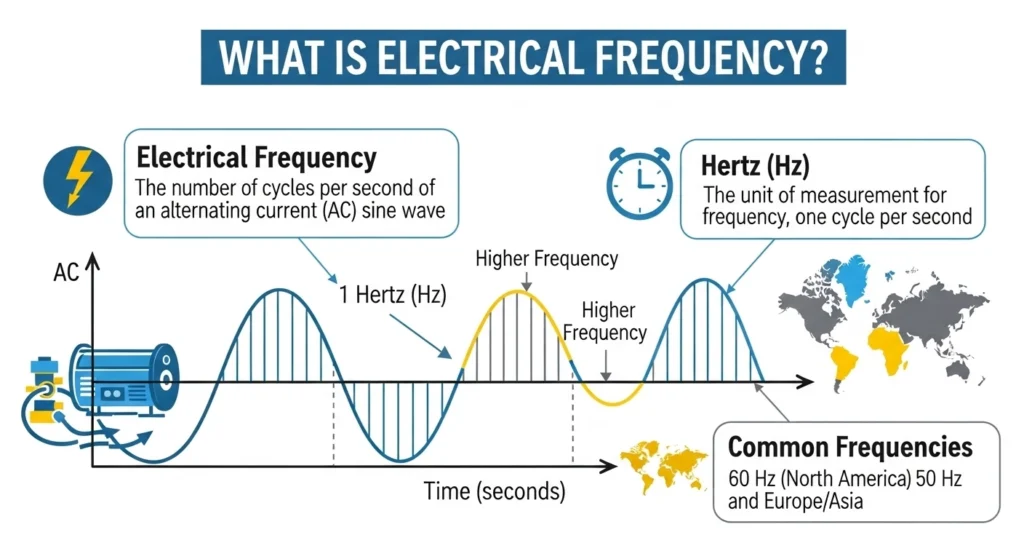
Electrical frequency is the number of complete cycles of an alternating current (AC) or alternating voltage that occur in one second. It indicates how quickly the current changes direction during AC operation. Frequency is one of the most important electrical parameters because it affects the performance, efficiency, and synchronization of electrical equipment such as generators, transformers, motors, and power systems.
The SI unit of electrical frequency is Hertz (Hz), named after the German physicist Heinrich Hertz. One Hertz means one complete cycle per second.
In modern power systems, maintaining the correct frequency is essential for stable operation. Even a small deviation from the standard frequency can affect electrical equipment and the overall reliability of the power grid.
Definition
Electrical frequency is the number of complete AC cycles that occur in one second. It is measured in Hertz (Hz), where:
- 1 Hz = 1 cycle per second (cps)
The relationship between frequency and time period is:
- Frequency (f) = 1 / Time Period (T)
Where:
- f = Frequency (Hz)
- T = Time period (seconds)
Simple Explanation
Unlike direct current (DC), which flows continuously in one direction, alternating current (AC) continuously changes its direction. During each cycle, the current flows in the positive direction, returns to zero, flows in the negative direction, and then returns to zero again.
This complete forward-and-backward movement is called one cycle.
The number of these complete cycles occurring every second is called the electrical frequency. A higher frequency means the current changes direction more rapidly, while a lower frequency means it changes direction more slowly.
Practical Example
Electrical frequency standards vary around the world:
- 50 Hz is the standard frequency in countries such as the United Kingdom, India, Pakistan, Saudi Arabia, Australia, and most of Europe.
- 60 Hz is the standard frequency in countries such as the United States, Canada, Mexico, and parts of South America.
This means:
- In a 50 Hz power system, the alternating current completes 50 full cycles every second.
- In a 60 Hz power system, the alternating current completes 60 full cycles every second.
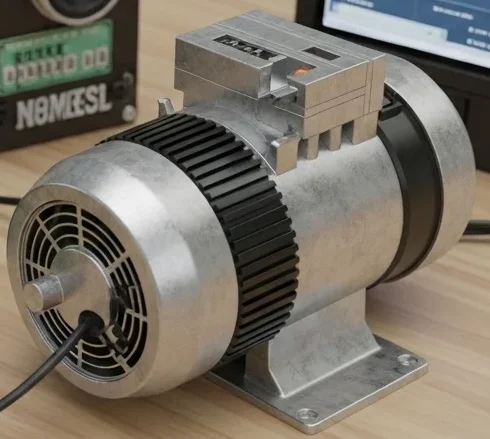
For example, if an AC motor is designed to operate at 50 Hz, connecting it to a 60 Hz supply without proper design considerations may change its operating speed and performance. This is why electrical equipment is manufactured to match the frequency of the country’s power system.
Key Points
- Electrical frequency is the number of AC cycles completed in one second.
- It is measured in Hertz (Hz).
- 1 Hz = 1 complete cycle per second.
- Standard power system frequencies are 50 Hz and 60 Hz.
- Frequency affects the operation of motors, generators, transformers, clocks, and other AC electrical equipment.
- Maintaining a stable frequency is essential for the safe and reliable operation of electrical power systems.
Working Principle
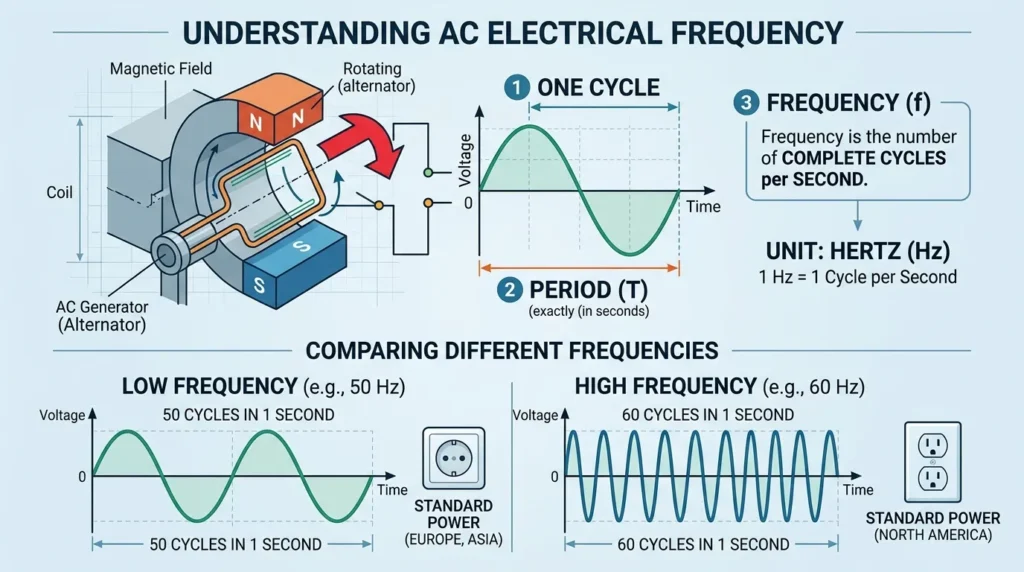
The electrical frequency working principle is based on the generation of alternating voltage and current.Electrical frequency is the rate at which an alternating current (AC) completes one full cycle in one second. It is measured in Hertz (Hz), where 1 Hz equals one cycle per second. The frequency is determined by the rotational speed of the AC generator and the number of magnetic poles in the generator. As the generator rotates, it produces alternating voltage and current that continuously change direction. The faster the generator rotates, the higher the frequency of the generated AC power. A constant electrical frequency is essential for the proper operation of electrical equipment such as motors, transformers, generators, clocks, and electronic devices. Maintaining the standard frequency ensures efficient performance, stable power supply, and reliable operation of the entire electrical system.
Step-by-Step Explanation
A generator rotates a coil inside a magnetic field
This rotation produces alternating voltage
The voltage rises, falls, and reverses direction
Each complete wave is one cycle
The number of cycles per second is the frequency
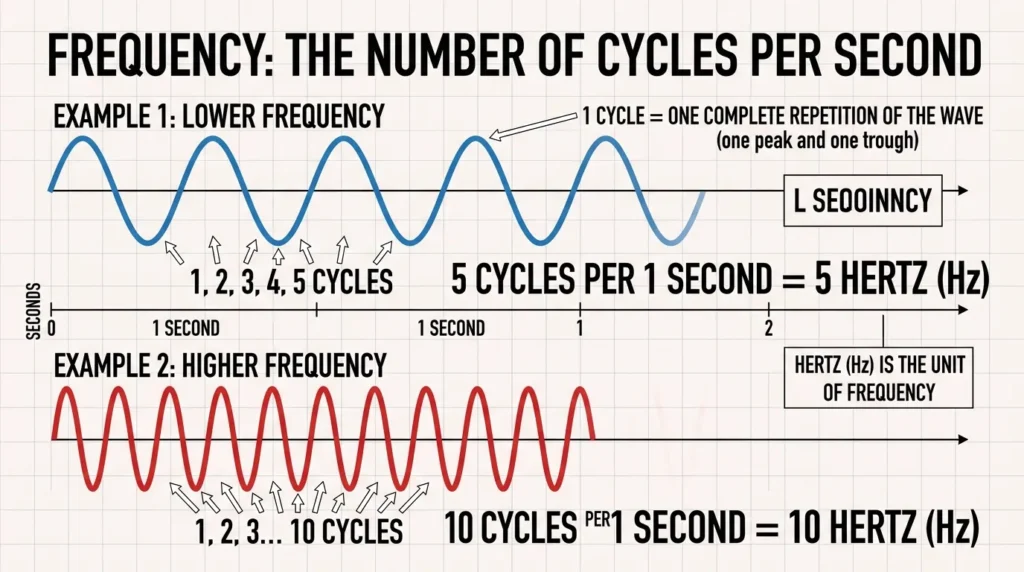
Frequency is the number of complete cycles or oscillations of an alternating current (AC) or wave that occur in one second. It is measured in Hertz (Hz), where 1 Hz equals one cycle per second. In an AC electrical system, the voltage and current continuously change direction, and each complete change is called a cycle. The frequency determines how fast these cycles occur. For example, a 50 Hz power supply completes 50 cycles every second, while a 60 Hz supply completes 60 cycles every second. Frequency is an important parameter in electrical power systems because it affects the operation and performance of electrical equipment such as motors, transformers, and generators.
Easy Analogy
Think of a pendulum swinging:
- One full swing (left to right and back) = one cycle
- Number of swings per second = frequency
Key Points
- Frequency depends on generator speed
- Higher speed = higher frequency
- Stable frequency is important for system performance
Types / Classification
Types of Electrical Frequency
Standard Power Frequency
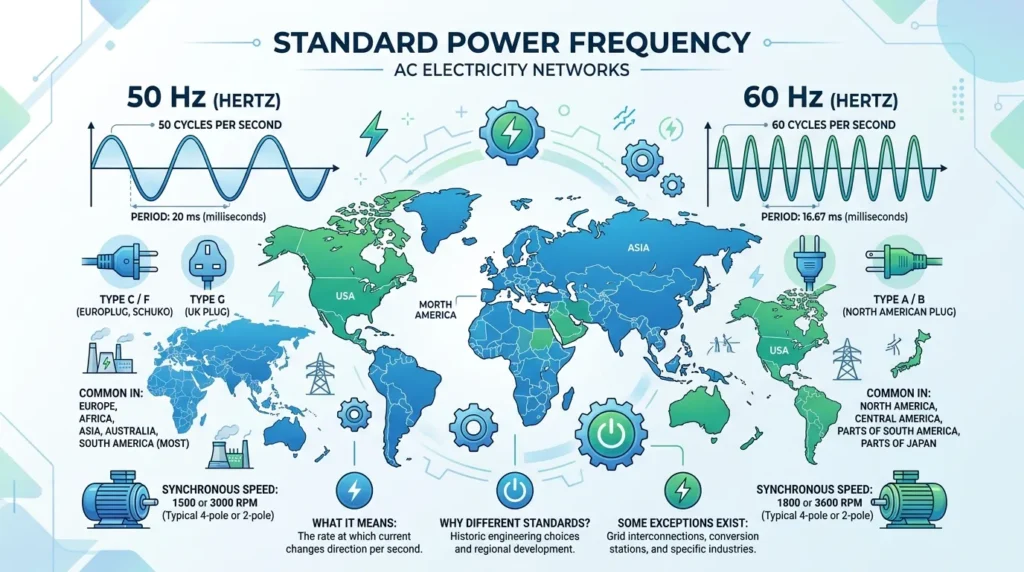
Standard power frequency is the fixed frequency at which alternating current (AC) electrical power is generated, transmitted, and distributed in a power system. It represents the number of AC cycles completed in one second and is measured in Hertz (Hz). Most countries use a standard frequency of 50 Hz, while others, such as the United States, Canada, and parts of Japan, use 60 Hz. Maintaining the standard power frequency is essential for the efficient and reliable operation of electrical equipment such as motors, transformers, generators, clocks, and household appliances. Any significant deviation from the standard frequency can reduce equipment performance, cause overheating, and affect the stability of the electrical power system.
- Used in power systems
- Common values: 50 Hz and 60 Hz
- Used in homes and industries
Low Frequency
- Below 50 Hz
- Used in special applications like traction systems
High Frequency
- Above 60 Hz
- Used in communication systems and electronics
Variable Frequency
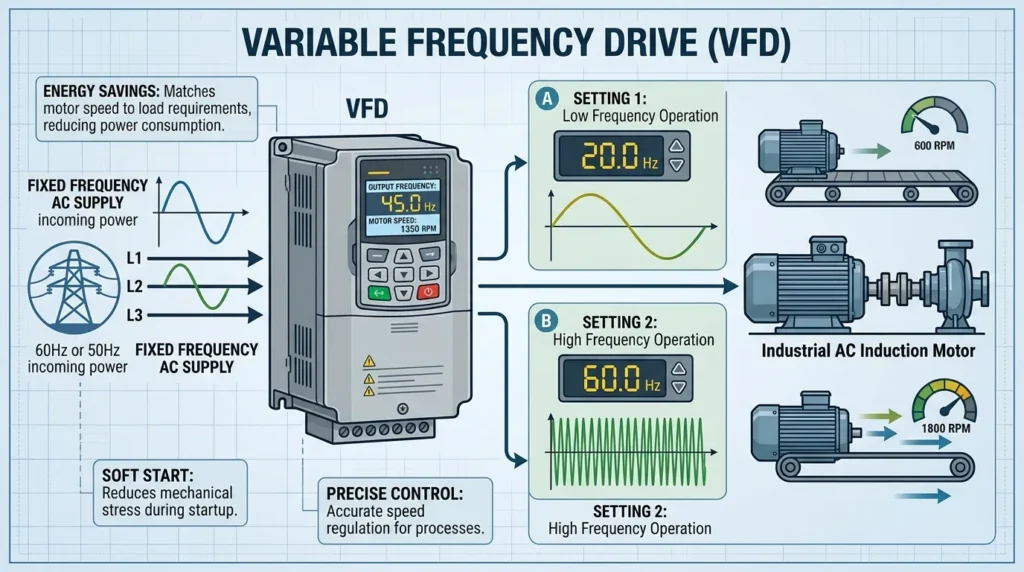
Variable frequency refers to an AC power supply whose frequency can be adjusted according to the requirements of the electrical system or equipment. Unlike a standard fixed frequency of 50 Hz or 60 Hz, variable frequency allows the output frequency to be increased or decreased to control the speed and performance of AC motors. This is commonly achieved using a Variable Frequency Drive (VFD), which converts the incoming AC power into DC and then produces AC power at the desired frequency. Variable frequency is widely used in industrial machines, pumps, fans, compressors, conveyors, and HVAC systems to improve energy efficiency, provide smooth motor starting, reduce mechanical stress, and achieve precise speed control.
- Frequency can be adjusted
- Used in motor speed control systems
4. Main Components Involved in Electrical Frequency Control
Electrical frequency remains stable only when several components work together in a power system. These components generate electrical power, regulate generator speed, measure frequency, balance electrical load, and maintain the standard operating frequency. Proper coordination among these components ensures reliable and efficient operation of the entire electrical grid.
1. Generator
The generator is the primary source of alternating current (AC) in a power system. It converts mechanical energy supplied by a turbine into electrical energy through electromagnetic induction.
The frequency produced by a generator depends mainly on its rotational speed and the number of magnetic poles. Therefore, maintaining the correct generator speed is essential for producing the required frequency.
Functions
- Generates alternating current (AC)
- Produces electrical frequency
- Converts mechanical energy into electrical energy
- Supplies power to the electrical grid
Example
A generator designed to operate at 3000 RPM with two poles produces 50 Hz, while the same generator operating at 3600 RPM produces 60 Hz.
2. Turbine
A turbine provides the mechanical energy required to rotate the generator. Depending on the power plant, the turbine may be driven by steam, water, natural gas, wind, or other energy sources.
Since generator frequency depends directly on rotational speed, controlling the turbine speed is one of the most important methods of maintaining a stable electrical frequency.
Functions
- Drives the generator shaft
- Controls generator rotational speed
- Maintains constant electrical frequency
- Balances power generation with load demand
Types of Turbines
- Steam turbine
- Gas turbine
- Hydro turbine
- Wind turbine
3. Frequency Meter
A frequency meter is an electrical measuring instrument used to measure the frequency of an alternating current (AC) supply. It determines how many electrical cycles occur in one second and displays the value in Hertz (Hz).
The meter detects the alternating waveform of the input voltage or current and accurately calculates its frequency. Frequency meters are widely installed in power stations, substations, industrial plants, laboratories, switchgear panels, and electrical distribution systems.
Accurate frequency measurement helps maintain power system stability and ensures that electrical equipment operates within its designed frequency range.
Functions
- Measures AC frequency
- Displays frequency in Hertz (Hz)
- Monitors power system performance
- Detects abnormal frequency variations
- Helps maintain grid stability
4. Electrical Load
The electrical load includes all equipment and appliances that consume electrical power from the supply system.
As consumers switch electrical equipment ON or OFF, the total system load changes. If the load suddenly increases, generators slow down slightly, causing the system frequency to decrease. Likewise, when the load decreases, generator speed and frequency may increase.
Balancing generation and load is essential for maintaining a constant frequency.
Functions
- Consumes electrical energy
- Influences generator speed
- Affects system frequency and stability
- Determines overall power demand
5. Frequency Control System
The frequency control system continuously monitors the electrical frequency and automatically adjusts generator output to maintain the standard frequency.
Modern power plants use advanced automatic control systems, governors, and digital controllers to balance power generation with changing electrical demand.
Functions
- Monitors system frequency continuously
- Adjusts turbine and generator speed
- Balances power generation and load
- Prevents frequency fluctuations
- Maintains reliable grid operation
Overall Function of These Components
Together, the generator, turbine, frequency meter, electrical load, and frequency control system ensure that electrical frequency remains stable and within safe operating limits. Maintaining a constant frequency improves power quality, protects electrical equipment, and ensures the reliable operation of the electrical power system.
5. Advantages of Electrical Frequency
Maintaining the correct electrical frequency is essential for the efficient operation of power systems and electrical equipment. A stable frequency improves power quality, enhances equipment performance, and ensures reliable electricity distribution.
5. Advantages of Electrical Frequency
Maintaining the correct electrical frequency is essential for the safe, efficient, and reliable operation of electrical power systems. A stable frequency ensures that generators, transformers, motors, transmission lines, and electrical appliances perform according to their design specifications. It also improves power quality, reduces energy losses, extends equipment lifespan, and supports the stable operation of the electrical grid.
The following are the major advantages of maintaining the correct electrical frequency.
1. Ensures Smooth Operation of AC Systems
A constant electrical frequency allows AC motors, generators, transformers, and other alternating current equipment to operate smoothly and efficiently. Stable frequency prevents irregular operation, excessive vibration, and overheating, ensuring continuous and reliable performance in both residential and industrial applications.
Benefits
- Smooth equipment operation
- Reduced mechanical stress
- Better performance
- Increased reliability
2. Improves Power Transmission Efficiency
Standard electrical frequencies of 50 Hz and 60 Hz enable efficient generation, transmission, and distribution of electrical energy over long distances. Maintaining the correct frequency minimizes operational problems and helps utilities deliver a stable power supply to consumers.
Benefits
- Efficient power distribution
- Reduced transmission losses
- Improved power quality
- Reliable electricity supply
3. Allows Generator Synchronization
In large power stations, multiple generators operate together to meet varying electricity demands. For successful synchronization, all generators must operate at the same voltage, frequency, and phase sequence.
Maintaining a stable frequency allows generators to share electrical loads safely without causing instability or equipment damage.
Benefits
- Safe generator synchronization
- Better load sharing
- Increased grid reliability
- Continuous power generation
4. Essential for AC Motor Operation
The operating speed of many AC motors is directly related to the supply frequency. If the frequency changes, the motor speed also changes, affecting machine performance and efficiency.
Maintaining the correct frequency ensures:
- Accurate motor speed
- Proper torque production
- Reduced overheating
- Longer motor life
- Higher operational efficiency
This is especially important in industries using pumps, compressors, fans, conveyors, and manufacturing equipment.
5. Maintains Power System Stability
One of the most important advantages of electrical frequency is maintaining the stability of the entire power system.
A stable frequency indicates that electrical generation and electrical demand are balanced. If frequency remains within acceptable limits, the electrical grid operates safely and reliably.
Benefits
- Reduces the risk of blackouts
- Prevents system instability
- Improves grid reliability
- Supports continuous electricity supply
6. Standardization Simplifies Equipment Design
Most countries use standardized electrical frequencies of 50 Hz or 60 Hz. This international standardization allows manufacturers to design electrical equipment that complies with regional power systems.
Standard frequencies provide:
- Easier equipment manufacturing
- Better compatibility
- Simplified installation
- Lower production costs
- Improved global equipment availability
7. Improves Equipment Reliability
Electrical equipment performs best when supplied with its rated frequency. Operating within the specified frequency range reduces electrical and mechanical stress on components.
Stable frequency helps:
- Increase equipment lifespan
- Reduce overheating
- Minimize unexpected failures
- Lower maintenance costs
- Improve operational safety
This results in higher reliability for household appliances, industrial machinery, and commercial electrical systems.
8. Supports Energy Efficiency
Maintaining the correct frequency helps electrical machines operate at their optimum efficiency. Motors, transformers, and generators consume less energy when operating under proper frequency conditions, reducing electricity costs and improving overall system efficiency.
Benefits
- Lower energy consumption
- Reduced operating costs
- Improved machine efficiency
- Better resource utilization
9. Enhances Power Quality
Stable electrical frequency is an important factor in maintaining good power quality. It ensures that sensitive electronic equipment, computers, medical devices, and communication systems receive a consistent and reliable power supply.
Benefits
- Fewer power disturbances
- Reliable operation of sensitive equipment
- Reduced electrical noise
- Improved system performance
10. Supports Modern Technologies
Many modern technologies rely on precise frequency control for efficient operation. Applications such as Variable Frequency Drives (VFDs), renewable energy systems, smart grids, industrial automation, robotics, and communication networks require stable frequency to achieve maximum performance and reliability.
Benefits
- Improved automation
- Better renewable energy integration
- Enhanced industrial productivity
- Reliable smart grid operation
The correct electrical frequency is fundamental to every AC power system. It ensures the efficient operation of electrical equipment, improves power quality, supports reliable electricity transmission, enables generator synchronization, increases equipment lifespan, reduces maintenance costs, and enhances the overall stability and efficiency of modern electrical power systems.
6. Disadvantages and Limitations of Electrical Frequency
Although electrical frequency is essential for AC power systems, it also presents several challenges that require continuous monitoring and control.
1. Frequency Variations Can Damage Equipment
Large deviations from the rated frequency may cause overheating, reduced efficiency, vibration, or malfunction in motors, transformers, generators, and electronic equipment.
2. Requires Continuous Monitoring
Power system operators must constantly monitor frequency to maintain grid stability and prevent equipment damage.
3. Difficult to Maintain During System Disturbances
Sudden changes in electrical load, generator failures, or transmission faults can make it difficult to maintain a constant frequency.
4. Sensitive to Load Changes
An increase in electrical load tends to reduce system frequency, while a decrease in load may increase it. Continuous balancing is required.
5. High-Frequency Systems Require Specialized Design
Electrical equipment designed for higher frequencies often requires special materials, insulation, and cooling methods, increasing manufacturing costs.
6. Synchronization Challenges
Multiple generators can only operate together if they maintain identical voltage, frequency, and phase sequence, making synchronization more complex.
7. Applications of Electrical Frequency
Electrical frequency is a fundamental parameter in almost every electrical and electronic system. It plays a vital role in power generation, transmission, industrial automation, consumer electronics, and communication systems.
Home Applications
Electrical frequency is used in almost every household appliance.
Examples include:
- Ceiling fans
- Refrigerators
- Air conditioners
- Washing machines
- Microwave ovens
- Water pumps
- Television systems
- Household power supply
Maintaining the correct frequency ensures efficient and safe operation of these appliances.
Industrial Applications
Industries rely on stable electrical frequency for continuous production and reliable machine operation.
Applications include:
- AC induction motors
- Motor control systems
- Manufacturing machinery
- Conveyor systems
- Industrial pumps
- Compressors
- Power plants
- Industrial automation
Stable frequency improves production efficiency and reduces equipment failures.
Modern Technology Applications
Modern electrical and electronic technologies depend heavily on accurate frequency control.
Applications include:
- Variable Frequency Drives (VFDs)
- Renewable energy systems
- Solar power inverters
- Wind power generation
- Communication systems
- Radio and television broadcasting
- Computer power supplies
- Signal processing equipment
- Medical electronics
- Smart electrical grids
Frequency control enables efficient energy management, precise motor speed control, and reliable operation of advanced electronic systems.
Why Electrical Frequency Is Important
Electrical frequency is one of the most important parameters in an AC power system. It ensures the proper operation of generators, motors, transformers, transmission networks, communication equipment, and modern electronic devices. Maintaining a stable frequency improves power quality, enhances equipment performance, increases system reliability, and supports the safe and efficient operation of electrical and electronic systems worldwide.
Comparison Section
Difference Between Frequency and Time Period
| Feature | Frequency | Time Period |
| Definition | Cycles per second | Time for one cycle |
| Unit | Hertz (Hz) | Seconds (s) |
| Relation | f = 1/T | T = 1/f |
| Example | 50 Hz | 0.02 s |
This table explains the difference between frequency and time period, which are closely related concepts.
8. Electrical Frequency Selection Guide: How to Choose the Right Frequency
Selecting the correct electrical frequency is essential for the safe and efficient operation of electrical equipment. Every electrical device is designed to operate at a specific frequency, and using the wrong frequency can reduce performance, cause overheating, increase energy consumption, or even damage the equipment.
The choice between standard frequency and variable frequency depends on the application, type of equipment, and operational requirements.
Use Standard Frequency When
Standard frequencies of 50 Hz or 60 Hz are suitable for applications that require a constant and stable power supply.
Common Applications
- Household electrical appliances
- Residential power distribution
- Commercial buildings
- Office equipment
- Lighting systems
- Electrical transmission and distribution networks
- Power generation stations
- Standard industrial machinery
Benefits
- Reliable and stable operation
- Compatible with most electrical equipment
- Simplifies equipment design and maintenance
- Ensures proper synchronization of generators and power systems
Use Variable Frequency When
Variable frequency is used when the speed or output of an electric motor needs to be controlled. This is usually achieved using a Variable Frequency Drive (VFD), which adjusts the supply frequency to match the required motor speed.
Common Applications
- Conveyor systems
- Pumps
- Fans and blowers
- Compressors
- HVAC systems
- Elevators and escalators
- CNC machines
- Industrial automation
- Renewable energy systems
Benefits
- Precise motor speed control
- Improved energy efficiency
- Reduced starting current
- Lower mechanical wear and tear
- Increased equipment lifespan
- Better process control
9. Electrical Frequency Selection Guide: How to Choose the Right Operating Frequency
Choosing the correct electrical frequency is essential for the safe, reliable, and efficient operation of electrical equipment. Every motor, transformer, generator, and electronic device is designed to operate at a specific frequency. Using an incorrect frequency can reduce efficiency, affect performance, shorten equipment life, and even cause permanent damage.
Whether you are designing a residential electrical system, installing industrial equipment, or selecting a motor control system, understanding frequency requirements helps ensure reliable operation and compliance with electrical standards.
Selection Tips for Beginners
If you are new to electrical engineering or power systems, the following practical guidelines will help you select and maintain the correct operating frequency.
1. Match the Device Frequency Rating
Always check the equipment nameplate before connecting it to the electrical supply. Manufacturers specify the operating frequency to ensure the equipment performs safely and efficiently.
For example:
- A 50 Hz motor should normally operate on a 50 Hz supply.
- A 60 Hz motor should normally operate on a 60 Hz supply unless the manufacturer specifically approves dual-frequency operation.
Using the correct frequency ensures proper motor speed, cooling, efficiency, and overall performance.
2. Avoid Frequency Mismatch
Operating electrical equipment on the wrong frequency can lead to several operational problems.
Possible Effects
- Motor overheating
- Reduced efficiency
- Incorrect motor speed
- Excessive vibration
- Increased energy consumption
- Equipment malfunction
- Reduced service life
- Premature insulation failure
Always verify that the power supply frequency matches the equipment manufacturer’s specifications before installation.
3. Use Proper Frequency Control Equipment
Many industrial applications require variable motor speeds rather than a fixed operating frequency. In these cases, suitable frequency control devices should be installed.
Common Frequency Control Devices
- Variable Frequency Drives (VFDs)
- Electronic motor controllers
- PLC-based automation systems
- Digital motor protection relays
- Soft starters with integrated control
These devices regulate frequency accurately, improve motor performance, reduce starting current, save energy, and protect equipment from abnormal operating conditions.
4. Monitor Frequency Regularly
Continuous frequency monitoring helps maintain power system stability and detect abnormal operating conditions before they become serious problems.
Common Measuring Instruments
- Frequency meters
- Digital multimeters with frequency measurement
- Power quality analyzers
- Smart energy monitoring systems
- SCADA monitoring systems
Routine monitoring is especially important in power plants, substations, industrial facilities, and renewable energy systems, where even small frequency deviations can affect equipment performance.
5. Consider the Application Requirements
Different electrical applications require different frequency characteristics.
Use Standard Frequency (50 Hz or 60 Hz) For:
- Household appliances
- Residential power systems
- Commercial buildings
- Lighting systems
- Standard industrial equipment
- Electrical transmission and distribution
Use Variable Frequency For:
- Motor speed control
- Pumps
- Fans
- Compressors
- Conveyor systems
- HVAC equipment
- Industrial automation
- Energy-saving applications
Selecting the appropriate frequency improves both system performance and energy efficiency.
6. Follow National and International Standards
Always use equipment designed for the standard frequency used in your country and follow recognized electrical standards such as:
- IEC (International Electrotechnical Commission)
- IEEE (Institute of Electrical and Electronics Engineers)
- NEMA (National Electrical Manufacturers Association)
Compliance with these standards ensures compatibility, safety, and reliable operation.
Quick Selection Checklist
Before selecting electrical equipment or designing a power system, verify the following:
- ✔ Check the equipment nameplate for the rated frequency.
- ✔ Match the supply frequency with the equipment specification.
- ✔ Use 50 Hz or 60 Hz for standard AC power systems.
- ✔ Install a Variable Frequency Drive (VFD) when adjustable motor speed is required.
- ✔ Avoid operating equipment at an incorrect frequency.
- ✔ Monitor system frequency regularly.
- ✔ Follow applicable IEC, IEEE, or NEMA standards.
- ✔ Perform routine maintenance and periodic frequency testing.
Selecting the correct electrical frequency improves equipment efficiency, extends service life, reduces maintenance costs, and ensures reliable operation of electrical systems.
10. Common Electrical Frequency Problems and Solutions
Electrical frequency problems can affect the performance of generators, motors, transformers, and other electrical equipment. Identifying these problems early and applying the correct solution helps maintain system stability and prevents costly failures.
1. What Happens If the Frequency Is Too High?
When the electrical frequency rises above its rated value, equipment may operate faster than intended. Motors can overspeed, generators may experience increased mechanical stress, and sensitive electronic devices may not function correctly.
Possible Problems
- Motors run faster than their rated speed.
- Increased mechanical wear.
- Equipment overheating.
- Reduced equipment lifespan.
- Unstable power system operation.
Solutions
- Use automatic frequency control systems.
- Adjust generator speed using the governor.
- Reduce excess power generation.
- Monitor system frequency continuously.
2. What Happens If the Frequency Is Too Low?
A decrease in electrical frequency usually indicates that electrical demand is greater than the available generation. Motors may lose torque, slow down, or even stall under heavy loads.
Possible Problems
- Reduced motor speed.
- Motor overheating due to increased current.
- Poor equipment performance.
- Generator instability.
- Possible system shutdown during severe frequency drops.
Solutions
- Maintain proper generator speed.
- Increase power generation when demand rises.
- Reduce unnecessary electrical loads.
- Use automatic load shedding if required.
3. Why Does Electrical Frequency Fluctuate?
Frequency fluctuations occur whenever electrical generation and electrical demand are not balanced.
Common Causes
- Sudden increase in electrical load.
- Generator failure.
- Renewable energy output variations.
- Transmission system faults.
- Poor governor response.
- Inadequate frequency regulation.
Solutions
- Install automatic frequency control (AFC) systems.
- Improve generator governor performance.
- Maintain proper load balancing.
- Use energy storage systems where appropriate.
- Continuously monitor the electrical grid.
4. How Do You Measure Electrical Frequency?
Electrical frequency can be measured using several instruments depending on the application.
Common Measuring Devices
- Frequency meter
- Digital multimeter with frequency function
- Oscilloscope
- Power quality analyzer
- Smart electrical monitoring systems
Most industrial facilities continuously monitor frequency to maintain power quality and system reliability.
5. Why Is Frequency Stability Important?
A stable electrical frequency ensures that all connected equipment operates safely and efficiently.
Benefits of Stable Frequency
- Protects motors and generators.
- Prevents overheating.
- Improves equipment lifespan.
- Maintains power quality.
- Ensures reliable grid operation.
- Reduces maintenance costs.
11. Future Trends in Electrical Frequency Control
Electrical frequency control is advancing rapidly with the adoption of smart technologies, renewable energy, digital automation, and artificial intelligence. Future power systems will rely on intelligent monitoring and automatic control to maintain stable frequency under changing operating conditions.
1. Smart Grids with Automatic Frequency Control
Modern smart grids use intelligent communication systems and advanced automation to monitor electricity generation and demand in real time.
Advantages
- Automatic frequency regulation
- Faster fault detection
- Improved grid reliability
- Better load balancing
- Reduced power outages
2. Renewable Energy Integration
As solar and wind power continue to expand, maintaining frequency becomes more challenging because renewable energy sources produce variable power output.
Future electrical grids will use advanced frequency control techniques to integrate renewable energy while maintaining system stability.
Benefits
- Improved renewable energy utilization
- Better grid stability
- Lower carbon emissions
- Increased energy reliability
3. Advanced Frequency Monitoring Systems
Modern monitoring systems use digital sensors, IoT devices, and cloud-based platforms to continuously measure and analyze system frequency.
Features
- Real-time monitoring
- Remote access
- Automatic fault detection
- Data logging
- Predictive maintenance
- Performance analytics
4. Power Electronics for Frequency Control
Power electronic devices are becoming essential for controlling electrical frequency in modern power systems.
Examples
- Variable Frequency Drives (VFDs)
- Grid-connected inverters
- Static frequency converters
- Flexible AC Transmission Systems (FACTS)
These technologies provide precise frequency regulation while improving energy efficiency and power quality.
5. Growth of Variable Frequency Drives (VFDs)
The use of Variable Frequency Drives (VFDs) continues to grow in residential, commercial, and industrial applications.
Benefits
- Precise motor speed control
- Lower energy consumption
- Reduced starting current
- Longer motor life
- Improved process automation
- Reduced maintenance costs
6. Artificial Intelligence and Predictive Frequency Control
Artificial Intelligence (AI) is expected to play a major role in future power systems.
AI-based frequency control systems can:
- Predict frequency deviations before they occur.
- Automatically balance electrical loads.
- Optimize generator operation.
- Improve renewable energy integration.
- Reduce the risk of blackouts.
The Future of Electrical Frequency Control
The future of electrical frequency control focuses on smart grids, AI-driven automation, renewable energy integration, advanced monitoring systems, and intelligent power electronics. These technologies will provide greater frequency stability, higher energy efficiency, improved equipment reliability, and a more resilient electrical grid capable of meeting the growing demands of modern power systems.
Conclusion
Understanding what is electrical frequency is essential for anyone working with electrical systems. It defines how often current changes direction and directly affects the performance of equipment.
From power generation to modern electronics, frequency plays a critical role. Maintaining stable frequency ensures safe and efficient operation of systems.
By learning its working principle, types, applications, and limitations, you can better analyze and design electrical systems. Continue practicing and observing real-world systems to strengthen your understanding.