
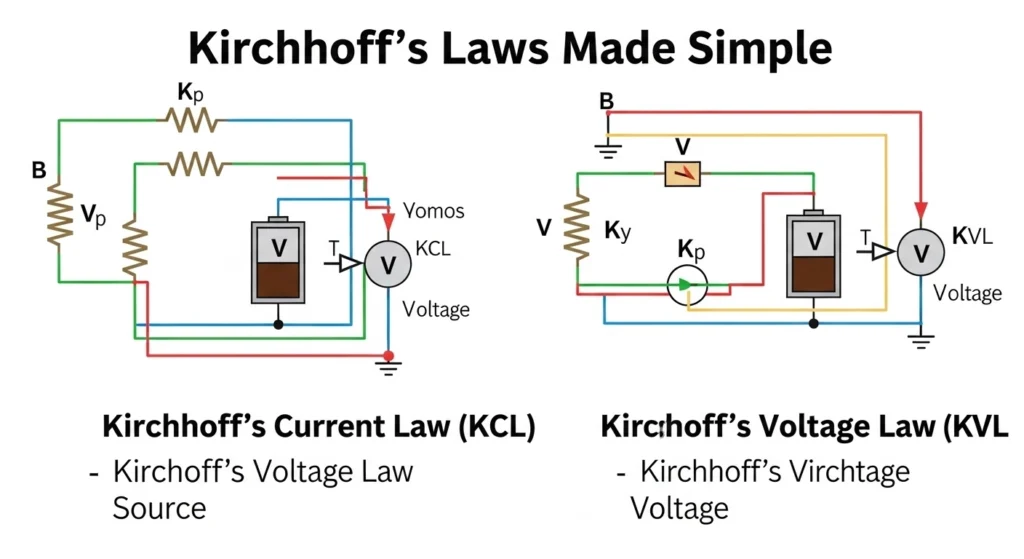

Imagine you are troubleshooting a circuit in your home. A light is not turning on, even though power is available. You check the wires, switches, and connections—but how do you logically analyze where the problem lies? This is where Kirchhoff’s Laws become essential.
In electrical engineering, circuits can become complex very quickly. Without a systematic method, understanding how current and voltage behave is difficult. Kirchhoff’s Laws provide a simple yet powerful way to analyze any electrical circuit, whether small or large.
These laws are fundamental for students, engineers, and technicians. They help you calculate unknown currents, voltages, and power in a circuit accurately.
In this article, you will learn Kirchhoff’s Laws made simple, including their working principle, types, applications, advantages and disadvantages, and practical troubleshooting techniques. By the end, you will be confident in applying these laws to real-world electrical problems.
What is Kirchhoff’s Laws Made Simple?
Kirchhoff’s Laws are two basic rules used to analyze electrical circuits. They are based on the conservation of energy and charge.
Simple Definition:
Kirchhoff’s Laws state that:
- The total current entering a junction equals the total current leaving it.
- The total voltage around any closed loop is zero.
These laws were introduced by German physicist Gustav Kirchhoff.
Simple Explanation:
Think of electricity like water flowing in pipes:
- Current is like water flow.
- Voltage is like pressure.
Kirchhoff’s Laws help us track how this “flow” behaves in a circuit.
Practical Example:
If three wires meet at a point:
- 5A enters
- 2A and 3A leave
The total current is balanced:
5A = 2A + 3A
Working Principle
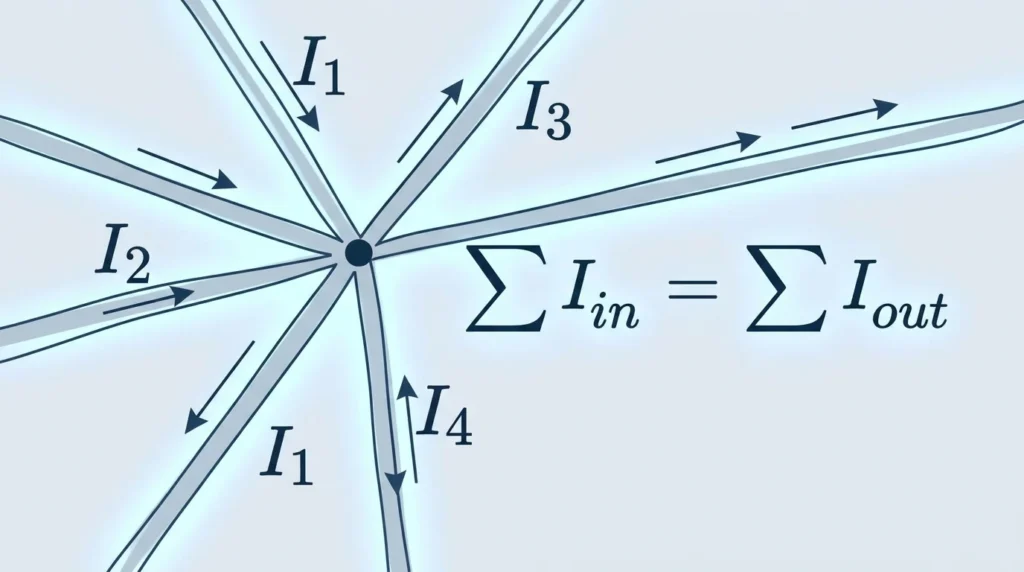
The Kirchhoff’s Laws working principle is based on two key physical rules.The working principle of Kirchhoff’s Laws is based on two fundamental concepts of electrical engineering: conservation of electric charge and conservation of energy. These laws help analyze how current and voltage behave in an electrical circuit. Kirchhoff’s Current Law (KCL) states that the total current entering a junction is equal to the total current leaving it, which means electric charge cannot accumulate at a single point. Kirchhoff’s Voltage Law (KVL) states that the total voltage in a closed loop must balance, meaning the energy supplied by the source is equal to the energy used by circuit components. Together, these laws allow engineers and technicians to calculate unknown currents, voltages, and resistances in simple and complex circuits. For example, in a multi-loop electrical network, KCL is used to analyze current flow at nodes, while KVL is applied to calculate voltage drops across components. These principles are widely used in electrical circuit design, troubleshooting, power systems, and electronic engineering applications.
- Conservation of Charge (for current)
- Conservation of Energy (for voltage)
Step-by-Step Explanation
For Current (KCL):
- Identify a junction (node)
- Note all incoming currents
- Note all outgoing currents
- Apply equation:
Sum of incoming currents = Sum of outgoing currents
For Voltage (KVL):
- Identify a closed loop
- Add all voltage rises
- Subtract all voltage drops
- The total must equal zero
Easy Analogy:
- KCL: Like traffic at a junction—cars entering must equal cars leaving
- KVL: Like walking in a circle—you end up at the same height (no net change)
Types / Classification
Kirchhoff’s Laws are divided into two main types:
Kirchhoff’s Current Law (KCL)
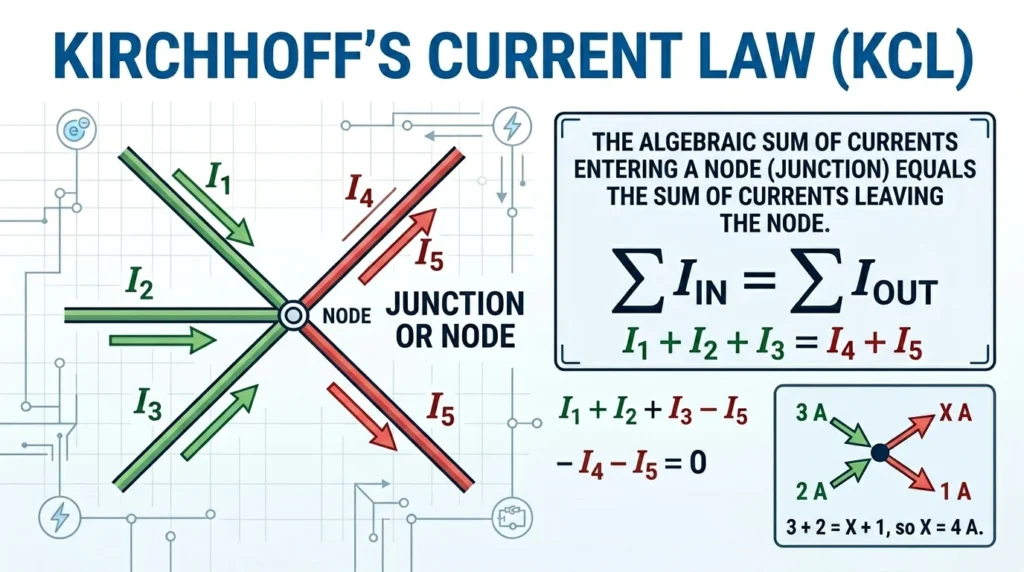
Kirchhoff’s Current Law (KCL) is one of the fundamental laws of electrical engineering used to analyze electrical circuits. It states that the total current entering a junction or node is always equal to the total current leaving that junction. In simple words, electric charge cannot accumulate at one point in a circuit, so the incoming and outgoing currents must remain balanced. This law is based on the principle of conservation of electric charge. For example, if 10 amperes of current enter a node and two branches carry 6 amperes and 4 amperes away from the node, the total outgoing current will also be 10 amperes. KCL is widely used in circuit analysis, electrical network design, troubleshooting, and electronic system calculations. It helps engineers and technicians determine unknown currents in complex circuits accurately and efficiently.KCL deals with current at a node.
Statement:
The total current entering a node is equal to the total current leaving the node.
Formula:
Sum of currents entering = Sum of currents leaving
Use:
- Node analysis
- Current distribution
Kirchhoff’s Voltage Law (KVL)
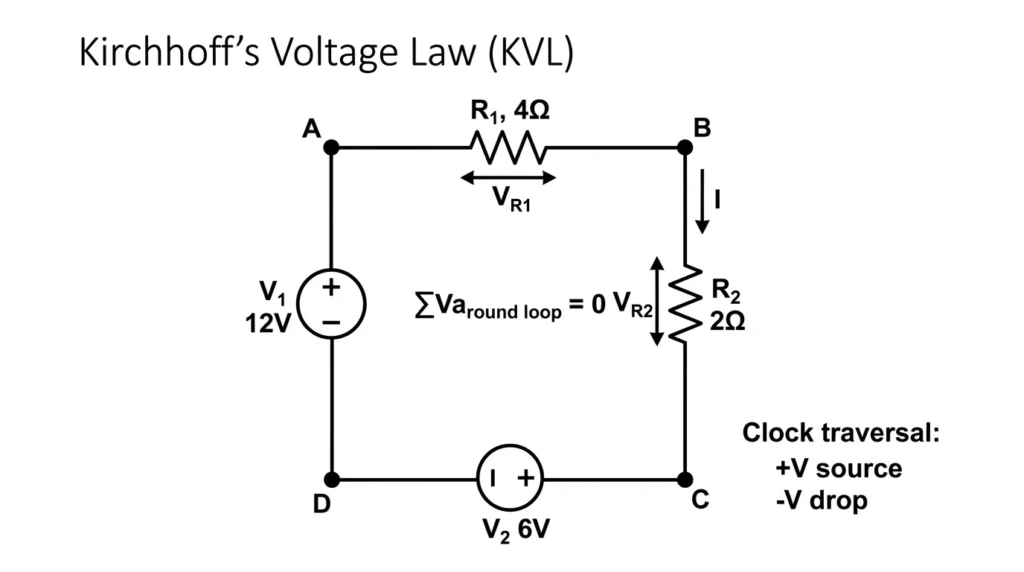
Kirchhoff’s Voltage Law (KVL) is an important law in electrical engineering used for analyzing electrical circuits and voltage distribution. It states that the total sum of all voltages around any closed loop in a circuit is always equal to zero. In simple words, the voltage supplied by the power source is equal to the total voltage consumed by the electrical components in that loop. This law is based on the principle of conservation of energy, which means energy cannot be created or destroyed within the circuit. For example, if a circuit has a 12-volt battery and two resistors causing voltage drops of 7 volts and 5 volts, then the total voltage drop becomes 12 volts, balancing the source voltage. KVL is widely used in circuit design, troubleshooting, electrical calculations, and network analysis. It helps electrical engineers, students, and technicians calculate unknown voltages and understand how electrical energy flows in a closed circuit.KVL deals with voltage in a loop.
Statement:
The sum of all voltages in a closed loop is zero.
Formula:
Total voltage rise = Total voltage drop
Use:
- Loop analysis
- Voltage calculation
Main Components
To apply Kirchhoff’s Laws, you need to understand basic circuit elements:
Nodes (Junctions)
- Points where two or more wires connect
- Used in KCL analysis
Loops
- Closed paths in a circuit
- Used in KVL analysis
Branches
- Path between two nodes
- Contains circuit elements
Voltage Sources
- Provide electrical energy
- Example: batteries
Resistors
- Oppose current flow
- Cause voltage drop
Function:
These components help define where and how Kirchhoff’s Laws are applied in a circuit.
Advantages
Kirchhoff’s Laws offer many practical benefits:
- Applicable to any electrical circuit
- Helps find unknown current and voltage
- Works for both AC and DC circuits
- Essential for circuit design and analysis
- Simple and logical approach
- Supports complex network analysis
- Widely used in engineering and education
Disadvantages / Limitations
Despite their usefulness, there are some limitations:
- Time-consuming for very large circuits
- Requires solving multiple equations
- Can become complex without practice
- Not ideal for quick calculations
- Needs proper understanding of circuit layout
Applications
Kirchhoff’s Laws have wide usage in electrical systems:
Home Applications
- Troubleshooting wiring issues
- Understanding appliance circuits
Industrial Applications
- Power distribution systems
- Machine circuit design
Modern Technology
- Electronic circuit design
- Printed circuit boards (PCBs)
- Power supplies
- Renewable energy systems
These are key Kirchhoff’s Laws applications in real-world scenarios.
Comparison Section
Difference Between KCL and KVL
| Feature | KCL | KVL |
| Based On | Charge conservation | Energy conservation |
| Applies To | Nodes | Loops |
| Measures | Current | Voltage |
| Equation | Incoming = Outgoing | Sum = 0 |
| Use | Current analysis | Voltage analysis |
This table clearly shows the difference between KCL and KVL, helping you understand their roles.
Selection Guide
When using Kirchhoff’s Laws, choosing the right approach is important.
Use KCL when:
- Analyzing current at nodes
- Multiple branches meet
- Finding unknown currents
Use KVL when:
- Working with loops
- Calculating voltages
- Series circuits are involved
Tips for Beginners:
- Start with simple circuits
- Label currents and voltages clearly
- Follow consistent sign conventions
- Double-check calculations
Common Problems & Solutions
Why do equations not balance?
Problem: Incorrect current direction assumption
Solution: Recheck direction; negative result means opposite direction
Why is KVL giving wrong voltage?
Problem: Sign errors in voltage drops
Solution: Follow loop direction consistently
How to handle complex circuits?
Problem: Too many nodes and loops
Solution: Break circuit into smaller parts
Can Kirchhoff’s Laws be used in AC circuits?
Yes, they apply to both AC and DC circuits
Future Trends
Kirchhoff’s Laws remain fundamental, but their application is evolving.
- Used in circuit simulation software
- Important in smart grid design
- Essential for renewable energy systems
- Applied in electric vehicle technology
- Integrated into AI-based circuit analysis tools
As circuits become more advanced, these laws continue to serve as the foundation of electrical analysis.
Conclusion
Kirchhoff’s Laws made simple provide a strong foundation for understanding electrical circuits. By applying KCL and KVL, you can analyze any circuit with confidence.
These laws are essential for students, engineers, and technicians. They help solve real-world problems, design systems, and improve troubleshooting skills.
While they may seem challenging at first, consistent practice makes them easy to use. Mastering these concepts will greatly improve your electrical knowledge and problem-solving ability.
Keep practicing, start with simple circuits, and gradually move to complex systems. This is the best way to truly understand Kirchhoff’s Laws.