
Imagine receiving your monthly electricity bill and wondering how the energy was actually used in your home. Maybe your air conditioner consumes more power than expected, or perhaps certain appliances run longer than necessary. Traditional electricity meters only show total energy consumption, but they do not provide detailed information about how electricity is being used.
This is where a Smart Energy Meter Project becomes very useful.
Smart energy meters are modern devices that measure electricity usage in real time and provide detailed information about energy consumption. These meters can send data automatically to users or utility companies, helping people manage electricity more efficiently.
For electrical students and engineers, building a Smart Energy Meter Project is an excellent way to understand modern power monitoring systems, microcontrollers, sensors, and smart grid technology.
In this article, you will learn:
- What a Smart Energy Meter Project is
- Smart energy meter project working principle
- Types of smart energy meters
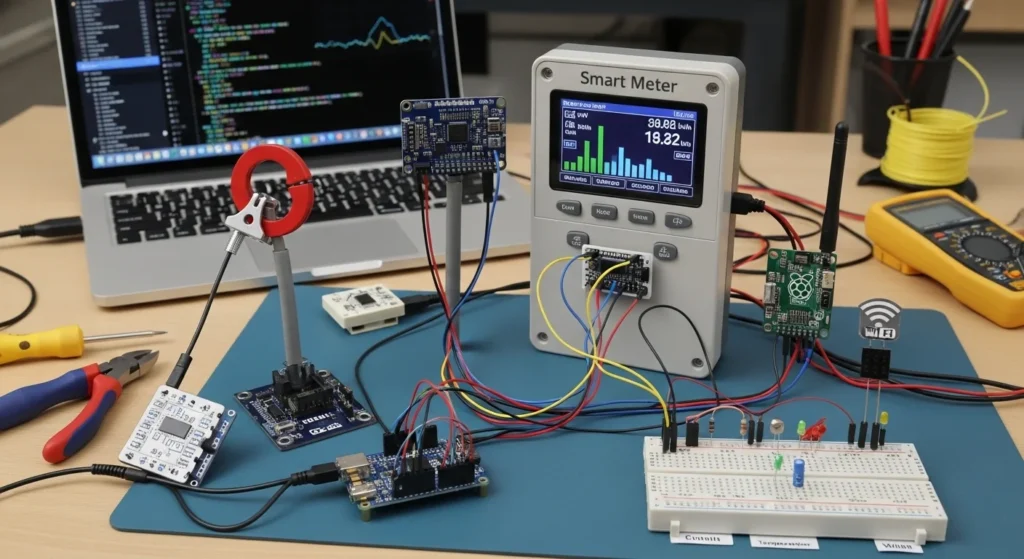
- Important components used in the project
- Smart energy meter project advantages and disadvantages
- Smart energy meter project applications in real life
This guide explains the project in simple language so beginners and students can easily understand the concept and implement it in their academic or practical projects.
What is Smart Energy Meter Project?
A Smart Energy Meter Project is an electrical and electronics project that measures electricity consumption digitally and sends the data to users or monitoring systems.
Unlike traditional electricity meters, smart meters provide real-time information about energy usage.
Simple Definition
A Smart Energy Meter Project is a system that monitors, measures, and reports electricity consumption using digital technology and communication systems.
Simple Explanation
Traditional meters record total energy usage but require manual reading by technicians.
Smart energy meters solve this problem by:
- Measuring electricity consumption automatically
- Sending data digitally
- Allowing remote monitoring
Practical Example
Consider a smart energy meter installed in a house. The system measures how much electricity is used by appliances like refrigerators, lights, and air conditioners. The meter then sends the information to a mobile app or monitoring system.
Users can easily see their daily electricity consumption and reduce unnecessary energy usage.
This makes the Smart Energy Meter Project an important technology in modern energy management systems.
Smart Energy Meter Project Working Principle
The smart energy meter project working principle is based on measuring voltage and current, calculating power consumption, and transmitting the data digitally.
In simple terms, the system measures how much electricity flows through a circuit and converts that information into energy consumption data.
Think of it like a digital electricity accountant that records every unit of energy used.
Step-by-Step Working Process
The smart energy meter project operates through several steps.
1. Voltage and Current Measurement
Sensors measure the electrical parameters of the system:
- Voltage level
- Current flow
These measurements are the foundation for energy calculation.
2. Signal Processing
The measured electrical signals are sent to a microcontroller or processing unit.
The controller processes the signals and calculates:
- Power consumption
- Energy usage (kWh)
3. Energy Calculation
The system calculates energy using the formula:
Energy = Power × Time
This allows the system to track total electricity consumption.
4. Data Display
The calculated energy data is displayed on a digital display such as an LCD screen.
Users can see their energy consumption in real time.
5. Data Transmission
Some smart energy meters send data to remote systems using communication technologies such as:
- Wi-Fi
- GSM
- Internet networks
This allows remote monitoring of electricity usage.
6. Energy Monitoring
The system continuously monitors energy consumption and updates the data regularly.
This real-time monitoring helps users control electricity usage efficiently.
Types / Classification of Smart Energy Meter Projects
Smart energy meter projects can be classified based on communication technology and system design.
GSM-Based Smart Energy Meter
This type uses GSM communication to send energy data through mobile networks.
Features include:
- Remote meter reading
- Automatic billing information
- SMS notifications
These systems are widely used in smart grid applications.
Wi-Fi Based Smart Energy Meter
Wi-Fi smart meters send energy data through wireless internet networks.
Users can monitor electricity consumption through mobile apps or web dashboards.
This type is commonly used in smart homes.
IoT-Based Smart Energy Meter
IoT-based meters connect to cloud platforms and allow advanced energy monitoring.
Advantages include:
- Real-time data access
- Remote monitoring
- Data analytics
These systems are widely used in modern smart grid systems.
Prepaid Smart Energy Meter
Prepaid meters allow users to pay for electricity before using it.
The system automatically disconnects power when the balance reaches zero.
This method is commonly used in rental properties and energy management programs.
Main Components of Smart Energy Meter Project
Several electronic and electrical components are used to build a smart energy meter project.
Microcontroller
The microcontroller is the brain of the system.
Its functions include:
- Processing sensor data
- Calculating energy consumption
- Controlling communication modules
Popular microcontrollers include Arduino and similar development boards.
Current Sensor
The current sensor measures the electrical current flowing through the circuit.
This information is used to calculate power consumption.
Voltage Sensor
Voltage sensors measure the supply voltage.
Accurate voltage measurement is important for calculating electrical power.
Display Unit
A display unit such as an LCD screen shows:
- Voltage readings
- Current readings
- Total energy consumption
This helps users monitor electricity usage.
Communication Module
Communication modules allow the system to send data remotely.
Examples include:
- GSM modules
- Wi-Fi modules
- IoT communication systems
These modules enable smart monitoring.
Power Supply Circuit
The system requires a stable power supply to operate electronic components safely.
Smart Energy Meter Project Advantages and Disadvantages
Understanding smart energy meter project advantages and disadvantages helps evaluate the benefits of this technology.
Advantages
- Real-time electricity monitoring
- Accurate energy measurement
- Reduces manual meter reading
- Helps users control electricity consumption
- Supports smart grid systems
- Enables remote monitoring
- Improves energy efficiency
These benefits make smart meters essential for modern energy management.
Disadvantages / Limitations
Despite many advantages, smart energy meters have some limitations.
- Higher installation cost compared to traditional meters
- Requires communication network infrastructure
- Cybersecurity concerns in connected systems
- Technical maintenance requirements
However, these limitations are being improved with modern technologies.
Smart Energy Meter Project Applications
Smart energy meter project applications are expanding rapidly in modern electrical systems.
Residential Applications
Smart meters are widely used in homes to monitor electricity usage.
They help homeowners:
- Track daily electricity consumption
- Reduce energy waste
- Control electricity bills
Industrial Applications
Industries use smart meters to monitor energy usage of machines and equipment.
Benefits include:
- Improved energy efficiency
- Better power management
- Reduced operational costs
Commercial Applications
Smart energy meters are used in commercial buildings such as:
- Shopping malls
- Offices
- Hotels
- Hospitals
These systems help manage large-scale electricity usage.
Smart Grid Systems
Smart energy meters play an important role in modern smart grids.
They help utility companies monitor electricity demand and supply efficiently.
Comparison: Smart Energy Meter vs Traditional Energy Meter
Understanding the difference between smart energy meter and traditional energy meter helps highlight the advantages of modern systems.
| Feature | Smart Energy Meter | Traditional Energy Meter |
| Data Monitoring | Real-time monitoring | No real-time monitoring |
| Meter Reading | Automatic | Manual reading required |
| Communication | Remote data transmission | No communication |
| Energy Management | Advanced monitoring | Limited information |
| Cost | Higher | Lower |
Smart meters provide better control and monitoring of electricity consumption.
Selection Guide
Choosing the right smart energy meter project requires careful planning.
Determine Project Requirements
Decide whether the system is for:
- Home monitoring
- Industrial monitoring
- Smart grid applications
Choose Suitable Communication Technology
Select communication modules based on the project requirement:
- GSM for remote monitoring
- Wi-Fi for smart home systems
- IoT platforms for advanced analytics
Ensure Measurement Accuracy
Accurate sensors are essential for reliable energy measurement.
Consider Cost and Complexity
Beginner students should start with simple microcontroller-based systems before developing advanced projects.
Common Problems & Solutions
Students working on smart energy meter projects may encounter several technical problems.
Why is the energy reading incorrect?
Possible causes:
- Sensor calibration issues
- Incorrect programming
- Faulty sensors
Solution:
- Recalibrate sensors
- Verify program code
- Replace damaged components
Why is the display not showing data?
Possible causes:
- Loose wiring
- Power supply problems
- Display module failure
Solution:
- Check wiring connections
- Verify power supply voltage
- Test display module
Why is data transmission not working?
Possible causes:
- Communication module failure
- Network connectivity issues
- Software configuration errors
Solution:
- Check module connections
- Test network signal
- Verify communication code
Future Trends in Smart Energy Meter Technology
Smart energy meter technology is evolving rapidly.
IoT Integration
Future smart meters will connect with advanced IoT platforms for real-time monitoring and analytics.
Artificial Intelligence for Energy Management
AI systems can analyze energy usage patterns and recommend energy-saving strategies.
Smart Grid Expansion
Smart energy meters will become a key component of modern smart grid infrastructure.
Renewable Energy Integration
Smart meters will help manage energy generated from solar panels and other renewable sources.
Conclusion
The Smart Energy Meter Project is an important innovation in modern electrical systems. It allows real-time monitoring of electricity consumption and provides detailed information about energy usage.
Understanding the smart energy meter project working principle helps electrical students and engineers learn how voltage and current measurements can be converted into energy data. Using microcontrollers, sensors, and communication modules, smart meters provide advanced energy monitoring features.
The smart energy meter project advantages and disadvantages show that although these systems may have higher initial costs, they provide significant benefits such as accurate monitoring, remote access, and improved energy management.
Smart energy meter project applications are growing rapidly in homes, industries, and smart grid systems. As technology advances, smart meters will play an even bigger role in energy efficiency and sustainable power management.
For students and beginners, building a smart energy meter project is an excellent way to understand modern electrical monitoring technology and prepare for future smart energy systems.