
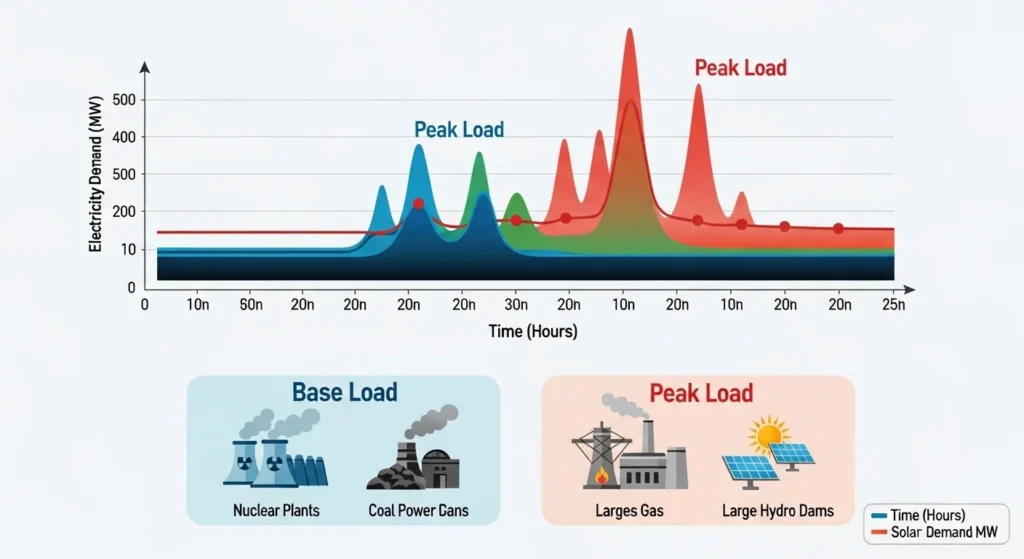

Imagine a typical summer day in a large city. Early in the morning, electricity demand is moderate. In the afternoon, when air conditioners, factories, offices, and homes are running at full capacity, the demand suddenly rises. At night, demand reduces again but never becomes zero.
As electrical engineers, we must design power systems that handle both steady demand and sudden increases. This is where understanding Base Load vs Peak Load becomes very important.
The stability of the entire power system depends on how well we manage these loads. If we underestimate peak demand, blackouts can occur. If we oversize the system unnecessarily, it becomes expensive and inefficient.
In this article, you will learn:
- The clear meaning of base load and peak load
- The Base Load vs Peak Load working principle
- Types and components
- Base Load vs Peak Load applications
- Base Load vs Peak Load advantages and disadvantages
- The difference between base load and peak load in a practical table
I will explain everything in simple, clear language, just like a senior engineer guiding a junior.
2. What is Base Load vs Peak Load?
Definition
Base Load is the minimum level of electrical demand that exists on the power system continuously over a period of time.
Peak Load is the highest level of electrical demand that occurs during a specific time, usually for a short duration.
Simple Explanation
Think of electricity demand like water usage in a city:
- Even at midnight, some water is still being used — this is like base load.
- During morning hours when everyone is bathing and cooking, water demand increases — this is like peak load.
Similarly, electricity demand never becomes zero. Some loads like hospitals, streetlights, communication systems, and refrigerators operate 24/7. This constant demand is base load.
When additional heavy loads such as air conditioners, industrial machines, or electric heaters operate together, demand rises to peak load.
Practical Example
In a city:
- Minimum demand at 3:00 AM = 500 MW → Base Load
- Maximum demand at 4:00 PM = 900 MW → Peak Load
The power system must be designed to handle both safely and efficiently.
3. Base Load vs Peak Load Working Principle
The Base Load vs Peak Load working principle is based on demand variation over time.
Electric power demand changes hourly, daily, and seasonally. Engineers study this variation using a load curve.
Step-by-Step Explanation
Electricity demand is measured continuously.
A graph is plotted between time and load.
The lowest steady portion of the graph represents base load.
The highest points represent peak load.
Different power plants are assigned to handle different portions of the load.
Easy Analogy
Think of a bus service:
- A few buses always run on fixed routes (base load supply).
- During rush hour, extra buses are added (peak load supply).
Similarly:
- Base load power plants run continuously.
- Peak load plants start only when demand increases.
4. Types / Classification
Base Load Power Plants
These plants operate continuously to meet base load demand.
Common types:
- Coal power plants
- Nuclear power plants
- Large hydro power plants
Characteristics:
- High efficiency at constant load
- Not suitable for frequent start/stop
- Lower operating cost per unit
Peak Load Power Plants
These plants operate only during high demand periods.
Common types:
- Gas turbine plants
- Diesel generator plants
- Pumped storage hydro plants
Characteristics:
- Quick start capability
- Higher operating cost
- Operate for short duration
Intermediate Load Plants
These operate between base and peak loads.
Examples:
- Combined cycle gas plants
They balance efficiency and flexibility.
5. Main Components
In understanding Base Load vs Peak Load, these components are important:
Power Plants
Generate electricity according to load demand.
Load Dispatch Center
Monitors demand and controls which plant should operate.
Transmission System
Carries electricity from plant to distribution system.
Load Curve Monitoring System
Records demand variations over time.
Each component works together to maintain system stability and prevent overloading.
6. Base Load vs Peak Load Advantages and Disadvantages
Advantages
Base Load:
- Stable and continuous supply
- Lower generation cost per unit
- High efficiency at steady operation
Peak Load:
- Handles sudden demand increase
- Prevents blackouts
- Provides system flexibility
Real-World Benefits
- Ensures 24/7 power availability
- Optimizes fuel usage
- Improves grid reliability
7. Disadvantages / Limitations
Base Load Limitations
- Not flexible for quick demand changes
- High initial installation cost
- Slow startup time
Peak Load Limitations
- Higher fuel cost
- Less efficient
- More maintenance due to frequent operation
Proper planning is required to balance both.
8. Base Load vs Peak Load Applications
Home Applications
- Refrigerators → Base load
- Air conditioners → Peak load
Industrial Applications
- Continuous manufacturing lines → Base load
- Heavy machinery during shifts → Peak load
Modern Technology
- Data centers → Base load
- EV charging stations → Peak load
These Base Load vs Peak Load applications are critical for grid planning.
9. Difference Between Base Load and Peak Load
Here is a clear comparison table:
| Parameter | Base Load | Peak Load |
| Definition | Minimum continuous demand | Maximum demand level |
| Duration | 24/7 | Short duration |
| Type of Plant | Coal, Nuclear | Gas turbine, Diesel |
| Operating Cost | Low per unit | High per unit |
| Startup Time | Slow | Fast |
| Efficiency | High at constant load | Lower efficiency |
This table clearly shows the difference between base load and peak load.
10. Selection Guide
Choosing between base load and peak load systems depends on:
Demand Pattern
Study daily and seasonal load curves.
Budget
Base load plants need high initial investment.
Fuel Availability
Coal, gas, hydro availability matters.
Grid Stability
Large grids require strong base load support.
Tips for Beginners
- Always analyze load curve first.
- Avoid oversizing peak plants.
- Ensure reserve margin for safety.
- Plan for future expansion.
11. Common Problems & Solutions (FAQs Style)
What happens if peak load exceeds generation capacity?
Problem: Voltage drops and blackouts.
Solution: Use reserve generators and load shedding.
Why can’t base load plants handle peak demand?
Answer: They cannot increase output quickly due to mechanical and thermal limits.
How is peak load reduced?
Solution:
- Demand-side management
- Time-of-use tariffs
- Energy-efficient appliances
What is load shedding?
Temporary disconnection of supply to maintain system balance.
12. Future Trends
The future of Base Load vs Peak Load management is changing rapidly.
Smart Grids
Automatically balance demand and supply.
Renewable Energy
Solar and wind reduce base load dependency.
Energy Storage Systems
Battery storage supports peak load.
Demand Response Programs
Consumers reduce usage during peak hours.
Modern grids are moving toward flexible and intelligent systems.
13. Conclusion
Understanding Base Load vs Peak Load is fundamental for every electrical engineer and technician. Base load ensures continuous power supply, while peak load management prevents system overload during high demand periods.
A well-designed power system always maintains a balance between steady generation and flexible response. By analyzing load curves, selecting suitable power plants, and using smart technologies, engineers can ensure reliable and economical electricity supply.
As a junior engineer, always remember: power system planning is not only about generating electricity — it is about generating the right amount at the right time.
Mastering this concept will strengthen your foundation in power system engineering and grid management.