
Imagine you are operating a 100 MW power plant. On paper, it looks powerful and capable of supplying electricity to thousands of homes. But at the end of the year, you discover that it actually produced energy equal to running at only 60 MW continuously.
Why did this happen?
This is where Plant Capacity Factor becomes important. It tells us how effectively a power plant is being used compared to its maximum possible output. In power system engineering, this value directly affects profitability, reliability, and system planning.
If you ignore Plant Capacity Factor, you may overestimate plant performance or misunderstand operational efficiency. As a junior engineer, you must clearly understand how much energy a plant can produce versus how much it actually produces.
In this article, you will learn:
- The clear meaning of Plant Capacity Factor
- The Plant Capacity Factor working principle
- Types and calculation methods
- Plant Capacity Factor applications
- Plant Capacity Factor advantages and disadvantages
- The difference between capacity factor and load factor
Let us break it down step by step in simple and practical language.
2. What is Plant Capacity Factor?
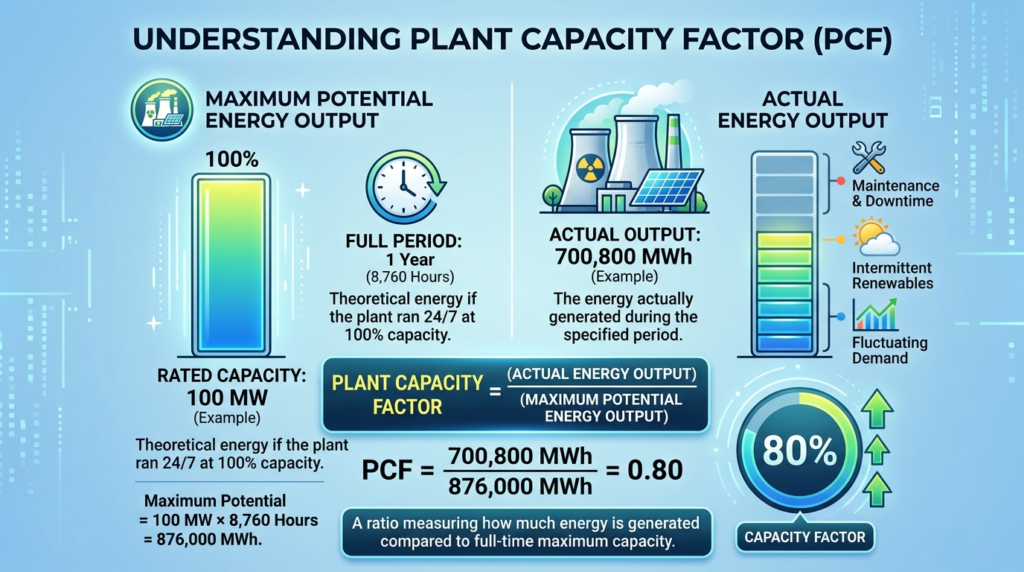
Plant Capacity Factor (PCF) is the ratio of actual energy produced by a power plant over a period of time to the maximum possible energy it could have produced at full capacity during the same period.Plant Capacity Factor is a measure used in power generation to show how efficiently a power plant operates compared to its maximum possible output over a specific period of time. It is defined as the ratio of the actual electrical energy produced by the plant to the total energy it could have produced if it operated continuously at full rated capacity. The capacity factor is usually expressed as a percentage. For example, if a 100 MW power plant generates less electricity than its maximum possible output due to maintenance, fuel limitations, seasonal conditions, or varying demand, its capacity factor will be below 100%. A higher capacity factor indicates better plant utilization, improved efficiency, and more reliable power generation. Different power plants have different capacity factors depending on their technology and operating conditions. Nuclear and thermal power plants generally have higher capacity factors, while solar and wind power plants may have lower values because they depend on weather conditions. Understanding plant capacity factor is important for electrical students, engineers, and technicians because it helps evaluate power plant performance, operational efficiency, and energy production reliability.
Detailed Explanation and Calculation of Plant Capacity Factor
Plant Capacity Factor is an important performance indicator used in power generation systems to determine how effectively a power plant utilizes its installed generating capacity over a specific period. Every power plant is designed with a rated capacity, which represents the maximum amount of power it can produce under normal operating conditions. For example, a power plant with a capacity of 100 MW can theoretically generate 100 MW of electricity continuously if it operates at full load throughout the year.
In actual operation, however, power plants rarely run at their full rated capacity all the time. Various factors such as scheduled maintenance, unexpected equipment failures, fuel shortages, transmission constraints, seasonal demand fluctuations, and operational limitations can reduce the amount of electricity generated. Because of these practical limitations, the actual energy output is usually lower than the maximum possible output.
Plant Capacity Factor measures the percentage of the plant’s potential generation that is actually achieved. It provides a realistic picture of how much the plant is utilized and helps engineers evaluate its operational performance.
Formula for Plant Capacity Factor
Capacity Factor (%) = (Actual Energy Generated ÷ Maximum Possible Energy) × 100
Where:
- Actual Energy Generated = Total electrical energy produced during the specified period.
- Maximum Possible Energy = Rated Plant Capacity × Total Operating Hours during the period.
The result is expressed as a percentage.
Practical Example of Capacity Factor Calculation
Consider a power plant with the following specifications:
- Plant Rating = 100 MW
- Time Period = 1 Year
- Total Hours in One Year = 8760 Hours
Step 1: Calculate Maximum Possible Energy
If the plant operates continuously at its full rated capacity throughout the year:
Maximum Possible Energy = 100 MW × 8760 Hours
Maximum Possible Energy = 876,000 MWh
This represents the highest amount of electrical energy the plant could generate under ideal conditions.
Step 2: Determine Actual Energy Generated
Assume that due to maintenance shutdowns, varying electricity demand, and operational constraints, the plant actually produces:
Actual Energy Generated = 525,600 MWh
Step 3: Calculate Capacity Factor
Capacity Factor = (525,600 ÷ 876,000) × 100
Capacity Factor = 0.60 × 100
Capacity Factor = 60%
Interpretation of the Result
A capacity factor of 60% means that the power plant generated only 60% of the electricity it could have produced if it had operated at full load for every hour of the year. In other words, the plant was effectively utilized at 60% of its maximum generating capability.
This does not necessarily indicate poor performance. Many power plants are intentionally operated below full capacity because electricity demand changes throughout the day and year. Additionally, maintenance activities and operational requirements are necessary to ensure safe and reliable operation. Therefore, capacity factor is a valuable tool for assessing plant utilization, planning future generation capacity, comparing different power plants, and evaluating overall system performance.
3. Plant Capacity Factor Working Principle
The Plant Capacity Factor working principle is based on energy comparison over time.
It compares two values:
- What the plant could have produced
- What the plant actually produced
Step-by-Step Explanation
Identify plant rated capacity (MW).
Identifying plant rated capacity in megawatts (MW) means determining the maximum electrical power a power plant is designed to generate under normal operating conditions. The rated capacity shows the total output capability of the plant and is usually specified by the manufacturer or plant design engineers. It is calculated based on the combined output of generators, turbines, and other power generation equipment installed in the plant. For example, if a power station has two generators rated at 50 MW each, the total plant rated capacity becomes 100 MW. This value is important for power system planning, load management, grid connection, and energy distribution because it helps engineers understand how much electricity the plant can supply safely and efficiently. Plant rated capacity is commonly used in thermal power plants, hydroelectric stations, diesel power plants, nuclear plants, and renewable energy systems such as solar and wind farms. Understanding plant rated capacity is important for electrical students, engineers, and technicians because it plays a major role in power generation analysis, system design, and electrical energy management.
Determine total operating hours in the period.
Calculate maximum possible generation.
Record actual generation from energy meters.
Divide actual output by maximum possible output.
Easy Analogy
Think of a bus with 50 seats.
If the bus runs every day but carries an average of 30 passengers, it is not fully utilized.
Capacity factor is like checking how often the bus seats were filled compared to total possible seats.
4. Types / Classification
Plant Capacity Factor varies depending on plant type.
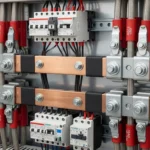
Realistic Electrical Panels
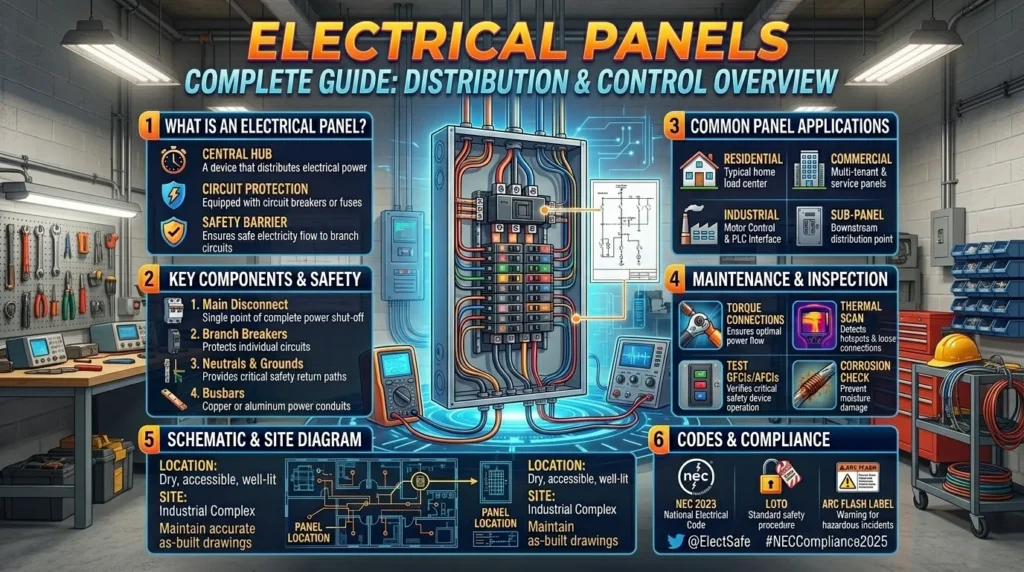
Realistic Electrical Panels are practical and professionally designed control panels used to distribute, control, and protect electrical power in homes, industries, and commercial buildings. These panels are called “realistic” because they are designed according to actual field requirements, safety standards, load conditions, and working environments. A realistic electrical panel includes properly arranged components, accurate wiring, labeling, safety protection, and easy maintenance access.
For more detilas click the link Realistic Electrical Panels
The working principle of a realistic electrical panel is based on safe power distribution and control. Electrical energy enters the panel through the main incoming supply and is then distributed to different circuits through breakers, contactors, relays, and busbars. Protective devices disconnect the supply during overloads or short circuits, ensuring system safety. This operation follows Electric Circuit Theory, where controlled current flow allows safe operation of electrical systems.
A realistic electrical panel contains several important components such as:
- Main Circuit Breaker
- Busbars
- Contactors
- Relays
- MCBs and MCCBs
- Wiring ducts
- Terminal blocks
- Indicators and meters
- Earthing system
Each component is placed carefully to improve cooling, safety, and maintenance. Proper cable management and labeling are also important features of professional electrical panels.
Realistic electrical panels are widely used in factories, power plants, shopping malls, hospitals, and residential buildings. Industrial panels may include PLC systems, motor starters, VFDs, and automatic control circuits for advanced automation.
One of the main advantages of realistic electrical panels is improved safety and reliability. Proper design reduces electrical faults, overheating, and maintenance problems. These panels also improve troubleshooting and system efficiency. However, designing a high-quality panel requires technical knowledge, proper planning, and quality materials, which can increase installation cost.
Modern realistic electrical panels often use modular designs, digital monitoring systems, and smart automation technologies. These features help improve energy management and remote control capabilities.
Overall, realistic electrical panels are an essential part of modern electrical systems. Their professional design, safe operation, and organized structure ensure reliable power distribution and efficient electrical control in residential, commercial, and industrial applications.
Thermal Power Plant Capacity Factor
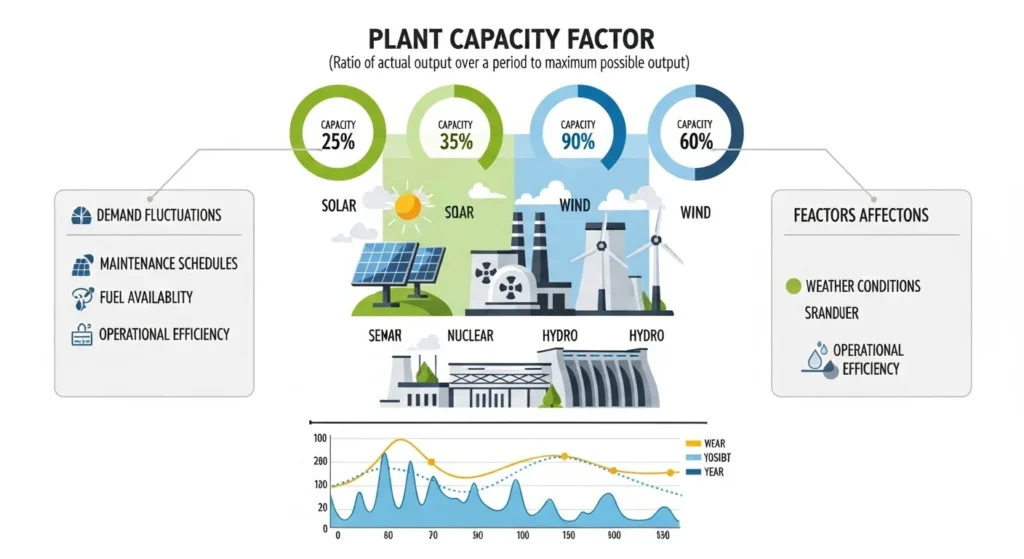
Coal and nuclear plants usually have high capacity factors (60%–90%).
They are designed for continuous base load operation.
The capacity factor of a thermal power plant is a measure of how effectively the plant utilizes its installed generating capacity over a specific period of time. It represents the ratio of the actual electrical energy produced by the plant to the maximum possible energy it could have generated if it had operated continuously at its rated capacity throughout the period. Thermal power plants, such as coal-fired, oil-fired, gas-fired, and biomass power stations, are designed to provide a stable and reliable source of electricity. However, they rarely operate at full load all the time due to factors such as maintenance requirements, equipment failures, fuel supply limitations, environmental regulations, and variations in electricity demand. As a result, the actual energy generated is usually lower than the maximum possible output. The capacity factor helps engineers and plant operators evaluate plant utilization, operational efficiency, and economic performance. A high capacity factor indicates that the thermal power plant is operating for most of the time and producing electricity close to its rated capacity, while a low capacity factor suggests that the plant remains idle or operates at reduced output for significant periods. For example, a 500 MW thermal power plant operating continuously for one year could theoretically generate 4,380,000 MWh of electricity. If the plant actually generates 3,066,000 MWh during the year, its capacity factor would be 70%. Thermal power plants typically have capacity factors ranging from 50% to 85%, depending on fuel availability, maintenance schedules, and grid demand. Base-load thermal power plants generally achieve higher capacity factors because they operate continuously to meet the constant electricity demand of consumers. Therefore, the capacity factor is an important indicator used in power system planning, economic analysis, performance assessment, and reliability evaluation of thermal generating stations.
For more detilas click this link Thermal Power Plant
Hydropower Plant Capacity Factor
Hydro plants depend on water availability.
Capacity factor may vary from 30% to 70%.
The capacity factor of a hydropower plant is a measure of how effectively the plant utilizes its installed generating capacity over a specific period of time. It is defined as the ratio of the actual electrical energy produced by the hydropower station to the maximum possible energy that could have been generated if the plant operated at its rated capacity continuously throughout the period. Hydropower plants convert the potential and kinetic energy of flowing or stored water into electrical energy using turbines and generators. Although hydroelectric stations are highly efficient and reliable, they do not always operate at full capacity because their power generation depends heavily on water availability. Factors such as seasonal rainfall, river flow variations, reservoir water levels, drought conditions, irrigation requirements, environmental regulations, and electricity demand significantly affect the amount of power generated. As a result, the actual energy output is often lower than the theoretical maximum output.
A high capacity factor indicates that the hydropower plant has a consistent water supply and operates near its rated capacity for most of the year. Conversely, a low capacity factor suggests that the plant experiences reduced water flow, seasonal operation, or limited electricity demand. For example, a 200 MW hydropower plant operating continuously for one year could theoretically generate 1,752,000 MWh of electricity. If the plant actually produces 876,000 MWh during the year, its capacity factor would be 50%. Hydropower plants typically have capacity factors ranging from 30% to 70%, depending on reservoir size, river conditions, and operating strategy. Large reservoir-based hydroelectric stations generally achieve higher capacity factors than run-of-river plants because stored water allows more flexible operation. The capacity factor is an important performance indicator used by engineers, utility companies, and power system planners to evaluate plant utilization, estimate energy production, analyze economic performance, and ensure the efficient management of water resources for electricity generation.
For more detilas click this link Hydropower Plant
Wind Power Plant Capacity Factor
Wind plants depend on wind speed.
Typical capacity factor: 25%–45%.
The capacity factor of a wind power plant is a measure of how effectively the wind farm utilizes its installed generating capacity over a specific period of time. It is defined as the ratio of the actual electrical energy generated by the wind turbines to the maximum possible energy that could have been produced if the turbines operated at their rated capacity continuously throughout the period. Capacity factor is one of the most important performance indicators for wind energy systems because wind turbines cannot generate electricity at full power all the time. Unlike conventional power plants, wind farms depend entirely on the availability and speed of wind, which naturally varies throughout the day and across different seasons. As a result, the actual power output of a wind power plant fluctuates continuously according to weather conditions.
Several factors influence the capacity factor of a wind power plant, including average wind speed, wind consistency, turbine design, hub height, site location, air density, maintenance schedules, and grid availability. When wind speeds are too low, turbines may not generate electricity. Similarly, during extremely high wind speeds, turbines are often shut down automatically to prevent mechanical damage. Therefore, even though a wind farm may have a large installed capacity, it usually produces less than its theoretical maximum output over the year.
For example, a wind farm with an installed capacity of 100 MW operating continuously for one year could theoretically generate 876,000 MWh of electricity. If the actual energy produced during the year is 306,600 MWh, the capacity factor would be 35%. Modern onshore wind farms typically achieve capacity factors between 25% and 40%, while offshore wind farms often reach 40% to 60% due to stronger and more consistent winds. A higher capacity factor indicates better utilization of wind resources and improved economic performance. Engineers, utility companies, and renewable energy developers use capacity factor analysis to evaluate site suitability, estimate annual energy production, compare wind projects, and assess the overall efficiency and profitability of wind power generation systems.
For more detilas click this link Wind Power Plant
Solar Power Plant Capacity Factor
Solar plants operate only during daytime.
Typical capacity factor: 15%–25%.
The capacity factor of a solar power plant is a measure of how effectively the plant utilizes its installed generating capacity over a specific period of time. It is defined as the ratio of the actual electrical energy produced by the solar power plant to the maximum possible energy that could have been generated if the plant operated continuously at its rated capacity throughout the period. Capacity factor is one of the most important performance indicators for solar energy systems because solar panels can generate electricity only when sunlight is available. Unlike conventional power plants that can operate day and night, solar power plants depend entirely on solar radiation, making their energy production variable and weather-dependent.
Several factors affect the capacity factor of a solar power plant, including sunlight intensity, geographical location, seasonal changes, cloud cover, dust accumulation on solar panels, ambient temperature, panel orientation, shading, and system efficiency. Since solar panels do not generate electricity during nighttime and produce reduced output during cloudy or rainy weather, the actual energy generated is significantly lower than the theoretical maximum output. As a result, solar power plants generally have lower capacity factors compared to thermal, nuclear, or hydroelectric power stations.
For example, a solar power plant with an installed capacity of 100 MW could theoretically generate 876,000 MWh of electricity if it operated at full power continuously for one year. However, if the plant actually produces 175,200 MWh during the year, the capacity factor would be 20%. Most utility-scale solar power plants typically achieve capacity factors ranging from 15% to 30%, depending on the amount of available sunlight and local environmental conditions. Solar plants located in desert regions with high solar irradiance often achieve higher capacity factors than those in areas with frequent cloud cover.
The capacity factor is an important parameter used by engineers, utility companies, and renewable energy developers to estimate annual energy production, evaluate plant performance, compare solar projects, assess economic viability, and plan future investments in solar energy infrastructure. It provides a realistic measure of how efficiently a solar power plant converts available sunlight into useful electrical energy throughout the year.
Key Components and Systems That Affect Plant Capacity Factor
The Plant Capacity Factor is directly influenced by the performance, reliability, and availability of several major components within a power generation system. These components determine how consistently a power plant can operate and how much electricity it can generate compared to its maximum potential output. Any malfunction, inefficiency, or interruption in these systems can reduce operating hours and lower the overall capacity factor. Therefore, maintaining these components in good condition is essential for achieving high plant utilization and reliable power generation.
Prime Mover
The prime mover is the main machine that converts energy from fuel, steam, water, or wind into mechanical power. Depending on the type of power plant, the prime mover may be a steam turbine, gas turbine, water turbine, or wind turbine. The efficiency and reliability of the prime mover have a direct impact on electricity production. If the turbine operates below its designed performance level or experiences mechanical failures, the plant’s output decreases, resulting in a lower capacity factor.
Generator
The generator converts mechanical energy supplied by the prime mover into electrical energy. It is one of the most critical components in any power plant. Generator faults, insulation failures, overheating, or electrical problems can force the plant to reduce output or shut down completely. A well-maintained generator ensures continuous power production and helps maintain a high capacity factor.
Fuel Supply System
In thermal and gas-fired power plants, a reliable fuel supply system is essential for continuous operation. Fuel shortages, transportation issues, storage problems, or interruptions in fuel delivery can reduce plant operating hours and lower energy production. A stable fuel supply allows the plant to operate closer to its rated capacity.
Cooling System
The cooling system removes excess heat from plant equipment and maintains safe operating temperatures. Poor cooling performance can cause overheating of turbines, generators, boilers, condensers, and other equipment. Excessive temperatures may force operators to reduce plant output or temporarily shut down the facility, negatively affecting the capacity factor.
Maintenance and Reliability System
Regular maintenance programs help prevent unexpected equipment failures and improve plant availability. Frequent breakdowns, delayed repairs, and poor maintenance practices increase downtime and reduce energy generation. Effective preventive maintenance ensures reliable operation, minimizes outages, and helps achieve a higher plant capacity factor.
All of these components must operate efficiently and reliably to maximize plant utilization and maintain a high capacity factor throughout the operating period.
6. Plant Capacity Factor Advantages and Disadvantages
Advantages
- Measures real plant performance
- Helps in financial planning
- Indicates reliability level
- Useful for comparing different plants
- Assists in investment decisions
Real-World Benefits
- Improves operational planning
- Reduces unexpected downtime
- Increases return on investment
7. Disadvantages / Limitations
- Does not show efficiency directly
- Cannot explain cause of low output
- Weather-dependent plants show naturally low values
- May be misunderstood without proper context
Plant Capacity Factor alone is not enough; it must be analyzed with other performance indicators.
Major Applications of Plant Capacity Factor in Power Systems
The Plant Capacity Factor is a widely used performance indicator in the electrical power industry. It provides valuable information about how effectively a power plant utilizes its installed capacity over a specific period. Engineers, utility companies, investors, and energy planners use capacity factor data to evaluate plant performance, estimate future energy production, and make informed operational and financial decisions. Because it reflects the actual utilization of a power plant, the capacity factor plays a crucial role in the planning, management, and development of modern power systems.
Power System Planning
One of the most important applications of plant capacity factor is in power system planning. Engineers use capacity factor values to estimate the annual energy generation of existing and proposed power plants. Accurate generation estimates help utilities determine future electricity supply, plan capacity expansions, and ensure that sufficient power is available to meet growing consumer demand. Capacity factor data is also used when selecting suitable technologies for new generation projects.
Financial and Economic Analysis
Investors, project developers, and financial institutions closely examine a power plant’s capacity factor before approving investments or funding energy projects. A higher capacity factor generally indicates better utilization of plant assets and greater revenue potential. Financial analysts use capacity factor calculations to estimate annual energy sales, operating profitability, project payback periods, and return on investment. Therefore, capacity factor is a key parameter in evaluating the economic viability of power generation projects.
Renewable Energy Project Assessment
Capacity factor is particularly important for renewable energy systems such as solar, wind, and hydropower plants. Since renewable energy sources are dependent on natural resources and weather conditions, capacity factor helps estimate realistic energy production levels. Developers use this information to assess site suitability, compare project locations, and predict long-term electricity generation before construction begins.
Grid Stability and Reliability Studies
Power system operators use capacity factor data for grid stability analysis, load forecasting, reserve planning, and reliability assessments. Understanding how much energy different power plants are likely to generate helps operators maintain a balance between electricity supply and demand. This information is essential for ensuring stable grid operation and preventing power shortages.
These applications make Plant Capacity Factor an essential tool for the efficient planning, operation, and development of modern electrical power systems.
9. Difference Between Capacity Factor and Load Factor
Many students confuse these terms. Let us compare.
| Parameter | Capacity Factor | Load Factor |
| Definition | Ratio of actual output to maximum possible output | Ratio of average load to peak load |
| Time Consideration | Long-term measurement | Demand-based measurement |
| Focus | Plant utilization | Load behavior |
| Used For | Performance evaluation | Demand analysis |
This table clearly shows the difference between capacity factor and load factor.
Guidelines for Selecting and Evaluating Plant Capacity Factor
Selecting and interpreting the Plant Capacity Factor correctly is essential for accurate power plant performance analysis. Although capacity factor is a valuable indicator of plant utilization, it should not be evaluated in isolation. Engineers, energy planners, researchers, and students must consider the type of power plant, operating conditions, fuel availability, maintenance schedules, and environmental factors before drawing conclusions. Proper analysis of capacity factor helps in making reliable engineering, operational, and financial decisions.
For Power Plant Performance Evaluation
When assessing the overall performance of a power plant, capacity factor should be analyzed together with plant efficiency and availability data. A high capacity factor indicates that the plant is being utilized effectively, but it does not necessarily mean that the plant is operating efficiently. Combining capacity factor with efficiency measurements provides a more complete picture of plant performance and energy conversion effectiveness.
For Load and Demand Analysis
Capacity factor and load factor serve different purposes and should not be confused. When studying consumer demand patterns, electrical load behavior, or system utilization, engineers should use load factor rather than capacity factor. Capacity factor focuses on power generation performance, whereas load factor evaluates how consistently electrical demand is distributed over time.
For Renewable Energy Projects
In renewable energy systems such as solar, wind, and hydropower plants, capacity factor is a critical parameter for estimating realistic annual energy production. Since renewable resources depend on weather and environmental conditions, expected capacity factors should be calculated using long-term climate and resource data rather than ideal operating assumptions. This approach provides more accurate projections for project planning and investment analysis.
Important Tips for Students and Beginners
When analyzing capacity factors, avoid making direct comparisons between different types of power plants without considering their operating characteristics. For example, a solar power plant naturally has a lower capacity factor than a coal-fired power plant because solar generation depends on sunlight availability. Similarly, annual capacity factor data is generally more reliable than monthly data because it reflects seasonal variations and long-term operating conditions. Understanding maintenance schedules, fuel supply conditions, weather patterns, and plant operating strategies is also essential for accurate interpretation.
Proper evaluation of Plant Capacity Factor enables engineers and decision-makers to assess plant performance accurately, improve system planning, optimize energy production, and make informed technical and economic decisions.
11. Common Plant Capacity Factor Problems and Their Solutions (Frequently Asked Questions)
Understanding the common issues that affect Plant Capacity Factor is important for engineers, students, and power plant operators. A low capacity factor often indicates that a plant is not fully utilizing its installed generating capacity. Various technical, operational, and environmental factors can influence plant utilization. The following frequently asked questions explain the most common problems and practical solutions related to plant capacity factor.
Why Is the Capacity Factor Low in Solar Power Plants?
Solar power plants typically have lower capacity factors because they depend entirely on sunlight for electricity generation. Solar panels can only produce power during daylight hours and their output decreases during cloudy, rainy, or dusty conditions. Additionally, there is no power generation at night. As a result, solar plants generally have capacity factors ranging from 15% to 30%, which is normal for this type of renewable energy system.
Can a Plant Capacity Factor Reach 100%?
In theory, a capacity factor of 100% means that a power plant operates continuously at its full rated capacity throughout the entire period without any interruption. However, in practical operation, achieving 100% capacity factor is almost impossible. All power plants require periodic maintenance, inspections, repairs, and occasional shutdowns. Unexpected equipment failures and operational constraints also prevent continuous full-load operation.
What Are the Main Causes of a Low Plant Capacity Factor?
Several factors can reduce the capacity factor of a power plant, including:
- Fuel shortages or interruptions in fuel supply
- Equipment failures and unexpected breakdowns
- Scheduled maintenance and repair activities
- Transmission and grid restrictions
- Low electricity demand
- Environmental and weather-related conditions
- Operational limitations and regulatory requirements
These factors reduce operating hours or force the plant to operate below its rated capacity.
How Can Plant Capacity Factor Be Improved?
Improving plant capacity factor requires increasing plant availability and reducing downtime. Effective strategies include:
- Implementing preventive and predictive maintenance programs
- Ensuring a stable and reliable fuel supply
- Upgrading aging equipment and control systems
- Improving operational planning and scheduling
- Reducing forced outages through condition monitoring
- Enhancing staff training and maintenance practices
These measures help maximize plant utilization and increase annual energy production.
Why Is Capacity Factor Important?
Capacity factor is important because it shows how effectively a power plant utilizes its installed generating capacity. It helps engineers evaluate plant performance, estimate annual energy production, analyze project economics, compare different generation technologies, and support long-term power system planning. A higher capacity factor generally indicates better utilization of plant resources and improved operational performance.
12. Future Trends in Plant Capacity Factor Optimization
The future of Plant Capacity Factor (PCF) management is being transformed by advanced technologies, digitalization, and smarter energy systems. As power plants face increasing pressure to maximize efficiency, reduce downtime, and improve reliability, modern solutions are helping operators achieve higher capacity factors than ever before. Emerging technologies such as artificial intelligence, real-time monitoring, energy storage, and hybrid power generation are playing a major role in optimizing plant performance. These innovations enable power plants to generate more electricity from the same installed capacity while reducing operational losses and maintenance costs.
Smart Monitoring Systems
Modern power plants are increasingly using smart monitoring systems equipped with sensors, Internet of Things (IoT) devices, and advanced analytics. These systems continuously collect real-time data on equipment performance, fuel consumption, temperature, vibration, and operating conditions. Operators can instantly identify performance issues and take corrective action before they affect plant output. Real-time monitoring improves plant utilization, reduces unexpected outages, and helps maintain a higher capacity factor.
Predictive Maintenance
Predictive maintenance is becoming a key strategy for improving plant reliability. Artificial Intelligence (AI) and machine learning algorithms analyze operational data to predict equipment failures before they occur. Instead of relying on fixed maintenance schedules, plant operators can perform maintenance only when necessary. This approach minimizes downtime, reduces maintenance costs, extends equipment life, and keeps generating units available for longer periods, ultimately increasing the plant’s capacity factor.
Energy Storage Integration
Energy storage technologies, particularly battery energy storage systems (BESS), are revolutionizing renewable energy plants. Solar and wind facilities often experience fluctuations in power generation due to changing weather conditions. Energy storage systems capture excess energy during peak production periods and release it when generation decreases. This improves the consistency of power output, enhances grid stability, and significantly increases the effective capacity factor of renewable energy plants.
Hybrid Power Plants
Hybrid power plants combine multiple energy sources such as solar, wind, hydro, natural gas, and battery storage into a single integrated system. By utilizing complementary energy sources, these plants can generate electricity more consistently throughout the day and year. For example, solar generation can be supported by wind power at night and battery storage during low-generation periods. This integrated approach maximizes energy production, improves system reliability, and increases overall plant capacity factor.
Digital Twins and Advanced Analytics
The adoption of digital twin technology is another emerging trend. A digital twin is a virtual model of a physical power plant that simulates real-world operations. Engineers can use these models to test operating strategies, identify inefficiencies, and optimize performance without affecting actual plant operations. Advanced analytics further help operators make data-driven decisions that improve plant availability and energy output.
Smarter Grids and Future Outlook
Future power systems will rely on smart grids capable of real-time communication between power plants, storage systems, and consumers. These intelligent grids will improve load balancing, reduce transmission constraints, and enable more efficient use of generation resources. As energy demand continues to grow, modern grids will require higher reliability, greater flexibility, and optimized power output. Consequently, improving plant capacity factor will remain a critical objective for utilities and power producers worldwide.
13. Conclusion
Plant Capacity Factor is one of the most important performance indicators in power system engineering. It tells us how effectively a plant is utilized compared to its maximum potential.
A high capacity factor usually indicates good planning, reliable operation, and proper maintenance. However, it must always be analyzed with plant type and operating conditions. Renewable plants naturally have lower capacity factors compared to thermal plants.
As an electrical engineer, you should never judge plant performance without calculating its capacity factor. It directly affects economics, reliability, and future planning.
Understanding this concept will strengthen your foundation in power generation and help you make smarter technical decisions.