
Imagine a typical summer day in a large city. Early in the morning, electricity demand is moderate. In the afternoon, when air conditioners, factories, offices, and homes are running at full capacity, the demand suddenly rises. At night, demand reduces again but never becomes zero.
As electrical engineers, we must design power systems that handle both steady demand and sudden increases. This is where understanding Base Load vs Peak Load becomes very important.
The stability of the entire power system depends on how well we manage these loads. If we underestimate peak demand, blackouts can occur. If we oversize the system unnecessarily, it becomes expensive and inefficient.
In this article, you will learn:
- The clear meaning of base load and peak load
- The Base Load vs Peak Load working principle
- Types and components
- Base Load vs Peak Load applications
- Base Load vs Peak Load advantages and disadvantages
- The difference between base load and peak load in a practical table
I will explain everything in simple, clear language, just like a senior engineer guiding a junior.
2. What Is Base Load vs Peak Load? Definition, Differences, and Practical Examples
Understanding the difference between base load and peak load is essential in electrical engineering and power system operation. Every electrical grid experiences changes in electricity demand throughout the day. Some electrical loads operate continuously, while others operate only during busy hours, causing demand to rise significantly.
To maintain a stable and reliable power supply, utility companies must continuously balance electricity generation with consumer demand. This is achieved by dividing the system demand into base load and peak load. Understanding these two types of loads helps engineers design efficient power plants, reduce energy costs, improve grid reliability, and prevent power shortages or blackouts.
Definition of Base Load
Base load is the minimum amount of electrical power that is continuously required by consumers over a given period, usually 24 hours. It represents the constant demand that exists regardless of the time of day or season.
This demand is supplied by base load power plants, which operate continuously because they are highly efficient and economical for long-term operation.
Examples of base load consumers include:
- Hospitals
- Data centers
- Street lighting
- Water supply systems
- Communication networks
- Refrigerators
- Industrial processes that operate continuously
Since these loads remain active throughout the day and night, they form the foundation of the electrical demand curve.
Definition of Peak Load
Peak load is the highest level of electrical demand that occurs during a specific period, usually lasting for a few hours. It happens when many electrical appliances and industrial equipment operate simultaneously.
Peak load commonly occurs during:
- Hot summer afternoons when air conditioners run continuously
- Winter evenings when electric heaters are widely used
- Business hours in commercial areas
- Industrial production periods
- Festivals or special events with increased electricity consumption
To meet this temporary increase in demand, utilities often start additional peak load power plants, which can quickly supply extra electricity.
Simple Explanation
Imagine the electricity demand in a city as the flow of water in a water supply system.
Even late at night, people still use some water for drinking, hospitals remain operational, factories continue essential processes, and public services function normally. This continuous water usage is similar to the base load in a power system.
Now imagine the morning or evening when millions of people start using showers, washing machines, cooking appliances, and other household equipment at the same time. Water demand rises sharply for a short period. This is similar to the peak load in an electrical system.
Electricity behaves in the same way.
Some electrical equipment operates 24 hours a day, creating a constant demand known as base load.
When additional high-power devices such as air conditioners, electric heaters, industrial machinery, pumps, elevators, and commercial equipment operate simultaneously, the total electricity demand increases rapidly. This higher demand is known as peak load.
Practical Example
Consider the electricity demand of a medium-sized city over a typical day.
- At 3:00 AM, most homes and businesses are inactive, but hospitals, streetlights, communication systems, refrigerators, and essential industrial processes continue operating. The total demand may be 500 MW, which represents the base load.
- At 4:00 PM, offices, shopping malls, factories, schools, air conditioners, elevators, and household appliances are all operating simultaneously. The total electricity demand may rise to 900 MW, representing the peak load.
In this example:
- Base Load = 500 MW
- Peak Load = 900 MW
The electrical grid and power plants must be designed to supply both the continuous base load and the temporary peak load safely, efficiently, and without interruption.
Why Understanding Base Load and Peak Load Is Important
Knowing the difference between base load and peak load helps electrical engineers and power system operators:
- Design efficient power generation systems.
- Select suitable base load and peak load power plants.
- Balance electricity generation with consumer demand.
- Reduce operating and fuel costs.
- Improve grid stability and reliability.
- Prevent overloading and blackouts.
- Support better energy planning and demand forecasting.
- Integrate renewable energy sources more effectively.
A clear understanding of base load and peak load is fundamental for anyone studying electrical engineering, power generation, transmission, distribution, or energy management, as these concepts form the basis of modern power system planning and operation..
3. Base Load vs Peak Load Working Principle: How Power Systems Meet Changing Electricity Demand
The working principle of base load and peak load is based on the fact that electricity demand is never constant. The amount of power consumed by homes, industries, commercial buildings, and public services changes continuously throughout the day, week, and even different seasons of the year.
To ensure a stable and uninterrupted electricity supply, power system operators continuously monitor these demand variations and adjust electricity generation accordingly. Instead of operating all power plants at full capacity all the time, utilities use different types of power plants to supply different portions of the electrical load. This approach improves efficiency, reduces fuel costs, minimizes emissions, and enhances the reliability of the electrical grid.
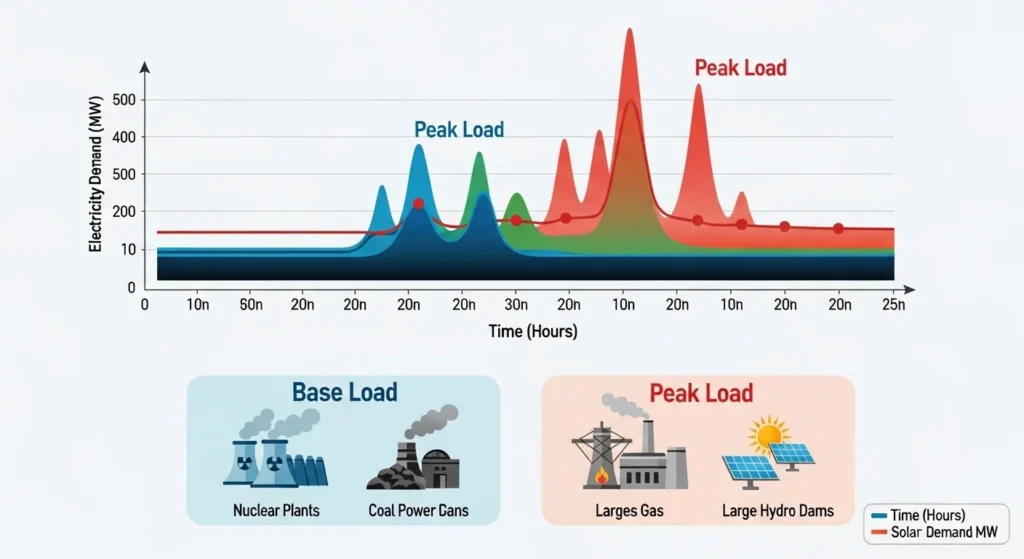
Engineers analyze these demand changes using a load curve, which is a graph showing how electrical demand varies with time. The lowest continuous portion of the load curve represents the base load, while the highest points represent the peak load.
Step-by-Step Working Principle
Step 1: Electricity Demand Is Continuously Measured
The first step is to continuously monitor electricity consumption across the power system.
Power utilities use advanced equipment such as:
- Smart energy meters
- Supervisory Control and Data Acquisition (SCADA) systems
- Load monitoring devices
- Grid control centers
- Digital energy management systems
These systems collect real-time data from residential, commercial, and industrial consumers to determine the total electricity demand at every moment.
Step 2: A Load Curve Is Created
The collected demand data is plotted on a graph known as the load curve.
In this graph:
- The horizontal axis (X-axis) represents time (hours, days, or months).
- The vertical axis (Y-axis) represents electrical load or power demand (kW, MW, or GW).
The load curve helps engineers visualize how electricity demand changes throughout the day and identify periods of low, average, and high demand.
Step 3: Base Load Is Identified
The lowest and most stable section of the load curve represents the base load.
This is the minimum amount of electricity that consumers require continuously, regardless of the time of day.
Typical base load consumers include:
- Hospitals
- Data centers
- Street lighting
- Water treatment plants
- Communication systems
- Refrigerators
- Continuous industrial processes
Since this demand remains relatively constant, it is supplied by power plants designed for continuous, efficient operation.
Step 4: Peak Load Is Identified
The highest points on the load curve represent the peak load.
Peak load occurs when many electrical devices operate simultaneously, causing electricity demand to rise significantly.
Common causes of peak load include:
- Air conditioners operating during hot afternoons
- Electric heaters used in winter
- Industrial production during working hours
- Commercial activities in shopping centers
- Evening household appliance usage
- Festivals and public events
Peak demand generally lasts only a few hours but requires additional electricity generation to maintain system stability.
Step 5: Different Power Plants Supply Different Portions of the Load
One of the most important principles of power system operation is load sharing.
Different types of power plants are assigned to handle different portions of the electrical load based on their:
- Operating efficiency
- Fuel cost
- Startup time
- Response speed
- Operating flexibility
- Environmental impact
This coordinated operation ensures reliable electricity generation while minimizing operating costs.
Base Load Power Plants
Base load power plants operate continuously because they are highly efficient for long-term operation and have relatively slow startup times.
Common examples include:
- Nuclear power plants
- Coal-fired thermal power plants
- Large combined-cycle power plants
- Geothermal power plants (in suitable regions)
These plants supply the constant minimum demand throughout the day and night.
Peak Load Power Plants
Peak load power plants operate only when electricity demand exceeds the base load.
These plants can start quickly and respond rapidly to sudden increases in demand.
Common examples include:
- Gas turbine power plants
- Hydroelectric power plants
- Diesel generator stations
- Pumped-storage hydroelectric plants
Although they are generally more expensive to operate, they provide the flexibility needed during high-demand periods.
Renewable Energy Contribution
Renewable energy sources also play an important role in supplying electrical power.
Examples include:
- Solar power plants
- Wind farms
- Small hydroelectric stations
- Biomass power plants
Their output depends on weather conditions and resource availability. When available, renewable energy helps reduce the load on conventional power plants, lower fuel consumption, and decrease greenhouse gas emissions.
Step 6: Load Balancing Maintains Grid Stability
The total electricity generated must always equal the total electricity consumed.
If demand suddenly increases and generation is insufficient:
- System frequency decreases.
- Voltage may become unstable.
- Equipment performance is affected.
- Power outages or blackouts may occur.
If generation exceeds demand:
- Frequency increases.
- Equipment may operate outside safe limits.
- Power quality may deteriorate.
Grid operators continuously adjust power plant outputs to maintain a balance between generation and demand, ensuring stable voltage and frequency throughout the electrical network.
Why Different Power Plants Handle Different Loads
Each type of power plant has unique operating characteristics.
Using the appropriate plant for each type of load offers several advantages:
- Improves overall power system efficiency.
- Reduces fuel and operating costs.
- Increases grid reliability.
- Minimizes unnecessary equipment wear.
- Enhances power quality.
- Supports renewable energy integration.
- Ensures continuous electricity supply during changing demand.
This coordinated load sharing is one of the fundamental principles of modern power system operation.
Easy Analogy
Imagine a city’s public bus service.
A small number of buses operate throughout the day, providing regular transportation regardless of passenger numbers. These buses represent base load power plants, which continuously supply the minimum electricity demand.
During the morning and evening rush hours, many more passengers need transportation. To meet this temporary increase in demand, additional buses are deployed. These extra buses represent peak load power plants, which operate only when electricity demand rises.
Similarly:
- Base load power plants operate continuously to meet the constant minimum demand.
- Peak load power plants start quickly during periods of high electricity demand and shut down when demand returns to normal.
Summary
The working principle of base load and peak load is based on continuously monitoring electricity demand and matching power generation to that demand. Engineers use load curves to identify the minimum continuous demand (base load) and the highest temporary demand (peak load). Base load power plants operate continuously because they are efficient for long-duration service, while peak load power plants start only when additional electricity is required. This coordinated approach ensures reliable power generation, stable grid operation, improved energy efficiency, lower operating costs, and an uninterrupted electricity supply for consumers.
4. Types / Classification
3.1 Base Load Power Plants: Continuous Power Supply for Essential Electricity Demand
Base load power plants are large electricity-generating stations designed to operate continuously and provide a stable supply of power to meet the minimum or constant electricity demand of an electrical grid. They form the foundation of every modern power system because they generate electricity 24 hours a day, 7 days a week, regardless of the time, weather conditions, or seasonal demand.
Every electrical grid has a certain amount of electricity demand that always exists. Even during late-night hours when most homes and businesses consume less electricity, essential facilities such as hospitals, data centers, water treatment plants, communication systems, railway networks, street lighting, and continuous industrial processes still require power. This constant demand is known as the base load, and it is supplied by base load power plants.
These power plants are specifically designed for long-term, uninterrupted operation. They achieve their highest efficiency when operating at a nearly constant output and are therefore not suitable for frequent start-ups, shutdowns, or rapid load changes. Instead, they provide the stable foundation of electricity generation, while peak load and intermediate load power plants handle fluctuations in demand.
Without base load power plants, maintaining a reliable and stable electricity supply would be extremely difficult, especially in large interconnected power systems.
How Base Load Power Plants Work
Base load power plants operate continuously by generating electricity at a nearly constant output.
The process generally works as follows:
- Fuel or another energy source produces mechanical energy.
- A turbine converts this energy into rotational motion.
- The turbine drives an electrical generator.
- The generator converts mechanical energy into electrical energy.
- Electricity is transmitted through transformers and transmission lines to the power grid.
- The plant continues operating continuously to satisfy the minimum electrical demand.
Since the demand for base load remains relatively stable throughout the day, these plants rarely need to change their output significantly.
Common Types of Base Load Power Plants
Several types of power plants are commonly used to supply base load electricity.
1. Coal-Fired Power Plants
Coal-fired power plants burn coal to produce steam, which drives a steam turbine connected to an electrical generator.
Features
- High electricity generation capacity
- Reliable continuous operation
- Suitable for large power systems
- Long operating life
Although many countries are gradually reducing coal usage due to environmental concerns, coal plants still provide a significant portion of base load electricity in many regions.
2. Nuclear Power Plants
Nuclear power plants generate heat through nuclear fission instead of burning fossil fuels.
The heat converts water into steam, which rotates a turbine connected to an electrical generator.
Features
- Extremely reliable
- Very high generation capacity
- Low greenhouse gas emissions during operation
- Excellent for continuous base load generation
- Long operating life
Because nuclear reactors require long startup and shutdown times, they are ideal for supplying constant electrical demand.
3. Large Hydroelectric Power Plants
Large hydroelectric stations with reliable water availability can also operate as base load power plants.
Water stored behind a dam flows through turbines to generate electricity continuously.
Features
- Renewable energy source
- High efficiency
- Low operating costs
- Long service life
- Clean electricity generation
However, their ability to supply base load depends on adequate and consistent water resources.
4. Geothermal Power Plants
Geothermal plants use heat naturally stored beneath the Earth’s surface to produce steam and generate electricity.
Features
- Renewable energy source
- Continuous power generation
- Low emissions
- High reliability
- Suitable for regions with geothermal resources
Since geothermal heat is available continuously, these plants are well suited for base load operation.
Key Characteristics of Base Load Power Plants
Base load power plants have several unique characteristics that distinguish them from peak load power plants.
Continuous Operation
These plants operate continuously throughout the day and night, supplying electricity without interruption.
High Operating Efficiency
They achieve maximum efficiency when operating at a constant output rather than frequently changing their generation level.
Long Operating Periods
Base load plants are designed to remain in operation for weeks or even months before scheduled maintenance.
Low Cost per Unit of Electricity
Although their construction cost is usually very high, the cost of generating each unit of electricity becomes relatively low over their long operating life.
Slow Startup and Shutdown
Large thermal and nuclear power plants require several hours or even days to start and synchronize with the electrical grid.
For this reason, they are not suitable for handling sudden increases in electricity demand.
Large Power Generation Capacity
Base load stations are capable of producing hundreds or even thousands of megawatts of electrical power continuously.
This makes them suitable for supplying electricity to large cities, industries, and national power grids.
High Capital Investment
Constructing a base load power plant requires substantial investment in equipment, infrastructure, safety systems, and transmission facilities.
However, their long service life makes them economically attractive over time.
Supports Grid Stability
Because they operate continuously, base load plants help maintain:
- Stable system frequency
- Constant voltage
- Reliable electricity supply
- Balanced power generation
- Improved power quality
Advantages of Base Load Power Plants
Base load power plants offer several important benefits for modern electrical power systems.
Major Advantages
- Provide continuous and reliable electricity generation.
- Supply the minimum electrical demand of the grid.
- Operate efficiently at constant output levels.
- Reduce the cost of electricity generation over time.
- Improve overall power system stability.
- Support large industrial and commercial consumers.
- Ensure uninterrupted electricity for essential services.
- Offer long operating life with proper maintenance.
- Form the foundation of national electrical grids.
- Enable reliable integration with other power generation sources.
Limitations of Base Load Power Plants
Despite their advantages, base load plants also have some limitations.
Common Limitations
- High initial construction cost.
- Long project completion time.
- Slow startup and shutdown.
- Limited flexibility during rapid demand changes.
- Require significant maintenance planning.
- Some types produce environmental emissions.
- Not suitable for meeting sudden peak electricity demand.
Importance in Modern Power Systems
Base load power plants play a critical role in ensuring that electricity is always available for essential services and continuous industrial operations.
They supply power to:
- Residential consumers
- Hospitals
- Data centers
- Airports
- Railway systems
- Water treatment plants
- Communication networks
- Manufacturing industries
- Commercial buildings
- Government facilities
Without these continuously operating plants, maintaining a stable electrical grid would be extremely challenging.
Role in the Electrical Grid
Modern electrical grids use a combination of different power plants to meet changing electricity demand.
- Base load power plants provide the constant minimum electricity demand.
- Intermediate load power plants adjust their output to meet moderate demand changes.
- Peak load power plants start quickly to supply electricity during periods of maximum demand.
This coordinated operation ensures that electricity generation always matches consumer demand while minimizing operating costs and maximizing system reliability.
Base load power plants are the backbone of modern electrical power systems. They operate continuously to supply the minimum level of electricity required by consumers and are designed for high efficiency, long-term operation, and dependable performance. Common examples include coal-fired, nuclear, large hydroelectric, and geothermal power plants. Although they require significant capital investment and are less flexible during rapid demand changes, they provide economical, reliable, and uninterrupted electricity generation that supports homes, industries, hospitals, and other critical infrastructure. By working alongside intermediate and peak load power plants, they help create a balanced, stable, efficient, and reliable electrical grid capable of meeting varying electricity demands throughout the day.
Peak Load Power Plants: Supplying Electricity During Maximum Demand
Peak load power plants are designed to generate electricity only during periods of high power demand, known as peak load conditions. These plants operate when electricity consumption suddenly rises, such as on hot summer afternoons when air conditioners are heavily used, during evening hours when residential demand increases, or during periods of high industrial activity. Their primary purpose is to provide additional power to the electrical grid, prevent power shortages, and maintain a stable electricity supply.
Unlike base load power plants that run continuously, peak load plants remain on standby and are started only when needed. Therefore, they are built with fast startup capability, allowing them to reach full power output within minutes. This rapid response helps grid operators maintain the balance between electricity generation and consumption.
Although peak load power plants have higher operating and fuel costs than base load plants, they are essential for ensuring grid reliability, preventing voltage drops, and meeting temporary spikes in electricity demand. They also provide emergency backup power during unexpected generator failures or sudden increases in load.
Common Types of Peak Load Power Plants
- Gas turbine power plants
- Diesel generator power plants
- Pumped storage hydroelectric power plants
- Hydroelectric power plants with quick-start capability
Characteristics of Peak Load Power Plants
- Operate only during periods of maximum electricity demand.
- Can start and reach full output within a short time.
- Have higher operating and fuel costs than base load plants.
- Run for relatively short durations.
- Help maintain grid stability and voltage regulation.
- Provide emergency and reserve power when required.
- Improve the overall reliability of the electrical power system.
Intermediate Load Power Plants: Balancing Efficiency and Grid Flexibility
Intermediate load power plants, also called load-following power plants, are designed to operate between base load and peak load power plants. They generate electricity during periods of moderate demand and adjust their output as electricity consumption changes throughout the day. These plants bridge the gap between continuously operating base load stations and rapidly responding peak load plants, making them an important part of modern power systems.
Intermediate load plants are built to offer a combination of good fuel efficiency and operational flexibility. They can increase or decrease power generation much faster than coal or nuclear power plants while operating more economically than most peak load plants. This makes them ideal for handling daily demand variations without relying entirely on expensive peak load generation.
By following changes in electricity demand, intermediate load power plants reduce stress on both base load and peak load stations, improve fuel utilization, and help maintain a stable and reliable electrical grid.
Common Types of Intermediate Load Power Plants
- Combined cycle gas power plants
- Natural gas-fired thermal power plants
- Medium-capacity hydroelectric power plants
- Flexible biomass power plants (in some regions)
Characteristics of Intermediate Load Power Plants
- Operate during periods of moderate electricity demand.
- Adjust power output according to daily load variations.
- Offer higher efficiency than many conventional thermal power plants.
- Have faster startup and shutdown times than coal and nuclear plants.
- Balance fuel economy with operational flexibility.
- Support grid stability by following changing electricity demand.
- Reduce the operating burden on both base load and peak load power plants.
- Improve overall power system efficiency and reliability.
Intermediate load power plants are essential for maintaining a flexible, efficient, and dependable electricity supply. Their ability to respond to changing demand while operating economically helps utilities optimize fuel consumption, maintain system stability, and ensure uninterrupted power delivery throughout the day.
5. Major Components in Base Load and Peak Load Power Systems
To understand Base Load vs Peak Load operation in a power system, it is important to know the main components that work together to supply electricity reliably and efficiently.
Power Plants
Power plants are the primary sources of electricity generation. Different types of plants are operated according to the level of electricity demand.
- Base load plants supply continuous power.
- Intermediate load plants adjust output as demand changes.
- Peak load plants operate during periods of highest demand.
Load Dispatch Center
The load dispatch center is the control hub of the power system.
Its functions include:
- Monitoring real-time electricity demand.
- Controlling power generation from different plants.
- Maintaining the balance between generation and consumption.
- Ensuring stable and economical system operation.
Transmission System
The transmission system carries electrical energy from generating stations to substations and distribution networks.
It consists of:
- High-voltage transmission lines.
- Transmission towers.
- Substations and transformers.
This system minimizes power losses and enables electricity to be delivered over long distances.
Load Curve Monitoring System
The load curve monitoring system records and analyzes variations in electricity demand over time.
It helps operators:
- Identify base, intermediate, and peak demand periods.
- Plan generation schedules.
- Forecast future electricity requirements.
- Improve overall system efficiency.
Importance of Coordination
All these components work together to maintain power system stability, reliability, and safety. Proper coordination helps:
- Prevent overloading of equipment.
- Maintain system frequency and voltage.
- Reduce the risk of blackouts.
- Ensure uninterrupted electricity supply to consumers.
In a modern electrical power system, the effective interaction between power plants, dispatch centers, transmission networks, and load monitoring systems is essential for meeting changing electricity demand while maintaining stable and efficient operation.
6. Advantages and Disadvantages of Base Load and Peak Load Power Plants
Both base load and peak load power plants play essential roles in maintaining a reliable and efficient power system. While each type offers unique advantages, they also have certain limitations depending on how they are used.
Advantages of Base Load Power Plants
Base load power plants are designed to provide a continuous and stable supply of electricity.
Their key advantages include:
- Deliver a reliable and uninterrupted power supply.
- Generate electricity at a lower cost per unit over long operating periods.
- Achieve high efficiency when operating at a constant load.
- Support long-term grid stability and continuous industrial operations.
- Ideal for meeting the minimum or constant electricity demand.
Advantages of Peak Load Power Plants
Peak load power plants are used during periods of high electricity demand.
Their major benefits include:
- Respond quickly to sudden increases in power demand.
- Help prevent power shortages and blackouts.
- Improve the flexibility and reliability of the electrical grid.
- Maintain voltage and frequency stability during peak demand periods.
- Ensure sufficient electricity supply during emergencies and seasonal demand spikes.
Disadvantages of Base Load Power Plants
Although highly efficient, base load plants have some limitations:
- Require long startup and shutdown times.
- Cannot rapidly adjust power output to changing demand.
- Involve high initial construction and installation costs.
- Maintenance activities may require planned outages.
Disadvantages of Peak Load Power Plants
Peak load plants offer flexibility but also have certain drawbacks:
- Higher electricity generation cost per unit.
- Lower operating efficiency because they run for limited hours.
- Greater fuel consumption during operation.
- Increased operating and maintenance costs due to frequent start-stop cycles.
Real-World Benefits of Using Both Plant Types
Using both base load and peak load power plants together creates a balanced and dependable power system.
The combined benefits include:
- Ensures a continuous 24/7 electricity supply for consumers.
- Optimizes fuel utilization by assigning the right plant for different demand levels.
- Improves grid reliability and overall power system stability.
- Reduces the risk of overloads, voltage fluctuations, and blackouts.
- Enables efficient management of changing electricity demand throughout the day.
By combining the steady output of base load power plants with the rapid response capability of peak load power plants, modern power systems can deliver reliable, economical, and efficient electricity under all operating conditions.
7. Limitations of Base Load and Peak Load Power Plants
While base load and peak load power plants are essential for maintaining a reliable electricity supply, each has certain operational limitations. Understanding these drawbacks helps power system engineers select the most suitable generation sources and maintain an efficient electrical grid.
Base Load Power Plant Limitations
Base load power plants are designed for continuous operation but have limited operational flexibility.
Their main limitations include:
- Cannot respond quickly to sudden changes in electricity demand.
- Require long startup and shutdown times.
- Have high initial construction and installation costs.
- Major maintenance may require planned shutdowns, reducing availability.
- Not suitable for meeting short-term or peak electricity demand.
Peak Load Power Plant Limitations
Peak load power plants provide rapid power generation during high-demand periods but operate less efficiently than base load plants.
Their limitations include:
- Higher fuel costs due to short-duration operation.
- Higher electricity generation cost per unit.
- Lower overall efficiency compared to base load power plants.
- Frequent start-stop cycles increase equipment wear and maintenance requirements.
- Generally operate for only a few hours each day, reducing capacity utilization.
Importance of Proper Load Planning
An efficient power system requires a balanced combination of base load, intermediate load, and peak load power plants. Proper load planning helps:
- Maintain a continuous and reliable electricity supply.
- Minimize fuel and operating costs.
- Improve overall power system efficiency.
- Reduce the risk of overloading and blackouts.
- Ensure stable voltage and frequency under varying load conditions.
By carefully coordinating different types of power plants, utilities can achieve a reliable, economical, and flexible power system capable of meeting both constant and fluctuating electricity demand.
8. Applications of Base Load and Peak Load Power
Understanding the applications of base load and peak load power is essential for designing an efficient and reliable electrical power system. Different sectors require different types of power supply depending on whether the electricity demand is continuous or varies throughout the day.
Residential Applications
In homes, some electrical appliances operate continuously, while others are used only during specific periods of high demand.
Base Load Applications
- Refrigerators
- Wi-Fi routers and communication equipment
- Home security systems
- Lighting for essential areas
Peak Load Applications
- Air conditioners
- Electric water heaters
- Microwave ovens
- Washing machines and clothes dryers
Industrial Applications
Industries require a combination of continuous and variable power to maintain production efficiency.
Base Load Applications
- Continuous manufacturing and production lines
- Process industries operating 24/7
- Industrial control and automation systems
- Essential plant equipment
Peak Load Applications
- Heavy machinery during production shifts
- Large electric motors
- Welding equipment
- Cranes and material handling systems
Commercial Applications
Commercial buildings experience varying electricity demand throughout the day.
Base Load Applications
- Elevators and security systems
- Emergency lighting
- Computer servers
- Communication networks
Peak Load Applications
- HVAC (Heating, Ventilation, and Air Conditioning) systems
- Escalators during busy hours
- Commercial kitchen equipment
- High-capacity lighting during events
Modern Technology Applications
The growth of digital infrastructure has increased the importance of proper load management.
Base Load Applications
- Data centers
- Cloud computing servers
- Telecommunication networks
- Internet infrastructure
Peak Load Applications
- Electric vehicle (EV) charging stations
- Fast-charging hubs
- Smart grid demand response systems
- Battery energy storage during peak demand
Importance in Power System Planning
The practical applications of base load and peak load power are fundamental to modern grid planning and energy management. Proper classification of electrical loads helps utilities:
- Maintain a reliable and uninterrupted electricity supply.
- Improve power generation efficiency.
- Optimize fuel consumption and operating costs.
- Reduce the risk of overloading and power outages.
- Support the integration of renewable energy sources into the electrical grid.
Effective management of base load and peak load applications enables power utilities to deliver stable, economical, and efficient electricity while meeting the changing demands of residential, commercial, industrial, and modern technological infrastructures.
9. Difference Between Base Load and Peak Load
Here is a clear comparison table:
| Parameter | Base Load | Peak Load |
| Definition | Minimum continuous demand | Maximum demand level |
| Duration | 24/7 | Short duration |
| Type of Plant | Coal, Nuclear | Gas turbine, Diesel |
| Operating Cost | Low per unit | High per unit |
| Startup Time | Slow | Fast |
| Efficiency | High at constant load | Lower efficiency |
This table clearly shows the difference between base load and peak load.
10. Selection Guide for Base Load and Peak Load Power Plants
Selecting the appropriate combination of base load and peak load power plants is essential for ensuring reliable, economical, and efficient electricity generation. The choice depends on several technical, economic, and environmental factors.
Demand Pattern
The first step is to analyze the daily, weekly, and seasonal load curves to understand how electricity demand changes over time. Areas with stable demand require stronger base load capacity, while regions with large demand fluctuations need sufficient peak load support.
Budget and Investment
Base load power plants, such as coal and nuclear plants, require high initial capital investment but offer lower operating costs over their lifetime. Peak load plants generally require lower initial investment but have higher operating and fuel costs because they operate only during periods of high demand.
Fuel Availability
The availability and cost of fuel significantly influence plant selection.
Common fuel sources include:
- Coal
- Natural gas
- Hydropower
- Nuclear fuel
- Renewable energy resources
Choosing locally available energy sources helps reduce operating costs and improve long-term energy security.
Grid Stability Requirements
Large interconnected power systems require strong base load generation to maintain voltage, frequency, and system reliability. Peak load plants provide additional support during periods of high electricity demand and emergency situations.
Environmental Considerations
Modern power planning also considers environmental impact, carbon emissions, fuel efficiency, and government regulations. Cleaner technologies and renewable energy sources are increasingly being integrated into both base load and peak load generation strategies.
Tips for Beginners
When planning or studying electrical power systems, keep these best practices in mind:
- Analyze the load curve before selecting power plant capacity.
- Avoid oversizing peak load plants, as they increase operating costs.
- Maintain an adequate reserve margin for system reliability.
- Consider future demand growth and expansion requirements.
- Balance efficiency, flexibility, and environmental sustainability when selecting generation sources.
Proper selection of base load and peak load plants helps create a reliable, cost-effective, and efficient electrical power system capable of meeting both present and future electricity demand.
11. Common Problems and Solutions (FAQs)
Understanding common issues related to base load and peak load operation helps engineers and students better manage electrical power systems.
What Happens If Peak Load Exceeds Generation Capacity?
Problem:
When electricity demand becomes greater than the available generation capacity, the power system experiences overload conditions. This can result in voltage drops, frequency instability, equipment overloading, and widespread blackouts.
Solution:
Utilities manage this situation by:
- Operating reserve or standby generators.
- Implementing load shedding when necessary.
- Importing electricity from interconnected power grids.
- Using battery energy storage systems to support peak demand.
Why Can’t Base Load Power Plants Meet Peak Demand Quickly?
Answer:
Base load power plants are designed to operate continuously at nearly constant output. Because of mechanical, thermal, and operational limitations, they require significant time to increase or decrease generation and therefore cannot respond rapidly to sudden demand changes.
How Can Peak Load Be Reduced?
Electric utilities reduce peak demand through several demand-side management strategies, including:
- Demand response programs.
- Time-of-use electricity pricing.
- Energy-efficient appliances and lighting.
- Smart meters and automated energy management systems.
- Consumer awareness programs that encourage shifting electricity use to off-peak hours.
These measures lower peak demand, improve grid efficiency, and reduce operating costs.
What Is Load Shedding?
Load shedding is the temporary and controlled interruption of electricity supply to selected areas when generation cannot meet demand. It helps maintain the balance between electricity generation and consumption, preventing complete system failure and protecting the electrical grid from widespread blackouts.
Why Is Load Forecasting Important?
Accurate load forecasting enables utilities to:
- Schedule power generation efficiently.
- Reduce fuel consumption and operating costs.
- Improve system reliability.
- Ensure adequate reserve capacity for future demand.
12. Future Trends in Base Load and Peak Load Management
Modern electrical power systems are evolving toward smarter, cleaner, and more flexible methods of managing electricity demand and generation. Several emerging technologies are transforming the way base load and peak load are handled.
Smart Grids
Smart grids use advanced sensors, communication networks, and automated control systems to continuously monitor electricity demand and supply. They can automatically balance loads, improve grid reliability, detect faults quickly, and optimize power distribution in real time.
Renewable Energy Integration
Renewable energy sources such as solar, wind, and hydroelectric power are becoming a larger part of electricity generation. Although these resources are variable, they help reduce dependence on conventional fossil-fuel-based base load plants while lowering greenhouse gas emissions.
Energy Storage Systems
Large-scale battery energy storage systems store excess electricity during periods of low demand and release it during peak demand. Energy storage improves grid stability, supports renewable energy integration, and reduces the need for additional peak load power plants.
Demand Response Programs
Demand response programs encourage consumers to reduce or shift electricity usage during peak demand periods through pricing incentives and automated energy management systems. These programs help flatten the load curve and reduce stress on the electrical grid.
Artificial Intelligence and Smart Analytics
Artificial intelligence (AI) and advanced data analytics are increasingly being used for load forecasting, predictive maintenance, fault detection, and real-time optimization of power system operations. These technologies improve efficiency, reduce operating costs, and enhance overall grid reliability.
Microgrids and Distributed Energy Resources
Microgrids, rooftop solar systems, and distributed energy resources allow electricity to be generated closer to consumers. This reduces transmission losses, improves energy resilience, and provides additional support during peak demand or grid outages.
Future Outlook
The future of base load and peak load management lies in the integration of smart grids, renewable energy, energy storage systems, artificial intelligence, and demand response technologies. These innovations are creating more flexible, reliable, sustainable, and cost-effective electrical power systems capable of meeting growing global electricity demand while reducing environmental impact.
13. Conclusion
Understanding Base Load vs Peak Load is fundamental for every electrical engineer and technician. Base load ensures continuous power supply, while peak load management prevents system overload during high demand periods.
A well-designed power system always maintains a balance between steady generation and flexible response. By analyzing load curves, selecting suitable power plants, and using smart technologies, engineers can ensure reliable and economical electricity supply.
As a junior engineer, always remember: power system planning is not only about generating electricity — it is about generating the right amount at the right time.
Mastering this concept will strengthen your foundation in power system engineering and grid management.