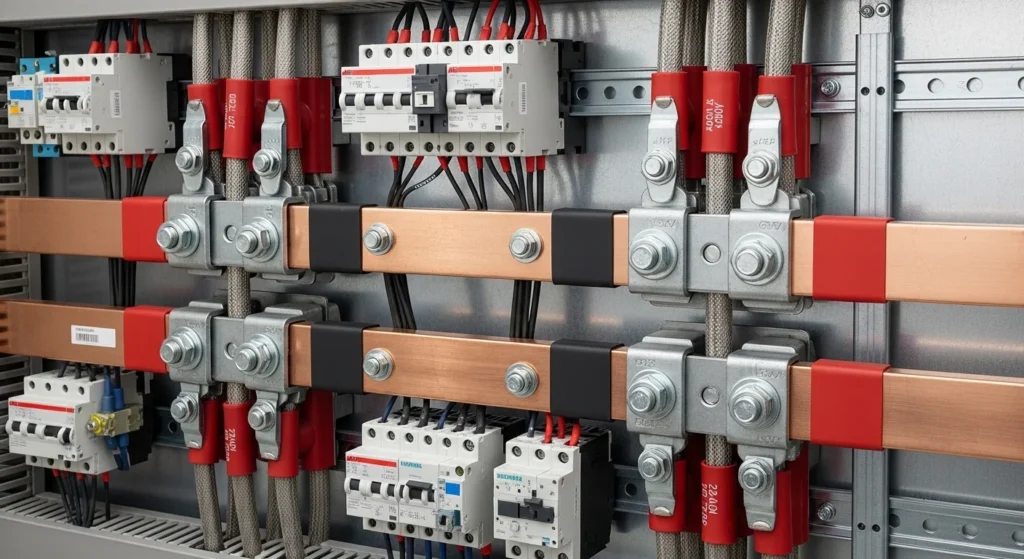

Imagine you enter a large industrial power panel. Instead of seeing dozens of thick cables connected everywhere, you notice solid metallic bars neatly arranged and connected to circuit breakers and feeders. These bars distribute heavy current safely and efficiently across the system. Those are busbars.
Understanding the Busbar System is very important for electrical students, engineers, and technicians because it plays a central role in power distribution. Without a proper busbar arrangement, managing high current in substations, panels, and industries would be unsafe and complicated.
A busbar system ensures that electrical power is distributed reliably from one source to multiple outgoing circuits. It improves system efficiency, simplifies maintenance, and enhances safety.
In this detailed guide, you will learn the busbar system working principle, types, components, busbar system applications, and busbar system advantages and disadvantages. I will explain everything in simple language, just like a senior electrical engineer teaching a junior.
2. What is a Busbar System?
A Busbar System is an arrangement of solid metallic conductors used to collect and distribute electrical power efficiently within a power system.
Simple Explanation
A busbar is a thick copper or aluminum bar that carries large amounts of current. Multiple circuits are connected to this bar to receive or supply power.
Practical Example
In a substation, power from a transformer enters a main busbar. From that busbar, power is distributed to different feeders and outgoing lines.
In simple words:
A busbar system is a central power distribution pathway.
3. Busbar System Working Principle
The busbar system working principle is simple and practical.
Step-by-Step Explanation
- Power enters the main incoming breaker.
- The breaker connects supply to the busbar.
- The busbar carries heavy current safely.
- Outgoing feeders are connected to the busbar.
- Each feeder supplies power to different loads.
Easy Analogy
Think of a busbar system like a water distribution pipe:
- Main tank = Transformer
- Main pipe = Busbar
- Small pipes = Outgoing feeders
- Houses = Electrical loads
The busbar collects and distributes power just like a water pipeline distributes water.
4. Types / Classification of Busbar Systems
Busbar systems are classified based on design and reliability.
Single Busbar System
- One main busbar
- Simple and economical
- Easy to install
- Less reliability
Used in small substations.
Double Busbar System
- Two busbars
- One active, one standby
- Higher reliability
- Suitable for large substations
Ring Busbar System
- Busbars arranged in ring shape
- High reliability
- Fault isolation is easy
Mesh Busbar System
- Complex arrangement
- Very high reliability
- Used in critical power systems
Each type depends on load importance and system size.
5. Main Components of a Busbar System
Busbar Conductors
Copper or aluminum bars that carry current.
Insulators
Support and isolate busbars from panel body.
Circuit Breakers
Control and protect the busbar.
Disconnectors
Used for isolation during maintenance.
Bus Coupler
Connects two busbars together.
Each component ensures safe power flow and protection.
6. Busbar System Advantages
Here are key busbar system advantages and disadvantages (starting with advantages):
- Handles high current safely
- Better heat dissipation
- Reduces wiring complexity
- Easy maintenance
- Improves system reliability
- Compact design
These advantages make busbars ideal for industrial power distribution.
7. Disadvantages / Limitations
- Higher initial installation cost
- Requires proper insulation
- Fault may affect multiple feeders (in single bus system)
- Space requirement in large systems
- Skilled installation required
Despite limitations, busbars remain essential in modern power systems.
8. Busbar System Applications
Busbar system applications are wide and important.
Home Applications
- Distribution boards
- Main switch panels
Industrial Applications
- Factory power distribution
- Motor control centers
Power Stations
- Substations
- Transformer yards
Modern Technology
- Data centers
- Renewable energy plants
- Electric vehicle charging stations
Busbar system applications continue expanding with growing energy demand.
9. Comparison: Busbar System vs Cable System
Many students ask about the difference between busbar system and cable system.
| Feature | Busbar System | Cable System |
| Current Capacity | Very High | Moderate |
| Installation | Structured | Flexible |
| Maintenance | Easy | Difficult |
| Space Requirement | Compact | More space |
| Cost | Higher initial | Lower initial |
The main difference between busbar system and cable system is current carrying capacity and structural arrangement.
10. Selection Guide
Choosing the right busbar system depends on:
- Load current requirement
- Voltage level
- Short circuit rating
- Space availability
- Future expansion plan
- Budget
Tips for Beginners
- Always calculate maximum load current.
- Select proper copper or aluminum material.
- Check insulation level.
- Follow safety standards.
Correct selection ensures long-term reliability.
11. Common Problems & Solutions
Why busbar overheating occurs?
Cause:
- Overload
- Loose connection
Solution:
- Tighten connections
- Check load calculation
Why insulation failure happens?
Cause:
- Dust accumulation
- Moisture
Solution:
- Regular cleaning
- Maintain dry environment
What happens during short circuit?
High fault current flows.
Solution:
- Use proper circuit breakers
- Ensure correct short-circuit rating
12. Future Trends
Busbar technology is improving with modern innovations.
- Insulated bus duct systems
- Smart monitoring sensors
- Compact modular busbar designs
- Fire-resistant busbars
- Eco-friendly insulation materials
With growing renewable energy systems, demand for efficient busbar systems is increasing.
13. Conclusion
The Busbar System is a critical part of electrical power distribution. It collects and distributes high current safely and efficiently.
In this guide, we discussed the busbar system working principle, types, components, busbar system applications, and busbar system advantages and disadvantages. We also explained the difference between busbar system and cable system.
As a junior engineer, always focus on proper current calculation, insulation, and protection while designing busbar arrangements. Strong understanding of busbar systems will help you design reliable and safe electrical installations.
Keep learning practical system layouts, and your confidence in power distribution engineering will grow.