
Imagine you are working at home and suddenly too many electrical appliances are turned on at once. The wiring starts heating, and there is a risk of fire. Suddenly, the power goes off automatically. You check the distribution board and find that the circuit breaker has tripped.
This is a simple real-life example of how protection systems work in electrical engineering.
Understanding What is a Circuit Breaker? is very important for electrical students, engineers, and technicians because circuit breakers protect electrical systems from dangerous conditions such as overload and short circuit.
Circuit breakers are widely used in homes, industries, and power transmission networks.
In this article, you will learn the circuit breaker working principle, types, components, applications, advantages and disadvantages, and the difference between circuit breaker and fuse. I will explain everything in simple language like a senior engineer teaching a junior.
2. What is a Circuit Breaker?
A circuit breaker is an electrical protection device that automatically stops current flow when a fault occurs in a circuit.
Simple Explanation
When current exceeds the safe limit, the circuit breaker trips and disconnects the electrical supply.
Practical Example
If you connect too many high-power devices in one socket, current increases beyond safe limits. The circuit breaker senses the abnormal condition and switches off the circuit.
In simple words:
A circuit breaker is an automatic electrical safety switch.
3. Circuit Breaker Working Principle
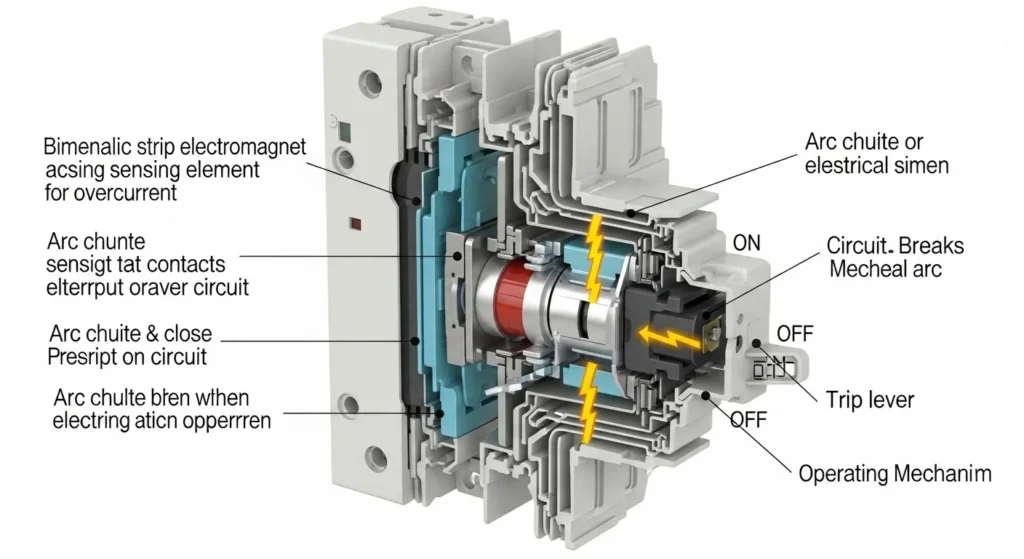
The circuit breaker working principle is based on two effects:
- Thermal effect of current
- Magnetic effect of current
Step-by-Step Working
- Normal Operation
- Current flows safely.
- Current flows safely.
- Overload Condition
- Excess current produces heat.
- Excess current produces heat.
- Thermal Protection
- Bimetal strip bends and trips the mechanism.
- Bimetal strip bends and trips the mechanism.
- Short Circuit Condition
- High magnetic force triggers instantaneous tripping.
- High magnetic force triggers instantaneous tripping.
- Contact Opening
- Supply is disconnected.
- Supply is disconnected.
Easy Analogy
Think of a circuit breaker like a security guard.
- Normal situation → Gate remains open
- Danger situation → Gate closes automatically
This is the basic circuit breaker working principle.
4. Types / Classification of Circuit Breakers
Circuit breakers are classified according to insulation medium.
1. Air Circuit Breaker (ACB)
- Uses air for arc extinction.
- Suitable for low and medium voltage systems.
- Commonly used in industrial panels.
Oil Circuit Breaker (OCB)
- Uses oil as arc quenching medium.
- Provides strong insulation.
Vacuum Circuit Breaker (VCB)
- Arc is extinguished in vacuum chamber.
- Very reliable and long life.
SF6 Circuit Breaker
- Uses sulfur hexafluoride gas.
- High arc interruption capability.
5. Main Components of a Circuit Breaker
Contacts
Allow current flow during normal operation.
Arc Chamber
Helps in arc quenching.
Operating Mechanism
Manual, spring, or motor-driven.
Trip Unit
Detects fault current.
Insulation System
Prevents leakage current.
Each part is important for safe operation.
6. Circuit Breaker Advantages
- Automatic protection
- Reusable after tripping
- Prevents electrical fire hazards
- High reliability
- Suitable for modern power systems
- Long service life
These are the main circuit breaker advantages and disadvantages.
7. Disadvantages / Limitations
- Higher cost than fuse
- Requires maintenance
- Mechanical parts may wear out
- Complex structure
- Needs proper calibration
Despite these limitations, circuit breakers are essential protection devices.
8. Circuit Breaker Applications
Home Applications
- Protects household wiring
- Prevents appliance damage
Industrial Applications
- Motor protection
- Machine control panels
Power Systems
- Substations
- Transmission grids
Renewable Energy Systems
- Solar power protection
- Wind energy systems
Circuit breaker applications are expanding with modern electrical technology.
9. Comparison: Circuit Breaker vs Fuse
| Feature | Circuit Breaker | Fuse |
| Reusability | Yes | No |
| Maintenance | Required | None |
| Cost | Higher | Lower |
| Protection Type | Automatic reset | Needs replacement |
| Response Time | Moderate | Fast |
The main difference between circuit breaker and fuse is reusability.
10. Selection Guide
When selecting a circuit breaker:
- Check voltage rating
- Select correct current rating
- Consider breaking capacity
- Check environmental conditions
- Follow load calculation
Beginner Tips
- Use certified products
- Match breaker with load current
- Install according to standards
11. Common Problems & Solutions
Why does circuit breaker trip frequently?
Cause:
- Overload or short circuit.
Solution:
- Reduce load.
- Check wiring.
Why breaker does not reset?
Cause:
- Internal mechanical fault.
Solution:
- Repair or replace breaker.
Why overheating occurs?
Cause:
- Loose connections.
Solution:
- Tighten terminals.
12. Future Trends
Circuit breaker technology is improving.
- Smart digital circuit breakers
- IoT monitoring systems
- AI fault detection
- Eco-friendly insulation materials
- Remote control protection devices
Future electrical systems will be more intelligent and automated.
13. Conclusion
Understanding What is a Circuit Breaker? is essential for safe electrical system design. A circuit breaker protects electrical circuits by automatically disconnecting supply during overload or short circuit conditions.
We discussed the circuit breaker working principle, types, components, applications, and the difference between circuit breaker and fuse.
Although circuit breakers are more expensive than fuses, their reliability and reusability make them very important in modern electrical systems.