
Imagine you press the switch of a small water pump connected to a battery. Within seconds, the pump starts rotating and pushes water to the tank. Inside that pump, a DC motor is quietly doing its job. From electric toys and car wipers to industrial conveyor belts, DC motors are everywhere.
Understanding What is a DC Motor? is very important for electrical students, technicians, and engineers. DC motors convert electrical energy into mechanical rotation. They are widely used where speed control and smooth operation are required.
In this detailed guide, you will learn the DC motor working principle, types of DC motors, main components, DC motor applications, and DC motor advantages and disadvantages. I will also explain the difference between AC motor and DC motor in a simple way. By the end, you will clearly understand how a DC motor works and how to select the right one for your project.
What Is a Direct Current (DC) Motor? Definition, Function, and Uses (2026)
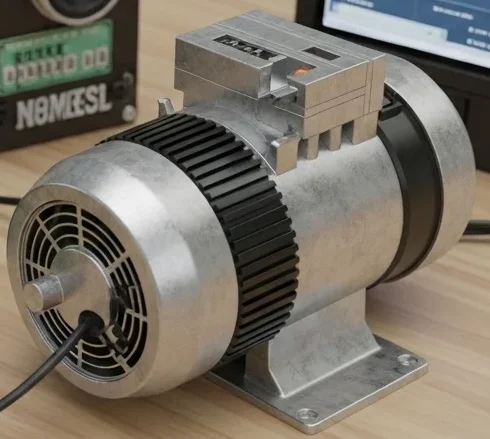
A Direct Current (DC) motor is an electrical machine that converts direct current electrical energy into mechanical energy in the form of rotational motion.
In simple terms, when a DC voltage is applied to a motor, it produces rotational movement. This rotation can be used to drive machines, fans, pumps, wheels, and many other mechanical devices.
Practical Example of a Direct Current (DC) Motor
Consider a battery-operated toy car. The battery provides a Direct Current (DC) electrical supply. When the car is switched on, the DC motor inside the vehicle rotates the wheels. This is a simple practical example of a DC motor in operation.
So, if someone asks, “What is a DC motor?”, the simple answer is:
A DC motor is an electrical device that converts Direct Current (DC) electrical energy into mechanical rotational energy.
Direct Current (DC) Motor Working Principle Explained (2026)
The working principle of a Direct Current (DC) motor is based on the fundamental principle that a current-carrying conductor placed within a magnetic field experiences a mechanical force.
This force produces movement, and in a DC motor, the resulting force generates torque that causes the rotor to rotate.
Step-by-Step Working of a Direct Current (DC) Motor
- A Direct Current (DC) voltage is applied to the motor terminals.
- Electrical current flows through the armature winding.
- The armature is positioned within a magnetic field.
- The interaction between the magnetic field and current-carrying conductor produces a force.
- This force generates torque.
- The torque causes the rotor to rotate and produce mechanical motion.
Easy Analogy
Imagine pushing a door. When you apply force at the handle, the door rotates on its hinge. Similarly:
- Current = Your push
- Magnetic field = Door hinge support
- Torque = Rotational movement
Fleming’s Left-Hand Rule
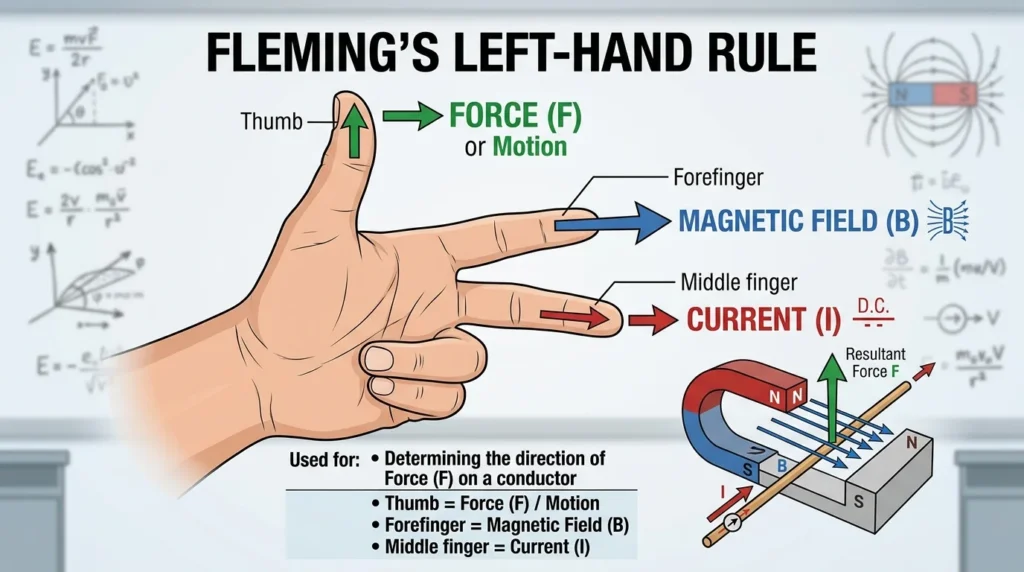
Fleming’s Left-Hand Rule is a simple method used to determine the direction of force or motion in an electric motor when a current-carrying conductor is placed inside a magnetic field. According to this rule, if the thumb, forefinger, and middle finger of the left hand are stretched perpendicular to each other, then the forefinger represents the direction of the magnetic field, the middle finger represents the direction of electric current, and the thumb represents the direction of motion or force produced on the conductor. This rule helps explain the working principle of electric motors where electrical energy is converted into mechanical motion. Fleming’s Left-Hand Rule is widely used in electrical engineering, motor design, industrial machinery, and educational studies to understand motor rotation and electromagnetic force. Understanding this rule is important for electrical students, engineers, and technicians because it forms the basic foundation of motor operation and electromagnetic principles used in modern electrical systems.
The direction of rotation can be found using Fleming’s Left-Hand Rule:
- Thumb → Force
- First finger → Magnetic field
- Second finger → Current
This explains the direction of motor rotation clearly.
Types / Classification of DC Motors (2026)
DC motors are classified mainly based on field winding connection.
Series DC Motor
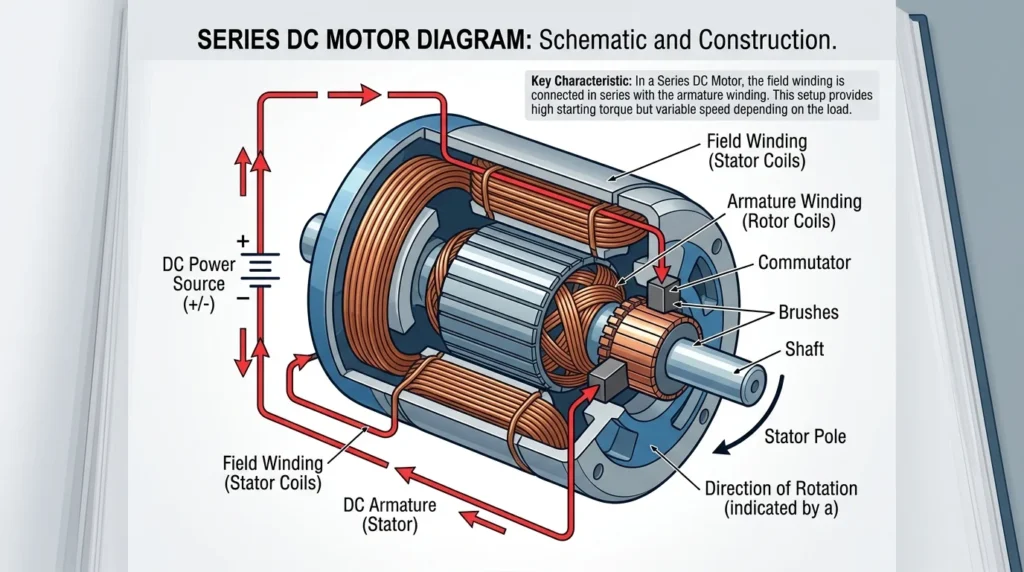
A series DC motor is a type of direct current motor in which the field winding is connected in series with the armature winding, allowing the same current to flow through both components. This motor is known for producing very high starting torque, making it suitable for applications that require heavy starting loads such as electric trains, cranes, hoists, elevators, and industrial machinery. When electrical current flows through the motor, a strong magnetic field is created in the field winding, and interaction between the magnetic field and armature conductors produces rotational motion. The speed of a series DC motor changes according to the load condition, meaning the motor runs slower under heavy loads and faster under light loads. However, it should never be operated without load because the speed may increase dangerously. Series DC motors are widely used in traction systems and lifting equipment because of their powerful starting performance and simple construction. Understanding the series DC motor is important for electrical students, engineers, and technicians because it is one of the most commonly used DC motors in heavy-duty electrical applications.
- Field winding is connected in series with armature.
- High starting torque.
- Speed varies with load.
Applications: Cranes, electric trains, heavy lifting equipment.
Shunt DC Motor
In this motor:
- Field winding is connected in parallel with armature.
- Speed remains almost constant.
- Moderate starting torque.
Applications: Lathes, fans, conveyors.
Compound DC Motor
This motor has both series and shunt windings.
It combines advantages of both motors:
- Good starting torque
- Better speed regulation
There are two types:
- Cumulative compound
- Differential compound
Permanent Magnet DC Motor (PMDC)
Instead of field winding, permanent magnets are used.
- Simple design
- Small size
- Low maintenance
Applications: Toys, small pumps, automotive systems.
Main Components (2026)
Understanding the main components helps in learning the Direct Current (DC) motor working principle and its operation.
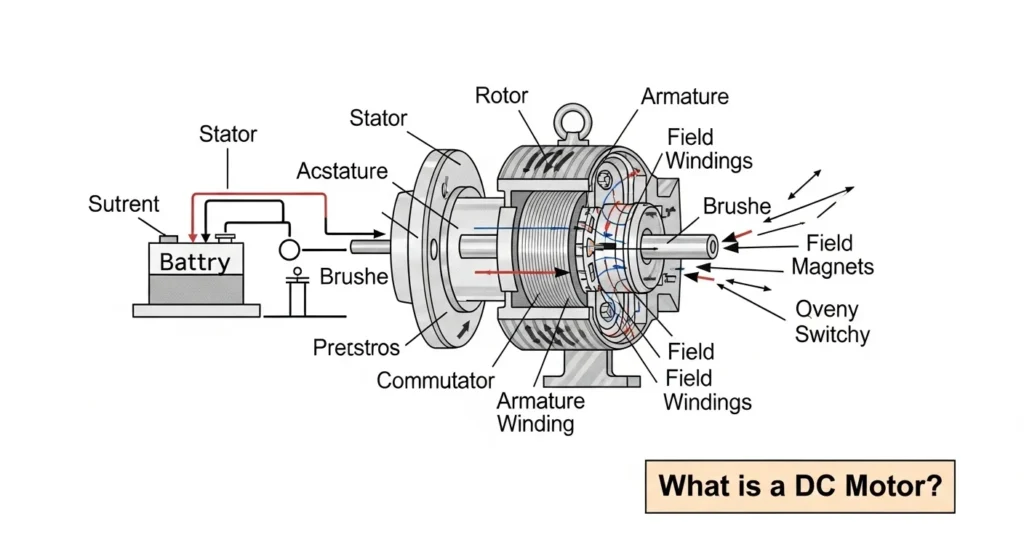
Stator
The stationary part of the motor that produces the required magnetic field.
Rotor (Armature)
The rotating part of the motor that carries electrical current and produces torque.
Commutator
A rotating electrical switch that reverses the direction of current in the armature winding to maintain continuous rotation.
Carbon Brushes
Conductive carbon contacts that supply electrical current to the armature through the commutator.
Shaft
Connected to the rotor and transfers the mechanical power generated by the motor to the connected load.
Each component plays a vital role in the proper operation and performance of a Direct Current (DC) motor.
DC Motor Advantages and Benefits: Key Features (2026)
The main advantages of a Direct Current (DC) motor include:
- High starting torque
- Easy speed control
- Simple speed regulation
- Good performance at low speeds
- Quick starting and stopping
- Suitable for battery-powered applications
These advantages make DC motors suitable for many applications requiring precise speed control and high starting torque.
DC Motor Disadvantages and Limitations (2026)
The main limitations of a Direct Current (DC) motor include:
- Requires regular maintenance due to brush wear
- Can produce sparks at the commutator
- Less suitable for very high-power applications
- Can be more expensive than Alternating Current (AC) motors at higher ratings
- Brushes and the commutator can contribute to mechanical and electrical losses
Because of these limitations, Alternating Current (AC) motors are often preferred for many large-scale industrial applications.
DC Motor Applications and Uses in Different Industries (2026)
Direct Current (DC) motor applications are diverse and practical across residential, industrial, automotive, and modern technology sectors.
Residential and Home Applications
- Water pumps
- Mixers
- Small electrical appliances
- Battery-powered toys
Industrial Applications
- Conveyor belt systems
- Rolling mills
- Elevators
- Printing machines
Automotive Applications
- Car windshield wipers
- Power windows
- Starter motors
Modern Technology Applications
- Robotics
- Computer Numerical Control (CNC) machines
- Electric vehicles
- Solar-powered systems
DC motor applications continue to expand with the growth of renewable energy systems, electric transportation, automation, and advanced control technologies.
DC Motor vs AC Motor Comparison (2026)
Many students want to understand the key differences between an Alternating Current (AC) motor and a Direct Current (DC) motor.
| Feature | Direct Current (DC) Motor | Alternating Current (AC) Motor |
|---|---|---|
| Power Supply | Direct Current (DC) | Alternating Current (AC) |
| Speed Control | Generally easier | Comparatively more complex |
| Maintenance | Higher, especially in brushed motors | Generally lower |
| Starting Torque | Typically high | Varies by motor type |
| Cost | Often higher | Often lower |
The main difference between an Alternating Current (AC) motor and a Direct Current (DC) motor is the type of electrical supply they use, along with differences in speed control, construction, maintenance, and typical applications.
DC Motor Selection Guide (2026)
Choosing the right Direct Current (DC) motor is important for achieving reliable performance, efficiency, and longer operating life.
Key Factors to Consider
- Required torque
- Required operating speed
- Motor power rating
- Available supply voltage
- Duty cycle and operating duration
- Environmental conditions
Selection Tips for Beginners
- For constant-speed applications: Use a shunt motor.
- For heavy starting loads: Use a series motor.
- For small battery-powered devices: Use a Permanent Magnet Direct Current (PMDC) motor.
- Check the motor’s voltage rating carefully before installation.
- Always ensure the load torque is compatible with the motor’s available torque.
Proper motor selection can improve efficiency, reliability, performance, and service life.
Common DC Motor Problems, Causes, and Solutions (2026)
Why Is My Direct Current (DC) Motor Not Starting?
Causes:
- No power supply
- Loose or damaged wiring
- Worn carbon brushes
Solutions:
- Check the supply voltage using a digital multimeter.
- Inspect the brushes and commutator for wear or damage.
- Tighten or repair any loose electrical connections.
Why Is There Sparking in a Direct Current (DC) Motor?
Causes:
- Dirty or damaged commutator
- Uneven brush contact
- Worn brushes
Solutions:
- Clean and inspect the commutator.
- Ensure proper brush alignment and contact.
- Replace worn or damaged brushes.
Why Is a Direct Current (DC) Motor Overheating?
Causes:
- Excessive mechanical or electrical load
- Poor ventilation or inadequate cooling
- Short circuit or damaged motor winding
Solutions:
- Reduce the motor load to the recommended operating level.
- Improve ventilation and cooling around the motor.
- Check the winding insulation resistance and inspect for electrical faults.
Future Trends and Advancements in DC Motors (2026)
DC motor technology is evolving rapidly with advancements in efficiency, automation, and intelligent control systems.
Brushless Direct Current (BLDC) Motors
- Eliminate traditional brushes and mechanical commutators.
- Provide high operating efficiency.
- Require less maintenance.
- Are widely used in electric vehicles, drones, robotics, and other modern applications.
Smart Motor Control Systems
- Use digital motor controllers for precise operation.
- Support Internet of Things (IoT)-based monitoring and diagnostics.
- Improve energy efficiency and overall motor performance.
The growing adoption of electric vehicles and renewable energy systems is increasing demand for advanced, efficient, and intelligent DC motor technologies.
Conclusion
Now you clearly understand What is a DC Motor?, its working principle, types, components, applications, and DC motor advantages and disadvantages. A DC motor converts electrical energy into mechanical rotation using magnetic force.
We discussed the DC motor working principle in simple steps and explained the difference between AC motor and DC motor. You also learned how to select the right motor and solve common problems.
As a junior engineer, always focus on fundamentals. When you understand how torque is produced and how current interacts with magnetic field, everything becomes easy. Keep practicing with real machines and diagrams. Practical experience will make you confident in motor technology.