
Imagine you are standing in a factory control room. A small push button is pressed, and a large motor starts running. The button carries very small current, but the motor requires heavy current. How is this possible? The answer is a relay.
Understanding the Relay Working Principle is one of the most important fundamentals in electrical engineering. Relays allow a small control signal to safely operate a high-power circuit. Without relays, automation, protection systems, motor control, and industrial machines would not function properly.
Whether you are designing a control panel, troubleshooting a motor starter, or working on automation systems, relay knowledge is essential. In this article, you will learn the Relay Working Principle, types of relays, components, applications, advantages and disadvantages, comparison with contactors, selection guide, common faults, and future trends.
I will explain everything in simple language, just like a senior engineer guiding a junior technician on-site.
what is relay working 2026
The Relay Working Principle is based on electromagnetic operation, where a small electrical signal controls a larger electrical circuit.
Simple Definition
A relay is an electrically operated switch that uses an electromagnet to open or close contacts.
Practical Example
When you press a start button in a motor control circuit:
- The button energizes the relay coil.
- The relay closes its contacts.
- The motor circuit gets power and starts running.
In simple words, a relay acts as a bridge between a low-power control circuit and a high-power load circuit.
Relay Working Principle Explained Step-by-Step 2026
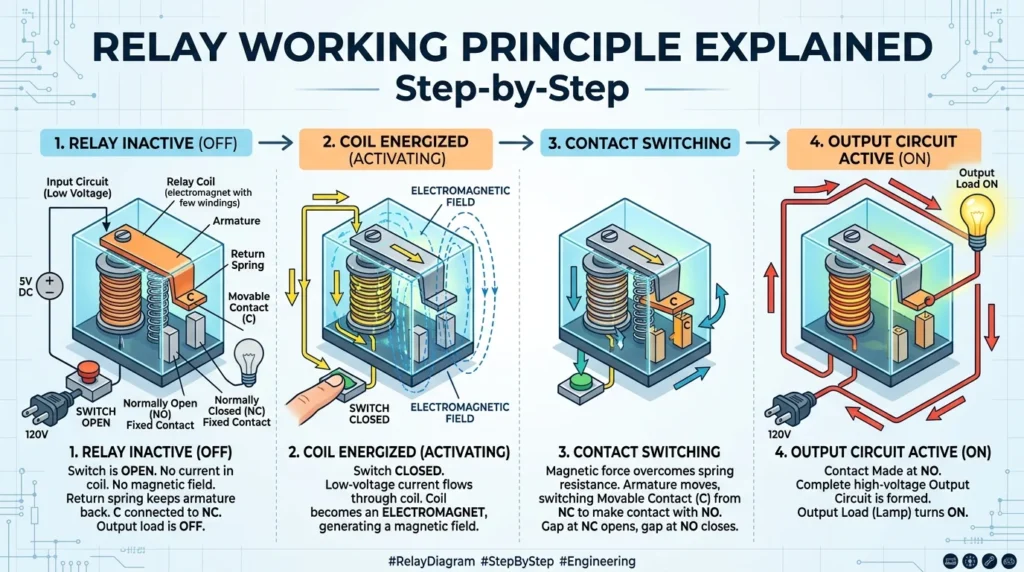
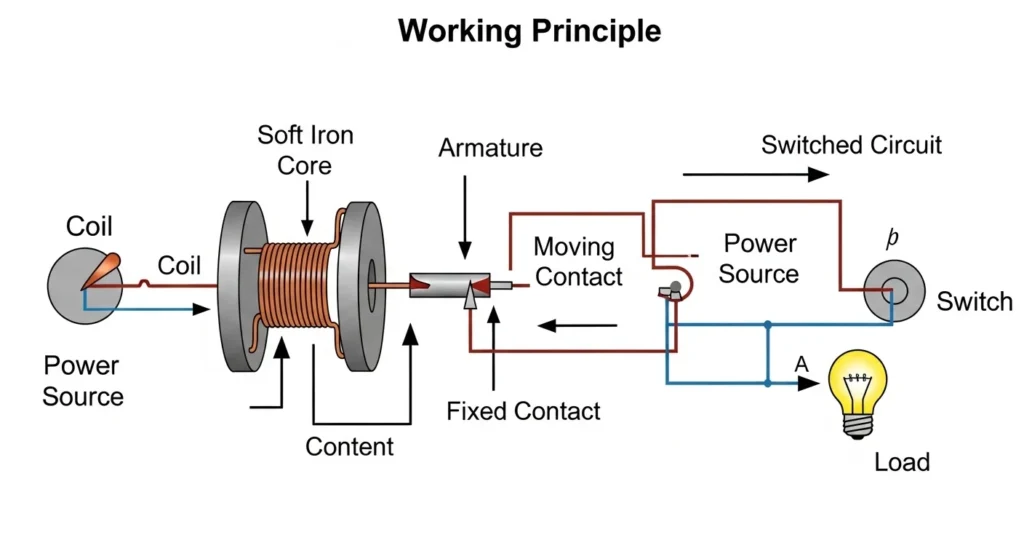
The relay working principle is based on using a small electrical signal to control a larger electrical circuit safely and automatically. First, when electric current flows through the relay coil, it creates a magnetic field around the coil. This magnetic field attracts a movable metal armature connected to electrical contacts inside the relay. As the armature moves, the contacts either close or open the connected circuit depending on the relay design. When the contacts close, current flows to the load and the connected device starts operating. When the control current is removed, the magnetic field disappears, and a spring returns the armature and contacts to their original position, stopping the current flow. Relays are widely used in electrical control systems, motor starters, automation panels, protection systems, and industrial machinery because they allow low-power circuits to safely control high-power electrical equipment. Understanding the relay working principle step-by-step is important for electrical students, engineers, and technicians because relays are essential components in modern electrical control and protection systems.
The Relay Working Principle is simple if understood clearly.
Think of it like a magnet pulling a metal plate when electricity flows.
Step-by-Step Operation (2026)
Control Voltage Applied
- Voltage is applied to the relay coil.
Magnetic Field Produced
- The coil generates a magnetic field.
Armature Movement
- The magnetic field pulls the armature toward the coil.
Contact Change
- Normally Open (NO) contacts close.
- Normally Closed (NC) contacts open.
Load Circuit Activated
- The load receives power through the switched contacts.
Voltage Removed
- The magnetic field disappears.
- The spring returns the armature to its original position.
Easy Analogy
Imagine a door with a spring:
- When you push it, it opens.
- When you release it, the spring brings it back to its original position.
In a relay:
- Electricity energizes the coil and moves the armature.
- When the power is removed, the spring returns the armature to its original position.
This is the core working principle of a relay.
Types / Classification of Relays 2026
There are different types of relays based on design and function.
Electromagnetic Relay
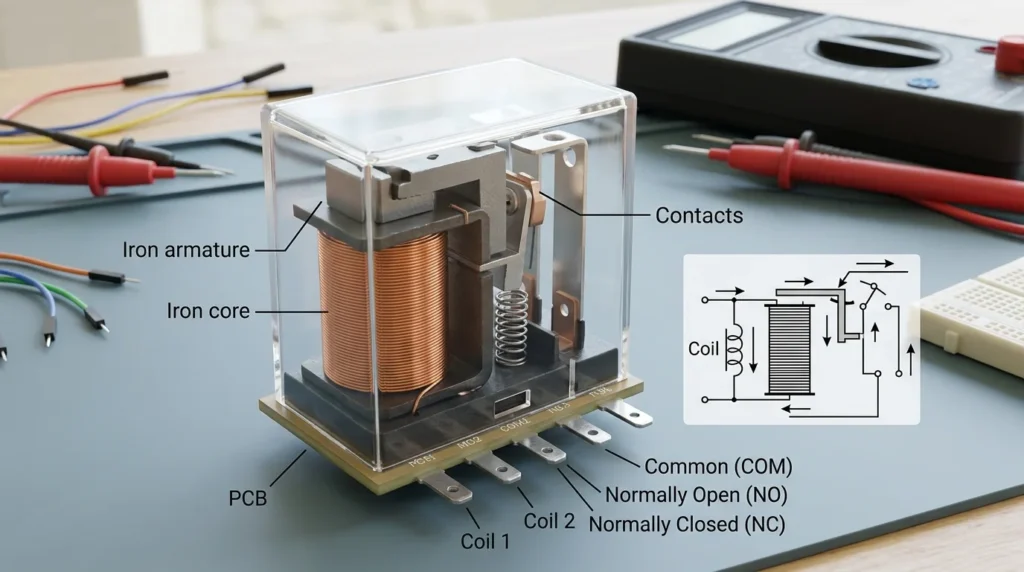
An electromagnetic relay is an electrically operated switching device used to control electrical circuits automatically with the help of an electromagnet. It works by using a coil that creates a magnetic field when electric current flows through it. This magnetic field attracts a movable armature, which opens or closes electrical contacts connected to another circuit. Electromagnetic relays are widely used in electrical control systems, industrial automation, motor protection, power distribution, and switching applications because they allow low-power control circuits to safely operate high-power electrical loads. These relays provide electrical isolation between control and power circuits, improving safety and reliability. Common components of an electromagnetic relay include the coil, armature, spring, contacts, and iron core. When the coil is energized, the relay changes the contact position, and when the current stops, the spring returns the contacts to their original state. Due to their simple design, reliable operation, and low cost, electromagnetic relays are commonly used in control panels, protection systems, household appliances, and industrial machinery.
- Most common type.
- Uses coil and armature.
- Suitable for general control circuits.
Solid State Relay (SSR)
- No moving parts.
- Uses electronic components.
- Faster and more durable.
Thermal Relay
- Used for motor overload protection.
- Works based on heat generation.
Reed Relay
- Uses magnetic reed switch.
- Compact and fast switching.
Protective Relay

A protective relay is an electrical protection device used to detect faults and abnormal conditions in power systems and automatically disconnect the faulty section to prevent equipment damage and improve system safety. It continuously monitors electrical parameters such as current, voltage, frequency, power, and impedance in electrical circuits. When the relay detects conditions like overload, short circuit, earth fault, overvoltage, or undervoltage, it sends a signal to the circuit breaker to isolate the affected part of the system. Protective relays are widely used in power plants, substations, transmission lines, transformers, generators, motors, and industrial electrical systems. Modern protective relays may use digital and microprocessor-based technology for faster operation, better accuracy, and advanced monitoring functions. These relays help improve electrical system reliability, reduce equipment damage, minimize downtime, and protect human safety during electrical faults. Understanding protective relays is important for electrical students, engineers, and technicians because they play a major role in electrical protection and power system stability.
- Used in power systems.
- Protects transformers, generators, and lines.
Each type has specific Relay Working Principle applications depending on usage.
Essential Relay Components and Their Functions (2026)
Understanding the main relay components is essential for troubleshooting, maintenance, and proper circuit operation.
Relay Coil
Creates a magnetic field when electrical voltage is applied.
Magnetic Core
Enhances the magnetic strength produced by the coil.
Armature
Moves when the magnetic field is generated, changing the position of the contacts.
Return Spring
Returns the armature to its normal position when the coil is de-energized.
Electrical Contacts
Allow or interrupt the flow of electrical current.
- Normally Open (NO): Contacts remain open until the relay is energized.
- Normally Closed (NC): Contacts remain closed until the relay is energized.
- Common (COM): The shared contact that switches between the NO and NC terminals.
Each component plays a critical role in the proper operation of a relay.
Relay Working Principle Advantages and Disadvantages 2026
Advantages
- Allows low-power control of high-power devices
- Provides electrical isolation
- Simple design
- Reliable switching
- Easy to replace
- Cost-effective
These Relay Working Principle advantages and disadvantages must be considered during selection.
Disadvantages / Limitations
- Mechanical wear over time
- Slower than electronic switches
- Produces clicking noise
- Contact arcing possible
- Limited switching speed
Solid-state relays reduce some of these limitations.
Relay Working Principle Applications 2026
Relay Working Principle applications are found everywhere.
Motor Control Panels
Start and stop motors safely.
Automation Systems
Used in PLC panels.
Protection Systems
Protect generators and transformers.
Home Appliances
Used in refrigerators and AC units.
Automotive Systems
Control headlights and horns.
Relays are essential in both small and large systems.
Relay vs Contactor Differences (2026)
Current Rating
| Feature | Relay | Contactor |
|---|---|---|
| Current Rating | Low to medium | High |
| Application | Control circuits | Power circuits |
| Size | Small | Large |
| Switching Load | Light loads | Heavy loads |
| Common Usage | Automation and control | Motor and power control |
The difference between a relay and a contactor mainly depends on the electrical load capacity, switching requirements, and intended application.
Relay Selection Guide (2026)
Choosing the right relay depends on several important electrical and operating factors.
Coil Voltage Requirement
Match the relay coil voltage with the control circuit voltage, such as 12 volts (V), 24 volts (V), or 230 volts (V).
Electrical Contact Rating
The contacts must safely handle the required load current and voltage.
Number of Electrical Contacts
Select the required contact arrangement, such as a single-pole configuration or multiple-pole configuration.
Application Type
Consider whether the relay is required for general electrical control, automation, switching, or protection applications.
Operating Environment
Choose a relay suitable for the surrounding conditions, including high-temperature, dusty, humid, or industrial environments.
Switching Speed Requirement
Consider the required switching speed, particularly when the relay is used in automation and control systems.
Always check the manufacturer’s specifications carefully before selecting and installing a relay.
Common Problems & Solutions 2026
Why relay is not clicking?
Reason: No coil voltage.
Solution: Check control supply.
Why load not turning ON?
Reason: Burnt contacts.
Solution: Replace relay.
Why relay overheating?
Reason: Incorrect coil voltage.
Solution: Verify voltage rating.
Why contacts getting welded?
Reason: Excessive load current.
Solution: Use higher-rated relay.
Regular inspection improves reliability.
Future Trends 2026
Relay technology is improving.
Smart Protective Relays
Digital and microprocessor-based.
Solid-State Relays
Longer life and silent operation.
IoT Integration
Remote monitoring of relay status.
Compact Design
Space-saving modular relays.
Energy-Efficient Coils
Reduced power consumption.
Modern power systems rely on advanced relay technology.
Conclusion
The Relay Working Principle is a fundamental concept in electrical engineering. It allows a small control signal to operate larger loads safely and efficiently. By using electromagnetic force, relays open and close contacts to control circuits.
Understanding the relay working principle, types, applications, and the difference between relay and contactor is essential for every electrical student and technician. Although relays have mechanical limitations, they remain reliable and widely used in control and protection systems.
Mastering relay operation builds strong knowledge in automation, motor control, and power system protection. Always focus on correct selection, proper installation, and regular maintenance for safe and efficient performance.