
Think about what happens when you press the power button on your phone charger. Within seconds, energy begins flowing into the battery, allowing your device to recharge. When you switch on a fan, it starts spinning immediately. These everyday actions are possible because of electric current — the movement of electrical charge that powers nearly everything around us.
Understanding electric current is essential for electrical students, engineers, technicians, and beginners because it is one of the most fundamental concepts in electrical engineering. Whether you are installing wiring, designing circuits, troubleshooting equipment, or ensuring electrical safety, knowing how current behaves helps you work efficiently and safely.
In this article, you will learn what electric current is, the electric current working principle, types of current, key components involved, advantages and disadvantages, and real-world applications. You will also learn troubleshooting tips and future trends shaping electrical systems. The explanations are simple, practical, and based on real-world engineering understanding.
Electric current is the flow of electric charge through a conductor.
Definition
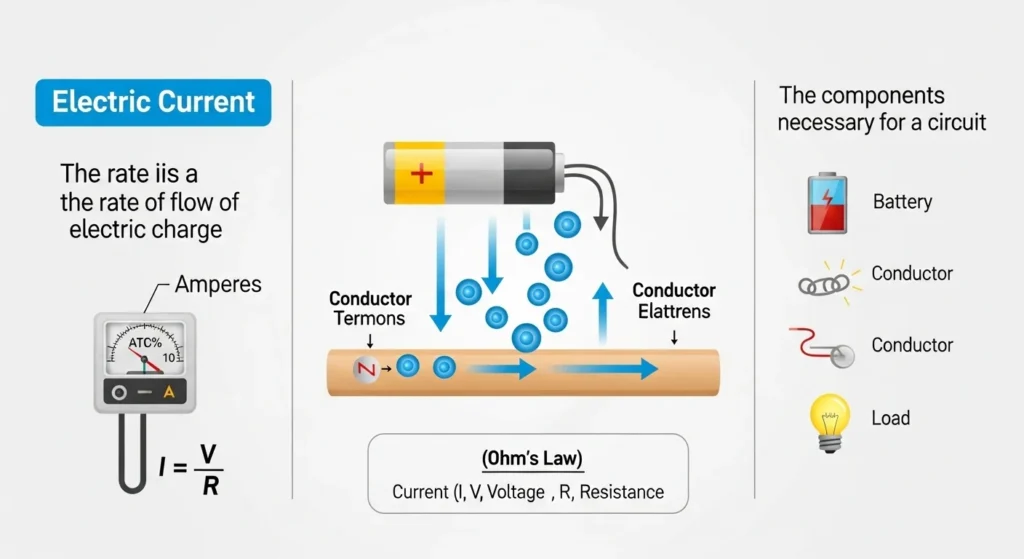
Electric current is the rate at which electric charges (usually electrons) move through a wire or conductive path.
Unit of Measurement
Electric current is measured in amperes (A), often called amps.
Simple Explanation
Atoms contain electrons that can move. When a voltage pushes these electrons through a conductor like copper wire, their movement forms an electric current.
Practical Example
When you turn on a light switch, current flows through the wire to the bulb, causing it to glow.
In simple terms:
Electric current is the movement of electrons that carries electrical energy.
Electric Current Working Principle
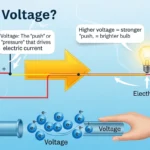
The electric current working principle is based on the movement of electrons caused by a potential difference (voltage).
Easy Analogy: Water Flow System
- Voltage = water pressure
- Current = water flow
- Wire = pipe
- Switch = valve
- Load = water wheel
Higher pressure pushes more water through a pipe. Similarly, higher voltage pushes more electrons, increasing current.
Step-by-Step Process
- A power source creates voltage.
- Voltage pushes electrons through a conductor.
- Electrons move in a closed circuit.
- The electrical device (load) uses the energy.
- Current returns to the source.
Important Conditions for Current Flow
- Presence of voltage
- Closed circuit path
- Conductive material
- Connected load
Without these, current cannot flow.
Types / Classification of Electric Current
Electric current is mainly divided into two types.
1. Direct Current (DC)
Direct current flows in one constant direction.
Characteristics
- Steady flow of electrons
- Constant voltage level
- Stored in batteries
Sources
- Batteries
- Solar panels
- DC power supplies
Uses
- Mobile phones and laptops
- Electronic circuits
- Electric vehicles
2. Alternating Current (AC)
Alternating current changes direction periodically.
Characteristics
- Reverses direction many times per second
- Voltage varies in waveform
- Efficient for long-distance transmission
Sources
- Power stations
- Generators
- Inverters
Uses
- Household power supply
- Industrial equipment
- Air conditioning systems
Understanding the difference between AC and DC electric current is essential for electrical design and safe equipment operation.
Main Components Affecting Electric Current
1. Voltage Source
Provides electrical pressure to move electrons.
2. Conductors
Allow current to flow (copper, aluminum).
3. Resistance
Opposes the flow of current.
4. Load
Consumes electrical energy (motors, bulbs).
5. Switches & Controls
Open or close the circuit.
6. Protective Devices
Fuses, circuit breakers, and grounding ensure safety.
These components determine how current flows in a circuit.
Electric Current Advantages and Disadvantages
Advantages
- Powers homes, industries, and technology
- Enables lighting, heating, and cooling
- Essential for communication and computing
- Easily transmitted through wires
- Supports automation and industrial machinery
- Enables renewable energy systems
Disadvantages / Limitations
- Can cause electric shock and injuries
- Overcurrent may cause fires and equipment damage
- Requires protective systems and insulation
- Power interruptions affect productivity
- Improvised wiring can be dangerous
Electric Current Applications
Electric current applications are everywhere in modern life.
Home Applications
- Lighting and fans
- Refrigerators and air conditioners
- Charging electronic devices
- Kitchen appliances
Industrial Applications
- Motors and heavy machinery
- Welding systems
- Automation and robotics
- Conveyor systems
Modern Technology Applications
- Computers and networking systems
- Telecommunications and internet
- Medical equipment
- Electric vehicles and charging systems
Understanding electric current applications helps in designing reliable and efficient systems.
Comparison: Electric Current vs Voltage
| Feature | Electric Current | Voltage |
| Definition | Flow of charge | Electrical pressure |
| Unit | Ampere (A) | Volt (V) |
| Function | Moves energy | Pushes current |
| Measurement tool | Ammeter | Voltmeter |
| Analogy | Water flow | Water pressure |
Voltage pushes current, while current delivers energy.
Selection Guide: Choosing the Right Current Rating
Choosing proper current ratings ensures safety and efficiency.
For Household Wiring
- Use wires rated for expected current
- Avoid overloading sockets
For Electrical Devices
- Check current rating before connection
- Use proper adapters and fuses
For Industrial Systems
- Use three-phase systems for heavy loads
- Install overload protection
Tips for Beginners
- Never exceed current ratings
- Use circuit breakers and grounding
- Choose correct wire gauge
- Follow safety standards
Common Problems & Solutions
Why do wires overheat?
Cause: excessive current flow
Solution: reduce load and use proper wire size.
Why does the circuit breaker trip?
Cause: overload or short circuit
Solution: inspect wiring and redistribute load.
Why is a device not working?
Cause: no current flow due to open circuit
Solution: check connections and switches.
What causes electric shock?
Cause: current passing through the body
Solution: ensure insulation and grounding.
Future Trends in Electric Current Systems
Smart Electrical Systems
Real-time monitoring improves efficiency and safety.
Renewable Energy Integration
Solar and wind systems rely on efficient current management.
Electric Transportation
Electric vehicles depend on controlled current flow.
Energy-Efficient Devices
Modern appliances use less current for better performance.
Smart Grids & Automation
Advanced control improves current distribution.
The future of electric current management focuses on safety, efficiency, and sustainability.
Conclusion
Electric current is the flow of electric charge that powers modern life. From lighting homes to operating industrial machinery and advanced technology, current is essential for energy delivery. Understanding the electric current working principle, types, components, and safety considerations is fundamental for students and electrical professionals.
Knowing the difference between AC and DC, selecting proper current ratings, and applying safety measures ensures reliable and efficient electrical systems. While electric current offers enormous benefits, improper handling can cause hazards, making safety practices critical.
As electrical systems evolve with renewable energy, smart grids, and electric transportation, understanding electric current becomes even more important. A strong foundation in this concept enables safer designs, effective troubleshooting, and future innovation.