
Have you ever felt a small shock after touching a metal door handle on a dry day, or seen a balloon stick to a wall after rubbing it on your hair? That tiny shock and simple experiment are examples of electricity in action. At the same time, the electricity that powers your home, runs fans, lights rooms, and charges your phone is another form of the same phenomenon.
Understanding the types of electricity (static and current) is essential for electrical students, engineers, technicians, and beginners because these two forms form the foundation of electrical science. Static electricity explains charge buildup and electrostatic effects, while current electricity powers modern life and industrial systems.
In this article, you will learn what static and current electricity are, their working principles, key differences, components, advantages and disadvantages, and practical applications. By the end, you will clearly understand how electricity behaves and why both types are important in electrical engineering and daily life.
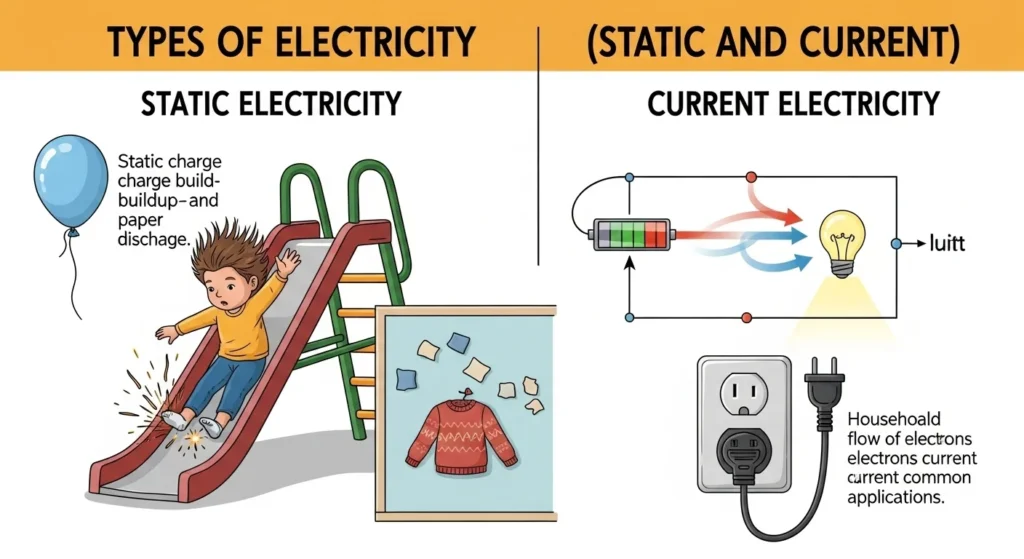
Electricity exists in two main forms: static electricity and current electricity.
Simple Definition
- Static electricity is the buildup of electric charges on a surface.
- Current electricity is the continuous flow of electric charge through a conductor.
Simple Explanation
Electric charges (electrons) can either accumulate in one place or move through a path.
- When charges gather and stay in one place → static electricity.
- When charges flow through a wire → current electricity.
Practical Example
- Shock after walking on carpet → static electricity
- Light bulb glowing when switched on → current electricity
Both forms involve electric charges, but their behavior and uses are different.
Types of Electricity Working Principle
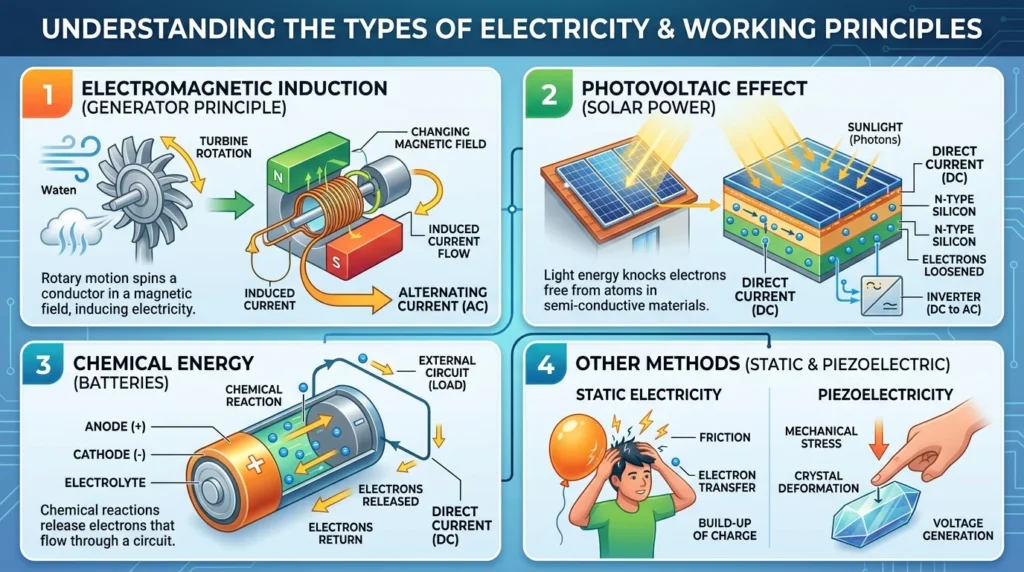
The working principle of the two main types of electricity—static electricity and current electricity—is based on the behavior and movement of electric charges (electrons). Although both involve electric charges, they operate in different ways. Static electricity occurs when electrons accumulate on the surface of an object due to friction, contact, or induction, creating an imbalance of positive and negative charges. These charges remain stationary until they are suddenly discharged, such as during a lightning strike or when you experience a small shock after touching a metal object. In contrast, current electricity is produced when electrons flow continuously through a conductor because of an applied voltage from a power source like a battery, generator, or electrical grid. This continuous movement of electrons occurs only when there is a complete closed circuit, allowing electrical energy to be transferred to devices such as lights, motors, computers, and household appliances. Together, these two principles explain how electricity behaves in both natural phenomena and modern electrical systems, making them fundamental concepts in electrical engineering and technology.
Easy Analogy
Think of water:
- Water stored in a tank = static electricity
- Water flowing in a pipe = current electricity
Static Electricity Working Process
Two materials rub together.
Electrons transfer from one surface to another.
One object becomes negatively charged.
The other becomes positively charged.
Charge remains stored until discharged.
Current Electricity Working Process
A voltage source creates electrical pressure.
Electrons begin to move through a conductor.
Movement occurs in a closed circuit.
Electrical devices use the energy.
Current returns to the source.
Types / Classification of Electricity
Electricity is one of the most important forms of energy in the modern world. It powers homes, industries, communication systems, transportation, and countless electronic devices that people use every day. Although electricity is often discussed as a single concept, it can actually be classified into two major types: static electricity and current electricity. These two forms of electricity behave differently and are used in different applications.
Understanding how each type works, how it is produced, and where it is used is essential for students, technicians, and anyone interested in electrical science. It also helps in understanding the operation of electrical systems and the safe handling of electrical equipment.
Static Electricity
Static electricity is the accumulation of electric charges on the surface of an object. Unlike current electricity, these charges do not move continuously through a conductor. Instead, they remain at rest until they find a path to discharge suddenly.
Static electricity is a common natural phenomenon that people experience in everyday life. Although it is often associated with small electric shocks, it also has many useful industrial applications.
How Static Electricity Forms
Static electricity occurs when electrons move from one material to another. Electrons are negatively charged particles found in atoms. When two different materials come into contact and then separate, some electrons may transfer between them.
This transfer can happen through:
- Friction: Rubbing two materials together causes electrons to move.
- Contact: Touching two materials allows charge transfer.
- Separation: Pulling materials apart can create an imbalance of charges.
As a result, one object becomes negatively charged by gaining electrons, while the other becomes positively charged by losing electrons.
When the accumulated charge becomes large enough, it discharges suddenly, often producing a spark.
Examples of Static Electricity
Static electricity can be observed in many situations, including:
- Lightning during thunderstorms: Large charge differences between clouds and the ground create powerful electrical discharges.
- Removing synthetic clothes: Clothes rubbing against each other generate static charges, causing crackling sounds and small sparks.
- A balloon sticking to a wall: Rubbing a balloon against hair transfers electrons, allowing the balloon to cling to surfaces.
- Electric shock after walking on carpet: Friction between shoes and carpet builds up charge, which discharges when touching metal objects.
- Plastic wrap attraction: Thin plastic films often stick together because of static charges.
Characteristics of Static Electricity
Static electricity has several distinctive features:
- Charges remain stationary on the object’s surface.
- It commonly occurs on insulating materials such as plastic, rubber, and glass.
- It develops due to electron transfer.
- The discharge usually happens suddenly.
- It often produces sparks or small shocks.
- It can attract lightweight objects.
- It may damage sensitive electronic equipment if not controlled.
Applications of Static Electricity
Although it is sometimes viewed as a nuisance, static electricity has many practical uses.
Some important applications include:
- Electrostatic painting.
- Laser printers and photocopiers.
- Electrostatic air purification systems.
- Dust collection using electrostatic precipitators.
- Textile processing.
- Plastic manufacturing.
Industries use these applications to improve efficiency, reduce waste, and enhance product quality.
Current Electricity
Current electricity refers to the continuous flow of electric charge through a conductor. This movement of electrons provides the energy needed to operate electrical devices and systems.
Unlike static electricity, which remains at rest until discharged, current electricity moves continuously through wires and circuits as long as a complete path exists.
Current electricity is the form of electricity that powers modern civilization.
How Current Electricity Works
Electric current flows when there is:
- A source of electrical energy.
- Conductive pathways such as wires.
- A complete circuit.
- An electrical load that consumes energy.
The source creates a voltage difference that pushes electrons through the conductor. As electrons move, they transfer energy to electrical devices.
If the circuit becomes open due to a broken wire or switched-off connection, the flow of current stops immediately.
Examples of Current Electricity
Current electricity is found almost everywhere in daily life.
Examples include:
- Lighting systems.
- Ceiling fans.
- Refrigerators.
- Televisions.
- Mobile phone chargers.
- Computers and laptops.
- Industrial machinery.
- Water pumps.
- Electric vehicles.
- Air-conditioning systems.
Without current electricity, most modern technologies would not function.
Types of Current Electricity
Current electricity can be further classified into two main types:
Direct Current (DC)
Direct Current (DC) is the type of current in which electric charges flow continuously in one direction.
In DC systems, the polarity remains constant, meaning electrons always move from the negative terminal toward the positive terminal through the external circuit.
Sources of DC Electricity
Common sources include:
- Batteries.
- Solar panels.
- Fuel cells.
- DC generators.
- Power banks.
Applications of DC Electricity
DC power is widely used in:
- Electronic circuits.
- Mobile phones.
- Laptop computers.
- LED lighting systems.
- Electric vehicles.
- Telecommunications equipment.
- Portable devices.
- Solar energy systems.
Advantages of DC
- Stable voltage output.
- Efficient battery storage.
- Ideal for electronic devices.
- Easier integration with renewable energy systems.
Limitations of DC
- Difficult to transmit efficiently over long distances without conversion.
- Voltage transformation requires specialized equipment.
Alternating Current (AC)
Alternating Current (AC) is the type of current that changes direction periodically.
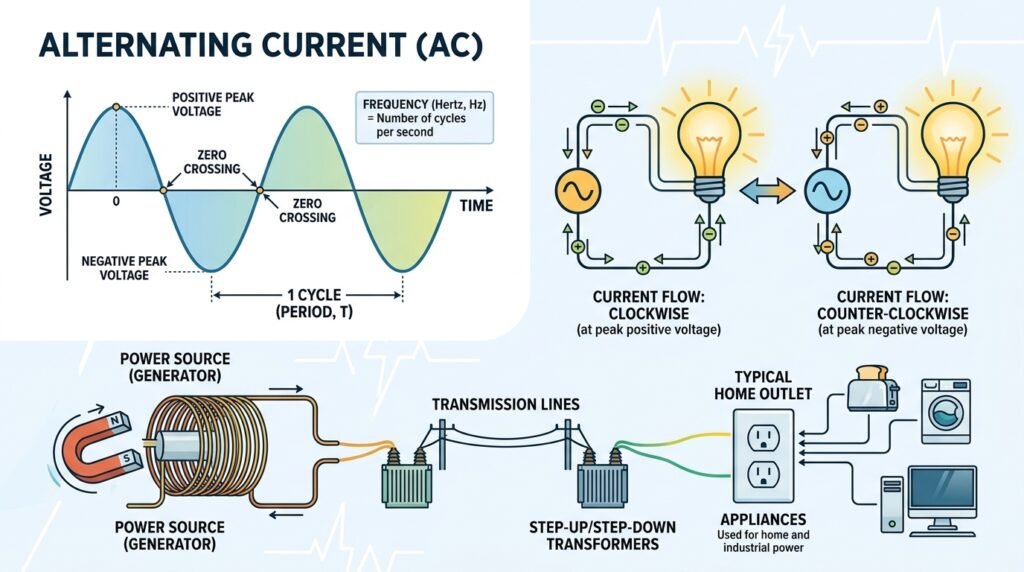
Instead of flowing continuously in one direction, the electrons reverse their direction many times every second. The frequency of these changes is measured in hertz (Hz).
In many countries, AC changes direction 50 times per second (50 Hz), while in others it changes 60 times per second (60 Hz).
Sources of AC Electricity
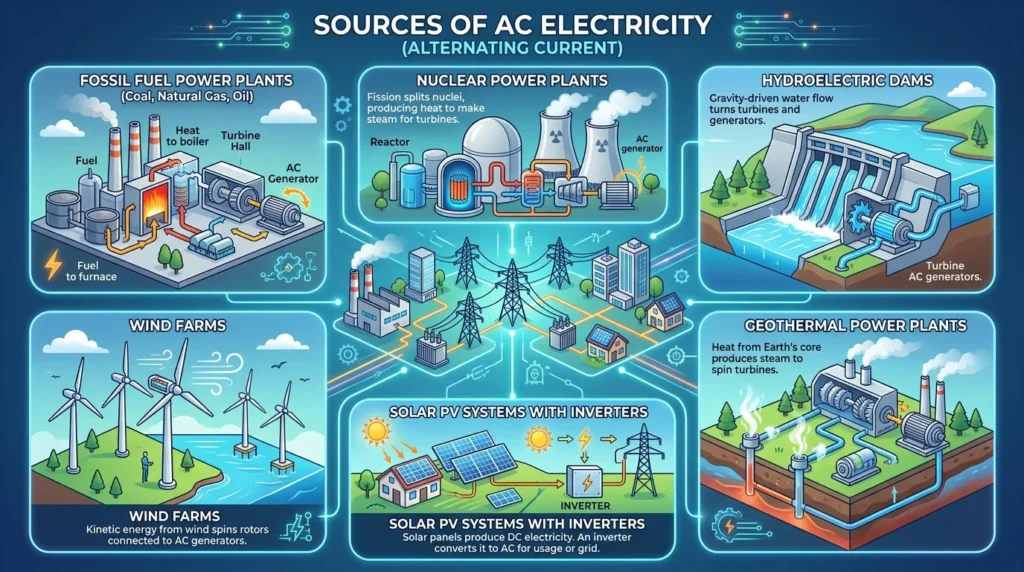
Alternating Current (AC) electricity is generated by devices that produce an electric current that periodically changes direction, typically at a frequency of 50 Hz or 60 Hz, depending on the country’s electrical system. The primary source of AC electricity is power stations, where generators convert mechanical energy into electrical energy through the principle of electromagnetic induction. These generators may be driven by steam turbines, water turbines, wind turbines, or gas turbines. In addition to conventional power plants, renewable energy systems such as hydroelectric dams, wind farms, and some solar power plants also contribute AC electricity to the power grid, either directly or through power conversion equipment. Once generated, AC electricity is transmitted over long distances using high-voltage transmission lines and transformers before being distributed to homes, commercial buildings, and industries. Because AC voltage can be easily stepped up or stepped down using transformers, it is the preferred choice for large-scale electricity generation, transmission, and distribution worldwide.
AC electricity is generated by:
- Power stations.
- Hydroelectric plants.
- Thermal power plants.
- Wind turbines.
- Large alternators.
Applications of AC Electricity
AC power is commonly used in:
- Residential buildings.
- Commercial facilities.
- Industrial plants.
- Street lighting systems.
- Air-conditioning systems.
- Household appliances.
- Large motors.
- Power transmission networks.
Advantages of AC
- Easy voltage transformation using transformers.
- Efficient long-distance transmission.
- Lower transmission losses.
- Suitable for large power distribution systems.
- Cost-effective for utility networks.
Limitations of AC
- More complex for battery storage.
- Many electronic devices require conversion to DC.
- Can present synchronization challenges in specialized systems.
Difference Between AC and DC Current Electricity
Understanding the difference between AC and DC electricity is essential for designing electrical systems and selecting suitable equipment.
| Feature | Direct Current (DC) | Alternating Current (AC) |
|---|---|---|
| Direction of Flow | Flows in one direction | Changes direction periodically |
| Voltage Polarity | Constant | Alternates continuously |
| Common Sources | Batteries, solar panels | Power stations and alternators |
| Frequency | Zero frequency | Usually 50 Hz or 60 Hz |
| Transmission | Less suitable for long distances | Highly efficient for transmission |
| Storage | Easily stored in batteries | Cannot be directly stored |
| Applications | Electronics and vehicles | Homes and industries |
| Voltage Conversion | More difficult | Easy using transformers |
Importance of Understanding Electricity Classification
Learning the classification of electricity provides a strong foundation for understanding electrical engineering and practical applications.
It helps individuals:
- Understand how electrical devices operate.
- Select appropriate power sources.
- Design safer electrical systems.
- Prevent equipment damage.
- Improve troubleshooting skills.
- Work safely around electrical equipment.
- Appreciate the role of electricity in modern life.
Whether working with a simple battery-powered device or a large industrial power network, understanding the differences between static electricity, DC electricity, and AC electricity is essential.
Electricity can be broadly classified into static electricity and current electricity, each serving unique purposes. Static electricity involves the accumulation of charges that remain stationary until discharged, while current electricity refers to the continuous movement of electric charges through conductors. Current electricity is further divided into Direct Current (DC) and Alternating Current (AC), both of which play vital roles in modern technology and infrastructure.
Static electricity explains natural phenomena such as lightning and has important industrial applications, whereas current electricity powers homes, industries, transportation systems, and electronic devices. Understanding the differences between these types of electricity not only enhances technical knowledge but also promotes safer and more efficient use of electrical energy in everyday life and professional environments.
Main Components Involved
Components in Static Electricity
Charged Objects
Materials that gain or lose electrons.
Insulating Materials
Prevent charge movement (plastic, rubber).
Ground Path
Allows charge discharge.
Components in Current Electricity
Power Source
Provides voltage (battery, generator).
Conductors
Allow current flow (copper wires).
Load
Consumes electrical energy (bulbs, motors).
Switch
Controls current flow.
Protection Devices
Provide safety (fuses, breakers, grounding).
Types of Electricity Advantages and Disadvantages
Advantages
Static Electricity
- Useful in pollution control systems
- Used in photocopiers and laser printers
- Enables electrostatic painting for smooth coating
Current Electricity
- Powers homes and industries
- Enables lighting, heating, and cooling
- Supports communication and computing
- Drives automation and machinery
Disadvantages / Limitations
Static Electricity
- Can damage electronic components
- Causes sparks in flammable environments
- Uncomfortable shocks
Current Electricity
- Risk of electric shock and fire hazards
- Requires infrastructure and maintenance
- Power outages disrupt operations
Types of Electricity Applications
Static Electricity Applications
Home & Daily Life
- Air purifiers and dust removal systems
Industrial Uses
- Electrostatic painting
- Smoke and dust precipitators
Modern Technology
- Laser printers and photocopiers
Current Electricity Applications
Home Applications
- Lighting and appliances
- Charging electronic devices
Industrial Applications
- Motors and machinery
- Welding and automation
Modern Technology
- Computers and telecommunications
- Electric vehicles and renewable energy systems
Understanding types of electricity applications helps in selecting the right technology for each purpose.
Comparison: Static vs Current Electricity
| Feature | Static Electricity | Current Electricity |
| Electron movement | Accumulated | Continuous flow |
| Path required | No | Yes |
| Duration | Sudden discharge | Continuous |
| Materials involved | Insulators | Conductors |
| Examples | Lightning, shocks | Household power |
| Practical use | Limited | Widly used |
Selection Guide: Choosing the Right Type of Electricity
Electricity can generally be divided into two major categories: static electricity and current electricity. Although both involve the movement or presence of electric charges, they serve very different purposes. Choosing the correct type depends entirely on the application, operating environment, safety requirements, and the intended outcome. Understanding when and where each type should be used helps improve efficiency, protect equipment, and ensure safe operation.
Use Static Electricity When:
Static electricity refers to the accumulation of electric charges on the surface of an object. Instead of flowing continuously through a conductor, these charges remain stationary until they are discharged. While static electricity is often associated with small shocks, it has several important industrial applications.
Electrostatic Painting
Electrostatic painting uses static charges to improve the efficiency of the painting process. Paint particles receive an electric charge, while the object being painted has an opposite charge. The attraction between the charges causes the paint to spread evenly over the surface.
Benefits include:
- Better paint coverage.
- Reduced paint wastage.
- Improved finish quality.
- Lower environmental pollution.
- Increased production efficiency.
This technique is widely used in the automotive, appliance, and furniture industries.
Dust Removal Systems
Static electricity is also used in pollution control systems known as electrostatic precipitators. These systems remove dust, smoke particles, and other pollutants from industrial exhaust gases.
Advantages include:
- High efficiency in particle removal.
- Improved air quality.
- Reduced industrial emissions.
- Compliance with environmental regulations.
Power plants, cement factories, and manufacturing facilities commonly use these systems.
Printing Technologies
Several modern printing processes rely on static electricity to transfer toner or ink onto paper.
Examples include:
- Laser printers.
- Photocopiers.
- Commercial printing equipment.
Static charges help ensure accurate image transfer and high-quality print results.
Use Current Electricity When:
Current electricity involves the continuous flow of electric charges through conductors such as wires. It is the most commonly used form of electricity in homes, businesses, and industries.
Powering Electrical Devices
Everyday electrical devices operate using current electricity.
Examples include:
- Mobile phone chargers.
- Televisions.
- Refrigerators.
- Computers.
- Washing machines.
- Air conditioners.
Without current electricity, modern life as we know it would not function.
Running Industrial Machinery
Industrial operations depend heavily on current electricity to power machinery and production systems.
Examples include:
- Electric motors.
- Pumps.
- Compressors.
- Conveyor belts.
- Manufacturing equipment.
- Processing machines.
Reliable electrical current ensures productivity and operational efficiency.
Operating Lighting and Appliances
Lighting systems in homes, offices, schools, and commercial buildings rely on current electricity.
Applications include:
- LED lighting.
- Street lighting.
- Decorative lighting.
- Heating appliances.
- Kitchen equipment.
- Office electronics.
Current electricity provides the continuous energy supply required for these systems to operate effectively.
Tips for Beginners
Understanding the differences between static and current electricity is essential, especially for students, technicians, and individuals new to electrical work. Following basic safety principles can prevent accidents and equipment damage.
Understand the Application Need
Before selecting a type of electricity, determine the purpose of the application.
Ask questions such as:
- Is continuous power required?
- Is the goal to attract particles or materials?
- Does the system involve electronic circuits?
- Are there risks associated with static buildup?
Selecting the correct type improves performance and reliability.
Ensure Proper Grounding for Safety
Grounding provides a safe path for unwanted electrical charges to flow into the earth.
Proper grounding helps:
- Prevent electric shock.
- Reduce static charge accumulation.
- Protect equipment.
- Improve system stability.
Grounding is essential in both industrial and residential environments.
Protect Electronics from Static Discharge
Sensitive electronic components can be damaged by even small static discharges that humans may not notice.
Protective measures include:
- Wearing grounding wrist straps.
- Using anti-static mats.
- Working in ESD-safe environments.
- Storing components in anti-static packaging.
These precautions are especially important in electronics manufacturing and repair.
Follow Safety Practices When Working with Current Electricity
Current electricity can be dangerous if handled improperly.
Always remember to:
- Switch off power before repairs.
- Use insulated tools.
- Wear appropriate protective equipment.
- Avoid wet conditions.
- Follow electrical safety regulations.
- Seek professional assistance when necessary.
Safe practices reduce the risk of injuries and equipment failures.
Common Problems and Solutions
Both static and current electricity can create challenges in practical applications. Understanding their causes and solutions helps prevent costly problems.
Why Do I Feel Shocks When Touching Metal?
Cause:
Static charge buildup on the body caused by friction between materials such as clothing, carpets, or shoes.
Solution:
- Increase indoor humidity levels.
- Use anti-static sprays and materials.
- Wear natural fiber clothing.
- Use grounding techniques.
- Install anti-static flooring where required.
These measures reduce the accumulation of static charges.
Why Are Electronic Components Damaged During Handling?
Cause:
Electrostatic Discharge (ESD), where stored static electricity suddenly transfers to sensitive components.
Solution:
- Wear grounding straps.
- Use anti-static mats and workstations.
- Store components in ESD-safe bags.
- Avoid touching exposed terminals.
- Train personnel in ESD handling procedures.
Proper ESD control significantly reduces electronic failures.
Why Does Electricity Not Flow in a Circuit?
Cause:
An open circuit caused by broken wires, loose connections, damaged switches, or blown fuses.
Solution:
- Check wire continuity using testing instruments.
- Inspect all electrical connections.
- Replace damaged conductors.
- Repair faulty switches.
- Replace blown protective devices.
Identifying the interruption restores normal operation.
Why Do Appliances Stop Working During Voltage Drops?
Cause:
Insufficient supply voltage or inadequate current electricity reaching the appliance.
Solution:
- Install voltage stabilizers.
- Use uninterrupted power supplies (UPS).
- Maintain electrical systems properly.
- Consult utility providers regarding persistent voltage problems.
- Employ backup generators when necessary.
Stable voltage ensures proper appliance performance and extends equipment lifespan.
Future Trends in Electricity
Advancements in technology are changing how electricity is generated, distributed, controlled, and utilized. Future developments focus on efficiency, sustainability, and improved safety.
Electrostatic Pollution Control
Modern industries are adopting advanced electrostatic systems to reduce environmental pollution.
Future developments include:
- More efficient electrostatic precipitators.
- Improved particulate collection.
- Lower industrial emissions.
- Enhanced environmental compliance.
These technologies contribute to cleaner air and healthier communities.
Static Protection Technologies
As electronic devices become smaller and more sophisticated, protection against electrostatic discharge becomes increasingly important.
Emerging technologies include:
- Advanced ESD protective materials.
- Self-grounding workstations.
- Intelligent monitoring systems.
- Enhanced protective packaging.
These innovations improve reliability in electronics manufacturing.
Smart Power Distribution
Digital technologies are transforming current electricity systems.
Modern power networks now feature:
- Real-time monitoring.
- Remote diagnostics.
- Automated fault detection.
- Energy consumption analysis.
- Predictive maintenance capabilities.
Smart distribution systems improve efficiency and reliability.
Renewable Energy Expansion
The global shift toward sustainable energy is accelerating.
Current electricity systems increasingly integrate:
- Solar energy installations.
- Wind power generation.
- Battery energy storage systems.
- Microgrids.
- Distributed energy resources.
Renewable energy supports long-term environmental sustainability and energy security.
Smart Homes and Automation
Homes and buildings are becoming more intelligent through automation technologies.
Features include:
- Smart lighting control.
- Automated climate management.
- Energy-efficient appliances.
- Voice-controlled devices.
- Remote monitoring applications.
- Intelligent energy management systems.
These systems optimize electricity usage while improving comfort and convenience.
Choosing between static electricity and current electricity depends entirely on the intended application. Static electricity is highly valuable in electrostatic painting, pollution control, and printing technologies, while current electricity powers the devices, machinery, lighting systems, and appliances that support modern life. Understanding their differences allows individuals and industries to make informed decisions based on efficiency, functionality, and safety requirements.
At the same time, awareness of common electrical problems, proper safety practices, and emerging technologies is becoming increasingly important. From ESD protection and smart power distribution to renewable energy integration and home automation, the future of electricity is moving toward greater intelligence, sustainability, and reliability. By applying the right electrical principles and embracing technological advancements, we can ensure safer and more efficient use of electricity for generations to come.
Conclusion
Understanding the types of electricity (static and current) is fundamental for anyone entering the electrical field. Static electricity involves the accumulation of charges and is useful in specialized industrial and technological applications. Current electricity involves the continuous flow of electrons and powers nearly every device and system in modern life.
Learning the types of electricity working principle, differences, applications, and safety considerations helps students and technicians design safer systems, protect sensitive electronics, and troubleshoot problems effectively.
Both forms of electricity play vital roles in technology and industry. Building a strong foundation in these concepts will improve your electrical knowledge and prepare you for advanced learning and real-world applications.