
Every time you switch on a light, charge your phone, or run a fan during a hot day, you are using electricity. It has become such a normal part of daily life that we rarely stop to think about what it actually is or how it works. From powering homes and hospitals to running industries and communication systems, electricity is the backbone of modern civilization.
Understanding electricity is essential for electrical students, engineers, technicians, and beginners because it forms the foundation of all electrical and electronic systems. Without a clear understanding of this concept, it is impossible to design, install, maintain, or troubleshoot electrical equipment safely and effectively.
In this article, you will learn what electricity is, how it works, its types, components, advantages and limitations, real-world applications, and future trends. The goal is to explain the concept in simple and clear language while maintaining professional accuracy.
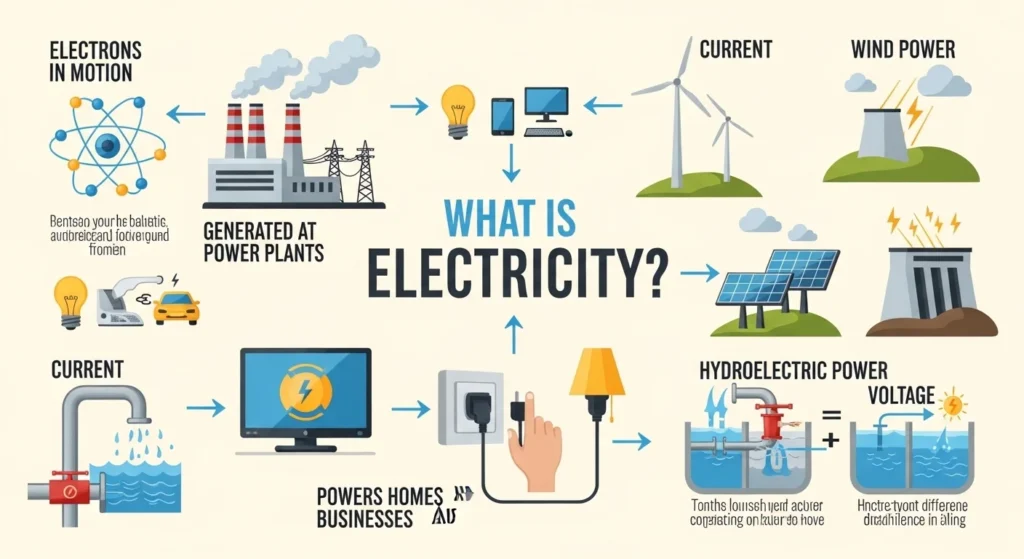
Electricity is the flow of electric charge, usually carried by tiny particles called electrons moving through a conductor such as a wire.
Simple Explanation
Atoms contain electrons that can move from one place to another. When these electrons move in an organized way through a conductor, an electric current is created. This movement of electrons is what we call electricity.
Practical Example
When you plug in a mobile charger, electricity flows through the wire and delivers energy to charge the battery.
In short:
Electricity is a form of energy created by moving electrons.
Electricity Working Principle (2026)
The working principle of electricity is based on the movement of electrons through a conductive material due to the presence of an electrical potential difference (voltage). When a voltage is applied across a conductor, it creates an electric field that pushes free electrons, causing them to move in an organized direction. This movement of electrons is known as electric current, which carries electrical energy from the power source to electrical devices. The energy transported by the current is then converted into useful forms such as light, heat, sound, or mechanical motion. Understanding this working principle is essential for studying electrical engineering, electronics, power systems, and circuit design.
Basic Principle of Electricity
Electricity flows only when there is a complete electrical circuit connecting the power source to the electrical load and back again. The power source provides the voltage needed to move electrons, while the conductor offers a path for current to flow. As electrons travel through the circuit, electrical devices consume electrical energy to perform useful work.
The flow of electricity depends on three basic electrical quantities:
- Voltage (V): The electrical force or pressure that pushes electrons through the circuit.
- Current (I): The movement of electric charge through a conductor.
- Resistance (R): The opposition that limits the flow of current.
These quantities work together according to the principles of electrical circuits and determine how efficiently electricity is delivered to electrical equipment.
Step-by-Step Working Process
A Power Source Creates Voltage
The process begins with a power source, such as a battery, generator, solar panel, or electrical power station. The power source creates an electrical potential difference, commonly called voltage, between its positive and negative terminals.
Examples of Power Sources:
- Batteries
- Electrical generators
- Solar photovoltaic panels
- Wind turbines
- Utility power grids
Purpose:
- Produce electrical energy.
- Create the voltage required for current flow.
- Supply power to the electrical circuit.
Voltage Pushes Electrons Through the Conductor
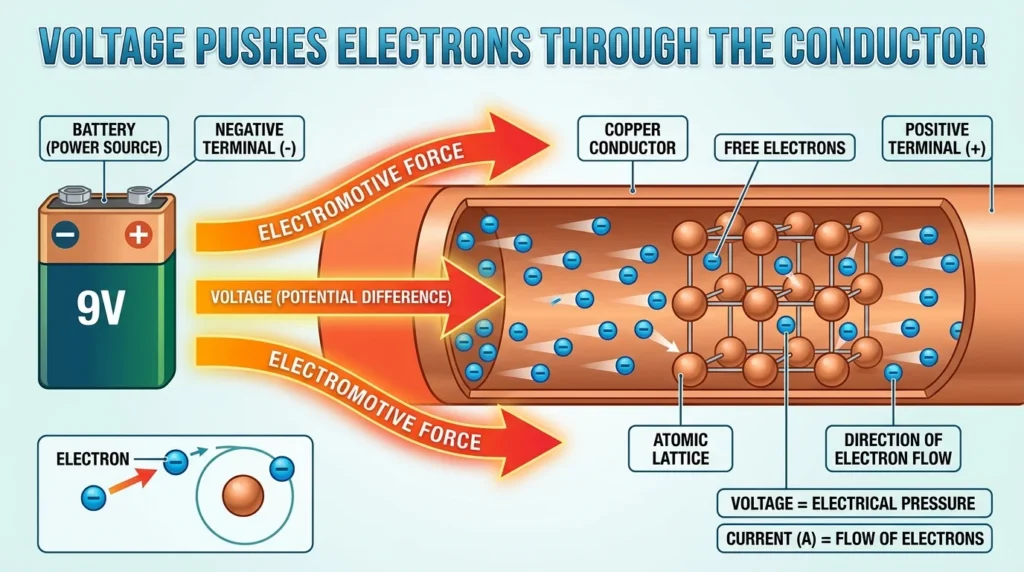
When a voltage is applied across a conductor, it creates an electric field that exerts a force on the free electrons present inside the material. This electrical force pushes the electrons from the negative terminal toward the positive terminal, causing them to move through the conductor. The organized movement of these electrons is known as electric current. The greater the applied voltage, the stronger the force acting on the electrons, resulting in a higher current flow if the circuit resistance remains constant. Conductive materials such as copper and aluminum allow electrons to move easily because they contain a large number of free electrons. However, the amount of current flowing through the conductor is also affected by its resistance, which opposes electron movement. This process of voltage pushing electrons through a conductor is the fundamental principle behind the operation of all electrical circuits, from simple household wiring to large industrial power systems.
Purpose:
- Initiates electron movement.
- Creates electric current.
- Delivers energy throughout the circuit.
Electrons Flow Through a Closed Circuit
Electric current can only flow when there is a closed electrical path. Electrons travel from the power source through conductors, pass through the electrical load, and return to the source, completing the circuit.
If the circuit is broken by an open switch, damaged wire, or disconnected component, current immediately stops flowing.
Purpose:
- Establish continuous current flow.
- Transfer electrical energy safely.
- Maintain circuit operation.
Electrical Devices Convert Energy into Useful Work
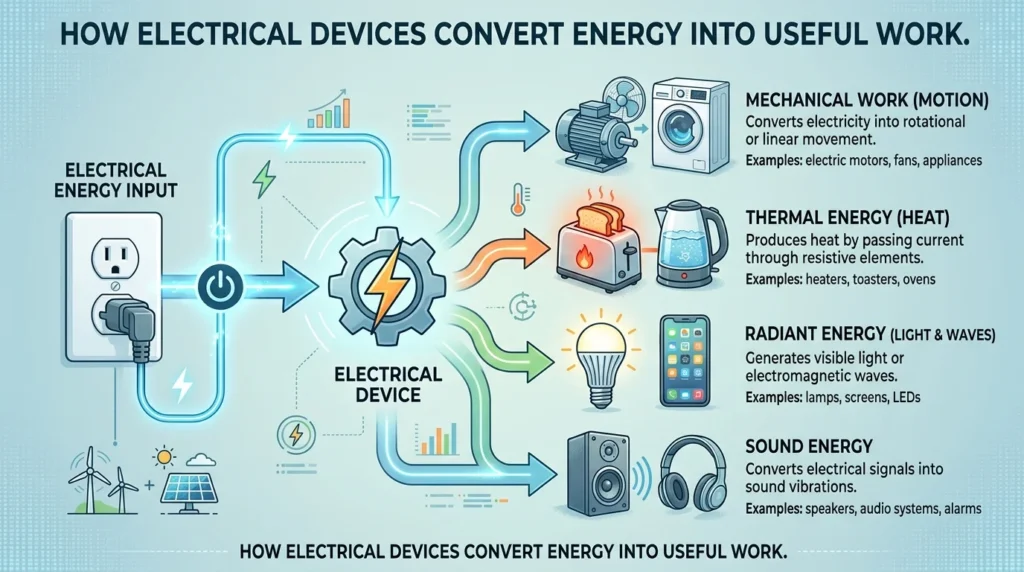
After electric current flows through a circuit, it reaches the electrical load, which is the device designed to use electrical energy for a specific purpose. These devices convert electrical energy into other useful forms such as light, heat, mechanical motion, sound, or digital signals, depending on their function. For example, a light bulb converts electrical energy into light and heat, an electric heater produces thermal energy, an electric motor converts electrical energy into mechanical motion, and a speaker transforms it into sound. Electronic devices such as computers, televisions, and smartphones use electrical energy to process information and perform complex operations. The efficiency of this energy conversion depends on the design and quality of the device, as some energy is naturally lost as heat during operation. This conversion of electrical energy into useful work is the primary purpose of every electrical system and enables homes, industries, transportation systems, healthcare facilities, and communication networks to operate efficiently.
Examples:
- Light bulbs convert electricity into light.
- Electric heaters convert electricity into heat.
- Electric motors convert electricity into mechanical motion.
- Speakers convert electricity into sound.
- Electronic devices process electrical signals for communication and control.
This energy conversion allows electrical systems to perform useful tasks in homes, industries, and commercial facilities.
Current Returns to the Power Source
After delivering energy to the electrical load, the current flows back to the power source through the return conductor, completing the electrical loop. This continuous circulation allows the circuit to operate as long as the power source remains connected and the circuit stays closed.
Purpose:
- Completes the electrical circuit.
- Maintains continuous current flow.
- Ensures uninterrupted operation.
Key Requirements for Electricity to Flow
For electricity to flow successfully, four essential elements must be present:
Power Source
Provides the electrical energy and voltage needed to move electrons.
Examples:
- Battery
- Generator
- Solar panel
- Electrical utility supply
Conductive Path
A conductor provides a low-resistance path for the movement of electrons.
Examples:
- Copper wire
- Aluminum conductor
- Electrical cables
Electrical Load
The load is the device that consumes electrical energy and converts it into useful work.
Examples:
- Lamps
- Motors
- Fans
- Computers
- Heaters
- Household appliances
Closed Circuit
A complete electrical path is necessary for continuous current flow.
Without a closed circuit:
- No current can flow.
- Electrical devices will not operate.
- Energy cannot be transferred.
Simple Water Flow Analogy
The working principle of electricity can be easily understood by comparing it to a water supply system.
- Voltage is like the water pressure that pushes water through a pipe.
- Current is like the flow of water moving through the pipe.
- Electrical wire is similar to the water pipe, providing a path for flow.
- Resistance is like a narrow section of the pipe that restricts water flow.
- Switch works like a valve, allowing or stopping the flow.
- Electrical load is like a water wheel or turbine that uses the flowing water to perform useful work.
Just as water can flow only through a complete pipeline, electricity can flow only through a complete electrical circuit.
Importance of Understanding the Working Principle
Understanding how electricity works provides several important benefits:
Forms the foundation of electrical and electronic engineering.
Helps analyze electrical circuits.
Improves troubleshooting skills.
Supports safe electrical installations.
Enables proper equipment selection.
Prevents electrical faults and overloads.
Increases energy efficiency.
Types of Electricity (2026)
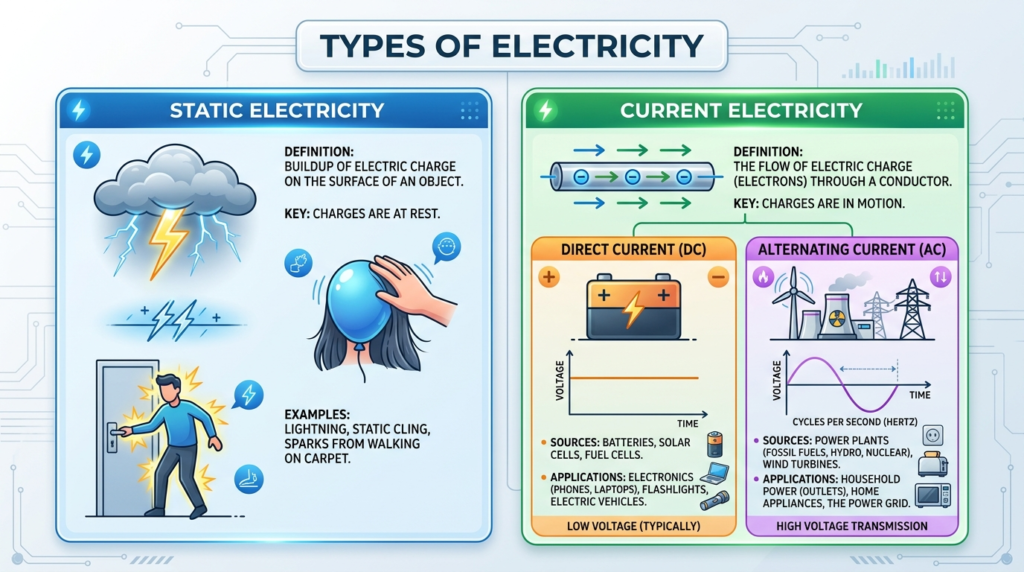
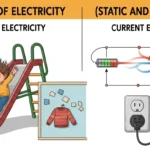
Electricity is mainly divided into two main types: Direct Current (DC) and Alternating Current (AC). Direct Current flows in one direction only and is commonly produced by batteries, solar panels, and electronic devices such as mobile phones and laptops. Alternating Current changes its direction continuously and is widely used in homes, industries, and power transmission systems because it can travel long distances efficiently. Another classification of electricity includes static electricity and current electricity. Static electricity is the buildup of electric charges on the surface of objects, while current electricity refers to the continuous flow of electric charge through conductors. Understanding the types of electricity is important for electrical students, engineers, and technicians because different electrical systems and devices operate using different forms of electric current.
Static Electricity
Static electricity is the accumulation of electric charges on the surface of an object. It occurs when electrons are transferred from one material to another through friction, contact, or induction. Unlike current electricity, these charges remain stationary on the object’s surface until they are discharged suddenly.
Static electricity is commonly produced when two different materials are rubbed together, causing one material to gain electrons while the other loses electrons. As a result, one object becomes negatively charged and the other positively charged.
Common Examples of Static Electricity
- Lightning during thunderstorms.
- A small electric shock after walking on a carpet and touching a metal object.
- A balloon sticking to a wall after being rubbed on hair.
- Clothes sticking together after drying.
- Sparks produced while removing certain synthetic fabrics.
Characteristics of Static Electricity
- Electric charges remain on the object’s surface.
- No continuous current flows.
- Usually produced by friction, contact, or induction.
- Discharges suddenly when a conductive path becomes available.
- Commonly observed in dry weather conditions.
Practical Applications
Although static electricity can sometimes be inconvenient, it is widely used in many industries, including:
- Photocopiers and laser printers.
- Electrostatic spray painting.
- Air purification systems.
- Powder coating processes.
- Electrostatic precipitators for pollution control.
Current Electricity
Current electricity is the continuous flow of electric charge through a conductor, such as a copper wire. It occurs when a voltage source creates an electrical potential difference that forces electrons to move through a closed circuit.
Current electricity is responsible for operating nearly all modern electrical and electronic equipment, including lighting systems, household appliances, industrial machines, communication devices, and transportation systems.
Characteristics of Current Electricity
- Electrons flow continuously through a conductor.
- Requires a complete closed circuit.
- Produced by voltage sources such as batteries, generators, and power stations.
- Supplies energy to electrical devices.
- Used in almost every modern electrical system.
Current electricity is divided into two main types:
Direct Current (DC)
Direct Current (DC) is a type of electrical current that flows in only one direction. The voltage remains relatively constant, making DC ideal for electronic devices and battery-powered equipment.
Common Sources of DC
- Batteries.
- Solar photovoltaic (PV) panels.
- Fuel cells.
- DC power supplies.
Applications of DC
- Mobile phones.
- Laptop computers.
- Electric vehicles.
- Portable electronic devices.
- Telecommunications equipment.
- Battery charging systems.
Advantages of DC
- Stable voltage output.
- Suitable for electronic circuits.
- Easy battery storage.
- High efficiency in low-voltage applications.
Alternating Current (AC)
Alternating Current (AC) is a type of electrical current that changes direction periodically, usually many times per second. In most countries, the frequency is either 50 Hz or 60 Hz, depending on the electrical system.
AC is the standard form of electricity used for power generation, transmission, and distribution because it can be transformed easily to different voltage levels using transformers.
Common Sources of AC
- Power stations.
- Electrical generators.
- Utility power grids.
Applications of AC
- Residential electrical systems.
- Commercial buildings.
- Industrial machinery.
- Air conditioning systems.
- Electric motors.
- Large-scale power distribution.
Advantages of AC
- Easy voltage transformation using transformers.
- Efficient long-distance power transmission.
- Suitable for high-power applications.
- Lower transmission losses at high voltages.
Difference Between AC and DC Electricity
Understanding the difference between alternating current and direct current is essential for selecting the appropriate electrical system and ensuring safe operation.
| Feature | Direct Current (DC) | Alternating Current (AC) |
|---|---|---|
| Direction of Flow | Flows in one direction only. | Changes direction periodically. |
| Voltage | Generally constant. | Continuously varies with time. |
| Common Sources | Batteries, solar panels, DC power supplies. | Power stations, generators, electrical grid. |
| Frequency | 0 Hz | Usually 50 Hz or 60 Hz |
| Typical Applications | Electronics, electric vehicles, portable devices. | Homes, industries, commercial buildings, power transmission. |
Importance of Understanding Different Types of Electricity
A clear understanding of static electricity, direct current, and alternating current provides several practical benefits:
Forms the basis for advanced electrical engineering studies.
Improves electrical safety.
Supports proper electrical system design.
Assists in equipment selection.
Enhances troubleshooting skills.
Helps prevent electrical hazards.
Main Components of an Electrical Circuit (2026)
An electrical circuit is a complete path through which electric current flows from a power source to an electrical load and then returns to the source. Every electrical system, whether it is a simple household lighting circuit or a complex industrial power network, is built using several essential components that work together to ensure the safe and efficient transfer of electrical energy. Each component performs a specific function, such as generating electrical energy, carrying current, controlling the flow of electricity, powering electrical devices, or protecting the system from faults. Understanding these components is fundamental for electrical engineering, circuit design, installation, maintenance, and troubleshooting.
Power Source
The power source is the component that supplies electrical energy to the circuit. It creates the voltage (electrical potential difference) required to move electrons through the conductor and power connected devices. Without a power source, no electrical current can flow.
Common Examples:
- Batteries
- Electrical generators
- Solar photovoltaic (PV) panels
- Wind turbines
- Utility power supply
Functions:
- Generates electrical energy.
- Creates the voltage needed for current flow.
- Supplies power to the entire circuit.
- Enables electrical devices to operate.
Conductors
Conductors are materials that allow electric current to flow easily because they contain a large number of free electrons. They connect all circuit components and provide a continuous path for electrical energy to travel from the power source to the load and back again.
Copper and aluminum are the most commonly used conductor materials because of their excellent electrical conductivity and durability.
Common Examples:
- Copper wires
- Aluminum cables
- Busbars
- Flexible electrical cables
Functions:
- Carry electrical current.
- Connect electrical components.
- Minimize power losses.
- Ensure efficient energy transmission.
Electrical Load
The electrical load is the component that consumes electrical energy and converts it into useful forms such as light, heat, mechanical motion, or sound. Every electrical circuit is designed to supply power to one or more loads.
Different types of loads require different amounts of voltage and current depending on their operating characteristics.
Common Examples:
- Light bulbs
- Electric motors
- Electric heaters
- Fans
- Refrigerators
- Air conditioners
- Computers
- Television sets
Functions:
- Converts electrical energy into useful work.
- Performs the intended operation of the circuit.
- Determines the amount of current drawn from the power source.
Switch
A switch is a control device used to open or close an electrical circuit. When the switch is closed, the circuit is complete and current flows to the load. When the switch is opened, the circuit is interrupted, stopping the flow of electricity.
Switches are available in many forms, ranging from simple manual switches used in homes to advanced automatic switches used in industrial control systems.
Common Examples:
- Wall light switches
- Push-button switches
- Toggle switches
- Rotary switches
- Automatic control switches
- Smart switches
Functions:
- Controls the flow of electricity.
- Turns electrical devices ON and OFF.
- Improves user convenience.
- Enhances operational safety.
Protection Devices
Protection devices safeguard electrical circuits, equipment, and users from dangerous conditions such as overloads, short circuits, earth faults, and excessive current. They automatically disconnect the electrical supply whenever abnormal operating conditions occur.
These devices play a vital role in preventing equipment damage, electrical fires, and electric shock hazards.
Common Examples:
- Fuses
- Circuit breakers (MCB, MCCB)
- Residual Current Devices (RCD)
- Earth Leakage Circuit Breakers (ELCB)
- Surge protection devices
Functions:
- Protect electrical equipment from damage.
- Prevent overloads and short circuits.
- Reduce fire hazards.
- Improve electrical safety.
- Automatically disconnect faulty circuits.
How These Components Work Together
The operation of an electrical circuit follows a simple sequence:
The power source generates electrical energy.
The conductors carry the electric current.
The switch controls whether the circuit is open or closed.
The electrical load uses the electrical energy to perform useful work.
The protection devices continuously monitor the circuit and disconnect the power if a fault occurs.
Together, these components ensure that electricity is delivered safely, efficiently, and reliably.
Importance of Understanding Circuit Components
A clear understanding of the main components of an electrical circuit provides several benefits:
Forms the foundation of electrical and electronic engineering.
Helps design safe electrical systems.
Improves troubleshooting and maintenance.
Supports correct component selection.
Prevents electrical faults and equipment damage.
Enhances system reliability and efficiency.
Ensures compliance with electrical safety standards.
Advantages and Disadvantages of Electricity (2026)
Electricity is one of the most versatile and essential forms of energy used in modern society. It powers homes, industries, transportation systems, healthcare facilities, communication networks, and advanced technologies. Because electricity can be generated from various energy sources and transmitted efficiently over long distances, it has become the backbone of economic development and technological progress. However, despite its numerous advantages, electricity also has certain limitations, including infrastructure costs, safety risks, environmental concerns, and energy storage challenges. Understanding both the benefits and drawbacks of electricity is important for engineers, policymakers, businesses, and consumers to ensure its safe, efficient, and sustainable use.
Advantages of Electricity (2026)
Electricity offers numerous benefits that make it the preferred source of energy for residential, commercial, industrial, and technological applications.
Clean and Convenient Energy at the Point of Use
Electricity is considered a clean source of energy at the point of consumption because it does not produce smoke, harmful gases, or direct emissions while powering electrical devices. It can be used safely and conveniently in homes, offices, hospitals, and industries.
Benefits:
- No direct air pollution during use.
- Quiet operation.
- Easy to control and distribute.
- Suitable for indoor and outdoor applications.
Easy Transmission Over Long Distances
One of the greatest advantages of electricity is that it can be transmitted efficiently across hundreds of kilometers using high-voltage transmission lines. Step-up and step-down transformers help minimize transmission losses and deliver power safely to consumers.
Benefits:
- Supplies electricity to remote locations.
- Reduces transmission losses.
- Supports national power grids.
- Enables reliable energy distribution.
Powers Modern Technology and Automation
Nearly every modern technology depends on electricity. Computers, smartphones, industrial automation systems, artificial intelligence, robotics, and communication networks all require a continuous and reliable electrical supply.
Applications:
- Information technology.
- Smart homes.
- Industrial automation.
- Artificial intelligence (AI).
- Internet of Things (IoT).
- Robotics.
High Energy Conversion Efficiency
Electrical energy can be converted into other useful forms such as light, heat, sound, and mechanical motion with high efficiency. This makes electricity one of the most flexible energy sources available.
Examples:
- Electric motors convert electricity into mechanical energy.
- LED lamps convert electricity into light efficiently.
- Electric heaters convert electricity into thermal energy.
- Speakers convert electricity into sound.
Supports Everyday Life
Electricity plays a vital role in improving the quality of life by powering essential household appliances and public services.
Common Uses:
- Lighting systems.
- Heating and cooling equipment.
- Refrigerators and freezers.
- Cooking appliances.
- Water pumps.
- Communication devices.
- Entertainment systems.
Improves Industrial Productivity
Industrial operations rely heavily on electricity to power machinery, manufacturing equipment, and automated production lines.
Benefits:
- Increases production efficiency.
- Reduces manual labor.
- Improves product quality.
- Supports continuous manufacturing operations.
Supports Renewable Energy Integration
Electricity generated from renewable energy sources such as solar, wind, and hydropower helps reduce dependence on fossil fuels and promotes sustainable development.
Benefits:
- Reduces greenhouse gas emissions.
- Encourages clean energy generation.
- Supports energy independence.
- Improves environmental sustainability.
Disadvantages and Limitations of Electricity (2026)
Although electricity offers many benefits, it also has several disadvantages and limitations that must be carefully managed.
Requires Extensive Infrastructure
Generating, transmitting, and distributing electricity requires significant investment in power plants, substations, transformers, transmission lines, and distribution networks.
Challenges:
- High installation costs.
- Continuous maintenance requirements.
- Complex power distribution systems.
- Infrastructure expansion for growing demand.
Risk of Electric Shock and Fire Hazards
Electricity can be dangerous if it is not handled properly. Faulty wiring, damaged equipment, overloaded circuits, or improper installation can lead to electric shocks, burns, and fires.
Safety Risks:
- Electric shock.
- Electrical burns.
- Short circuits.
- Fire hazards.
- Equipment damage.
Proper grounding, insulation, protective devices, and adherence to electrical safety standards are essential to minimize these risks.
Power Outages Affect Daily Life
Interruptions in the electricity supply can disrupt homes, hospitals, industries, transportation systems, and communication networks.
Effects of Power Outages:
- Production losses in industries.
- Communication interruptions.
- Healthcare service disruptions.
- Food spoilage due to refrigeration failure.
- Reduced business productivity.
Environmental Impact of Power Generation
Although electricity itself is clean at the point of use, some methods of generating electricity—particularly those using coal, oil, and natural gas—can contribute to air pollution and greenhouse gas emissions.
Environmental Concerns:
- Carbon dioxide emissions.
- Air pollution.
- Water consumption.
- Habitat disruption from large energy projects.
The increasing adoption of renewable energy sources is helping to reduce these environmental impacts.
Energy Storage Challenges
Large-scale electrical energy storage remains a significant technical and economic challenge. Because electricity must usually be consumed as it is generated, reliable storage technologies are essential for balancing supply and demand.
Current Storage Technologies:
- Lithium-ion batteries.
- Pumped hydro storage.
- Flow batteries.
- Compressed air energy storage.
Improving energy storage systems remains a major focus of modern electrical engineering.
Importance of Understanding the Advantages and Disadvantages
Understanding both the strengths and limitations of electricity helps engineers, policymakers, and consumers make informed decisions regarding energy production, distribution, and consumption.
Key benefits include:
- Better energy management.
- Improved electrical safety.
- Increased system reliability.
- Greater energy efficiency.
- Support for sustainable development.
- Reduced environmental impact.
Applications of Electricity in Everyday Life (2026)
Electricity is one of the most important forms of energy and is essential for almost every aspect of modern life. It powers homes, industries, businesses, transportation systems, healthcare facilities, communication networks, and advanced technologies around the world. From operating simple household appliances to supporting complex industrial machinery and digital infrastructure, electricity plays a vital role in improving productivity, comfort, safety, and economic development. As technology continues to advance, the demand for reliable and efficient electrical power continues to grow, making electricity an indispensable resource for society.
Home Applications
Electricity is used extensively in residential buildings to provide comfort, convenience, and safety. Nearly every household appliance depends on electrical power for its operation.
Common Home Applications:
- Lighting systems for homes and apartments.
- Ceiling fans and ventilation systems.
- Refrigerators and freezers.
- Air conditioners and room heaters.
- Electric ovens, microwaves, and induction cooktops.
- Washing machines and dryers.
- Water pumps and water heaters.
- Phone, tablet, and laptop charging.
- Smart home devices and security systems.
- Television and entertainment systems.
Benefits:
- Improves daily living standards.
- Increases comfort and convenience.
- Supports household automation.
- Enhances energy efficiency with modern appliances.
Industrial Applications
Industries rely heavily on electricity to operate machinery, manufacturing equipment, and automated production systems. Reliable electrical power is essential for maintaining productivity and ensuring uninterrupted industrial operations.
Common Industrial Applications:
- Running electric motors and heavy machinery.
- Welding and metal fabrication processes.
- Manufacturing and assembly lines.
- Industrial automation and robotic systems.
- Conveyor belt systems.
- Industrial heating and cooling equipment.
- Pumps, compressors, and ventilation systems.
- Quality control and testing equipment.
Benefits:
- Increases production efficiency.
- Reduces manual labor.
- Improves product quality.
- Supports continuous industrial operations.
Commercial Applications
Commercial buildings use electricity to provide a safe, comfortable, and productive environment for employees and customers.
Common Commercial Applications:
- Office lighting and air conditioning.
- Elevators and escalators.
- Shopping malls and retail stores.
- Hotels and restaurants.
- Banks and financial institutions.
- Security and surveillance systems.
- Billing and payment systems.
- Digital advertising displays.
Benefits:
- Enhances customer experience.
- Improves workplace productivity.
- Supports business operations.
- Ensures reliable communication and security.
Modern Technology Applications
Nearly every modern technological innovation depends on electricity for operation, communication, and data processing.
Common Technology Applications:
- Computers and laptops.
- Data centers and cloud computing facilities.
- Smartphones and tablets.
- Internet infrastructure and Wi-Fi networks.
- Telecommunications equipment.
- Artificial intelligence (AI) systems.
- Robotics and automation.
- Smart home and IoT devices.
Benefits:
- Enables digital communication.
- Supports global connectivity.
- Improves information processing.
- Drives technological innovation.
Healthcare Applications
Modern healthcare systems rely on electricity to operate life-saving medical equipment and provide quality patient care.
Common Healthcare Applications:
- MRI and CT scan machines.
- X-ray equipment.
- Ventilators and patient monitors.
- Surgical equipment.
- Laboratory testing instruments.
- Hospital lighting and emergency systems.
- Refrigeration for medicines and vaccines.
Benefits:
- Improves patient diagnosis.
- Supports life-saving treatments.
- Enhances healthcare efficiency.
- Ensures continuous hospital operations.
Transportation Applications
Electricity has become an essential part of modern transportation systems, improving efficiency while reducing environmental impact.
Common Transportation Applications:
- Electric vehicles (EVs).
- Electric trains and metro systems.
- Charging stations.
- Traffic signal systems.
- Airport operations.
- Railway signaling equipment.
Benefits:
- Reduces fuel consumption.
- Lowers carbon emissions.
- Improves transportation efficiency.
- Supports sustainable mobility.
Renewable Energy Applications
Renewable energy technologies use electricity to generate, store, and distribute clean energy efficiently.
Common Renewable Energy Applications:
- Solar photovoltaic (PV) systems.
- Wind power generation.
- Battery energy storage systems.
- Smart grids.
- Hybrid renewable energy installations.
- Electric vehicle charging infrastructure.
Benefits:
- Promotes clean energy.
- Reduces greenhouse gas emissions.
- Improves energy sustainability.
- Supports energy independence.
Importance of Electricity in Modern Society
Electricity is the backbone of modern civilization. It supports education, healthcare, communication, transportation, manufacturing, agriculture, and scientific research. Without a reliable electricity supply, essential services and economic activities would come to a halt.
Some of its key contributions include:
Facilitates sustainable energy solutions.
Powers homes, offices, and industries.
Enables communication through the internet and mobile networks.
Supports medical and emergency services.
Drives industrial growth and economic development.
Improves quality of life through modern technology.
Encourages innovation and scientific advancement.
Comparison Between Static Electricity and Current Electricity (2026)
Understanding the difference between static electricity and current electricity is essential for anyone studying electrical engineering or working with electrical systems. Although both involve electric charges, they behave very differently and serve different purposes. Static electricity refers to the accumulation of electric charges on the surface of an object without continuous movement, whereas current electricity is the steady flow of electrons through a conductor in a closed circuit. Recognizing these differences helps in selecting the appropriate electrical system, improving safety, and understanding how electrical devices operate in real-world applications.
Comparison Table: Static Electricity vs Current Electricity
| Feature | Static Electricity | Current Electricity |
|---|---|---|
| Definition | Accumulation of electric charge on an object’s surface. | Continuous flow of electric charge through a conductor. |
| Flow of Electrons | No continuous flow. | Continuous and controlled flow. |
| Duration | Temporary discharge. | Continuous while the circuit remains closed. |
| Power Source | Friction, contact, or induction. | Batteries, generators, solar panels, or power grids. |
| Circuit Required | No. | Yes, a complete closed circuit is required. |
| Examples | Lightning, static shock, balloon sticking to a wall. | Household electricity, industrial machines, electronic devices. |
| Energy Output | Usually small and short-lived. | Stable and suitable for powering equipment. |
| Practical Applications | Photocopiers, laser printers, electrostatic painting. | Homes, industries, transportation, healthcare, communication systems. |
Why Understanding the Difference Matters
Knowing whether an application requires static or current electricity helps engineers and technicians choose the correct equipment and safety measures. While static electricity is useful in specialized industrial processes, current electricity is the primary source of power for almost all residential, commercial, and industrial electrical systems.
Selection Guide: Choosing the Right Electrical Supply (2026)
Selecting the correct electrical supply is essential for ensuring safety, efficiency, and reliable performance. Different applications require different types of electrical power depending on voltage, current, load capacity, and operating conditions. Whether designing a residential installation, powering sensitive electronic devices, or operating heavy industrial machinery, choosing the appropriate electrical supply helps prevent equipment damage, reduce energy losses, and improve system reliability.
For Homes
Most residential buildings receive single-phase alternating current (AC) from the public electricity grid. This supply is suitable for lighting, household appliances, heating, cooling, and general domestic use.
Recommendations:
- Use standard AC grid power.
- Install proper earthing (grounding).
- Use circuit breakers and residual current devices (RCDs).
- Select correctly rated wiring and outlets.
- Avoid overloading electrical circuits.
Benefits:
- Safe household operation.
- Reliable electricity supply.
- Protection against electrical faults.
For Electronic Devices
Most electronic equipment operates on direct current (DC) even when connected to an AC outlet. Adapters and power supplies convert AC into DC before powering the device.
Recommendations:
- Use the correct DC voltage specified by the manufacturer.
- Match current ratings carefully.
- Use certified chargers and adapters.
- Avoid using incompatible power supplies.
Suitable Devices:
- Smartphones.
- Laptops.
- Tablets.
- Routers.
- LED lighting systems.
- Portable electronic equipment.
For Industrial Systems
Industrial facilities generally use three-phase AC power because it provides higher efficiency and can handle heavy electrical loads.
Recommendations:
- Use three-phase AC for motors and large machinery.
- Install overload protection devices.
- Ensure proper grounding and bonding.
- Use industrial-grade circuit breakers and protective relays.
- Perform regular electrical inspections.
Applications:
- Manufacturing plants.
- Industrial automation.
- Pumping stations.
- Compressors.
- Heavy machinery.
Safety Tips for Beginners
Following basic electrical safety practices is essential when working with any electrical system.
Important Tips:
- Always verify the voltage rating before connecting equipment.
- Use certified electrical cables and protection devices.
- Never overload sockets or extension cords.
- Switch off the power before performing maintenance.
- Replace damaged cables immediately.
- Keep electrical equipment away from water.
- Follow national electrical safety standards and installation codes.
These simple precautions significantly reduce the risk of electric shock, equipment damage, and electrical fires.
Common Electrical Problems and Their Solutions (2026)
Electrical systems are designed to operate safely and efficiently, but problems can still occur due to equipment failure, improper installation, overloading, aging components, or poor maintenance. Identifying the cause of an electrical fault quickly helps prevent equipment damage, reduces downtime, and improves user safety. Understanding the most common electrical problems and their practical solutions is essential for homeowners, electricians, technicians, and engineers. Regular inspections, proper protection devices, and adherence to electrical safety standards can significantly reduce the risk of electrical failures.
Why Is My Device Not Turning On?
One of the most common electrical issues is when an appliance or electronic device fails to power on. This problem may be caused by a simple connection issue or a fault within the electrical supply system.
Possible Causes
- Loose or disconnected power plug.
- Blown fuse.
- Tripped circuit breaker.
- Power outage.
- Damaged power cable.
- Faulty wall socket.
- Internal device malfunction.
Recommended Solutions
- Verify that the plug is securely connected.
- Check whether the wall outlet is supplying power.
- Inspect the fuse and replace it if necessary.
- Reset the circuit breaker if it has tripped.
- Test the device using another power outlet.
- Replace damaged power cords or connectors.
- If the problem continues, have the device inspected by a qualified technician.
Why Do Circuit Breakers Trip Frequently?
Circuit breakers automatically disconnect the electrical supply whenever unsafe conditions such as overloads or short circuits occur. Frequent tripping usually indicates an underlying electrical problem that should not be ignored.
Possible Causes
- Circuit overload.
- Short circuit.
- Earth (ground) fault.
- Faulty electrical appliance.
- Damaged wiring.
- Loose electrical connections.
Recommended Solutions
- Disconnect unnecessary electrical loads.
- Distribute high-power appliances across different circuits.
- Inspect wiring for signs of damage.
- Test appliances individually to identify faulty equipment.
- Replace damaged cables and components.
- Consult a licensed electrician if the breaker continues to trip.
Why Do Lights Flicker?
Flickering lights are a common indication of unstable electrical conditions. Although occasional flickering may be harmless, frequent or persistent flickering should be investigated promptly.
Possible Causes
- Loose electrical wiring.
- Voltage fluctuations.
- Faulty light switch.
- Defective LED driver or ballast.
- Overloaded electrical circuit.
- Utility power supply issues.
Recommended Solutions
- Tighten electrical connections.
- Replace damaged switches or light fixtures.
- Check voltage stability using appropriate measuring equipment.
- Reduce excessive electrical loading.
- Contact the electricity supplier if the issue affects multiple buildings.
What Causes Electric Shock?
Electric shock occurs when electrical current passes through the human body. Even relatively low voltages can cause serious injury, making electrical safety extremely important.
Possible Causes
- Contact with exposed live conductors.
- Damaged cable insulation.
- Improper grounding (earthing).
- Faulty electrical equipment.
- Wet conditions near electrical devices.
- Incorrect installation practices.
Recommended Solutions
- Ensure all equipment is properly grounded.
- Replace damaged cables and insulation immediately.
- Install Residual Current Devices (RCDs) or Ground Fault Circuit Interrupters (GFCIs).
- Keep electrical equipment away from water.
- Turn off the power before performing maintenance.
- Always follow approved electrical safety procedures.
Preventive Maintenance Tips
Many electrical problems can be avoided through regular inspection and preventive maintenance.
Best Practices:
- Inspect wiring and electrical connections regularly.
- Replace worn or damaged electrical components.
- Avoid overloading sockets and extension cords.
- Use correctly rated fuses and circuit breakers.
- Keep electrical panels clean and dry.
- Test protective devices periodically.
- Schedule routine maintenance for industrial electrical systems.
These preventive measures improve electrical reliability, reduce maintenance costs, and enhance overall safety.
Importance of Electrical Troubleshooting
Understanding common electrical faults allows users and professionals to:
Ensure compliance with electrical safety standards.
Identify problems quickly.
Minimize equipment downtime.
Prevent electrical fires.
Protect electrical equipment.
Improve workplace and household safety.
Increase the lifespan of electrical systems.
Future Trends in Electricity (2026)
The electricity sector is undergoing a major transformation as new technologies reshape the way electrical energy is generated, transmitted, distributed, stored, and consumed. Rapid advancements in renewable energy, smart grids, energy storage systems, artificial intelligence, and digital automation are making electrical systems more efficient, reliable, and environmentally sustainable. Governments, utility companies, and industries around the world are investing heavily in modern power infrastructure to meet growing energy demands while reducing carbon emissions. These innovations are paving the way for a cleaner, smarter, and more resilient electrical future.
Renewable Energy Integration
One of the most significant trends in the electricity industry is the increasing integration of renewable energy sources such as solar, wind, hydroelectric, and geothermal power. These clean energy technologies are reducing dependence on fossil fuels and helping countries achieve their environmental and climate goals.
Key Developments:
- Expansion of solar photovoltaic (PV) power plants.
- Growth of onshore and offshore wind farms.
- Increased use of hydroelectric and geothermal energy.
- Hybrid renewable energy systems.
- Decentralized power generation.
Benefits:
- Reduces greenhouse gas emissions.
- Improves energy sustainability.
- Lowers dependence on non-renewable fuels.
- Supports cleaner electricity production.
Smart Grids
Modern smart grids are transforming traditional electrical networks into intelligent systems capable of monitoring, analyzing, and controlling electricity flow in real time. By using digital communication technologies and advanced sensors, smart grids improve efficiency, reliability, and power quality.
Key Features:
- Real-time monitoring of electrical networks.
- Automatic fault detection and isolation.
- Smart meters for accurate energy measurement.
- Demand-response management.
- Remote monitoring and control.
Benefits:
- Reduces power outages.
- Improves grid reliability.
- Enhances energy efficiency.
- Optimizes electricity distribution.
Advanced Energy Storage Solutions
Energy storage has become a critical component of modern power systems, particularly as renewable energy generation continues to expand. Advanced battery technologies allow excess electricity to be stored and used when demand is high or renewable generation is low.
Emerging Technologies:
- Lithium-ion battery systems.
- Solid-state batteries.
- Flow batteries.
- Pumped hydro energy storage.
- Grid-scale battery storage systems.
Benefits:
- Provides backup power during outages.
- Stabilizes electrical grids.
- Supports renewable energy integration.
- Improves energy reliability.
Electric Vehicles (EVs)
The transportation industry is rapidly shifting toward electric vehicles (EVs) as governments and manufacturers focus on reducing emissions and improving energy efficiency. The expansion of EV charging infrastructure is increasing the demand for reliable electrical power systems.
Key Developments:
- Growth of electric cars, buses, and trucks.
- Fast-charging and ultra-fast charging stations.
- Smart charging technologies.
- Vehicle-to-Grid (V2G) integration.
- Battery recycling and second-life applications.
Benefits:
- Reduces fuel consumption.
- Lowers carbon emissions.
- Improves transportation sustainability.
- Encourages the use of clean energy.
Automation and Smart Homes
Modern homes and commercial buildings are increasingly adopting automation technologies that optimize electricity usage through intelligent control systems. Smart devices can monitor energy consumption, automate lighting and climate control, and improve overall energy efficiency.
Examples:
- Smart lighting systems.
- Intelligent thermostats.
- Home energy management systems.
- Smart appliances.
- Voice-controlled electrical devices.
- Automated security and surveillance systems.
Benefits:
- Reduces energy consumption.
- Lowers electricity bills.
- Improves user convenience.
- Enhances home security.
Artificial Intelligence and Digital Monitoring
Artificial Intelligence (AI) and machine learning are becoming increasingly important in the electricity sector. These technologies analyze large amounts of operational data to improve system performance and predict equipment failures before they occur.
Applications:
- Predictive maintenance.
- Fault detection and diagnosis.
- Load forecasting.
- Energy optimization.
- Automated grid management.
Benefits:
- Minimizes downtime.
- Reduces maintenance costs.
- Improves operational efficiency.
- Enhances system reliability.
Importance of Future Electrical Technologies
The future of electricity is centered on creating power systems that are:
- More energy-efficient.
- Environmentally sustainable.
- Digitally connected.
- Highly reliable.
- Secure against cyber threats.
- Capable of supporting renewable energy and electric transportation.
- Intelligent through automation and artificial intelligence.
These developments will help meet the growing global demand for electricity while reducing environmental impact and improving the resilience of electrical infrastructure.
Conclusion
Electricity is one of the most important discoveries that powers modern life. It is the movement of electrons that delivers energy to operate everything from small household devices to large industrial machines. Understanding the electricity working principle, types, components, applications, and safety aspects is essential for students, engineers, and technicians.
While electricity offers enormous benefits such as efficiency, convenience, and technological advancement, it must be handled with care due to safety risks and infrastructure challenges. With the growth of renewable energy, smart grids, and electric transportation, electricity will continue to shape the future of the world.
A strong foundation in electrical basics helps you design safer systems, troubleshoot effectively, and build innovative solutions for tomorrow.