
Electricity is one of the most written-about topics in engineering, yet the word itself gets repeated until it loses its force. Reports, essays, manuals, and exam answers all sound sharper when you vary your vocabulary: sometimes power fits better, sometimes current, sometimes mains or supply. Each alternative carries its own shade of meaning, and using the wrong one can confuse a reader — or cost marks in an exam.
This guide gives you ten precise alternatives for electricity, each with a clear meaning and original examples drawn from real electrical contexts. If you are new to the subject itself, start with what is electricity first, then build your vocabulary here.
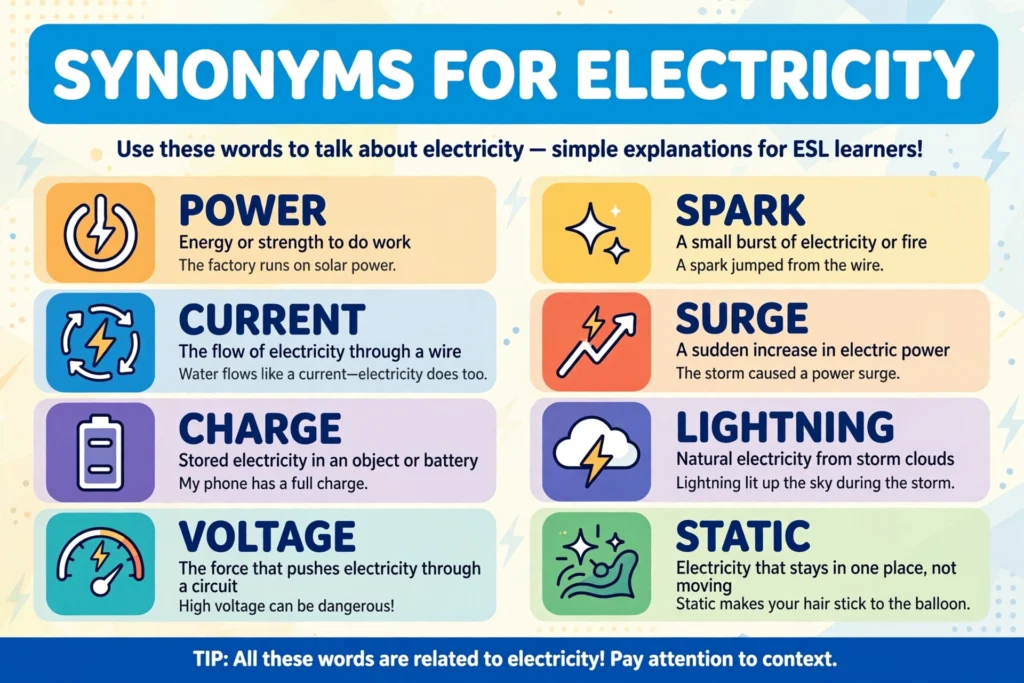
Power
Meaning: The most common engineering synonym — the rate at which electrical energy is delivered or consumed, measured in watts. In everyday technical speech, “power” simply means electricity in usable form.
Example: The power went out across the whole street during the storm.
Another example: This motor draws too much power for a standard household socket.
Current
Meaning: Strictly, the flow of electric charge — but engineers often use it loosely to mean electricity itself, especially when talking about something being live or energized.
Example: Do not touch that wire; the current is still on.
Another example: The technician confirmed current was reaching the motor terminals.
Electrical Energy
Meaning: The formal, scientific term — energy carried by moving charges, measured in joules or kilowatt-hours. Use it in academic writing and energy calculations.
Example: Solar panels convert sunlight directly into electrical energy.
Another example: The factory’s monthly electrical energy consumption rose by twelve percent.
Mains
Meaning: The public electricity supply delivered through the grid to buildings — “mains electricity.” Common in British and South Asian English.
Example: The inverter switches to battery when the mains fail.
Another example: This appliance runs on 230 V mains supply.
Supply
Meaning: Electricity considered as something delivered to a load — the source side of the circuit. “Power supply” is the full form.
Example: Check the supply before you blame the equipment.
Another example: An unstable supply can damage sensitive electronics.
Juice
Meaning: Informal slang for electricity, especially battery power in portable devices. Fine for conversation; never use it in reports or exams.
Example: My phone is out of juice — lend me your charger.
Another example: The drill has enough juice left for one more hole.
Wattage
Meaning: Colloquial term for electric power expressed in watts — often used when discussing how much power a device needs or produces.
Example: Check the wattage before plugging two heaters into one socket.
Another example: The new bulbs give the same light at half the wattage.
Charge
Meaning: In the battery and capacitor sense — stored electricity ready to be used. “The battery has no charge” means it holds no usable electricity.
Example: The UPS keeps its charge for about twenty minutes.
Another example: A capacitor stores charge and releases it in a sudden burst.
Electron Flow
Meaning: The physics-level description — electricity as the movement of electrons through a conductor. Used when explaining how electricity actually works.
Example: Electron flow in a copper wire moves from the negative terminal toward the positive.
Another example: Understanding electron flow makes series and parallel circuits much clearer.
Spark
Meaning: A poetic or dramatic synonym — a flash of electricity, or the lively energy of an idea. Works in creative writing, not in technical documents.
Example: A spark jumped between the terminals as he connected the battery.
Another example: Her presentation brought a real spark to the engineering seminar.
How to Choose the Right Word
Match the word to the situation. In lab reports, manuals, and exams, stick with power, electrical energy, current, or supply — these are precise and always safe. Mains is perfect when you mean the grid supply specifically, and it is the natural word across India, Pakistan, and the UK.
Save juice and spark for conversation and creative writing. They add color but sound unprofessional in a technical document. Wattage sits in the middle: widely understood among technicians, but “power rating” reads better in formal writing.
One caution: current and charge have strict technical meanings (flow of charge, and stored charge). Using them loosely is fine in speech, but in an exam answer, use them precisely — examiners notice. Our guide to static and current electricity explains the physics behind the words.
Electricity Words Around the World
English is not the same everywhere, and neither is electricity vocabulary. In India and Pakistan, power cut and load shedding are everyday phrases for supply interruptions — far more common than the American “outage.” If the light goes, everyone understands the mains have failed.
In British-influenced technical English, you will also meet mains far more often than in American writing, where “utility power” or “grid power” does similar work. Exam boards in South Asia accept all of these, but course books usually standardize on electrical energy and power. When in doubt, those two never go wrong.
FAQs
What is the most formal synonym for electricity?
Electrical energy is the most formal and scientific. It is the term used in textbooks, research papers, and energy statistics, where electricity is treated as a measurable quantity in joules or kilowatt-hours.
Can I use “power” instead of “electricity” in an exam?
Usually yes, but check the context. In “the power failed,” power clearly means electricity. In calculations, though, keep them distinct: power (watts) is the rate, while electrical energy (joules) is the total amount. Mixing them up loses marks — see electrical power and energy for the difference.
Is “juice” acceptable in technical writing?
No. Juice is slang for battery power in casual speech. It will sound unprofessional in reports, manuals, documentation, and exams. Use “charge” or “battery power” instead.
What do British engineers mean by “mains”?
The mains is the public AC supply from the grid — typically 230 V in the UK, India, and Pakistan. “Mains-powered” means a device plugs into the wall socket rather than running on batteries.
What is the difference between “supply” and “power”?
Supply emphasizes the source — where the electricity comes from (“check the supply”). Power emphasizes the electricity itself or its rate of delivery (“the power is out”). In practice they overlap heavily, and “power supply” combines both ideas.
Conclusion
Electricity wears many names: power in the workshop, electrical energy in the textbook, mains on the building plan, juice in conversation. Learning these ten synonyms — and more importantly, learning when each one fits — will make your technical English sharper and more natural. Use the formal terms where precision matters, keep the slang where it belongs, and your writing about electricity will carry real current.