
An arc flash is one of the most violent events that can happen in an electrical system. In a fraction of a second, an explosive release of energy sends temperatures soaring above the surface of the sun, hurls molten metal through the air, and produces a pressure wave strong enough to knock a worker across a room. Every year, arc flash incidents injure electricians and maintenance staff who were simply doing routine work near energized equipment.
This guide explains what an arc flash is, what causes it, why it is so dangerous, and — most importantly — the protection measures that keep workers alive. Whether you are a student, an apprentice electrician, or a facility manager, understanding arc flash is a core part of electrical safety.
What Exactly Is an Arc Flash?
An arc flash is an explosive electrical discharge that travels through the air between conductors, or between a conductor and ground. Normally, air is an insulator. But when the voltage is high enough — or the gap small enough — the air breaks down and becomes a conducting plasma channel. Enormous current rushes through that channel, releasing a massive burst of heat, light, sound, and pressure.
Do not confuse an arc flash with an arc blast, though the two happen together. The arc flash is the brilliant release of light and heat; the arc blast is the explosive pressure wave and shower of molten metal that follows. Together they can destroy switchgear cubicles and cause fatal injuries meters away from the fault point.
Arc flash can occur in any electrical equipment: switchboards, panel boards, motor control centers, transformers, and even large plug-and-socket connections. Higher voltages and higher available fault currents make the event more severe, but low-voltage 400 V systems in commercial buildings have caused serious arc flash injuries too.
What Causes an Arc Flash?
Most arc flash incidents are triggered by something small and ordinary going wrong near live conductors. The common causes include:
- Accidental contact: a dropped spanner, screwdriver, or test probe bridging two live parts or a live part and the earthed enclosure.
- Dust and contamination: conductive dust, moisture, or corrosion on insulators that slowly degrades insulation until it fails.
- Loose connections: a poorly tightened lug that overheats, melts surrounding insulation, and eventually creates a fault path.
- Damaged insulation: cables nicked during installation, insulation aged by heat, or rodents chewing through cable sheaths.
- Human error: racking a breaker into the wrong position, opening a panel under load, or working on equipment believed to be dead.
- Equipment failure: a breaker or contactor failing to clear a fault quickly, letting the arc burn far longer than designed.
Once the arc strikes, it feeds on itself. The plasma is highly conductive, so current keeps flowing; the heat vaporizes copper and aluminum, and the metal vapor itself becomes fuel for the arc. This is why an arc flash grows explosively in milliseconds. Many of these root causes overlap with general electrical hazards found in industrial plants.
Why Is Arc Flash So Dangerous?
The numbers behind an arc flash explain why it kills and maims even experienced workers:
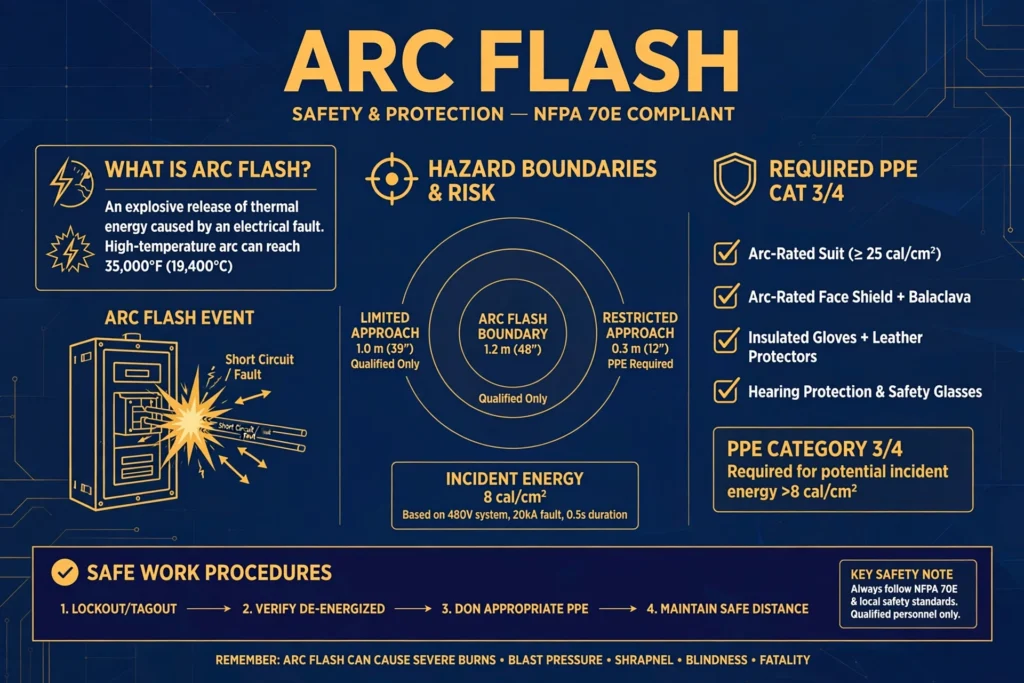
- Extreme heat: arc temperatures reach 19,000°C — hotter than the surface of the sun (about 5,500°C). At that temperature, copper vaporizes instantly and clothing ignites on contact with the radiant heat alone.
- Intense light: the flash produces blinding ultraviolet and visible light that can permanently damage eyesight, even for bystanders who glance at it.
- Pressure wave: the superheated air expands explosively, creating pressures that collapse lungs, rupture eardrums, and throw workers into walls or equipment.
- Molten metal: vaporized and molten copper, aluminum, and steel spray outward at high speed, causing deep burns and penetrating injuries.
- Toxic gases: vaporized insulation and metal produce poisonous fumes that damage lungs.
- Deafening sound: noise levels can exceed 140 dB — well past the threshold of pain and enough to cause instant hearing damage.
Burns are the most common serious injury. Unlike a brief touch of a hot surface, arc flash burns come from radiant heat that ignites ordinary clothing, which then keeps burning against the skin. This is why the right protective clothing matters more than most people expect.
Arc Flash Protection Measures
No single device eliminates arc flash risk. Protection comes from layers: good design, correct work practices, and personal protective equipment (PPE).
1. De-energize Whenever Possible
The safest arc flash is the one that never happens. The first rule in standards like NFPA 70E is to put equipment in an electrically safe work condition — switched off, isolated, locked out, tested dead — before touching it. Live work should be the rare exception, justified in writing, not the routine.
2. Arc Flash Risk Assessment and Labelling
Facilities should calculate the incident energy (measured in cal/cm²) at each piece of equipment and label it with the arc flash boundary — the distance within which PPE is required — plus the required PPE category. These labels turn an invisible hazard into a visible warning every worker can read before opening a panel.
3. Arc-Rated PPE
When live work cannot be avoided, workers wear arc-rated clothing: flame-resistant shirts and trousers, arc flash suits with hoods for high-energy locations, insulated gloves, and face protection such as safety goggles plus an arc-rated face shield. Ordinary polyester or nylon clothing is dangerous because it melts into the skin; arc-rated fabrics self-extinguish.
4. Engineered Controls
Modern switchgear can be specified with arc-resistant construction that vents the blast away from the operator, arc-fault relays that detect the flash of light and trip the breaker in milliseconds, and remote racking tools that let workers operate breakers from outside the arc flash boundary. Fast fault clearing is the single biggest factor in reducing incident energy — which is why correctly rated electrical protection devices are part of arc flash safety, not just equipment protection.
5. Training and Procedures
Workers need to recognize the hazard, read the labels, select the right PPE, and follow written procedures for tasks like voltage testing and breaker operation. Refresher training matters because complacency — “I have opened this panel a hundred times” — is behind many incidents.
Arc Flash at Home and in Small Commercial Sites
Arc flash is usually discussed in industrial terms, but the physics is the same in a home distribution board. A short circuit in a domestic panel can still produce a dangerous flash, which is why covers should never be left off, DIY work inside a live consumer unit is reckless, and any sign of burning smell, buzzing, or scorch marks means calling an electrician immediately. Our guide to electrical safety at home covers the household side in detail.
FAQs
What is the difference between arc flash and short circuit?
A short circuit is any unintended low-resistance connection between conductors. An arc flash is what happens when that fault occurs through the air, creating a plasma arc with explosive release of heat, light, and pressure. Every arc flash involves a short circuit, but not every short circuit produces an arc flash — a bolted fault inside a well-designed enclosure may clear safely without one.
Can arc flash happen at low voltage?
Yes. Serious arc flash incidents have occurred on 230 V and 400 V systems, especially where the available fault current is high (near a large transformer) and protection is slow. Voltage matters, but fault current and clearing time matter just as much.
What is the arc flash boundary?
It is the distance from the fault source within which a person could receive second-degree burns from the thermal energy. Inside the boundary, arc-rated PPE is mandatory; outside it, the risk of burn injury drops to an acceptable level. The boundary is printed on equipment warning labels after an engineering study.
What does cal/cm² mean on an arc flash label?
It is the incident energy — the heat energy per unit area that would strike a worker’s body at a given working distance. PPE is rated to withstand specific values (for example, 8, 25, or 40 cal/cm²). The label tells the worker which category of protection the location requires.
Does an RCD or MCB protect against arc flash?
Not directly. RCDs detect earth leakage and MCBs detect overcurrent, but neither is designed to sense the light and pressure signature of an arc flash or to clear it in the few milliseconds needed. Dedicated arc-fault detection relays, fast breakers, and arc-resistant switchgear are the engineered answer.
What should I do if I witness an arc flash?
Do not touch the victim until you are sure the power is off — they may still be in contact with live parts. Call emergency services, switch off the supply if you can do so safely from a distance, and give first aid for burns and shock while waiting. Afterwards, the incident must be investigated before the equipment is re-energized.
Conclusion
An arc flash is a rare but devastating event: a plasma explosion hot enough to vaporize metal, triggered by something as small as a dropped tool or a loose connection. The good news is that nearly every incident is preventable. De-energize before work, respect the labels and boundaries, wear proper arc-rated PPE when live work is unavoidable, and make sure protection devices clear faults fast. Electricity rewards respect and punishes complacency — and nowhere is that truer than with arc flash.
See the Wikipedia article on arc flash.