
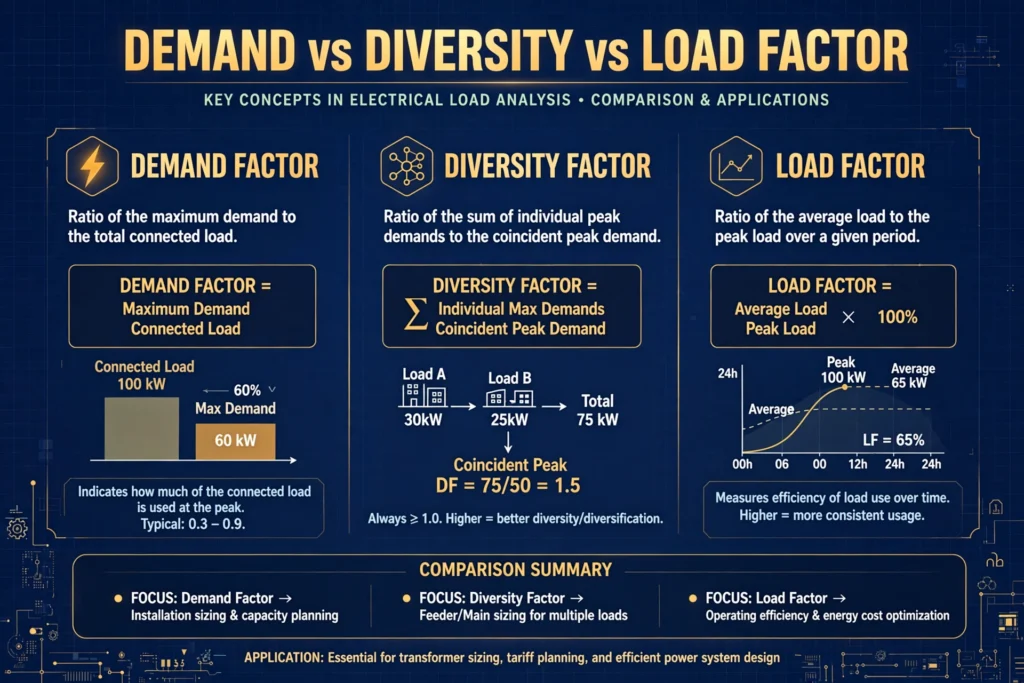

Three of the most confusing terms in electrical load calculations are demand factor, diversity factor, and load factor. Students mix them up in exams, and even working electricians sometimes reach for the wrong one when sizing a cable or a transformer. The confusion is understandable: all three are ratios, all three describe how electrical load behaves, and all three affect the size and cost of the equipment you install.
This guide clears up the confusion for good. You will learn the exact definition of each factor, its formula, what its value tells you, and where engineers actually use it. A side-by-side comparison table and a fully worked workshop example will lock the ideas in place.
What Is Demand Factor?
Demand factor answers a simple practical question: out of everything connected, how much actually runs at the same time? It is the ratio of the maximum demand of a system to the total connected load.
Formula: Demand Factor = Maximum Demand ÷ Total Connected Load
Its value is always 1 or less. A demand factor of 0.6 means that, at the busiest moment, only 60 percent of the connected equipment is drawing its full rated power. The rest is switched off, idle, or running below rating.
Think of a house. The nameplate ratings of every appliance — air conditioner, water heater, washing machine, lights, fans, chargers — might add up to 20 kW of connected load. But the family never runs everything at once. The main meter might record a maximum demand of just 8 kW on the hottest evening. The demand factor is 8 ÷ 20 = 0.4.
Engineers use demand factor to avoid oversizing. Without it, every feeder, breaker, and transformer would be sized for the full connected load, and installations would cost far more than necessary. For a deeper look at how loads are grouped and estimated, see our guide to types of electrical loads.
What Is Diversity Factor?
Diversity factor looks at the same idea from the opposite direction. Instead of comparing peak to connected load, it compares the sum of the individual maximum demands to the maximum demand of the whole group.
Formula: Diversity Factor = Sum of Individual Maximum Demands ÷ Maximum Demand of the Whole System
Its value is always 1 or greater. Why? Because individual machines rarely hit their peaks at the same moment. A water heater peaks in the morning, an air conditioner peaks in the afternoon, and a welding machine peaks whenever the welder strikes an arc. Add up each device’s personal record, and you get a number bigger than the highest reading the main meter ever saw.
Take a small apartment building with four flats. Each flat’s meter once recorded its own maximum: 6, 5, 7, and 4 kW — a sum of 22 kW. But the building’s main meter never went above 14 kW, because the flats peak at different times. The diversity factor is 22 ÷ 14 = 1.57.
Higher diversity means more spreading of peaks, which means a smaller, cheaper main supply can serve the same set of loads. Distribution engineers rely on this when sizing the transformer that feeds a street or a housing colony.
What Is Load Factor?
Load factor measures how steadily a load runs over a period of time — a day, a month, or a year. It is the ratio of the average load to the maximum demand during that period.
Formula: Load Factor = Average Load ÷ Maximum Demand
Its value is always 1 or less. A load factor of 0.5 over a month means the system ran at half its peak capacity on average. A load factor close to 1 means a flat, steady load — like a data center or a continuously running pump. A low load factor means short, sharp peaks with long quiet gaps — like a home with an electric shower.
Utilities care deeply about load factor because it drives tariffs. Two customers can consume the same total energy (kWh), but the one with the lower load factor forces the utility to keep more generation and network capacity ready for brief peaks. That is why industrial tariffs often include a demand charge on top of the energy charge. Our article on base load vs peak load explains the utility side of this picture.
Side-by-Side Comparison
The table below puts all three factors next to each other so the differences are impossible to miss.
| Feature | Demand Factor | Diversity Factor | Load Factor |
|---|---|---|---|
| Definition | Maximum demand ÷ total connected load | Sum of individual maximum demands ÷ system maximum demand | Average load ÷ maximum demand (over a period) |
| Value range | 0 to 1 | 1 and above | 0 to 1 |
| Answers the question | How much of the connected load runs at peak? | How spread out are the individual peaks? | How steady is the load over time? |
| Main use | Sizing feeders, breakers, transformers | Sizing the main supply from sub-circuits | Energy billing, tariff design, efficiency studies |
| Typical home value | 0.3 – 0.5 | 1.5 – 3 | 0.2 – 0.4 |
| Higher value means | More equipment running together | Peaks more spread out in time | Steadier, flatter load profile |
Worked Example: A Small Workshop
Let us put all three factors to work on one realistic case. A workshop has five machines with nameplate ratings of 50, 40, 30, 20, and 10 kW.
Step 1 — Connected load. Add the ratings: 50 + 40 + 30 + 20 + 10 = 150 kW of total connected load.
Step 2 — Individual maximum demands. Sub-metering shows each machine’s own peak: 40, 32, 24, 16, and 8 kW. The sum of individual maximum demands is 40 + 32 + 24 + 16 + 8 = 120 kW.
Step 3 — System maximum demand. The workshop’s main meter records a coincident peak of 95 kW, because the machines never all hit full load in the same minute.
Step 4 — Average load. Over a 30-day month (720 hours), the workshop consumes 34,200 kWh. Average load = 34,200 ÷ 720 = 47.5 kW.
Now the three factors:
- Demand factor = 95 ÷ 150 = 0.63
- Diversity factor = 120 ÷ 95 = 1.26
- Load factor = 47.5 ÷ 95 = 0.50
What does this tell the engineer? The 150 kW of connected machinery only needs roughly a 100 kW supply — the demand factor of 0.63 saves real money on transformer and cable sizing. The peaks are moderately spread out (diversity of 1.26). And the load runs at half its peak on average (load factor 0.50), which suggests shifting some heavy work to off-peak hours could cut the demand charge on the electricity bill. For the full method behind steps like these, see electrical load calculation.
How Engineers Use These Factors in Practice
In design work, demand factor and diversity factor decide equipment size. A consulting engineer estimating a new commercial building starts from the connected load of lighting, HVAC, and equipment, applies demand factors from experience or local codes, and arrives at the maximum demand. Diversity factors then combine the sub-panels into one main service size. Getting this right is the difference between a safe, economical installation and one that is either dangerously undersized or wastefully oversized.
Load factor lives more in the world of operations and billing. Plant managers track it month to month: a falling load factor with the same production output means peakier operation and higher demand charges. Raising it — by staggering machine starts or scheduling heavy loads at night — is one of the cheapest energy-saving measures available. Plants also watch the related plant capacity factor for long-term performance. And because reactive power inflates the current without doing useful work, many facilities pair load-factor improvement with power factor correction to bring the whole bill down.
FAQs
What is the difference between demand factor and load factor?
Demand factor compares the peak to the total connected load (how much of what is installed gets used at once). Load factor compares the average load to the peak over a time period (how steadily the load runs). Demand factor sizes equipment; load factor describes operating behavior and affects billing.
Why is diversity factor always greater than 1?
Because individual loads do not peak simultaneously. The sum of each device’s personal maximum is therefore larger than the highest combined peak the main meter ever records. Dividing the bigger number by the smaller one always gives a result above 1.
Can load factor ever be more than 1?
No. Average load can never exceed maximum demand over the same period — the peak is, by definition, the highest point. A load factor of exactly 1 would mean a perfectly flat load with no variation at all, which almost never happens in practice.
Which factor do I use to size a cable or breaker?
Use demand factor (with diversity factor for combining sub-circuits). These tell you the realistic maximum current the cable or breaker will actually see. Load factor is not used for sizing — it describes energy use over time, not the peak current.
What are typical demand factor values for homes?
Residential demand factors usually fall between 0.3 and 0.5, because lighting, heating, cooling, and appliances rarely all run at full power together. Kitchens are the exception — during cooking, several high-power appliances can coincide, so kitchen circuits get higher demand factors.
How are the three factors related to each other?
They describe the same load from three angles: demand factor links the peak to what is installed, diversity factor links the group peak to the individual peaks, and load factor links the average to the peak. Together they give a complete picture — installed capacity, coincident behavior, and steadiness over time.
Conclusion
Demand factor, diversity factor, and load factor are not interchangeable, but they fit together neatly. Demand factor tells you how much of the connected load shows up at peak, diversity factor tells you how scattered the individual peaks are, and load factor tells you how steady the load runs over time. Learn the three formulas, remember which one is above 1 and which two stay below it, and work through one example with real numbers — after that, no exam question or site calculation will mix them up again.
See the standard engineering definition of demand factor