
Look at any transmission tower and you will see the conductors do not touch the steel structure — they hang from, or stand on, bell-shaped or disc-shaped fittings. Those fittings are insulators, and they perform two jobs at once: they hold the heavy conductors mechanically against wind and weight, and they block the high voltage electrically so it cannot leak into the earthed tower.
Get insulators wrong and the result is flashover, leakage current, or a conductor dropping onto the tower steel. This guide covers the main types of insulators used in transmission lines — pin, suspension, strain, shackle and stay — with their construction, voltage ranges and a clear comparison.
What Do Insulators Do in Transmission Lines?
An overhead line insulator must satisfy three demands simultaneously. Electrically, it must withstand the line voltage plus lightning surges without puncturing or flashing over — and stay insulating when wet, dusty or polluted. Mechanically, it must carry the conductor’s weight plus wind and ice loads for decades. Practically, it must do both while hanging outdoors in sun, rain and pollution for 30–40 years.
Insulators sit at the junction of conductor and support structure — on cross-arms of terminal and transmission towers — and their choice depends on voltage level, which you can place in context with our overview of the power transmission system.
Pin Insulators
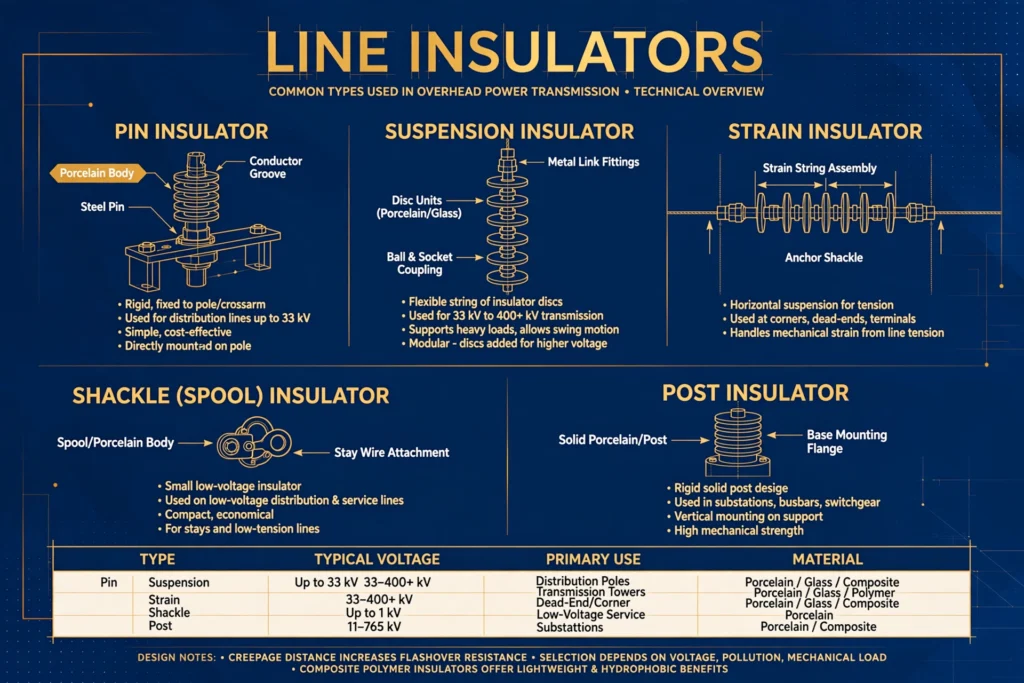
The pin insulator is the classic low-voltage insulator: a single porcelain or glass bell, grooved on the outside, mounted upright on a steel pin fixed to the cross-arm, with the conductor tied into the groove at the top or side. Its shape is no accident — the ridges (sheds) lengthen the leakage path that current would have to creep along the surface, especially when wet.
Voltage range: up to about 33 kV. Beyond that a single pin insulator becomes impractically large and heavy, which is why higher voltages switch to suspension strings. Used on: distribution lines, 11 kV feeders, straight runs with modest mechanical load. Limitation: one solid piece — if it cracks, the whole insulator must be replaced, and it cannot flex with conductor movement the way a string can.
Suspension (Disc) Insulators
The suspension insulator is the workhorse of high-voltage transmission. It consists of a string of identical disc-shaped units (each called a cap-and-pin unit) linked together, hanging vertically from the tower cross-arm, with the conductor clamped at the bottom of the string. Need a higher voltage? Simply add more discs — typically one disc per 11 kV, so a 132 kV line uses about 12 discs per string.
Advantages: modular (a damaged disc can be replaced without changing the whole string), flexible (swings with wind, reducing mechanical stress), and economical at high voltages. Strings are also used in double or triple parallel sets for important lines. Voltage range: 33 kV up to 765 kV and beyond. Used on: straight runs (tangent towers) of transmission lines everywhere. For perspective on the voltages involved, see extra-high-voltage transmission.
Strain Insulators
Where the line changes direction, terminates, or crosses a river or road with a long span, the conductor pulls horizontally with great force. Suspension strings cannot take that sideways tension — so strain insulators are used: essentially suspension strings mounted horizontally (or in the plane of the pull) to anchor the conductor against tension.
Strain strings use the same disc units but are arranged to take the full mechanical tension of the conductor, often with two or more strings in parallel at dead-end towers. They appear at angle towers, terminal towers and anywhere the line is “pulled tight.” Mechanically they are the strongest insulator arrangement on the line; electrically they behave like suspension strings of the same disc count.
Shackle and Stay Insulators
Shackle insulators are small, compact insulators used on low-voltage distribution lines (up to about 1 kV) at dead ends and sharp corners, where the conductor is looped through the shackle. You will see them on service drops to houses and small street-lighting spans.
Stay (guy) insulators sit in the stay wire — the diagonal steel wire that anchors a pole against the conductor’s pull. The stay wire runs from the pole top down to an ground anchor, and the stay insulator (usually an egg-shaped porcelain piece) inserted in the wire prevents the stay from becoming a live conductor if the pole-top hardware ever contacts the line. It is a small component with a purely safety-driven job.
Comparison Table
| Type | Voltage range | Mounting | Key strength | Typical use |
|---|---|---|---|---|
| Pin insulator | Up to 33 kV | Upright on steel pin | Simple, cheap, one piece | 11 kV distribution, straight runs |
| Suspension (disc) | 33 kV – 765 kV+ | String hangs vertically | Modular, flexible, scalable | HV/EHV straight runs |
| Strain | 33 kV – 765 kV+ | String horizontal, in tension | Takes full conductor tension | Angle, dead-end, terminal towers |
| Shackle | Up to 1 kV | Dead-end / corner | Compact, cheap | Service lines, LV corners |
| Stay (guy) | — (safety) | In stay wire | Isolates stay wire | Pole stays on distribution lines |
Insulator Materials: Porcelain, Glass and Polymer
Porcelain: the traditional material — strong, proven over a century, but heavy and shatters on impact. A cracked porcelain disc is hard to spot visually.
Toughened glass: popular in Europe and the Middle East; a damaged glass disc shatters completely and falls away, making failures obvious during line patrols — you can literally see the missing disc.
Polymer (silicone rubber / composite): the modern choice — a fiberglass core with silicone rubber sheds. Far lighter than porcelain, highly resistant to pollution flashover thanks to water-repelling (hydrophobic) sheds, but vulnerable to vandalism (gunshots) and aging from UV over very long service. New lines increasingly specify polymer.
The conductor material strung between these insulators matters too — see our guide to the types of electrical wires and their uses.
Common Failures and Maintenance
- Pollution flashover: dust, salt or industrial deposits on the surface become conductive when wet, causing flashover. Countered by washing, silicone coating, or polymer insulators.
- Cracked or punctured discs: lightning or mechanical shock damages individual discs; suspension strings allow single-disc replacement.
- Corona damage: at EHV, corona discharge at sharp fittings erodes sheds over time — grading rings control the field.
- Vandalism: insulators are frequent targets; glass makes damage visible, polymer needs inspection.
- Maintenance: visual patrols, infrared thermography for hot spots, and periodic cleaning in polluted or coastal areas.
FAQs
Why are suspension insulators made of discs?
Modularity. Each disc handles about 11 kV, so strings are built to any voltage by adding discs, and a single damaged disc can be replaced without scrapping the whole insulator — impossible with a one-piece design.
What is the difference between suspension and strain insulators?
Both use disc strings, but suspension strings hang vertically carrying only the conductor’s weight on straight runs, while strain strings are mounted horizontally to take the full pulling tension at angles, dead ends and terminals.
How many discs are used for 132 kV?
Roughly one disc per 11 kV, so about 12 discs per string for 132 kV — utilities often add one or two extra for pollution margin in coastal or industrial areas.
Why are insulators bell-shaped?
The sheds (ridges) increase the creepage distance — the path leakage current must travel along the surface — which keeps the insulator effective even when wet or dirty.
Which is better: porcelain, glass or polymer?
Polymer wins on weight and pollution performance for new lines; glass wins on damage visibility; porcelain wins on century-long track record. The choice depends on environment, vandalism risk and utility practice.
What causes insulator flashover?
Lightning surges, switching surges, or surface pollution becoming conductive in rain or fog. The arc jumps across or around the insulator instead of staying on the conductor — the exact failure insulators are designed to prevent.
Conclusion
Pin insulators serve the modest voltages of distribution, suspension strings carry the giants of EHV transmission with elegant modularity, strain assemblies anchor the line where tension rules, and shackle and stay types handle the small but vital safety jobs. Behind the variety lies one principle: keep the conductor mechanically supported and electrically isolated, in all weather, for decades. Choose the right type and material for the voltage and environment, maintain them against pollution and damage, and the line stays where it belongs — in the air, delivering power.
Further reading: Insulator (electricity) — Wikipedia.