
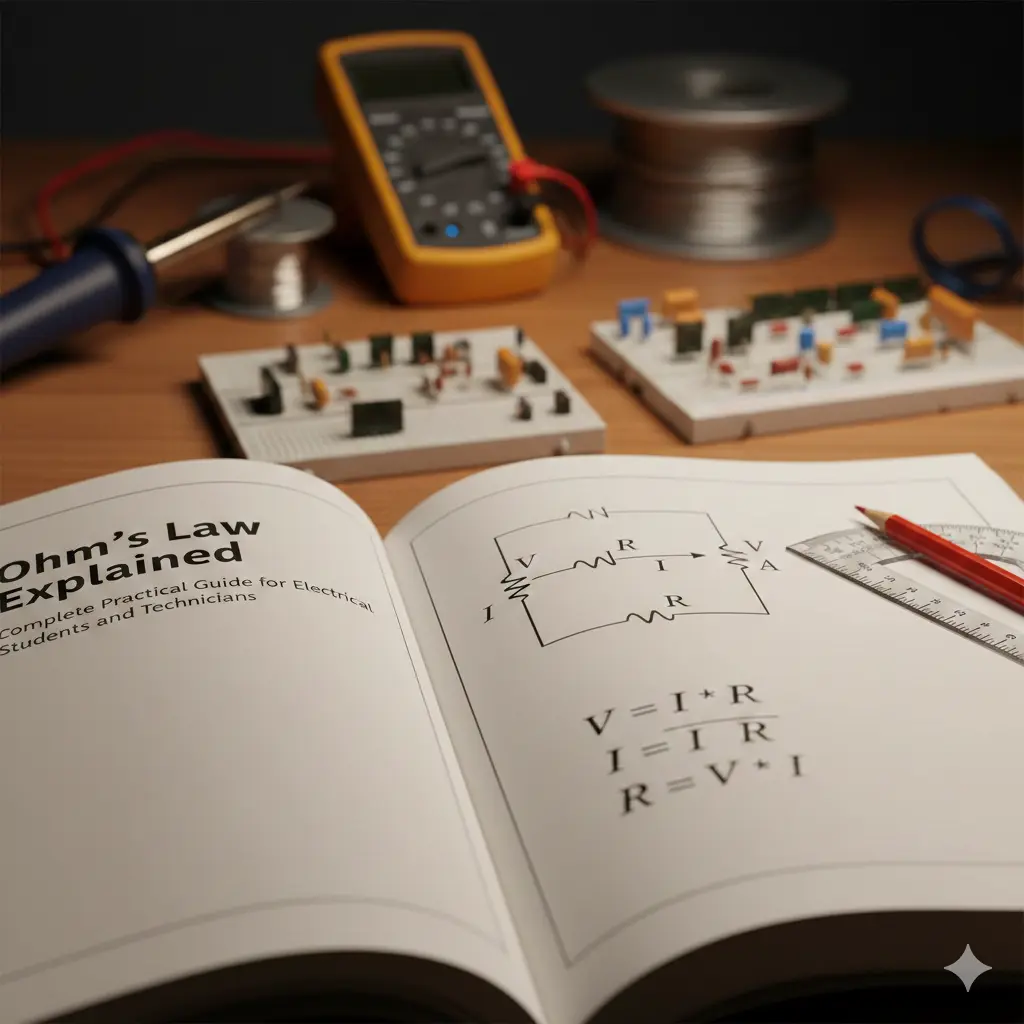

Imagine you are installing a small LED light in a workshop. You connect it directly to a battery without checking the voltage and resistance. Within seconds, the LED burns out. Why did that happen? Because too much current flowed through it.
This is where Ohm’s Law Explained becomes important. Ohm’s Law is one of the most basic and powerful rules in electrical engineering. It helps us calculate voltage, current, and resistance. Without understanding this law, it is impossible to design safe and efficient electrical circuits.
For electrical students, engineers, and technicians, Ohm’s Law is the foundation of circuit analysis. Whether you are working on house wiring, control panels, motors, or electronics, you use this law every day—sometimes without even realizing it.
In this guide, you will learn:
- What Ohm’s Law is in simple language
- Ohm’s Law working principle
- Types and forms of the law
- Main components involved
- Ohm’s Law applications
- Ohm’s Law advantages and disadvantages
- Difference between voltage and current
- Practical troubleshooting tips
Let’s understand this fundamental law step by step.
What Is Ohm’s Law (2026)
Ohm’s Law is one of the most fundamental principles in electrical and electronic engineering. It explains the relationship between voltage (V), current (I), and resistance (R) in an electrical circuit. Formulated by the German physicist Georg Simon Ohm in 1827, this law states that the electric current flowing through a conductor is directly proportional to the applied voltage and inversely proportional to the conductor’s resistance, provided that temperature and other physical conditions remain constant.
Ohm’s Law serves as the foundation for circuit analysis and is widely used in residential wiring, industrial power systems, electronic circuit design, renewable energy systems, and electrical troubleshooting. Engineers and technicians rely on this law to calculate unknown electrical values, select appropriate electrical components, and ensure the safe and efficient operation of electrical equipment.
Definition
Ohm’s Law states that:
The current flowing through a conductor is directly proportional to the voltage applied across it and inversely proportional to its resistance, provided the temperature remains constant.
This relationship helps engineers understand how changes in voltage or resistance affect the amount of current flowing in an electrical circuit.
Mathematical Formula
The mathematical expression of Ohm’s Law is:
V = I × R
Where:
- V = Voltage (Volts)
- I = Current (Amperes)
- R = Resistance (Ohms)
The same relationship can also be rearranged to calculate any unknown quantity:
- Current (I) = V ÷ R
- Resistance (R) = V ÷ I
These equations are widely used for electrical calculations, circuit design, and fault diagnosis.
Simple Explanation
Ohm’s Law simply explains how voltage, current, and resistance are connected to one another.
- If the voltage increases while resistance remains the same, current increases.
- If the resistance increases while voltage remains constant, current decreases.
- If the voltage decreases, the current also decreases.
- If the resistance decreases, more current flows through the circuit.
In simple words:
- Voltage provides the electrical force.
- Current is the flow of electric charge.
- Resistance controls or opposes the flow of current.
Together, these three quantities determine how every electrical circuit operates.
Practical Example
Consider a simple electrical circuit connected to a 12-volt battery and a 6-ohm resistor.
Given:
- Voltage (V) = 12 V
- Resistance (R) = 6 Ω
Using Ohm’s Law:
Current (I) = V ÷ R
I = 12 ÷ 6 = 2 Amperes
This means that 2 amperes of current will flow through the circuit.
This simple calculation helps engineers and technicians select the correct wire size, fuse rating, resistor value, and protection devices, thereby preventing overheating, equipment damage, and electrical failures.
Importance of Ohm’s Law
Ohm’s Law is essential because it enables electrical professionals to:
- Calculate voltage, current, and resistance accurately.
- Design safe and efficient electrical circuits.
- Select appropriate electrical components.
- Prevent overloads and short circuits.
- Troubleshoot electrical faults quickly.
- Improve energy efficiency.
- Protect electrical equipment from damage.
It is one of the first principles taught in electrical engineering and remains one of the most frequently used formulas in practical electrical work.
Ohm’s Law Working Principle (2026)
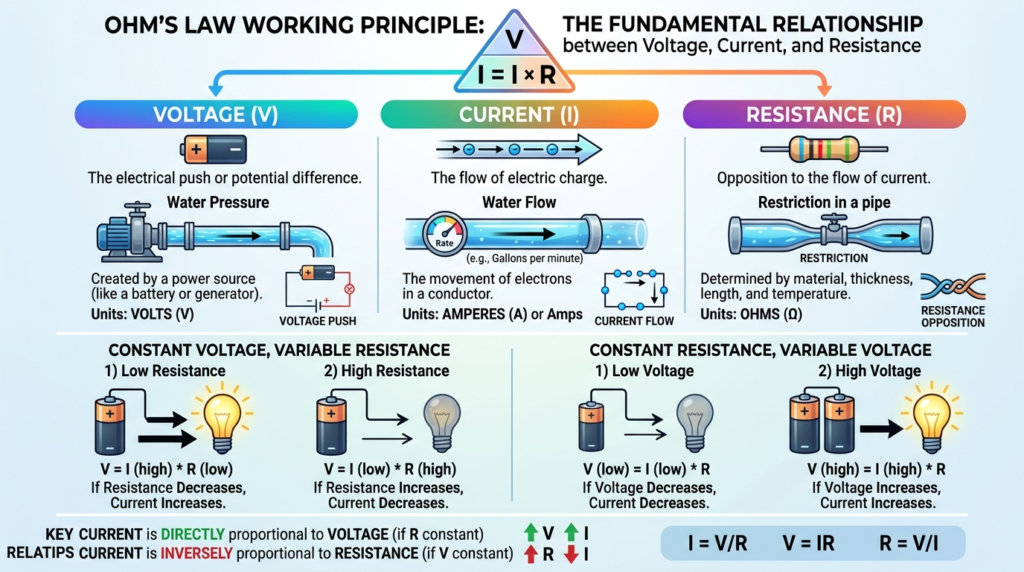
To understand the Ohm’s Law working principle, imagine electricity flowing like water in a pipe.Ohm’s Law working principle states that the current flowing through a conductor is directly proportional to the applied voltage and inversely proportional to the resistance, provided temperature remains constant. This means that when voltage increases, current also increases, while higher resistance reduces current flow. The law helps explain the relationship between voltage, current, and resistance in electrical circuits. Mathematically, Ohm’s Law is expressed as ( V = IR ), where ( V ) is voltage, ( I ) is current, and ( R ) is resistance. In practical electrical systems, Ohm’s Law is widely used to calculate circuit values, design electrical equipment, troubleshoot faults, and ensure safe operation of electronic and electrical devices.
- Voltage = Water pressure
- Current = Water flow
- Resistance = Pipe size restriction
Step-by-Step Explanation of Ohm’s Law (2026)
Ohm’s Law explains how electrical energy flows through a circuit by describing the relationship between voltage (V), current (I), and resistance (R). It states that the amount of current flowing through a conductor is directly proportional to the applied voltage and inversely proportional to the resistance, provided that temperature and other physical conditions remain constant. Understanding this process step by step helps students, technicians, and engineers analyze electrical circuits, perform accurate calculations, and troubleshoot electrical problems effectively.
A Voltage Source Creates Electrical Pressure
Every electrical circuit begins with a voltage source, such as a battery, generator, or power supply. The voltage source creates an electrical potential difference, often referred to as electrical pressure, between two terminals. This electrical pressure provides the energy required to move electrons through the circuit.
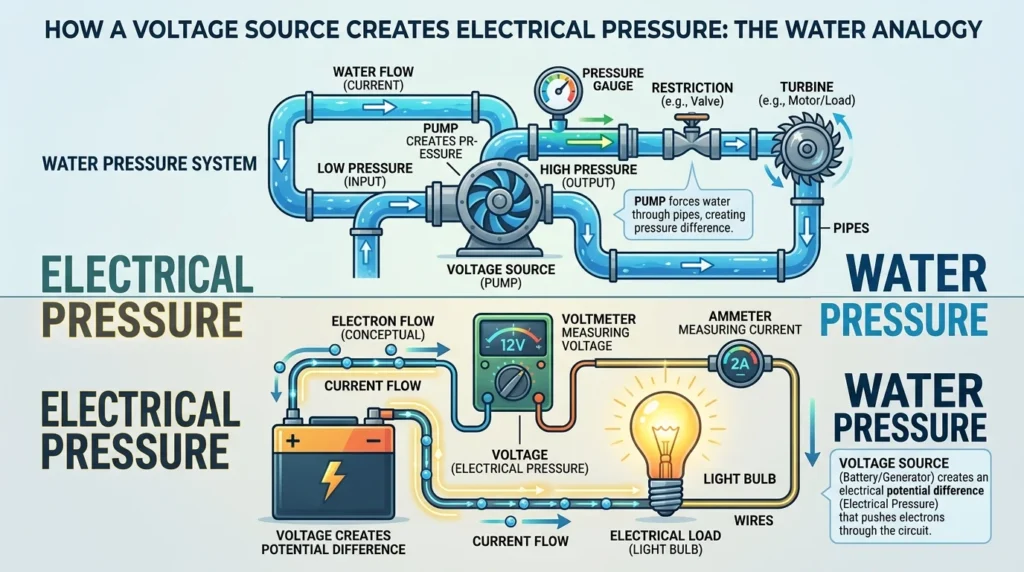
Key Points:
- Voltage is the driving force of electricity.
- It is measured in Volts (V).
- Without voltage, no current can flow.
- Common voltage sources include batteries, generators, solar panels, and power supplies.
Closing the Circuit Allows Current to Flow
When the circuit is completed by closing a switch or connecting all components, a continuous path is formed. This closed path allows electrons to move through the conductor, creating an electric current.
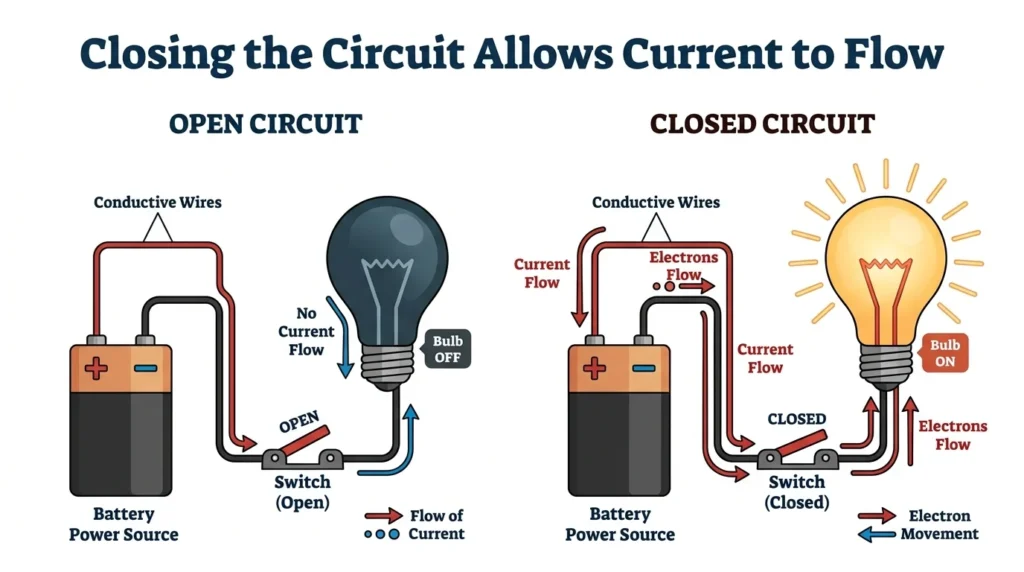
The movement of electrons supplies electrical energy to connected devices such as lamps, motors, heaters, and electronic circuits.
Key Points:
- Current flows only in a closed circuit.
- It is measured in Amperes (A).
- Current transfers electrical energy to electrical loads.
- An open circuit prevents current flow.
Resistance Opposes the Flow of Electrons
As electrons move through the conductor, they encounter resistance, which opposes their movement. Every electrical conductor and component has some resistance that limits the amount of current flowing in the circuit.
The amount of resistance depends on several factors, including:
- Material type
- Length of the conductor
- Cross-sectional area
- Temperature
Key Points:
- Resistance controls current flow.
- It is measured in Ohms (Ω).
- Higher resistance reduces current.
- Lower resistance allows more current to flow.
Current Depends on Voltage and Resistance
According to Ohm’s Law, the amount of current flowing in a circuit depends on both the applied voltage and the circuit resistance.
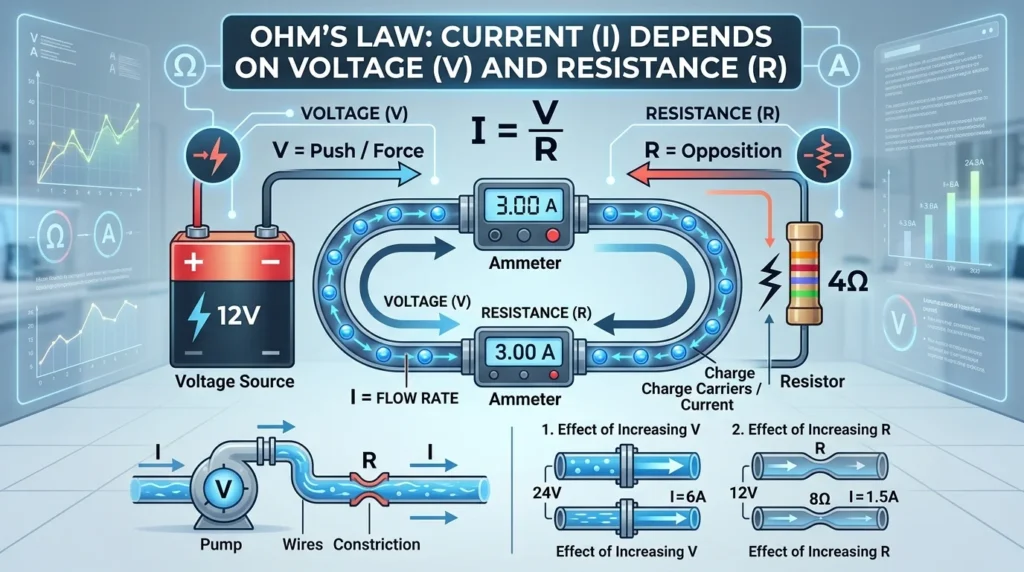
The mathematical relationship is:
Current (I) = Voltage (V) ÷ Resistance (R)
This means:
- Increasing the voltage while keeping resistance constant increases the current.
- Increasing the resistance while keeping voltage constant decreases the current.
This relationship enables engineers to predict circuit behavior and select suitable electrical components.
Important Points to Remember
Understanding the basic relationships in Ohm’s Law is essential for safe and efficient circuit design.
Higher Voltage → More Current
If resistance remains constant, increasing the applied voltage increases the flow of current through the circuit. More electrical pressure pushes more electrons through the conductor.
Higher Resistance → Less Current
If the voltage remains constant, increasing the resistance reduces the amount of current flowing through the circuit because the movement of electrons is more restricted.
Lower Resistance → More Current
Reducing resistance allows electrons to flow more easily, increasing the current in the circuit.
Zero or Extremely Low Resistance → Very High Current
If a circuit has almost no resistance, an extremely large current can flow. This condition is known as a short circuit and can damage electrical equipment, overheat conductors, trip circuit breakers, or even cause electrical fires. Therefore, protective devices such as fuses and circuit breakers are essential for preventing damage.
Simple Water Flow Analogy
Ohm’s Law can be understood easily by comparing an electrical circuit to a water supply system.
Imagine water flowing through a pipe:
- The water pressure represents voltage.
- The flow of water represents electric current.
- The size or restriction of the pipe represents resistance.
If the water pressure increases, more water flows through the pipe. Similarly, increasing voltage causes more current to flow through an electrical circuit.
If the pipe becomes narrower, it restricts the water flow. Likewise, increasing electrical resistance reduces the amount of current flowing through the conductor.
This simple analogy makes it easier to visualize how voltage, current, and resistance interact in accordance with Ohm’s Law.
Practical Importance
Understanding the step-by-step operation of Ohm’s Law helps engineers and technicians to:
Ensure reliable operation of electrical and electronic equipment.
Analyze electrical circuits accurately.
Design safe and efficient electrical systems.
Select suitable electrical components.
Prevent circuit overloads.
Troubleshoot electrical faults quickly.
Improve energy efficiency.
Main Components of Ohm’s Law (2026)
Ohm’s Law is based on three fundamental electrical quantities: Voltage (V), Current (I), and Resistance (R). These three components work together to determine how electricity flows through an electrical circuit. Understanding their relationship is essential for analyzing electrical systems, designing circuits, selecting components, and troubleshooting electrical faults. Every electrical and electronic device, from simple household appliances to advanced industrial equipment, operates according to the interaction of these three basic quantities. A clear understanding of voltage, current, and resistance forms the foundation of electrical engineering and helps ensure the safe, reliable, and efficient operation of electrical systems.
Voltage (V)
Voltage is the electrical potential difference between two points in a circuit. It is often referred to as electrical pressure because it provides the force that pushes electrons through a conductor. Without voltage, electrical current cannot flow. Voltage is produced by sources such as batteries, generators, solar panels, and power supplies, and it is measured in Volts (V) using a voltmeter.
Functions of Voltage:
- Provides the driving force for electric current.
- Pushes electrons through a conductor.
- Supplies electrical energy to the circuit.
- Enables electrical devices to operate efficiently.
- Maintains the required potential difference between circuit points.
Practical Examples:
- Household power supply (230 V or 120 V, depending on the country).
- Automobile batteries (12 V).
- Mobile phone chargers (5 V).
- Industrial power systems.
Current (I)
Current is the flow of electric charge through a conductor. It represents the movement of electrons from one point to another in a closed electrical circuit. Current is measured in Amperes (A) using an ammeter. The amount of current flowing in a circuit depends on the applied voltage and the resistance of the circuit, as described by Ohm’s Law.
Functions of Current:
- Delivers electrical energy to loads.
- Powers electrical and electronic devices.
- Produces heat, light, and mechanical motion.
- Operates motors, heaters, lamps, and electronic circuits.
- Transfers electrical power throughout the system.
Practical Examples:
- Current flowing through household appliances.
- Electric motors in industrial machinery.
- LED lighting circuits.
- Battery-powered electronic devices.
Resistance (R)
Resistance is the opposition offered by a material or component to the flow of electric current. Every conductor has some resistance, which limits the amount of current flowing through the circuit. Resistance is measured in Ohms (Ω) using an ohmmeter or a digital multimeter. The resistance of a conductor depends on factors such as material type, length, cross-sectional area, and temperature.
Functions of Resistance:
- Controls the amount of current flowing in a circuit.
- Protects electrical components from excessive current.
- Produces controlled voltage drops.
- Dissipates electrical energy as heat where required.
- Helps regulate circuit operation.
Practical Examples:
- Fixed resistors in electronic circuits.
- Heating elements in electric heaters.
- Current-limiting resistors for LEDs.
- Variable resistors (potentiometers) used for adjustment and control.
Relationship Between Voltage, Current, and Resistance
The three components of Ohm’s Law are mathematically related by the following equations:
- Voltage (V) = Current (I) × Resistance (R)
- Current (I) = Voltage (V) ÷ Resistance (R)
- Resistance (R) = Voltage (V) ÷ Current (I)
These relationships enable engineers and technicians to calculate unknown electrical quantities accurately and design circuits that operate safely and efficiently.
Importance of Understanding the Main Components
A thorough understanding of voltage, current, and resistance provides several practical benefits, including:
Reliable operation of electrical and electronic systems.
Accurate electrical calculations.
Safe electrical circuit design.
Proper selection of electrical components.
Improved troubleshooting and fault diagnosis.
Prevention of overloads and equipment damage.
Better energy efficiency.
Main Components of Ohm’s Law (2026)
Ohm’s Law is based on three fundamental electrical quantities: Voltage (V), Current (I), and Resistance (R). These three components work together to determine how electricity flows through an electrical circuit. Understanding their relationship is essential for analyzing electrical systems, designing circuits, selecting components, and troubleshooting electrical faults. Every electrical and electronic device, from simple household appliances to advanced industrial equipment, operates according to the interaction of these three basic quantities. A clear understanding of voltage, current, and resistance forms the foundation of electrical engineering and helps ensure the safe, reliable, and efficient operation of electrical systems.
Voltage (V)
Voltage is the electrical potential difference between two points in a circuit. It is often referred to as electrical pressure because it provides the force that pushes electrons through a conductor. Without voltage, electrical current cannot flow. Voltage is produced by sources such as batteries, generators, solar panels, and power supplies, and it is measured in Volts (V) using a voltmeter.
Functions of Voltage:
- Provides the driving force for electric current.
- Pushes electrons through a conductor.
- Supplies electrical energy to the circuit.
- Enables electrical devices to operate efficiently.
- Maintains the required potential difference between circuit points.
Practical Examples:
- Household power supply (230 V or 120 V, depending on the country).
- Automobile batteries (12 V).
- Mobile phone chargers (5 V).
- Industrial power systems.
Current (I)
Current is the flow of electric charge through a conductor. It represents the movement of electrons from one point to another in a closed electrical circuit. Current is measured in Amperes (A) using an ammeter. The amount of current flowing in a circuit depends on the applied voltage and the resistance of the circuit, as described by Ohm’s Law.
Functions of Current:
- Delivers electrical energy to loads.
- Powers electrical and electronic devices.
- Produces heat, light, and mechanical motion.
- Operates motors, heaters, lamps, and electronic circuits.
- Transfers electrical power throughout the system.
Practical Examples:
- Current flowing through household appliances.
- Electric motors in industrial machinery.
- LED lighting circuits.
- Battery-powered electronic devices.
Resistance (R)
Resistance is the opposition offered by a material or component to the flow of electric current. Every conductor has some resistance, which limits the amount of current flowing through the circuit. Resistance is measured in Ohms (Ω) using an ohmmeter or a digital multimeter. The resistance of a conductor depends on factors such as material type, length, cross-sectional area, and temperature.
Functions of Resistance:
- Controls the amount of current flowing in a circuit.
- Protects electrical components from excessive current.
- Produces controlled voltage drops.
- Dissipates electrical energy as heat where required.
- Helps regulate circuit operation.
Practical Examples:
- Fixed resistors in electronic circuits.
- Heating elements in electric heaters.
- Current-limiting resistors for LEDs.
- Variable resistors (potentiometers) used for adjustment and control.
Relationship Between Voltage, Current, and Resistance
The three components of Ohm’s Law are mathematically related by the following equations:
- Voltage (V) = Current (I) × Resistance (R)
- Current (I) = Voltage (V) ÷ Resistance (R)
- Resistance (R) = Voltage (V) ÷ Current (I)
These relationships enable engineers and technicians to calculate unknown electrical quantities accurately and design circuits that operate safely and efficiently.
Importance of Understanding the Main Components
A thorough understanding of voltage, current, and resistance provides several practical benefits, including:
Reliable operation of electrical and electronic systems.
Accurate electrical calculations.
Safe electrical circuit design.
Proper selection of electrical components.
Improved troubleshooting and fault diagnosis.
Prevention of overloads and equipment damage.
Better energy efficiency.
Advantages and Limitations of Ohm’s Law (2026)
Ohm’s Law is one of the most important and widely used principles in electrical and electronic engineering. It provides a simple mathematical relationship between voltage, current, and resistance, making it an essential tool for circuit analysis, electrical design, troubleshooting, and equipment selection. Engineers, technicians, electricians, and students use Ohm’s Law daily to perform accurate electrical calculations and ensure the safe operation of electrical systems. Despite its many advantages, Ohm’s Law also has certain limitations, particularly when dealing with non-linear devices and complex alternating current (AC) circuits. Understanding both its strengths and limitations is essential for applying it correctly in practical engineering applications.
Advantages of Ohm’s Law (2026)
Ohm’s Law offers numerous benefits that make it one of the fundamental concepts in electrical engineering. Its simplicity and practical usefulness have made it an indispensable tool for analyzing electrical circuits and designing reliable systems.
Simple and Easy to Understand
One of the greatest advantages of Ohm’s Law is its simplicity. The relationship between voltage, current, and resistance is expressed through straightforward mathematical formulas that are easy to learn and apply.
Benefits:
- Easy for beginners to understand.
- Simplifies electrical calculations.
- Reduces calculation errors.
- Forms the foundation of circuit analysis.
Helps Calculate Safe Current Levels
Ohm’s Law enables engineers to calculate the expected current flowing through an electrical circuit before installation. This helps prevent excessive current that could damage equipment or create safety hazards.
Benefits:
- Prevents circuit overloading.
- Improves electrical safety.
- Supports proper component selection.
- Reduces the risk of overheating.
Prevents Equipment Damage
By accurately determining current, voltage, and resistance values, Ohm’s Law helps engineers select appropriate electrical components that operate within their safe limits.
Benefits:
- Protects electrical equipment.
- Prevents overheating of wires.
- Extends equipment lifespan.
- Reduces maintenance costs.
Essential for Circuit Design
Ohm’s Law serves as the foundation for designing electrical and electronic circuits. Engineers use it to determine resistor values, conductor sizes, power supply requirements, and operating conditions.
Applications:
- Residential wiring.
- Industrial control panels.
- Electronic circuit design.
- Printed Circuit Boards (PCBs).
- Power supply design.
Useful for Troubleshooting
Technicians use Ohm’s Law extensively to diagnose electrical faults by comparing measured values with calculated values.
Applications:
- Detecting short circuits.
- Finding open circuits.
- Identifying faulty components.
- Verifying equipment performance.
Applicable in Both AC and DC Circuits
Although additional factors such as impedance are considered in advanced AC analysis, the basic relationship established by Ohm’s Law remains useful in both direct current (DC) and many alternating current (AC) circuit calculations.
Applications:
- DC power systems.
- Basic AC circuit analysis.
- Electronic devices.
- Laboratory experiments.
Saves Time in Electrical Calculations
Using simple mathematical formulas allows engineers and technicians to perform quick electrical calculations without complicated procedures.
Benefits:
- Faster circuit analysis.
- Improved work efficiency.
- Simplified engineering calculations.
- Better productivity during maintenance.
Forms the Foundation of Electrical Engineering
Nearly every branch of electrical and electronic engineering is built upon the principles of Ohm’s Law. It serves as the basis for understanding more advanced concepts such as electrical power, circuit analysis, electronics, automation, and power systems.
Importance:
- Fundamental engineering principle.
- Essential for advanced electrical studies.
- Supports modern electrical technologies.
- Used in education, research, and industry.
Limitations of Ohm’s Law (2026)
Although Ohm’s Law is extremely useful, it has several limitations that engineers must understand when analyzing complex electrical systems.
Applicable Mainly to Linear Circuits
Ohm’s Law accurately describes the relationship between voltage and current only in linear electrical circuits, where resistance remains constant.
Limitation:
- Not suitable for components with changing resistance characteristics.
Not Suitable for Non-Linear Devices
Many electronic components do not exhibit a linear relationship between voltage and current. Examples include diodes, transistors, LEDs, thermistors, and semiconductor devices.
Examples:
- Diodes.
- Transistors.
- LEDs.
- Semiconductor devices.
- Integrated circuits.
These components require more advanced analysis techniques beyond basic Ohm’s Law.
Temperature Affects Resistance
The resistance of most conductors changes with temperature. As temperature increases, conductor resistance generally increases, causing the current to vary from the value predicted using constant resistance.
Effects:
- Reduced calculation accuracy.
- Increased conductor resistance.
- Changes in circuit performance.
Insufficient for Complex AC Circuit Analysis
In alternating current (AC) systems, voltage and current are affected by inductance, capacitance, frequency, and phase angle. Therefore, impedance must be used instead of simple resistance.
Additional Factors in AC Circuits:
- Inductive reactance.
- Capacitive reactance.
- Impedance.
- Phase angle.
- Frequency.
Does Not Explain Power Factor
Ohm’s Law describes the relationship between voltage, current, and resistance but does not account for power factor, which is an important consideration in AC power systems.
Therefore, additional concepts are required to analyze:
- Real power.
- Reactive power.
- Apparent power.
- Power factor correction.
Cannot Analyze Complex Electrical Networks Alone
Large electrical systems containing multiple power sources, transformers, motors, and interconnected loads require additional electrical laws and analysis methods.
Additional Engineering Principles Include:
- Kirchhoff’s Voltage Law (KVL).
- Kirchhoff’s Current Law (KCL).
- Thevenin’s Theorem.
- Norton’s Theorem.
- Network analysis techniques.
Importance of Understanding Both Advantages and Limitations
Knowing the advantages and limitations of Ohm’s Law enables engineers and technicians to determine when it can be applied directly and when more advanced electrical analysis methods are required. This understanding improves calculation accuracy, enhances electrical safety, and supports better engineering decisions in both simple and complex electrical systems.
Applications of Ohm’s Law (2026)
Ohm’s Law is one of the most widely used principles in electrical and electronic engineering. It establishes the relationship between voltage (V), current (I), and resistance (R), enabling engineers, technicians, electricians, and students to analyze, design, and troubleshoot electrical circuits accurately. From simple household wiring to advanced industrial automation and renewable energy systems, Ohm’s Law is applied in almost every area of modern electrical technology. Understanding its practical applications helps ensure safe operation, efficient energy use, and reliable performance of electrical equipment.
Home Applications
Ohm’s Law is extensively used in residential electrical systems to ensure the safe and efficient operation of household appliances and wiring installations. It helps determine the correct current flow, select protective devices, and prevent electrical overloads.
Common Home Applications:
- Calculating current drawn by household appliances.
- Selecting the proper fuse and circuit breaker ratings.
- Designing LED lighting circuits.
- Determining suitable wire sizes for home wiring.
- Calculating voltage drop in residential circuits.
- Troubleshooting faulty electrical appliances.
- Ensuring safe power distribution within homes.
Benefits:
- Improves electrical safety.
- Prevents overloads and short circuits.
- Increases energy efficiency.
- Extends appliance lifespan.
Industrial Applications
Industries rely heavily on Ohm’s Law for designing, operating, and maintaining electrical systems. Accurate calculations are essential for powering heavy machinery, industrial motors, and automated production equipment.
Common Industrial Applications:
- Motor control circuits.
- Industrial control panel design.
- Electrical load calculations.
- Cable sizing and selection.
- Protection system design.
- Transformer and generator analysis.
- Industrial automation systems.
Benefits:
- Improves equipment reliability.
- Reduces energy losses.
- Prevents electrical failures.
- Supports efficient industrial operations.
Electronics Applications
Electronic circuits require precise control of voltage and current. Ohm’s Law is fundamental in selecting electronic components and ensuring that sensitive devices operate within their specified limits.
Common Electronics Applications:
- Selecting resistor values.
- Designing printed circuit boards (PCBs).
- Current limiting for LEDs.
- Battery-powered electronic devices.
- Sensor circuits.
- Amplifier and signal-processing circuits.
- Microcontroller and embedded system design.
Benefits:
- Protects sensitive electronic components.
- Improves circuit accuracy.
- Enhances device performance.
- Simplifies electronic circuit design.
Renewable Energy Applications
Renewable energy systems depend on Ohm’s Law for efficient electrical design and safe operation. Engineers use it to optimize power transmission and minimize energy losses.
Common Renewable Energy Applications:
- Solar photovoltaic (PV) systems.
- Wind energy installations.
- Battery energy storage systems.
- Charge controller design.
- Inverter sizing.
- Cable selection and voltage-drop calculations.
Benefits:
- Maximizes energy efficiency.
- Improves renewable energy performance.
- Reduces transmission losses.
- Supports sustainable energy systems.
Electric Vehicle (EV) Applications
Electric vehicles contain complex electrical systems that require accurate voltage, current, and resistance calculations. Ohm’s Law is essential for battery management, charging systems, and electric motor operation.
Common EV Applications:
- Battery Management Systems (BMS).
- Electric motor control.
- Charging station design.
- High-voltage cable sizing.
- Power converter circuits.
- Vehicle electrical protection systems.
Benefits:
- Improves battery efficiency.
- Enhances vehicle safety.
- Optimizes charging performance.
- Increases overall system reliability.
Power Supply Applications
Power supplies convert electrical energy into the voltage and current required by different electronic and electrical devices. Ohm’s Law is used to design and regulate these systems efficiently.
Common Applications:
- AC to DC power supplies.
- Regulated voltage supplies.
- Switching power supplies (SMPS).
- Laboratory power supplies.
- UPS (Uninterruptible Power Supply) systems.
Benefits:
- Provides stable voltage output.
- Protects connected equipment.
- Improves power quality.
- Increases operational efficiency.
Educational and Laboratory Applications
Ohm’s Law is one of the first concepts taught in electrical and electronic engineering education. It provides students with the foundation for understanding circuit analysis and electrical measurements.
Common Educational Applications:
- Laboratory experiments.
- Circuit analysis exercises.
- Engineering calculations.
- Technical training programs.
- Electrical simulation software.
Benefits:
- Develops analytical skills.
- Improves understanding of electrical principles.
- Prepares students for practical engineering work.
Everyday Practical Applications
Ohm’s Law is used daily by electricians, technicians, and engineers in a wide variety of maintenance and troubleshooting tasks.
Examples Include:
- Diagnosing electrical faults.
- Measuring voltage and current.
- Selecting appropriate resistors.
- Calculating electrical loads.
- Installing safe electrical wiring.
- Testing batteries and chargers.
- Repairing household appliances.
- Inspecting industrial equipment.
Importance of Ohm’s Law in Modern Technology
Despite rapid advancements in electrical engineering, automation, artificial intelligence, and smart technologies, Ohm’s Law remains one of the fundamental principles used in every electrical system. Modern design software, simulation tools, smart electronics, renewable energy systems, industrial automation, and intelligent power grids all rely on calculations based on Ohm’s Law.
Its continued importance lies in its ability to provide accurate electrical analysis, improve system efficiency, reduce equipment failures, and ensure safe operation across virtually every field of electrical engineering.
Comparison and Selection Guide for Ohm’s Law (2026)
Understanding Ohm’s Law requires not only knowing the relationship between voltage, current, and resistance but also understanding the differences between these electrical quantities and how to apply them correctly in practical situations. Engineers, technicians, and students use Ohm’s Law every day to design circuits, troubleshoot electrical faults, and ensure the safe operation of electrical equipment. Comparing voltage and current helps build a strong foundation in electrical engineering, while following a proper selection guide ensures accurate calculations and reliable system performance.
Difference Between Voltage and Current (2026)
Voltage and current are two fundamental electrical quantities that work together in every electrical circuit. Although they are closely related, they perform different functions. Voltage provides the force that pushes electrical charges, whereas current represents the actual movement of those charges through a conductor.
| Feature | Voltage | Current |
|---|---|---|
| Definition | Electrical potential difference or electrical pressure between two points. | The flow of electric charge through a conductor. |
| Unit | Volt (V) | Ampere (A) |
| Symbol | V | I |
| Role | Pushes electrons through the circuit. | Represents the movement of electrons. |
| Measured Using | Voltmeter | Ammeter |
| Direction | Exists between two points in a circuit. | Flows through the electrical circuit. |
| Effect | Causes current to flow. | Produces heat, light, and mechanical motion. |
| Dependence | Can exist even without current flow. | Requires voltage to flow in a closed circuit. |
| Formula | V = I × R | I = V ÷ R |
Key Differences
- Voltage is the electrical force that drives electrons through a conductor.
- Current is the actual flow of electrical charge caused by the applied voltage.
- Voltage is measured across a component, while current is measured through the component.
- Increasing voltage generally increases current if resistance remains constant.
- Both voltage and current are essential for the operation of electrical and electronic devices.
Understanding the difference between voltage and current is essential for correctly applying Ohm’s Law, designing safe electrical systems, and troubleshooting circuit problems.
Practical Selection Guide for Applying Ohm’s Law (2026)
Applying Ohm’s Law correctly requires accurate measurements, proper calculations, and careful consideration of equipment ratings. Following a systematic approach helps prevent electrical failures, improves safety, and ensures efficient circuit operation.
Identify the Known Values
The first step is to determine the electrical values already available. Measure or obtain the required voltage, current, or resistance before performing calculations.
Best Practices:
- Measure supply voltage accurately.
- Determine the circuit resistance.
- Identify the required current or voltage.
- Verify equipment specifications before calculations.
Use the Correct Ohm’s Law Formula
Select the appropriate equation based on the unknown value that needs to be calculated.
Common Formulas:
- Voltage: V = I × R
- Current: I = V ÷ R
- Resistance: R = V ÷ I
Using the correct formula ensures accurate circuit analysis and proper component selection.
Check Device Ratings
Every electrical component has maximum voltage, current, and power ratings. Operating beyond these limits can damage equipment and create safety hazards.
Important Considerations:
- Verify maximum current rating.
- Check voltage tolerance.
- Confirm resistor power rating.
- Follow manufacturer specifications.
Select Proper Measuring Instruments
Accurate measurements are essential for reliable calculations and troubleshooting.
Recommended Instruments:
- Voltmeter for measuring voltage.
- Ammeter for measuring current.
- Ohmmeter or digital multimeter for measuring resistance.
- Clamp meter for measuring current in live circuits.
Consider Temperature Effects
The resistance of conductors changes with temperature. High temperatures generally increase conductor resistance, affecting current flow and circuit performance.
Recommendations:
- Consider operating temperature during calculations.
- Use appropriate conductor materials.
- Allow for thermal expansion in high-power systems.
Follow Electrical Safety Standards
Safety should always be the highest priority when working with electrical circuits.
Safety Guidelines:
- Disconnect power before making circuit modifications.
- Wear appropriate personal protective equipment (PPE).
- Use insulated tools.
- Follow national electrical safety standards.
- Verify circuits before energizing equipment.
Tips for Beginners
Students and new technicians can improve their understanding of Ohm’s Law by following these practical recommendations:
- Always use calibrated measuring instruments.
- Double-check all calculations before applying power.
- Never assume resistance values without measurement.
- Verify component ratings before installation.
- Consider temperature effects on resistance.
- Use proper circuit diagrams during troubleshooting.
- Follow all electrical safety procedures.
- Practice solving numerical problems regularly.
Importance of Proper Application
Correct application of Ohm’s Law provides numerous benefits, including:
- Accurate electrical calculations.
- Improved circuit performance.
- Reduced equipment failures.
- Enhanced electrical safety.
- Better energy efficiency.
- Reliable troubleshooting.
- Increased equipment lifespan.
- Reduced maintenance costs.
Common Problems, Solutions, of Ohm’s Law (2026)
Ohm’s Law is one of the most fundamental principles in electrical and electronic engineering. It helps engineers, technicians, and students understand the relationship between voltage, current, and resistance, making it easier to diagnose and solve electrical problems. In practical applications, many electrical faults occur because of incorrect voltage levels, excessive current, poor wiring, or improper resistance values. By applying Ohm’s Law correctly, these problems can be identified quickly and resolved efficiently. Furthermore, even with the rapid advancement of modern technology, Ohm’s Law continues to play a vital role in the design, operation, and maintenance of electrical and electronic systems.
Common Problems and Their Solutions
The following are some of the most common electrical problems that can be analyzed and solved using Ohm’s Law.
Resistor Burning Out
A resistor may overheat or burn out when excessive current flows through it. This usually occurs when the resistance value is too low or when the applied voltage exceeds the resistor’s power rating. Excessive heat can permanently damage the resistor and may also affect nearby components.
Common Causes:
- Excess current caused by low resistance.
- Excessive supply voltage.
- Incorrect resistor power rating.
- Short circuit in the circuit.
Recommended Solutions:
- Increase the resistance value where appropriate.
- Reduce the applied voltage.
- Select a resistor with a higher power rating.
- Inspect the circuit for short circuits and wiring faults.
Excessive Current Flow
High current can damage electrical equipment, overheat wires, and trip protective devices. Ohm’s Law helps determine whether the current exceeds the safe operating limit.
Common Causes:
- Short circuit.
- Low circuit resistance.
- Faulty electrical components.
- Incorrect circuit design.
Recommended Solutions:
- Inspect the wiring for short circuits.
- Check all electrical connections.
- Replace damaged components.
- Verify resistance values according to the circuit design.
Voltage Drop in Long Cables
Voltage drop is a common problem in long electrical cables because conductor resistance increases with cable length. Excessive voltage drop reduces equipment performance and may prevent electrical devices from operating correctly.
Common Causes:
- Long cable length.
- Small conductor size.
- High load current.
- Poor cable connections.
Recommended Solutions:
- Use thicker conductors with lower resistance.
- Reduce cable length where possible.
- Improve connection quality.
- Perform voltage-drop calculations during system design.
Electrical Device Not Operating Properly
Electrical equipment may fail to operate if the supplied voltage is lower than its rated operating voltage. Low voltage results in insufficient current and poor device performance.
Common Causes:
- Insufficient supply voltage.
- Loose or damaged wiring.
- Excessive voltage drop.
- Incorrect power supply rating.
Recommended Solutions:
- Measure the supply voltage using appropriate instruments.
- Verify the equipment’s rated voltage.
- Inspect wiring and electrical connections.
- Replace faulty power supply components if necessary.
Overheating of Electrical Wires
Electrical conductors may become excessively hot when they carry more current than their rated capacity. Continuous overheating can damage insulation and increase the risk of fire.
Common Causes:
- Excessive current flow.
- Undersized conductors.
- Loose electrical connections.
- Continuous overloading.
Recommended Solutions:
- Select conductors with adequate current-carrying capacity.
- Tighten all electrical connections.
- Reduce excessive electrical loads.
- Install suitable protective devices.
Importance of Troubleshooting Using Ohm’s Law
Understanding Ohm’s Law Explained (2026) enables engineers and technicians to identify electrical faults quickly, calculate unknown electrical quantities accurately, and design safe, reliable, and energy-efficient electrical systems. Whether troubleshooting a simple household circuit or a complex industrial installation, Ohm’s Law remains one of the most effective tools for electrical problem solving.
Future Trends of Ohm’s Law (2026)
Although electrical technology continues to evolve rapidly, the fundamental principles of Ohm’s Law remain unchanged. Modern electrical engineering applications still depend on accurate voltage, current, and resistance calculations for efficient and reliable operation.
Smart Electronics
Modern electronic devices such as microcontrollers, embedded systems, sensors, and Internet of Things (IoT) devices continuously use Ohm’s Law for current limiting, voltage regulation, and circuit protection.
Applications:
- Embedded systems
- IoT devices
- Smart home automation
- Consumer electronics
Renewable Energy Systems
Renewable energy installations, including solar photovoltaic (PV) systems and wind power plants, rely on Ohm’s Law for cable sizing, voltage-drop calculations, battery management, and efficient power transmission.
Applications:
- Solar power systems
- Wind energy installations
- Battery storage systems
- Hybrid renewable energy systems
Electric Vehicles (EVs)
Electric vehicles require accurate electrical calculations for battery management, motor control, charging systems, and power electronics. Ohm’s Law is essential for ensuring safe and efficient operation of EV components.
Applications:
- Battery Management Systems (BMS)
- Electric traction motors
- Fast-charging systems
- Power converters
Advanced Circuit Simulation Software
Modern engineering software automatically applies Ohm’s Law during electrical circuit analysis, simulation, and design. Engineers use these tools to predict circuit performance before physical implementation.
Applications:
- Circuit simulation software
- PCB design tools
- Electrical system modeling
- Industrial automation design
Smart Power Grids
Future smart grids use intelligent monitoring systems to optimize voltage, current, and power flow. Although advanced automation is involved, the calculations remain fundamentally based on Ohm’s Law.
Applications:
- Smart substations
- Intelligent distribution networks
- Automated protection systems
- Energy management systems
Artificial Intelligence and Automation
Artificial intelligence (AI) and machine learning technologies are increasingly used for predictive maintenance, fault diagnosis, and energy optimization. These systems still rely on electrical measurements derived from the principles of Ohm’s Law.
Conclusion
Ohm’s Law Explained is the foundation of electrical engineering. It defines the relationship between voltage, current, and resistance in a simple mathematical form. We discussed the Ohm’s Law working principle, its applications, advantages and disadvantages, and the difference between voltage and current.
For electrical students and technicians, mastering Ohm’s Law builds strong analytical skills. It improves safety, prevents equipment damage, and supports professional growth.
A strong understanding of this basic law makes complex electrical systems easier to understand. Keep practicing calculations and applying them in real circuits.