
Think about what happens when you press the power button on your phone charger. Within seconds, energy begins flowing into the battery, allowing your device to recharge. When you switch on a fan, it starts spinning immediately. These everyday actions are possible because of electric current — the movement of electrical charge that powers nearly everything around us.
Understanding electric current is essential for electrical students, engineers, technicians, and beginners because it is one of the most fundamental concepts in electrical engineering. Whether you are installing wiring, designing circuits, troubleshooting equipment, or ensuring electrical safety, knowing how current behaves helps you work efficiently and safely.
In this article, you will learn what electric current is, the electric current working principle, types of current, key components involved, advantages and disadvantages, and real-world applications. You will also learn troubleshooting tips and future trends shaping electrical systems. The explanations are simple, practical, and based on real-world engineering understanding.
Electric current is the flow of electric charge through a conductor.
Definition
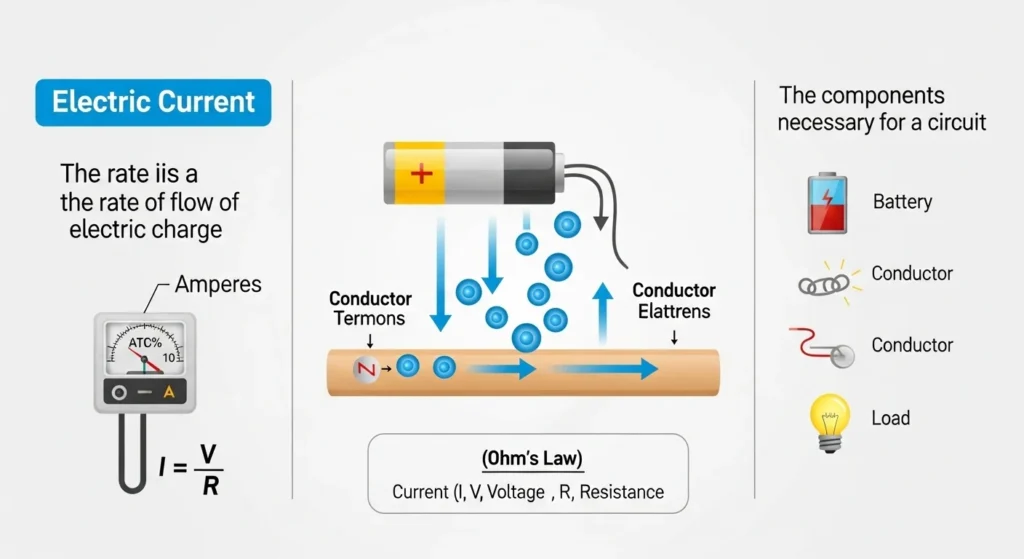
Electric current is the rate at which electric charges (usually electrons) move through a wire or conductive path.
Unit of Measurement
Electric current is measured in amperes (A), often called amps.
Simple Explanation
Atoms contain electrons that can move. When a voltage pushes these electrons through a conductor like copper wire, their movement forms an electric current.
Practical Example
When you turn on a light switch, current flows through the wire to the bulb, causing it to glow.
Electric current is the movement of electrons that carries electrical energy.
Electric Current Working Principle (2026)
The working principle of electric current is based on the movement of electrons through a conductor when a potential difference (voltage) is applied across it. Voltage creates an electric field that exerts a force on free electrons inside conductive materials such as copper or aluminum, causing them to move in a specific direction through a closed electrical circuit. This continuous movement of electrons is called electric current. The amount of current flowing in a circuit depends mainly on the applied voltage and the resistance of the conductor, as explained by Ohm’s Law. Electric current is the fundamental mechanism that enables electrical energy to be transferred from a power source to electrical devices, allowing them to perform useful work such as producing light, heat, sound, or mechanical motion.
Basic Working Principle
Electric current flows only when three essential conditions are met:
- A power source creates a voltage.
- A conductive path allows electrons to move.
- A closed circuit provides a complete path for current flow.
Once the circuit is closed, electrons begin moving from the negative terminal toward the positive terminal (electron flow), while conventional current is considered to flow from the positive terminal to the negative terminal.
Step-by-Step Working Process
Voltage Creates an Electric Field
A battery, generator, or power supply produces a voltage that creates an electric field inside the conductor.
Function:
- Produces electrical pressure.
- Pushes free electrons.
- Starts current flow.
Electrons Move Through the Conductor
The electric field causes free electrons to move through conductive materials such as copper or aluminum wires.
Function:
- Creates electric current.
- Transfers electrical energy.
- Supplies power to the circuit.
Current Reaches the Electrical Load
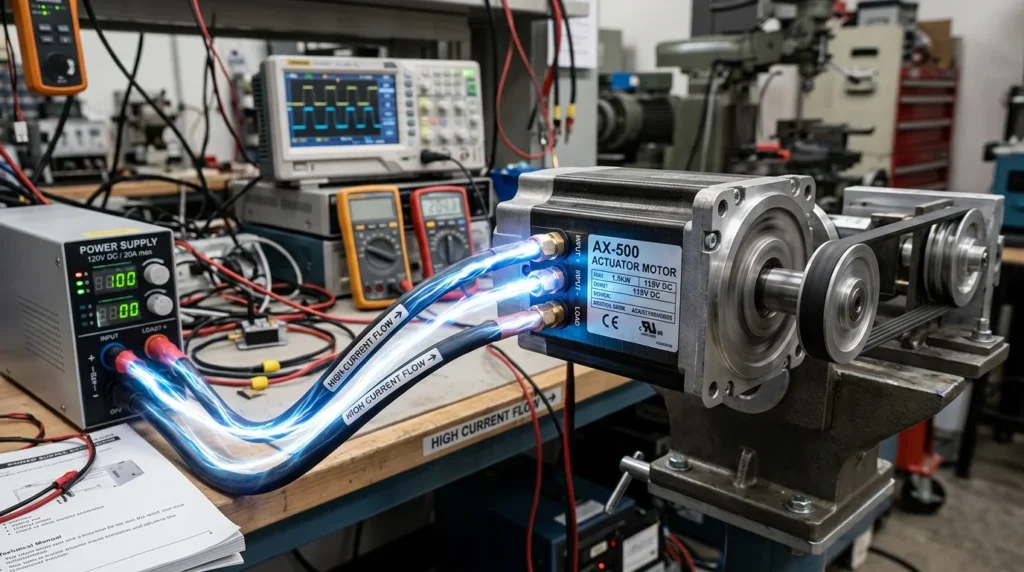
After flowing through the conductor, the electric current reaches the electrical load, which is the component that uses electrical energy to perform useful work. The load converts electrical energy into other forms of energy depending on its function. For example, a light bulb converts electrical energy into light and heat, an electric motor converts it into mechanical motion, a heater produces thermal energy, and a speaker converts it into sound. The amount of current consumed depends on the load’s power rating and electrical resistance. Once the electrical energy has been used by the load, the current continues its path back to the power source, completing the circuit. Without an electrical load, the circuit would have no practical purpose, as electrical energy would not be converted into useful output.
Examples:
- Light bulbs produce light.
- Electric heaters produce heat.
- Motors produce mechanical motion.
- Speakers produce sound.
Current Returns to the Source
After passing through the load, the current returns to the power source, completing the electrical circuit and allowing continuous operation.
Easy Analogy: Water Flow System
The working principle of electric current can be easily understood by comparing it to the flow of water through a pipe.
- Voltage = Water pressure.
- Current = Water flow.
- Wire = Water pipe.
- Switch = Valve controlling the flow.
- Load = Water wheel that performs useful work.
Just as higher water pressure pushes more water through a pipe, a higher voltage pushes more electrons through a conductor, resulting in a greater electric current when resistance remains unchanged. Likewise, a narrow pipe restricts water flow, just as higher electrical resistance limits the flow of current in a circuit.
Importance of Understanding the Working Principle
Understanding how electric current works helps engineers, electricians, and students to:
Ensure reliable operation of electrical systems.
Design safe electrical circuits.
Calculate voltage, current, and resistance accurately.
Troubleshoot electrical faults.
Improve energy efficiency.
Select appropriate electrical components.
Prevent overloads and short circuits.
Step-by-Step Process of Electric Current Flow (2026)
Understanding the step-by-step process of electric current flow is essential for learning how electrical circuits operate. Electric current flows only when a voltage source provides electrical energy and a complete conductive path exists between the source and the electrical load. As electrons move through the circuit, they transfer electrical energy that powers devices such as lights, motors, heaters, computers, and household appliances. Each stage of this process plays a crucial role in ensuring the safe and efficient operation of an electrical system.
A Power Source Creates Voltage
The process begins with a power source, such as a battery, generator, solar panel, or electrical utility supply. The power source creates a potential difference (voltage) between its positive and negative terminals. This voltage provides the electrical force needed to move electrons through the circuit.
Examples of Power Sources:
- Batteries
- Electrical generators
- Solar panels
- Wind turbines
- Utility power grid
Function:
- Produces electrical energy.
- Creates voltage.
- Supplies power to the circuit.
Voltage Pushes Electrons Through a Conductor
When the circuit is closed, the applied voltage creates an electric field that pushes free electrons through the conductor. Conductive materials such as copper and aluminum allow electrons to move easily because they contain many free electrons.
The greater the applied voltage, the stronger the force on the electrons, resulting in a higher current flow if the circuit resistance remains constant.
Function:
- Initiates electron movement.
- Produces electric current.
- Transfers electrical energy.
Electrons Move Through a Closed Circuit
Electric current can only flow when there is a complete closed circuit. Electrons travel from the power source through the conductor, pass through the electrical load, and return to the source. If the circuit is opened by a switch or broken wire, current immediately stops flowing.
Function:
- Provides a continuous path for current.
- Completes the electrical loop.
- Ensures uninterrupted energy transfer.
The Electrical Load Uses the Energy
As electric current reaches the electrical load, the electrical energy is converted into useful forms depending on the type of device.
Examples:
- Light bulbs convert electricity into light.
- Electric heaters convert electricity into heat.
- Motors convert electricity into mechanical motion.
- Speakers convert electricity into sound.
- Computers process electrical energy into digital operations.
Function:
- Converts electrical energy into useful work.
- Performs the intended task of the circuit.
Current Returns to the Source
After passing through the electrical load, the current returns to the power source through the return conductor, completing the electrical circuit. This continuous cycle allows the circuit to operate as long as the power source remains connected and the circuit stays closed.
Function:
- Completes the electrical loop.
- Maintains continuous current flow.
- Ensures stable circuit operation.
Important Conditions for Current Flow
For electric current to flow successfully, several essential conditions must be satisfied:
Presence of Voltage
A voltage source must provide the electrical pressure needed to move electrons.
Closed Circuit Path
The electrical circuit must be complete without any breaks or open switches.
Conductive Material
The circuit must include conductive materials such as copper or aluminum wires that allow electrons to move freely.
Connected Electrical Load
An electrical load must be connected to utilize the electrical energy supplied by the circuit.
Without these essential conditions, electric current cannot flow, and electrical devices will not operate properly.
Importance of Understanding Current Flow
Learning the step-by-step process of electric current flow helps students, electricians, and engineers to:
Ensure reliable operation of electrical equipment.
Understand how electrical circuits operate.
Design safe and efficient electrical systems.
Troubleshoot electrical faults effectively.
Select appropriate electrical components.
Improve energy efficiency.
Prevent overloads and short circuits.
Types and Classification of Electric Current (2026)
Electric current is primarily classified into two main types: Direct Current (DC) and Alternating Current (AC). Both types involve the movement of electric charge through a conductor, but they differ in the direction of electron flow, voltage characteristics, generation methods, and practical applications. Understanding the classification of electric current is essential for electrical engineering, electronics, power generation, and electrical system design because different applications require different types of current. While DC is widely used in electronic devices and battery-powered equipment, AC is the standard form of electricity used for power transmission and distribution around the world.
Direct Current (DC)
Direct Current (DC) is a type of electric current that flows continuously in one direction. In a DC circuit, the polarity remains constant, meaning electrons move steadily from the negative terminal toward the positive terminal. The voltage supplied by a DC source is generally stable, making it suitable for electronic devices and low-voltage electrical systems.
DC electricity is commonly produced by batteries, solar panels, fuel cells, and regulated DC power supplies. Because of its stable voltage, it is ideal for powering sensitive electronic equipment that requires a constant electrical supply.
Characteristics of Direct Current (DC)
- Flows in one direction only.
- Maintains constant polarity.
- Provides a stable voltage output.
- Easily stored in batteries.
- Suitable for low-voltage electrical systems.
- Ideal for electronic circuits and portable devices.
Common Sources of DC
- Batteries.
- Solar photovoltaic (PV) panels.
- Fuel cells.
- DC generators.
- Regulated DC power supplies.
Applications of DC
Direct current is widely used in applications where stable voltage is essential.
Common Uses:
- Mobile phones.
- Laptop computers.
- Electronic circuits.
- Electric vehicles (EVs).
- LED lighting systems.
- Telecommunications equipment.
- Battery charging systems.
- Portable electronic devices.
Advantages of DC
- Stable and consistent voltage.
- Easy energy storage using batteries.
- Highly suitable for electronics.
- Efficient for low-voltage applications.
- Reliable operation of sensitive equipment.
Alternating Current (AC)
Alternating Current (AC) is a type of electric current that changes direction periodically. Unlike DC, the polarity of AC reverses continuously, usually at a frequency of 50 Hz or 60 Hz, depending on the country’s electrical system.
AC electricity is generated by power stations using electrical generators based on electromagnetic induction. Because AC voltage can be easily increased or decreased using transformers, it is the preferred choice for large-scale power generation, long-distance transmission, and electrical distribution.
Characteristics of Alternating Current (AC)
- Changes direction periodically.
- Voltage varies in a sinusoidal waveform.
- Easily transformed to different voltage levels.
- Highly efficient for long-distance transmission.
- Used in national electrical power grids.
- Suitable for high-power applications.
Common Sources of AC
- Power stations.
- Electrical generators.
- Wind turbines.
- Hydroelectric power plants.
- Inverters.
- Utility electrical grid.
Applications of AC
Alternating current supplies electricity to almost every residential, commercial, and industrial facility.
Common Uses:
- Household electrical systems.
- Commercial buildings.
- Industrial machinery.
- Air conditioning systems.
- Electric motors.
- Water pumps.
- Refrigeration equipment.
- Large manufacturing facilities.
Advantages of AC
- Efficient long-distance power transmission.
- Easy voltage transformation using transformers.
- Lower transmission losses at high voltage.
- Suitable for heavy electrical loads.
- Widely available through national power grids.
Difference Between AC and DC Electric Current
Understanding the difference between alternating current and direct current is essential when selecting electrical equipment and designing electrical systems.
| Feature | Direct Current (DC) | Alternating Current (AC) |
|---|---|---|
| Direction of Flow | Flows in one direction only. | Changes direction periodically. |
| Voltage | Generally constant. | Continuously varies with time. |
| Frequency | 0 Hz | Usually 50 Hz or 60 Hz |
| Common Sources | Batteries, solar panels, DC power supplies. | Power stations, generators, utility grid. |
| Typical Applications | Electronics, electric vehicles, portable devices. | Homes, industries, commercial buildings, power transmission. |
Importance of Understanding Electric Current Classification
Learning the classification of electric current provides several important benefits:
Forms the foundation of electrical engineering and electronics.
Helps select the correct power source.
Supports safe electrical system design.
Improves troubleshooting and maintenance.
Ensures compatibility with electrical equipment.
Increases system efficiency and reliability.
Main Components Affecting Electric Current (2026)
The flow of electric current in any electrical circuit depends on several essential components that work together to generate, control, transmit, and utilize electrical energy. Each component performs a specific function that influences how much current flows, how efficiently energy is transferred, and how safely the electrical system operates. From the voltage source that creates electrical pressure to the protective devices that prevent electrical faults, every component plays a vital role in ensuring reliable circuit performance. Understanding these components is fundamental for electrical engineering, circuit design, troubleshooting, and safe electrical installations.
Voltage Source
The voltage source is the component that provides the electrical potential difference (voltage) required to move electrons through a conductor. Without voltage, electric current cannot flow. The amount of voltage supplied directly affects the amount of current flowing in the circuit, depending on the circuit resistance.
Common Examples:
- Batteries
- Electrical generators
- Solar panels
- DC power supplies
- Utility power grid
Functions:
- Produces electrical energy.
- Creates the electrical pressure that drives electrons.
- Supplies power to the entire circuit.
- Initiates current flow.
Conductors
Conductors provide a low-resistance path that allows electrons to move freely from the power source to the electrical load. Materials such as copper and aluminum are commonly used because of their excellent electrical conductivity.
The quality, size, and length of the conductor influence the amount of current that can safely flow through the circuit.
Common Examples:
- Copper wires
- Aluminum cables
- Busbars
- Flexible electrical cables
Functions:
- Carry electric current.
- Connect circuit components.
- Minimize energy losses.
- Ensure efficient power transmission.
Resistance
Resistance is the property of a material that opposes the flow of electric current. Every conductor has some resistance, and the amount depends on the material, length, cross-sectional area, and temperature.
According to Ohm’s Law, increasing resistance reduces current flow when the applied voltage remains constant.
Factors Affecting Resistance:
- Type of material.
- Length of the conductor.
- Cross-sectional area.
- Temperature.
Functions:
- Controls current flow.
- Protects circuits from excessive current.
- Influences power consumption.
- Helps regulate circuit performance.
Electrical Load
The electrical load is the device or equipment that consumes electrical energy and converts it into useful forms such as light, heat, sound, or mechanical motion. Different loads require different amounts of voltage and current depending on their power ratings.
Common Examples:
- Electric motors
- Light bulbs
- Fans
- Heaters
- Air conditioners
- Refrigerators
- Computers
- Industrial machinery
Functions:
- Uses electrical energy.
- Performs useful work.
- Determines the current demand of the circuit.
Switches and Control Devices
Switches and control devices regulate the flow of electric current by opening or closing the electrical circuit. When the switch is closed, current flows normally; when it is opened, the circuit is interrupted and current stops flowing.
Modern electrical systems also use automatic control devices for improved efficiency and automation.
Common Examples:
- Wall switches
- Push-button switches
- Toggle switches
- Relays
- Contactors
- Smart switches
Functions:
- Start or stop current flow.
- Control electrical equipment.
- Improve operational convenience.
- Support automated electrical systems.
Protective Devices
Protective devices safeguard electrical circuits, equipment, and users from dangerous conditions such as overloads, short circuits, earth faults, and excessive current. They automatically disconnect the electrical supply whenever abnormal conditions are detected.
These devices are essential for maintaining electrical safety and preventing equipment damage.
Common Examples:
- Fuses
- Miniature Circuit Breakers (MCBs)
- Molded Case Circuit Breakers (MCCBs)
- Residual Current Devices (RCDs)
- Earth Leakage Circuit Breakers (ELCBs)
- Grounding (Earthing) systems
Functions:
- Prevent electrical overloads.
- Protect against short circuits.
- Reduce the risk of electric shock.
- Prevent electrical fires.
- Improve overall system safety.
How These Components Affect Electric Current
Each component influences electric current in a different way:
- The voltage source creates the electrical force that drives current.
- Conductors provide the path through which current flows.
- Resistance limits or controls the amount of current.
- The electrical load determines how much current is required.
- Switches control when current flows or stops.
- Protective devices interrupt the circuit if unsafe conditions occur.
Together, these components determine how efficiently and safely electricity is delivered throughout an electrical system.
Importance of Understanding These Components
A thorough understanding of the components affecting electric current helps engineers, electricians, and students to:
Ensure compliance with electrical standards.
Design reliable electrical circuits.
Calculate current accurately.
Improve electrical safety.
Troubleshoot faults effectively.
Select appropriate electrical components.
Increase system efficiency.
Advantages and Disadvantages of Electric Current (2026)
Electric current is the continuous flow of electric charge through a conductor and is the driving force behind almost every modern electrical and electronic system. It powers homes, industries, transportation networks, communication systems, healthcare facilities, and countless technological devices. Without electric current, modern civilization would not be able to operate efficiently. Although electric current offers numerous benefits, it also presents certain risks and limitations that require proper design, protection, and maintenance. Understanding both the advantages and disadvantages of electric current helps engineers, electricians, technicians, and users operate electrical systems safely and efficiently.
Advantages of Electric Current
Electric current provides many practical benefits that make it one of the most important forms of energy in today’s world.
Powers Homes, Industries, and Technology
Electric current supplies energy to residential buildings, commercial facilities, factories, and modern technological systems, enabling the operation of thousands of electrical devices every day.
Benefits:
- Supports residential electricity supply.
- Operates industrial machinery.
- Powers commercial equipment.
- Enables modern digital technologies.
Enables Lighting, Heating, and Cooling
Electric current is used to produce light, heat, and cooling through various electrical appliances and systems.
Applications:
- LED lighting systems.
- Electric heaters.
- Air conditioners.
- Refrigeration systems.
- Water heating equipment.
Essential for Communication and Computing
Modern communication and information technology rely entirely on electric current to operate efficiently.
Examples:
- Computers.
- Smartphones.
- Internet infrastructure.
- Telecommunication networks.
- Data centers.
Easily Transmitted Through Conductors
Electric current can be transmitted efficiently through conductors such as copper and aluminum wires over both short and long distances.
Benefits:
- Reliable power distribution.
- Efficient energy transfer.
- Supports national electrical grids.
- Low transmission losses when properly designed.
Supports Automation and Industrial Machinery
Industrial automation systems depend on electric current to operate motors, sensors, controllers, and robotic equipment.
Applications:
- Manufacturing plants.
- Conveyor systems.
- Automated production lines.
- Industrial robotics.
- Process control systems.
Enables Renewable Energy Systems
Electric current is essential for integrating renewable energy technologies into modern electrical grids.
Examples:
- Solar photovoltaic systems.
- Wind turbines.
- Battery energy storage systems.
- Electric vehicle charging stations.
- Smart grid technologies.
Disadvantages and Limitations of Electric Current (2026)
Although electric current is highly beneficial, improper use or poor electrical system design can create serious hazards.
Risk of Electric Shock
Direct contact with live electrical conductors can result in electric shock, burns, or even fatal injuries.
Safety Measures:
- Proper insulation.
- Grounding (earthing).
- Residual Current Devices (RCDs).
- Safe work practices.
Overcurrent Can Cause Fires and Equipment Damage
Excessive current caused by overloads or short circuits can overheat electrical conductors and damage equipment.
Possible Effects:
- Electrical fires.
- Damaged appliances.
- Melted insulation.
- Circuit failure.
Requires Protective Systems
Electrical systems require protective devices to ensure safe operation.
Examples:
- Fuses.
- Circuit breakers.
- Surge protection devices.
- Protective relays.
- Ground fault protection.
These devices automatically disconnect faulty circuits before serious damage occurs.
Power Interruptions Reduce Productivity
Power outages can disrupt residential, commercial, and industrial activities, leading to financial losses and operational delays.
Affected Areas:
- Manufacturing industries.
- Hospitals.
- Offices.
- Communication networks.
- Data centers.
Unsafe Wiring Can Be Dangerous
Improper electrical installation or the use of low-quality wiring increases the risk of electrical accidents.
Common Problems:
- Loose connections.
- Poor insulation.
- Incorrect cable sizing.
- Overloaded circuits.
Following approved electrical standards greatly reduces these risks.
Applications of Electric Current (2026)
Electric current is used in almost every area of modern life. It powers essential equipment, supports industrial production, enables communication, and drives technological innovation. From simple household appliances to complex industrial machinery and advanced medical equipment, electric current is the foundation of today’s electrical infrastructure.
Home Applications
Electric current provides the energy needed to operate everyday household appliances and improve living standards.
Common Home Applications:
- Lighting systems.
- Ceiling fans.
- Refrigerators and freezers.
- Air conditioners.
- Electric heaters.
- Washing machines.
- Kitchen appliances.
- Phone and laptop charging.
- Water pumps.
- Television and entertainment systems.
Industrial Applications
Industries rely on electric current to operate heavy machinery and automated production systems efficiently.
Common Industrial Applications:
- Electric motors.
- Heavy manufacturing equipment.
- Welding machines.
- Conveyor systems.
- Industrial automation.
- Robotic production lines.
- Pumps and compressors.
- CNC machines.
Modern Technology Applications
Nearly every technological innovation depends on electric current for operation and communication.
Examples:
- Computers and servers.
- Data centers.
- Telecommunications equipment.
- Internet infrastructure.
- Medical diagnostic equipment.
- Artificial intelligence systems.
- Smart home devices.
- Electric vehicles and charging stations.
Importance of Electric Current Applications
The widespread use of electric current provides numerous advantages for society:
- Improves quality of life.
- Supports economic development.
- Increases industrial productivity.
- Enables digital communication.
- Advances healthcare technology.
- Encourages renewable energy adoption.
- Drives scientific and technological innovation.
Understanding these applications helps engineers and technicians design electrical systems that are efficient, reliable, safe, and capable of meeting modern energy demands.
Comparison Between Electric Current and Voltage (2026)
Electric current and voltage are two of the most fundamental concepts in electrical engineering. Although they are closely related, they perform different functions within an electrical circuit. Voltage is the electrical force or pressure that pushes electrons through a conductor, while electric current is the actual movement of those electrons. Both quantities work together to transfer electrical energy from a power source to an electrical load. Understanding the difference between current and voltage is essential for circuit analysis, equipment selection, electrical troubleshooting, and safe system design.
Comparison Table: Electric Current vs Voltage
| Feature | Electric Current | Voltage |
|---|---|---|
| Definition | The flow of electric charge through a conductor. | The electrical potential difference that pushes electric charge. |
| Unit of Measurement | Ampere (A) | Volt (V) |
| Symbol | I | V |
| Primary Function | Transfers electrical energy through a circuit. | Creates the force that moves electric current. |
| Measuring Instrument | Ammeter | Voltmeter |
| Analogy | Water flowing through a pipe. | Water pressure pushing the flow. |
| Depends On | Voltage and circuit resistance. | Power source or electrical supply. |
| Role in a Circuit | Powers electrical devices. | Drives current through the circuit. |
Why Understanding the Difference Is Important
Although voltage and current always work together, they perform different roles. Voltage provides the electrical pressure needed to move electrons, while electric current carries electrical energy to the connected load where it is converted into useful work such as light, heat, or mechanical motion. A proper understanding of both quantities helps engineers and technicians design efficient electrical systems, calculate circuit values accurately, and prevent electrical faults.
Selection Guide: Choosing the Right Current Rating (2026)
Selecting the correct current rating is essential for ensuring the safety, reliability, and efficiency of any electrical installation. Every electrical wire, cable, switch, fuse, circuit breaker, and electrical device is designed to carry a specific maximum amount of current. Exceeding these limits can cause overheating, insulation damage, equipment failure, and electrical fires. Choosing the proper current rating based on the application helps protect both electrical equipment and users while ensuring long-term system performance.
For Household Wiring
Residential electrical wiring should always be selected according to the expected electrical load and local electrical codes. Proper wire sizing prevents excessive heating and minimizes voltage drop.
Recommendations:
- Use cables with the correct current-carrying capacity.
- Avoid connecting too many appliances to a single outlet.
- Install properly rated circuit breakers.
- Ensure effective grounding (earthing).
- Follow national wiring standards.
Benefits:
- Improved electrical safety.
- Reduced fire risk.
- Reliable household power supply.
For Electrical Devices
Every electrical appliance has a specified current rating that should never be exceeded. Using the correct power supply and protective devices helps prevent equipment damage.
Recommendations:
- Check the device’s rated current before installation.
- Use manufacturer-approved adapters and chargers.
- Install correctly rated fuses where required.
- Avoid using undersized extension cords.
Suitable Devices:
- Computers.
- Televisions.
- Refrigerators.
- Air conditioners.
- Power tools.
- Electronic equipment.
For Industrial Systems
Industrial installations often operate with high electrical loads that require carefully selected conductors and protection systems.
Recommendations:
- Use three-phase AC systems for heavy machinery.
- Install overload relays and circuit breakers.
- Select industrial-grade cables with adequate current capacity.
- Perform regular inspections and maintenance.
- Use proper grounding and bonding techniques.
Applications:
- Manufacturing plants.
- Industrial motors.
- Conveyor systems.
- Automation equipment.
- Welding machines.
Safety Tips for Beginners
Following basic electrical safety guidelines helps prevent accidents and equipment damage.
Important Tips:
- Never exceed the rated current of wires or equipment.
- Use correctly rated circuit breakers and fuses.
- Choose the appropriate wire gauge for the expected load.
- Avoid overloading sockets and extension cords.
- Inspect wiring regularly for damage.
- Always follow approved electrical safety standards and installation codes.
These simple practices significantly improve electrical safety and system reliability.
Importance of Proper Current Selection
Choosing the correct current rating provides several important advantages:
- Prevents overheating and electrical fires.
- Protects electrical equipment from damage.
- Improves system efficiency.
- Increases equipment lifespan.
- Reduces maintenance costs.
- Ensures compliance with electrical safety regulations.
- Enhances overall reliability of electrical installations.
Common Electric Current Problems and Their Solutions (2026)
Electric current is essential for powering electrical systems, but various problems can occur due to excessive current, faulty wiring, damaged components, poor insulation, or improper installation. These issues can reduce system efficiency, damage electrical equipment, create fire hazards, and even cause serious electric shocks. Understanding the most common electric current problems, their causes, and the appropriate solutions helps homeowners, electricians, technicians, and engineers maintain safe and reliable electrical systems. Regular inspection, proper maintenance, and the use of protective devices are key to preventing electrical faults and ensuring continuous operation.
Why Do Wires Overheat?
Overheating wires are one of the most common electrical problems and can become a serious fire hazard if not addressed promptly. When more current flows through a conductor than it is designed to carry, excessive heat is generated due to the electrical resistance of the wire.
Possible Causes
- Excessive current flow.
- Overloaded electrical circuits.
- Undersized electrical wires.
- Loose electrical connections.
- Poor-quality conductors.
- Damaged insulation.
Recommended Solutions
- Reduce the connected electrical load.
- Use conductors with the correct wire size.
- Tighten all electrical connections.
- Replace damaged or undersized wiring.
- Install properly rated circuit breakers and fuses.
- Perform regular electrical inspections.
Why Does the Circuit Breaker Trip?
Circuit breakers are protective devices that automatically disconnect the electrical supply whenever unsafe conditions occur. Frequent tripping usually indicates an electrical fault that requires immediate attention.
Possible Causes
- Circuit overload.
- Short circuit.
- Ground (earth) fault.
- Faulty electrical appliance.
- Damaged wiring.
- Loose terminal connections.
Recommended Solutions
- Disconnect unnecessary electrical loads.
- Redistribute high-power appliances across different circuits.
- Inspect wiring for visible damage.
- Test electrical appliances individually.
- Replace faulty components.
- Consult a qualified electrician if the problem persists.
Why Is an Electrical Device Not Working?
If an electrical device does not operate, the problem is often related to an interruption in the flow of electric current somewhere within the circuit.
Possible Causes
- Open circuit.
- Loose or disconnected wiring.
- Faulty switch.
- Blown fuse.
- Tripped circuit breaker.
- Internal equipment failure.
Recommended Solutions
- Check all electrical connections.
- Verify that the circuit breaker is ON.
- Replace blown fuses if necessary.
- Inspect switches and sockets.
- Test the device using another power outlet.
- Have the equipment serviced if the fault remains.
What Causes Electric Shock?
Electric shock occurs when electric current passes through the human body. The severity depends on the amount of current, the voltage level, the duration of contact, and the path the current takes through the body.
Possible Causes
- Contact with exposed live conductors.
- Damaged cable insulation.
- Improper grounding (earthing).
- Wet working conditions.
- Faulty electrical equipment.
- Unsafe installation practices.
Recommended Solutions
- Ensure proper insulation of all conductors.
- Install effective grounding systems.
- Use Residual Current Devices (RCDs) or Ground Fault Circuit Interrupters (GFCIs).
- Replace damaged electrical cables immediately.
- Avoid handling electrical equipment with wet hands.
- Always disconnect the power supply before performing maintenance.
Preventive Measures
Most electric current problems can be prevented through proper installation and regular maintenance.
Best Practices:
- Use correctly rated wires and cables.
- Avoid overloading electrical circuits.
- Install quality circuit breakers and fuses.
- Inspect wiring periodically for wear or damage.
- Ensure proper grounding and bonding.
- Replace defective electrical components promptly.
- Follow national electrical safety standards and codes.
These preventive measures reduce the risk of equipment failure, electrical fires, and personal injury.
Importance of Understanding Electric Current Problems
Understanding common electric current problems provides several practical benefits:
Supports safe electrical installations.
Improves electrical safety.
Prevents equipment damage.
Reduces maintenance costs.
Increases system reliability.
Minimizes power interruptions.
Enhances troubleshooting skills.
Future trends in electric current systems?
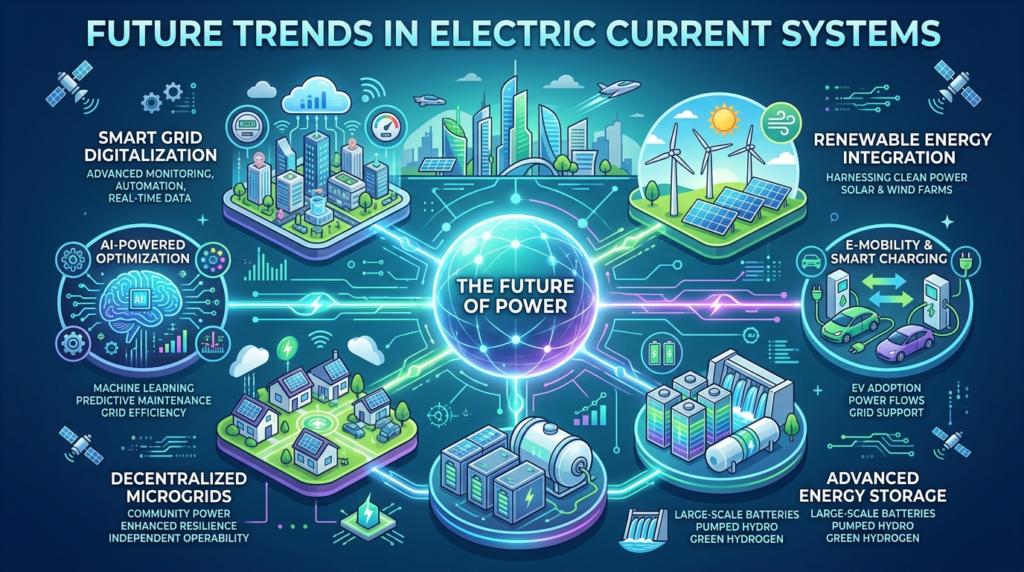
Future trends in electric current systems are focused on improving efficiency, reliability, safety, and smart energy management. Modern electrical systems are rapidly moving toward renewable energy integration, smart grids, electric vehicles, and advanced power electronics. High Voltage Direct Current (HVDC) transmission systems are becoming more popular because they reduce power losses over long distances. At the same time, smart grids use digital communication and automation to monitor and control electricity flow more efficiently. Renewable energy sources such as solar panels and battery storage systems mainly operate on DC power, increasing the importance of modern DC technologies. Wireless power transfer, energy-efficient devices, and AI-based electrical monitoring systems are also shaping the future of electric current systems. These advancements will help create cleaner, safer, and more sustainable electrical networks worldwide.
Smart Electrical Systems
Real-time monitoring improves efficiency and safety.
Renewable Energy Integration
Solar and wind systems rely on efficient current management.
Electric Transportation
Electric vehicles depend on controlled current flow.
Energy-Efficient Devices
Modern appliances use less current for better performance.
Smart Grids & Automation
Advanced control improves current distribution.
The future of electric current management focuses on safety, efficiency, and sustainability.
Conclusion
Electric current is the flow of electric charge that powers modern life. From lighting homes to operating industrial machinery and advanced technology, current is essential for energy delivery. Understanding the electric current working principle, types, components, and safety considerations is fundamental for students and electrical professionals.
Knowing the difference between AC and DC, selecting proper current ratings, and applying safety measures ensures reliable and efficient electrical systems. While electric current offers enormous benefits, improper handling can cause hazards, making safety practices critical.
As electrical systems evolve with renewable energy, smart grids, and electric transportation, understanding electric current becomes even more important. A strong foundation in this concept enables safer designs, effective troubleshooting, and future innovation.