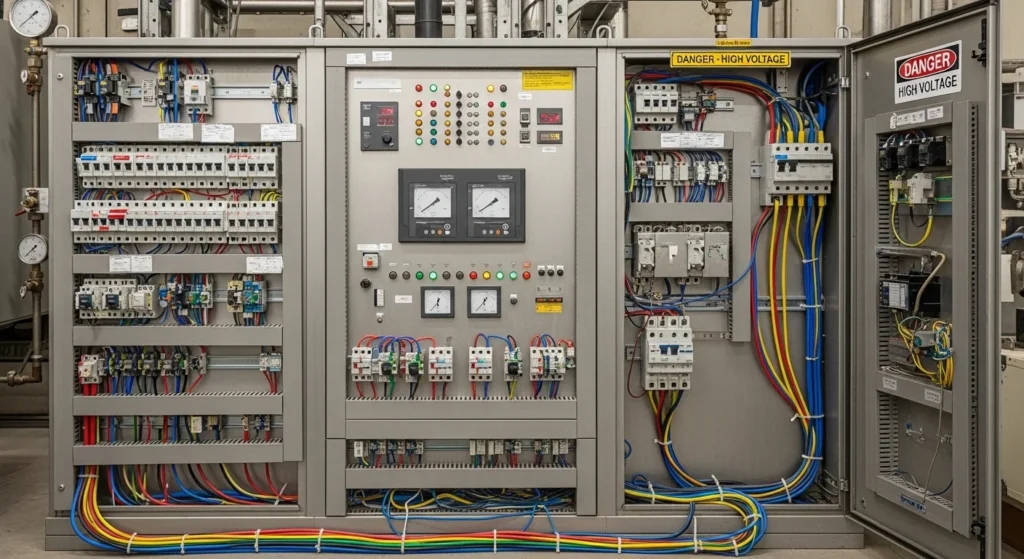

Imagine you walk into a factory where hundreds of motors, pumps, lights, and machines are operating smoothly. You see one large cabinet mounted against the wall with switches, breakers, meters, and indicator lights. That cabinet is the heart of the electrical system. If it is designed properly, everything works safely. If it is poorly designed, the entire system becomes dangerous.
This is why Electrical Panel Design is one of the most important skills for electrical engineers and technicians.
A well-designed panel ensures safety, proper load distribution, easy maintenance, and reliable operation. Whether you are working on a small house distribution board or a large industrial control panel, the design principles remain very important.
In this article, you will learn the Electrical Panel Design working principle, types, components, applications, advantages and disadvantages, comparison with similar systems, selection guide, troubleshooting tips, and future trends. I will explain everything in simple and practical language, just like a senior engineer guiding a junior on-site.
What is Electrical Panel Design?
Electrical Panel Design is the process of planning, arranging, and selecting electrical components inside a panel to safely distribute and control electrical power.
Simple Explanation
It is like designing the “control center” of an electrical system. The panel receives incoming power and distributes it to different loads such as lights, motors, and machines through protective devices.
Practical Example
In a house, the distribution board (DB) contains MCBs and RCCBs. In a factory, a motor control panel contains contactors, relays, overloads, and breakers. Both are examples of electrical panel design, but with different complexity levels.
A good design ensures:
- Proper protection
- Easy operation
- Safe wiring
- Future expansion
Electrical Panel Design Working Principle
The Electrical Panel Design working principle is based on safe power distribution and protection.
Think of the panel as a traffic control system.
Electricity is like traffic coming from the main highway (supply). The panel controls and distributes that traffic safely to different roads (loads).
Step-by-Step Working
Incoming Power Supply
- Power enters the panel through a main breaker.
Main Protection
- Main circuit breaker protects against short circuit and overload.
Busbar Distribution
- Power is distributed through busbars.
Branch Protection
- Each outgoing line has its own breaker or fuse.
Control Devices
- Contactors and relays control machines.
Monitoring
- Meters measure voltage, current, and power.
Earthing System
- Ensures safety in case of fault.
Easy Analogy
Imagine a water tank system:
- Main pipe brings water.
- Valves control flow.
- Small pipes distribute water.
- Safety valves prevent bursting.
An electrical panel works in a similar way but with electricity.
Types / Classification of Electrical Panels
There are different types based on application and function.
Main Distribution Panel (MDP)
- Receives main supply.
- Distributes power to sub-panels.
- Used in buildings and industries.
Sub Distribution Panel (SDP)
- Receives power from MDP.
- Supplies specific areas or floors.
Motor Control Center (MCC)
- Controls multiple motors.
- Contains contactors, overload relays, and starters.
- Common in factories.
Power Control Center (PCC)
- Controls high-power loads.
- Used in large industries and plants.
Control Panel
- Used for automation.
- Contains PLC, relays, timers, and sensors.
Each type serves a specific purpose in Electrical Panel Design applications.
Main Components of Electrical Panel
Understanding components is essential for proper design.
Circuit Breaker
Protects against overload and short circuit.
Busbar
Metal strip that distributes power.
Contactor
Switches motors or heavy loads automatically.
Overload Relay
Protects motors from overheating.
Relays
Control circuits and provide protection.
Meters
Measure voltage, current, and power.
Terminal Blocks
Used for organized wiring connections.
Earthing Bar
Provides grounding for safety.
Proper layout ensures easy maintenance and safe operation.
Electrical Panel Design Advantages and Disadvantages
Advantages
- Safe power distribution
- Organized wiring
- Easy fault detection
- Better load management
- Protection against electrical hazards
- Supports automation
These Electrical Panel Design advantages and disadvantages must be evaluated before installation.
Disadvantages / Limitations
- High initial design cost
- Requires skilled engineering
- Space requirement
- Poor design can cause overheating
- Maintenance required regularly
Proper planning reduces these limitations.
Electrical Panel Design Applications
Electrical Panel Design applications are everywhere.
Residential Buildings
Distribution boards for homes and apartments.
Commercial Buildings
Offices, malls, and hospitals.
Industrial Plants
Motor control centers and automation panels.
Renewable Energy Systems
Solar inverter panels.
Data Centers
Power distribution and backup systems.
Panels are the backbone of every electrical system.
Comparison Section
Difference Between PCC and MCC Panel
| Feature | PCC Panel | MCC Panel |
| Main Purpose | Power distribution | Motor control |
| Load Type | General loads | Motors |
| Components | Breakers, meters | Contactors, overloads |
| Application | Main plant supply | Production lines |
| Control Level | Limited control | Detailed motor control |
The difference between PCC and MCC panel is mainly in application and control level.
Selection Guide
Choosing the right Electrical Panel Design depends on:
Load Requirement
Calculate total load in kW or kVA.
Voltage Level
Single-phase or three-phase system.
Environment
Indoor or outdoor installation.
Protection Level
IP rating required.
Future Expansion
Keep extra space for new circuits.
Safety Standards
Follow electrical codes and regulations.
Beginners should always prepare a single-line diagram before starting the design.
Common Problems & Solutions
Why does panel overheat?
Reason: Poor ventilation or overloaded circuits.
Solution: Improve ventilation and check load calculation.
Why does breaker trip frequently?
Reason: Overload or short circuit.
Solution: Inspect wiring and connected loads.
Why is wiring messy?
Reason: Poor layout planning.
Solution: Use proper cable management and labeling.
Why is voltage drop high?
Reason: Undersized cables.
Solution: Select correct cable size.
Regular inspection and preventive maintenance are essential.
Future Trends
Electrical panel technology is evolving.
Smart Panels
Remote monitoring using IoT.
Digital Metering
Advanced energy analysis.
Compact Design
Space-saving modular panels.
Renewable Integration
Solar and battery integration.
Automation
PLC-based intelligent panels.
Future panels will be more intelligent and energy efficient.
Conclusion
Electrical Panel Design is a critical skill for every electrical engineer and technician. A well-designed panel ensures safe power distribution, proper load management, and reliable system performance. It includes careful selection of components, correct wiring layout, proper protection devices, and adherence to safety standards.
Understanding the Electrical Panel Design working principle, types, applications, and the difference between PCC and MCC panel helps build strong technical knowledge. Although it requires planning and experience, mastering panel design will greatly improve your engineering career.
Always focus on safety, calculation accuracy, and proper documentation. Strong fundamentals in panel design create safe and efficient electrical systems.