
Imagine entering a newly constructed house. The walls look clean, lights turn on instantly, fans run smoothly, and power sockets work perfectly. You do not see the wires, but they are carefully installed inside the walls and ceilings. If the wiring is done correctly, the house remains safe for many years. If it is poorly installed, it can cause shocks, short circuits, or even fire.
This is why understanding House Wiring Methods is very important for electrical students, engineers, and technicians.
House wiring is not just about connecting wires. It is about safety, load calculation, proper cable selection, protection devices, and correct installation methods. A strong foundation in wiring methods builds a strong career in electrical work.
In this article, you will learn the House Wiring Methods working principle, types, components, applications, advantages and disadvantages, comparison of different methods, selection guide, troubleshooting tips, and future trends. I will explain everything clearly and practically, just like guiding a junior technician at a construction site.
2. What is House Wiring Methods?
House Wiring Methods refer to the different techniques used to install electrical wiring in residential buildings for safe distribution of electricity.
Simple Explanation
It is the system used to connect the main power supply to lights, fans, switches, sockets, and appliances inside a house.
Practical Example
When electricity enters a house from the meter, it goes to the distribution board (DB). From there, wires run through walls or conduits to supply different rooms. The method used to install these wires (surface, concealed, conduit, etc.) is called a house wiring method.
A good wiring method ensures:
- Electrical safety
- Proper load distribution
- Easy maintenance
- Long service life
3. House Wiring Methods Working Principle
The House Wiring Methods working principle is based on safe power distribution and proper protection.
Think of wiring like a water supply system in a building.
Electricity flows from the main source to different points, just like water flows from a main tank to different taps.
Step-by-Step Working
Incoming Supply
- Power enters from the utility line.
- Passes through the energy meter.
Main Protection
- Main breaker controls entire house supply.
Distribution Board
- MCBs divide power into separate circuits.
Circuit Wiring
- Separate circuits for lights, sockets, and heavy loads.
Switch Control
- Switches control the flow of electricity to loads.
Earthing System
- Provides safety in case of fault.
Easy Analogy
Imagine a tree:
- Trunk = main supply
- Branches = different circuits
- Leaves = electrical appliances
Proper wiring ensures each branch receives safe power.
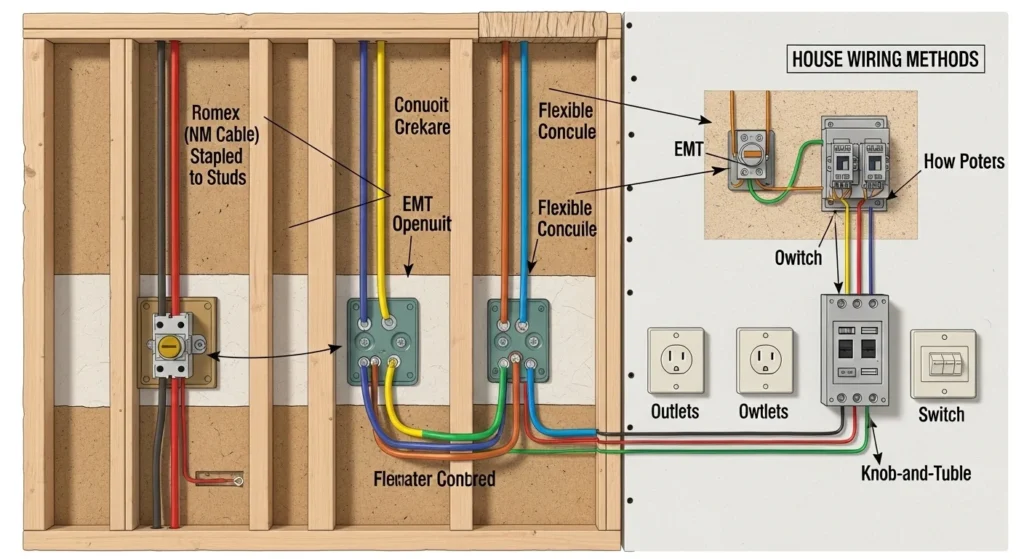
4. Types / Classification of House Wiring Methods
There are several types of wiring methods used in homes.
Cleat Wiring
- Wires supported on porcelain cleats.
- Used temporarily.
- Low cost but not safe for permanent use.
Batten Wiring (CTS/TRS Wiring)
- Wires fixed on wooden battens.
- Used in old houses.
- Easy installation but less protective.
Casing and Capping Wiring
- Wires placed inside wooden casing.
- Covered with capping.
- Better protection than batten wiring.
Conduit Wiring
Most commonly used method today.
Surface Conduit Wiring
- Conduits installed on wall surface.
- Easy maintenance.
- Used in workshops and garages.
Concealed Conduit Wiring
- Conduits hidden inside walls.
- Clean and modern appearance.
- Widely used in residential buildings.
Each method has specific House Wiring Methods applications depending on cost and safety needs.
5. Main Components of House Wiring
Understanding components is essential for proper installation.
Energy Meter
Measures electricity consumption.
Main Switch
Controls total house supply.
Distribution Board (DB)
Divides supply into circuits.
MCB (Miniature Circuit Breaker)
Protects against overload and short circuit.
RCCB/ELCB
Protects against earth leakage.
Switches
Control individual loads.
Sockets
Provide connection points for appliances.
Wires and Cables
Carry electrical current safely.
Earthing System
Provides protection against electric shock.
Each component must be properly rated and installed.
6. House Wiring Methods Advantages and Disadvantages
Advantages
- Safe electricity distribution
- Organized installation
- Easy control of circuits
- Reduced fire risk
- Long-lasting system
- Supports modern appliances
Understanding House Wiring Methods advantages and disadvantages helps in proper selection.
7. Disadvantages / Limitations
- Initial installation cost
- Requires skilled labor
- Poor installation can cause hazards
- Difficult modification in concealed wiring
- Needs regular inspection
Good planning reduces these issues.
8. House Wiring Methods Applications
House Wiring Methods applications are mainly in residential buildings.
Homes and Apartments
Lighting, fans, AC units, and sockets.
Villas and Large Houses
Advanced wiring with automation.
Small Offices
Basic power and lighting circuits.
Smart Homes
Integrated wiring for automation systems.
Temporary Construction Sites
Temporary cleat wiring.
Wiring methods are selected based on building type and safety requirements.
9. Comparison Section
Difference Between Surface and Concealed Wiring
| Feature | Surface Wiring | Concealed Wiring |
| Appearance | Visible | Hidden |
| Installation Cost | Lower | Higher |
| Maintenance | Easy | Slightly difficult |
| Safety | Moderate | High |
| Application | Workshops | Residential homes |
The difference between surface and concealed wiring mainly depends on appearance and safety level.
10. Selection Guide
Choosing the right House Wiring Methods depends on:
Budget
Concealed wiring costs more.
Building Type
Modern homes prefer concealed conduit wiring.
Safety Requirements
High safety areas need conduit wiring.
Future Expansion
Provide spare conduits.
Load Calculation
Calculate total connected load.
Local Electrical Codes
Always follow national safety standards.
Beginners should always prepare a wiring diagram before installation.
11. Common Problems & Solutions
Why do MCBs trip frequently?
Reason: Overloaded circuit.
Solution: Divide load properly.
Why is there electric shock from appliances?
Reason: Poor earthing.
Solution: Check and improve grounding.
Why do lights flicker?
Reason: Loose connections.
Solution: Tighten wiring terminals.
Why do wires overheat?
Reason: Undersized cable.
Solution: Use proper cable size.
Why does voltage drop occur?
Reason: Long wiring distance.
Solution: Increase cable size.
Regular maintenance prevents major faults.
12. Future Trends
House wiring is becoming more advanced.
Smart Wiring Systems
Integration with home automation.
Energy-Efficient Designs
Better load balancing.
Fire-Resistant Cables
Improved safety.
Solar Integration
Wiring compatible with rooftop solar.
IoT-Based Monitoring
Remote fault detection.
Future homes will use intelligent wiring systems.
13. Conclusion
House Wiring Methods form the backbone of every residential electrical system. Proper wiring ensures safety, efficient power distribution, and long service life. Understanding the House Wiring Methods working principle, types, applications, and the difference between surface and concealed wiring is essential for every electrical student and technician.
Although installation requires careful planning and skilled workmanship, the benefits of safe and organized wiring are significant. Always focus on correct load calculation, proper cable selection, and strong earthing systems. With solid fundamentals in house wiring, you can confidently handle residential electrical projects and build a strong professional career.