
Imagine you are operating a 100 MW power plant. On paper, it looks powerful and capable of supplying electricity to thousands of homes. But at the end of the year, you discover that it actually produced energy equal to running at only 60 MW continuously.
Why did this happen?
This is where Plant Capacity Factor becomes important. It tells us how effectively a power plant is being used compared to its maximum possible output. In power system engineering, this value directly affects profitability, reliability, and system planning.
If you ignore Plant Capacity Factor, you may overestimate plant performance or misunderstand operational efficiency. As a junior engineer, you must clearly understand how much energy a plant can produce versus how much it actually produces.
In this article, you will learn:
- The clear meaning of Plant Capacity Factor
- The Plant Capacity Factor working principle
- Types and calculation methods
- Plant Capacity Factor applications
- Plant Capacity Factor advantages and disadvantages
- The difference between capacity factor and load factor
Let us break it down step by step in simple and practical language.
2. What is Plant Capacity Factor?
Definition
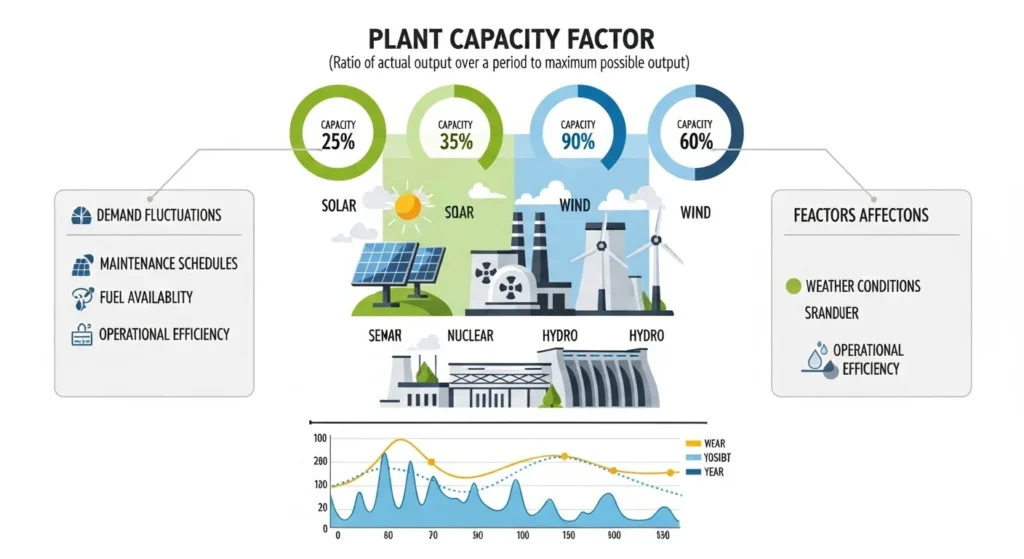
Plant Capacity Factor (PCF) is the ratio of actual energy produced by a power plant over a period of time to the maximum possible energy it could have produced at full capacity during the same period.
Simple Explanation
Every power plant has a rated capacity. For example, a 100 MW plant can produce 100 MW continuously if operated at full load.
However, due to maintenance, fuel shortages, demand variations, or technical issues, it does not run at full capacity all the time.
Plant Capacity Factor measures how much of its potential output the plant actually delivered.
Formula
Capacity Factor=Actual Energy GeneratedMaximum Possible Energy×100\text{Capacity Factor} = \frac{\text{Actual Energy Generated}}{\text{Maximum Possible Energy}} \times 100Capacity Factor=Maximum Possible EnergyActual Energy Generated×100
Practical Example
- Plant Rating = 100 MW
- Time Period = 1 Year (8760 hours)
- Maximum Possible Energy = 100 × 8760 = 876,000 MWh
- Actual Energy Produced = 525,600 MWh
Capacity Factor = (525,600 / 876,000) × 100 = 60%
This means the plant operated at 60% of its full capacity over the year.
3. Plant Capacity Factor Working Principle
The Plant Capacity Factor working principle is based on energy comparison over time.
It compares two values:
- What the plant could have produced
- What the plant actually produced
Step-by-Step Explanation
Identify plant rated capacity (MW).
Determine total operating hours in the period.
Calculate maximum possible generation.
Record actual generation from energy meters.
Divide actual output by maximum possible output.
Easy Analogy
Think of a bus with 50 seats.
If the bus runs every day but carries an average of 30 passengers, it is not fully utilized.
Capacity factor is like checking how often the bus seats were filled compared to total possible seats.
4. Types / Classification
Plant Capacity Factor varies depending on plant type.
Thermal Power Plant Capacity Factor
Coal and nuclear plants usually have high capacity factors (60%–90%).
They are designed for continuous base load operation.
Hydropower Plant Capacity Factor
Hydro plants depend on water availability.
Capacity factor may vary from 30% to 70%.
Wind Power Plant Capacity Factor
Wind plants depend on wind speed.
Typical capacity factor: 25%–45%.
Solar Power Plant Capacity Factor
Solar plants operate only during daytime.
Typical capacity factor: 15%–25%.
5. Main Components Affecting Plant Capacity Factor
Several components influence Plant Capacity Factor.
Prime Mover
Steam turbine, gas turbine, or water turbine.
Efficiency affects output.
Generator
Converts mechanical energy into electrical energy.
Fuel Supply System
Fuel interruptions reduce operating hours.
Cooling System
Overheating issues reduce performance.
Maintenance System
Frequent breakdowns lower capacity factor.
Each part must function properly to maintain high utilization.
6. Plant Capacity Factor Advantages and Disadvantages
Advantages
- Measures real plant performance
- Helps in financial planning
- Indicates reliability level
- Useful for comparing different plants
- Assists in investment decisions
Real-World Benefits
- Improves operational planning
- Reduces unexpected downtime
- Increases return on investment
7. Disadvantages / Limitations
- Does not show efficiency directly
- Cannot explain cause of low output
- Weather-dependent plants show naturally low values
- May be misunderstood without proper context
Plant Capacity Factor alone is not enough; it must be analyzed with other performance indicators.
8. Plant Capacity Factor Applications
Power System Planning
Engineers use it to estimate annual generation.
Financial Analysis
Investors check capacity factor before funding projects.
Renewable Energy Projects
Helps determine expected energy output.
Grid Stability Studies
Used in load forecasting and reserve planning.
These Plant Capacity Factor applications are critical for modern power systems.
9. Difference Between Capacity Factor and Load Factor
Many students confuse these terms. Let us compare.
| Parameter | Capacity Factor | Load Factor |
| Definition | Ratio of actual output to maximum possible output | Ratio of average load to peak load |
| Time Consideration | Long-term measurement | Demand-based measurement |
| Focus | Plant utilization | Load behavior |
| Used For | Performance evaluation | Demand analysis |
This table clearly shows the difference between capacity factor and load factor.
10. Selection Guide
When analyzing or selecting plant performance metrics:
For Plant Efficiency Study
Use Capacity Factor with efficiency data.
For Demand Study
Use Load Factor.
For Renewable Projects
Estimate realistic weather-based capacity factor.
Tips for Beginners
- Do not compare solar with coal directly without context.
- Always check annual data, not monthly data.
- Understand plant operating conditions.
Proper evaluation ensures accurate engineering decisions.
11. Common Problems & Solutions (FAQs Style)
Why is capacity factor low in solar plants?
Because solar panels generate power only during sunlight hours.
Can capacity factor be 100%?
Practically no. Maintenance and shutdowns always occur.
What reduces plant capacity factor?
- Fuel shortage
- Equipment failure
- Grid restrictions
- Scheduled maintenance
How to improve capacity factor?
- Preventive maintenance
- Reliable fuel supply
- Upgraded equipment
- Better operational planning
12. Future Trends
The future of Plant Capacity Factor management is evolving.
Smart Monitoring Systems
Real-time data improves plant utilization.
Predictive Maintenance
AI-based systems detect faults early.
Energy Storage Integration
Improves renewable plant capacity factor.
Hybrid Power Plants
Solar + Wind + Battery systems increase overall performance.
Modern grids demand higher reliability and optimized output.
13. Conclusion
Plant Capacity Factor is one of the most important performance indicators in power system engineering. It tells us how effectively a plant is utilized compared to its maximum potential.
A high capacity factor usually indicates good planning, reliable operation, and proper maintenance. However, it must always be analyzed with plant type and operating conditions. Renewable plants naturally have lower capacity factors compared to thermal plants.
As an electrical engineer, you should never judge plant performance without calculating its capacity factor. It directly affects economics, reliability, and future planning.
Understanding this concept will strengthen your foundation in power generation and help you make smarter technical decisions.