
Imagine a 3D printer slowly building a plastic model layer by layer. Every movement must be extremely precise. If the motor moves even slightly more or less than required, the final product will be damaged. The same precision is needed in CNC machines, robotics, and automation systems. This is where a Stepper Motor becomes very important.
A stepper motor is widely used in modern electrical and electronic systems because it can move in exact steps instead of rotating freely like a normal motor. This feature allows engineers and technicians to control position, speed, and direction with high accuracy.
For electrical students and beginners, understanding stepper motors is important because they are commonly used in automation, robotics, and industrial control systems. Many modern devices rely on this motor for accurate movement.
In this article, you will learn the Stepper Motor working principle, types, main components, applications, advantages and disadvantages, and how to select the right motor for your project. The explanation is simple and practical so beginners can easily understand the concept.
2. What is a Stepper Motor?
A Stepper Motor is a special type of electric motor that rotates in small fixed steps instead of continuous rotation.
In simple words, the motor moves step by step, and each electrical pulse sent to the motor causes it to rotate a specific angle.
Simple Definition
A Stepper Motor is an electromechanical device that converts electrical pulses into precise mechanical rotation.
Simple Explanation
Unlike normal motors that spin continuously when power is applied, a stepper motor moves in controlled steps. Each step represents a fixed angle such as:
- 1.8°
- 0.9°
- 7.5°
For example:
If a motor has 200 steps per revolution, it means the shaft rotates:
360° ÷ 200 = 1.8° per step
Practical Example
You can find stepper motors in:
- 3D printers
- CNC machines
- Robotics
- Camera systems
In these systems, precise position control is very important.
3. Stepper Motor Working Principle
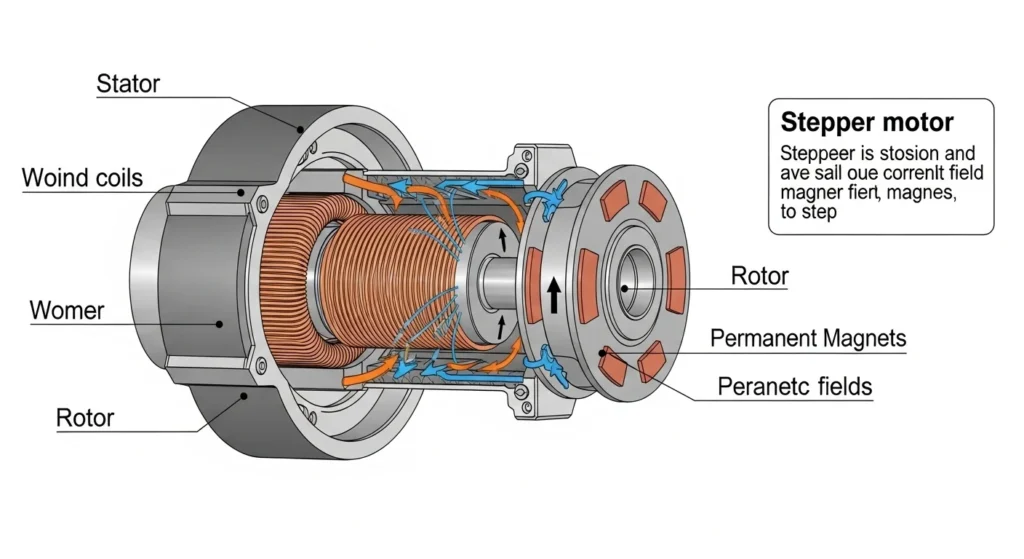
The Stepper Motor working principle is based on electromagnetic attraction between stator coils and the rotor.
When electrical pulses are applied to the motor windings in a sequence, a magnetic field is created. This magnetic field pulls the rotor step by step.
Step-by-Step Working
Electrical pulse is sent to the motor driver.
Driver energizes the stator coils.
Magnetic field is produced.
Rotor aligns with the magnetic field.
Next coil is energized.
Rotor moves to the next position.
This process repeats continuously.
Simple Analogy
Think of a staircase.
Instead of jumping directly to the top, you move one step at a time. A stepper motor works in a similar way.
Key Characteristics
- Moves in discrete steps
- Provides precise position control
- Works with digital signals
- Can rotate clockwise or counterclockwise
4. Types of Stepper Motors
Stepper motors are mainly classified into three types.
Permanent Magnet Stepper Motor
This motor uses a permanent magnet rotor.
Features
- Simple construction
- Low cost
- Moderate accuracy
Applications
- Printers
- Small automation systems
Variable Reluctance Stepper Motor
This motor has a soft iron rotor without permanent magnets.
Features
- High speed operation
- Lightweight rotor
- Lower torque compared to other types
Applications
- Industrial control systems
- Position control devices
Hybrid Stepper Motor
Hybrid motors combine features of permanent magnet and variable reluctance motors.
Features
- High precision
- High torque
- Very accurate positioning
Applications
- CNC machines
- Robotics
- Medical equipment
5. Main Components of a Stepper Motor
Understanding the components helps in learning how the motor works.
Stator
The stator is the stationary part of the motor.
Function:
- Contains multiple coils
- Produces magnetic fields
Rotor
The rotor is the rotating part connected to the shaft.
Function:
- Aligns with stator magnetic field
- Moves step by step
Windings
These are copper coils placed around the stator poles.
Function:
- Produce magnetic field when current flows
Shaft
The shaft transfers mechanical motion from the motor to the load.
Motor Driver
Stepper motors cannot run directly from power supply.
The driver circuit controls:
- Pulse signals
- Direction
- Speed
6. Stepper Motor Advantages
Stepper motors provide several benefits in electrical systems.
Advantages
- High precision movement
- Excellent position control
- Simple control system
- Reliable operation
- Good low-speed torque
- Easy digital control
- No feedback sensor required in many applications
Because of these advantages, they are widely used in automation and robotics.
7. Stepper Motor Disadvantages
Despite many benefits, stepper motors also have some limitations.
Stepper Motor Advantages and Disadvantages
Disadvantages
- Lower efficiency compared to some motors
- Limited high-speed performance
- Can produce vibration or noise
- Requires a driver circuit
- Can lose steps under heavy load
Proper design and control can reduce many of these issues.
8. Stepper Motor Applications
Stepper motors are used in many modern technologies.
Industrial Applications
- CNC machines
- Robotic arms
- Industrial automation
- Packaging machines
Home and Office Devices
- Printers
- Scanners
- Camera sliders
Modern Technology Applications
- 3D printers
- Medical equipment
- Telescope positioning systems
- Semiconductor manufacturing
These Stepper Motor applications require precise movement and control.
9. Comparison: Stepper Motor vs DC Motor
Many beginners ask about the difference between stepper motor and DC motor.
| Feature | Stepper Motor | DC Motor |
| Motion | Step-by-step | Continuous rotation |
| Control | Digital pulses | Voltage control |
| Precision | Very high | Moderate |
| Position Control | Easy | Requires feedback |
| Speed | Moderate | High |
| Applications | CNC, robotics | Fans, pumps |
Stepper motors are better when precise positioning is required.
10. Selection Guide
Choosing the right stepper motor is important for reliable performance.
Factors to Consider
Step Angle
Smaller step angle = higher precision.
Common values:
- 1.8°
- 0.9°
Torque Requirement
Select a motor that provides enough torque for the load.
Operating Voltage
Ensure compatibility with your driver and power supply.
Speed Requirement
Some applications require higher RPM.
Driver Compatibility
Choose a driver that supports:
- Microstepping
- Current control
- Direction control
Tip for Beginners
Always select a motor with 20–30% extra torque capacity.
11. Common Problems & Solutions
Problem 1: Motor Not Rotating
Possible causes:
- Wrong wiring
- No pulse signal
- Driver malfunction
Solution:
Check wiring and driver configuration.
Problem 2: Motor Vibrating
Cause:
- Incorrect step sequence
- Low voltage supply
Solution:
Adjust driver settings.
Problem 3: Motor Losing Steps
Cause:
- Overload
- High speed
Solution:
Reduce speed or use higher torque motor.
Problem 4: Excessive Heating
Cause:
- High current
- Poor ventilation
Solution:
Adjust current limit on driver.
12. Future Trends in Stepper Motor Technology
Stepper motor technology continues to evolve with modern automation.
Emerging Developments
Smart Stepper Motors
Integrated drivers and controllers.
Microstepping Technology
Improves precision and smooth motion.
Energy Efficient Designs
Reduced power consumption.
Advanced Industrial Automation
Stepper motors are increasingly used in:
- AI-based robotics
- Smart manufacturing
- Industry 4.0 systems
These innovations will expand Stepper Motor applications in the future.
13. Conclusion
Stepper motors play an essential role in modern electrical and automation systems. Unlike traditional motors, they move in controlled steps, which allows extremely precise positioning and motion control. Because of this capability, they are widely used in robotics, CNC machines, 3D printers, and many industrial applications.
In this guide, we discussed the Stepper Motor working principle, types, components, applications, and Stepper Motor advantages and disadvantages. We also explored the difference between stepper motor and DC motor to help beginners understand when to use each motor.
For electrical students and technicians, learning about stepper motors is very valuable because automation and robotics industries are growing rapidly. A strong understanding of these motors will help in designing efficient and reliable control systems.
Continuous learning and practical experimentation will help you master stepper motor technology and apply it successfully in real-world electrical projects.