
Imagine placing your smartphone on a small charging pad and seeing the battery start charging automatically—without plugging in any cable. This simple action demonstrates the concept of Wireless Power Transfer. Today, many devices such as smartphones, smartwatches, and electric toothbrushes use this technology to receive power without direct electrical connections.
In traditional electrical systems, power is transferred through wires and cables. While this method works well, wires can wear out, create safety hazards, and limit flexibility in design. Wireless Power Transfer solves many of these problems by allowing electricity to move from one device to another through electromagnetic fields.
For electrical students, engineers, and technicians, understanding this technology is becoming increasingly important because it is used in modern electronics, electric vehicles, medical implants, and industrial automation systems.
In this article, you will learn the Wireless Power Transfer working principle, types, main components, real-world applications, advantages and disadvantages, and practical troubleshooting methods. The explanations are simple and practical, designed to help beginners understand how this advanced electrical technology works and how it is used in modern engineering systems.
2. What is Wireless Power Transfer?
Wireless Power Transfer (WPT) is a technology that allows electrical energy to move from a power source to a device without using physical wires or direct electrical contact.
Simple Definition
Wireless Power Transfer is the process of transmitting electrical energy from a power source to a load through electromagnetic fields, radio waves, or magnetic coupling.
Simple Explanation
Instead of sending electricity through wires, a transmitter creates an electromagnetic field. A nearby receiver captures that energy and converts it back into electrical power.
This process allows devices to operate or charge without direct cable connections.
Practical Example
A common example is wireless smartphone charging.
How it works:
- The charging pad acts as the transmitter
- The smartphone acts as the receiver
- Energy moves through a magnetic field
- The phone battery starts charging
This simple system demonstrates how Wireless Power Transfer applications work in everyday technology.
3. Wireless Power Transfer Working Principle
The Wireless Power Transfer working principle is based on electromagnetic induction or electromagnetic radiation.
In simple terms, energy is transmitted from a transmitter coil to a receiver coil through a magnetic or electromagnetic field.
Step-by-Step Working Process
Power Supply Input
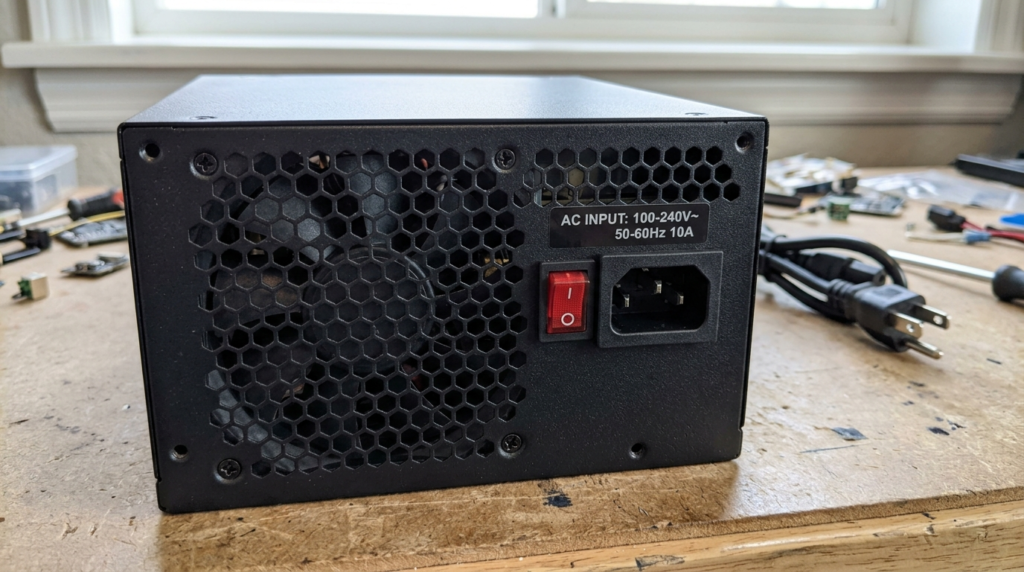
Power supply input is the electrical energy source provided to a power supply unit or electrical device for proper operation. It is the first stage of any electrical or electronic system where incoming electrical power enters the circuit before being converted, regulated, or distributed to different components. The input power may come from AC mains supply, batteries, generators, solar systems, or other electrical sources depending on the application. In most electronic devices, the power supply input receives alternating current (AC) from the utility source and converts it into direct current (DC) using rectifiers, filters, and voltage regulators. Proper input voltage and frequency are important to ensure safe and stable operation of electrical equipment. Power supply input systems often include protective components such as fuses, switches, surge protectors, and filters to prevent damage from overloads, voltage fluctuations, and electrical noise. Understanding power supply input is important for electrical students, engineers, and technicians because it forms the foundation of electrical power conversion, circuit operation, and equipment protection in modern electrical and electronic systems.
Oscillator Circuit
The circuit converts electrical power into a high-frequency alternating current.
Transmitter Coil Creates Magnetic Field
The alternating current flows through the transmitter coil and produces a changing magnetic field.
Energy Transfer Through Air
The magnetic field travels through the air between transmitter and receiver.
Receiver Coil Captures Energy
The receiver coil intercepts the magnetic field and produces electrical voltage.
Rectifier Converts AC to DC
The received energy is converted into usable DC power.
Device Charging
The device uses this electrical energy to operate or charge its battery.
Simple Analogy
Think of two tuning forks.
When one fork vibrates, the other one nearby also starts vibrating. Similarly, wireless power transfer allows energy to move through magnetic fields.
4. Types of Wireless Power Transfer
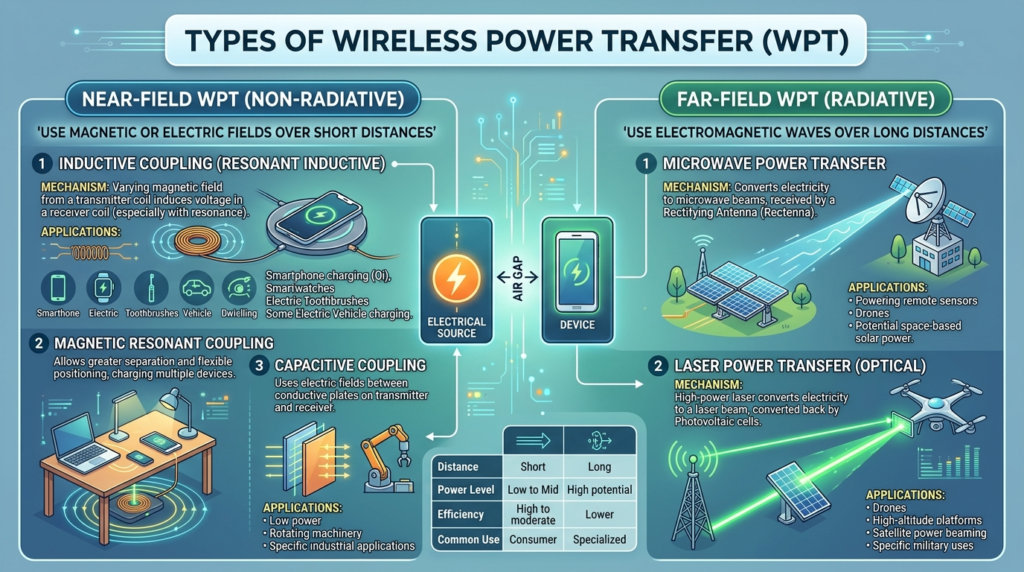
Wireless power systems are classified based on the distance and transmission method.Wireless power transfer is classified into different types based on the method used to transfer electrical energy without physical wires or direct electrical connections. The main types include inductive coupling, resonant inductive coupling, capacitive coupling, microwave power transfer, and laser power transfer. Inductive coupling is the most common method and works using electromagnetic induction between two nearby coils, widely used in wireless mobile chargers and electric toothbrushes. Resonant inductive coupling improves power transfer efficiency over slightly longer distances by using coils tuned to the same resonant frequency. Capacitive coupling transfers energy through electric fields between conductive plates and is suitable for low-power applications. Microwave power transfer uses electromagnetic waves to transmit power over long distances and is mainly used in research, satellite systems, and advanced communication technologies. Laser power transfer converts electrical energy into laser light and then back into electricity using photovoltaic cells. Wireless power transfer systems are widely used in smartphones, medical implants, electric vehicle charging, industrial automation, and consumer electronics because they improve convenience, safety, and flexibility. Understanding the types of wireless power transfer is important for electrical students, engineers, and technicians because this technology plays an important role in modern smart devices and future energy systems.
Inductive Coupling
This is the most common type used in consumer electronics.
Characteristics
- Works over very short distances
- Uses magnetic induction
- Requires coil alignment
Applications
- Wireless phone chargers
- Electric toothbrush charging
- Smartwatch charging docks
Resonant Inductive Coupling
This method improves efficiency by using resonant frequency matching between coils.
Characteristics
- Medium distance power transfer
- Higher efficiency than basic inductive systems
- Better alignment tolerance
Applications
- Electric vehicle charging
- Industrial automation systems
Radio Frequency (RF) Power Transfer
This method transmits energy using radio waves.
Characteristics
- Long-distance energy transmission
- Lower power levels
- Works without precise alignment
Applications
- IoT devices
- Wireless sensors
- Small electronic devices
Microwave Power Transfer
This technology converts electricity into microwaves and transmits energy through space.
Characteristics
- Very long-distance transfer
- High technical complexity
- Mostly experimental
Applications
- Space-based solar power
- Satellite power systems
5. Main Components of a Wireless Power Transfer System
A typical Wireless Power Transfer system contains several important components.
Power Source
The power source supplies electrical energy to the transmitter circuit.
Examples:
- Battery
- AC power supply
- Solar systems
Transmitter Circuit
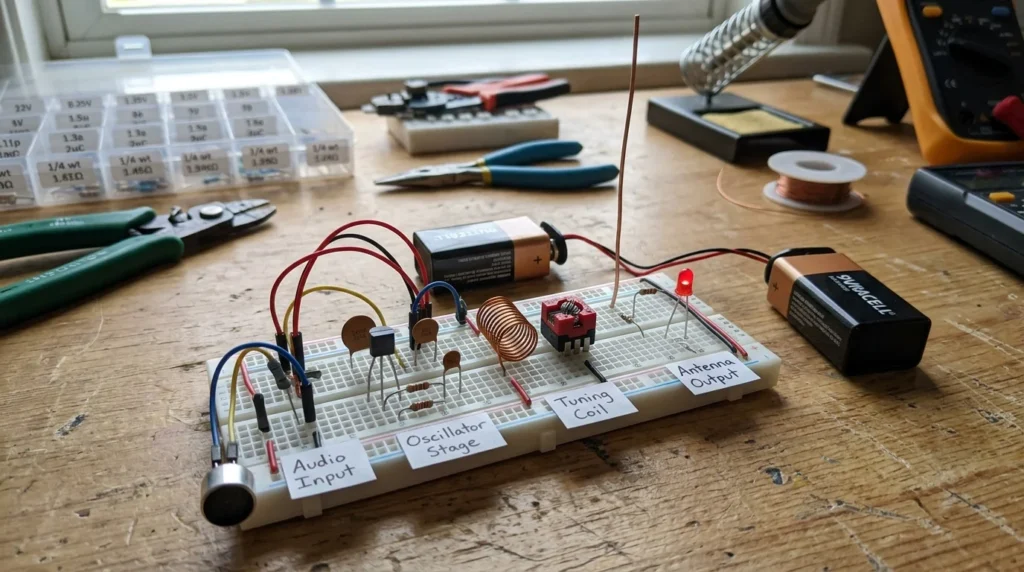
This circuit converts electrical energy into a high-frequency signal.A transmitter circuit is an electronic circuit designed to generate, process, and transmit electrical signals or electromagnetic waves from one location to another without direct physical connection. It converts electrical information such as audio, video, data, or control signals into a suitable form for wireless or wired communication. In wireless systems, the transmitter circuit creates high-frequency signals using oscillators, amplifiers, and modulation circuits, then sends these signals through an antenna. The transmitted signals travel through space and are received by a receiver circuit at the destination. Transmitter circuits are widely used in radio communication, television broadcasting, wireless power transfer, remote controls, mobile phones, Bluetooth devices, Wi-Fi systems, and industrial automation. Common components of a transmitter circuit include oscillators, transistors, capacitors, resistors, amplifiers, antennas, and power supply units. Proper circuit design helps improve signal strength, transmission range, efficiency, and communication quality. Understanding transmitter circuits is important for electrical students, engineers, and technicians because they are essential components in modern communication systems, wireless technology, and electronic control applications.
Function:
- Drives the transmitter coil
- Controls power transmission
Transmitter Coil
The transmitter coil produces the magnetic field needed for energy transfer.
Receiver Coil
The receiver coil captures the magnetic field and converts it into electrical energy.
Rectifier Circuit
This circuit converts received AC power into DC power.
Function:
- Makes energy usable for electronic devices.
Load Device
The load is the device that consumes the received electrical energy.
Examples:
- Smartphone
- Battery
- Electronic circuits
6. Wireless Power Transfer Advantages
Wireless power technology offers many benefits in modern electrical systems.
Wireless Power Transfer Advantages and Disadvantages
Advantages
- No cables or connectors required
- Improved safety and reliability
- Reduced wear and tear on connectors
- Convenient charging process
- Supports sealed devices (waterproof electronics)
- Lower maintenance in industrial systems
- Flexible device placement
These benefits make wireless systems attractive for consumer electronics and automation industries.
7. Wireless Power Transfer Disadvantages
Despite many benefits, wireless power systems also have limitations.
Disadvantages
- Lower efficiency compared to wired systems
- Limited transmission distance
- Higher system cost
- Alignment requirements in some systems
- Possible electromagnetic interference
- Power loss during transmission
Engineers must carefully design systems to minimize these issues.
8. Wireless Power Transfer Applications
Wireless power technology is used in many modern systems.
Home Electronics
- Wireless smartphone chargers
- Electric toothbrush charging stations
- Smartwatch charging pads
Industrial Applications
- Automated guided vehicles (AGVs)
- Factory automation equipment
- Wireless sensor networks
Medical Technology
Wireless power transfer is used in:
- Implantable medical devices
- Pacemakers
- Hearing aids
Electric Vehicles
Many modern electric vehicles use wireless charging pads installed in garages or parking spaces.
Smart Cities and IoT
Wireless power enables long-lasting IoT devices and remote sensors without frequent battery replacement.
These examples show the growing importance of Wireless Power Transfer applications in modern technology.
9. Comparison: Wireless Power Transfer vs Wired Power Transmission
Many students ask about the difference between wireless power transfer and wired power transmission.
| Feature | Wireless Power Transfer | Wired Power Transmission |
| Medium | Electromagnetic fields | Conductors and cables |
| Efficiency | Moderate | High |
| Installation | Simple | Requires wiring |
| Maintenance | Low | Higher due to cables |
| Mobility | Very flexible | Limited |
| Distance | Short to medium | Long distance possible |
Wireless systems offer convenience, while wired systems still provide better efficiency for large-scale power transmission.
10. Selection Guide
Choosing the right wireless power system depends on several factors.
Power Requirement
Determine how much power the device needs.
Example:
- Smartphone charger: low power
- Electric vehicle: high power
Distance
Consider the distance between transmitter and receiver.
Short distance systems are usually more efficient.
Efficiency
Select technology that offers the highest efficiency for your application.
Cost
More advanced systems may require higher initial investment.
Safety Standards
Ensure compliance with electromagnetic safety regulations.
Tip for Beginners
Start with inductive coupling systems, because they are simple, reliable, and widely used.
11. Common Problems & Solutions
Device Not Charging
causes:
- Coil misalignment
- Weak transmitter power
Solution:
Place the device correctly on the charging pad.
Slow Charging
Cause:
- Low efficiency
- Large gap between coils
Solution:
Reduce the distance between transmitter and receiver.
Overheating
Cause:
- High power losses
- Poor ventilation
Solution:
Improve cooling and use efficient circuits.
Interference with Electronics
Cause:
- Strong electromagnetic fields
Solution:
Use shielding and proper circuit design.
12. Future Trends in Wireless Power Technology
Wireless power technology is evolving rapidly.
Key Future Developments
Long-Distance Wireless Charging
Researchers are developing systems capable of transmitting energy over several meters.
Wireless Electric Vehicle Charging Roads
Roads may charge electric vehicles while they are driving.
Smart Home Integration
Wireless power systems may power multiple devices throughout a home.
Space-Based Solar Power
Satellites may collect solar energy and transmit it wirelessly to Earth.
Miniaturized Medical Devices
Wireless power will support advanced implantable medical electronics.
These innovations will expand the role of Wireless Power Transfer applications in modern engineering.
13. Conclusion
Wireless Power Transfer is transforming the way electrical energy is delivered to devices. Instead of relying on physical cables, this technology uses electromagnetic fields to transmit power between a transmitter and a receiver. This approach improves convenience, reduces mechanical wear, and enables new designs for modern electronic systems.
In this article, we explored the Wireless Power Transfer working principle, system components, and major Wireless Power Transfer applications in electronics, industry, medical devices, and electric vehicles. We also discussed the Wireless Power Transfer advantages and disadvantages, helping engineers understand both the benefits and limitations of this technology.
As wireless technology continues to evolve, its role in automation, smart homes, electric transportation, and IoT systems will continue to grow. For electrical students and engineers, understanding wireless power systems will become an important skill for designing the next generation of intelligent and energy-efficient devices.