
Imagine you are working on a home lighting system, and suddenly a short circuit occurs. The wires heat up, sparking a small fire risk. Luckily, the fuse installed in the circuit melts instantly, disconnecting the supply and preventing damage. This simple device saved the day.
Fuses are one of the most fundamental safety devices in electrical engineering. Despite their simplicity, they play a critical role in protecting electrical circuits from overcurrent, short circuits, and equipment damage. Understanding fuses is essential for students, technicians, and engineers to ensure both safety and reliability in electrical systems.
In this article, you will learn:
- What a fuse is and how it works
- Fuse working principle
- Types of fuses and their applications
- Fuse advantages and disadvantages
- How to select the correct fuse for a system
- Common problems and troubleshooting
By the end, you will have a clear understanding of fuse technology, enabling you to design, maintain, and troubleshoot circuits safely.
2. What is a Fuse?
Definition
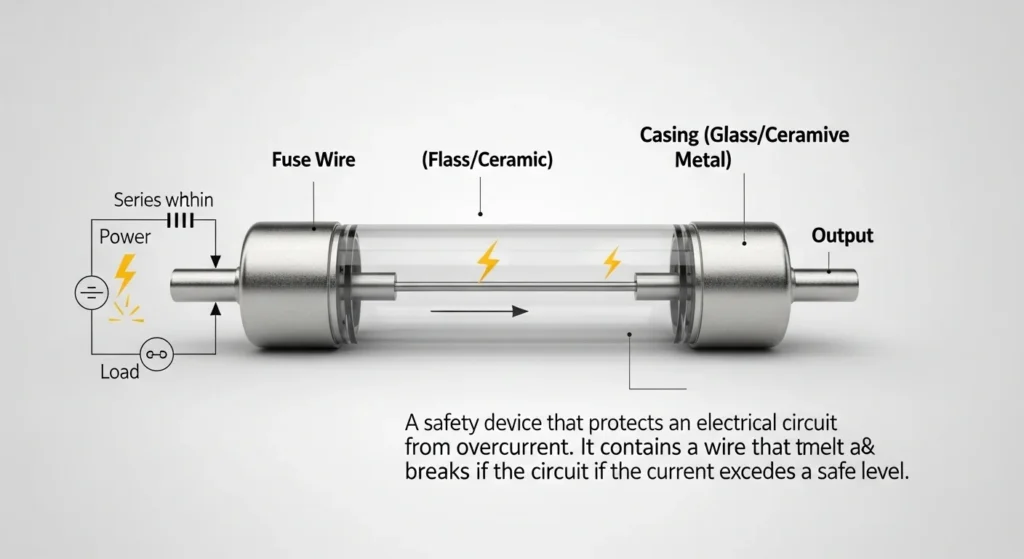
A fuse is a protective device that interrupts electrical flow when current exceeds a safe level, preventing damage to equipment and hazards like fire.
Simple Explanation
Think of a fuse as a “weak link” in the electrical circuit. It allows normal current to pass but melts when the current rises above its rated limit.
Practical Example
In a household circuit, if a 10A fuse is installed, it will allow currents up to 10A to flow. If a fault causes 15A, the fuse element melts, breaking the circuit, and protecting wiring and appliances.
3. Fuse Working Principle
The fuse working principle is simple:
Current flows through a thin metallic wire or strip inside the fuse.
Under normal conditions, the wire remains solid.
When excess current flows, the wire heats up due to resistance.
The wire melts, creating an open circuit.
Electrical flow stops, protecting the circuit.
Easy Analogy
A fuse is like a safety valve in a water pipe. If water pressure exceeds the limit, the valve opens to release pressure. Similarly, the fuse “blows” to stop excessive current.
4. Types / Classification
Fuses are classified based on their design, voltage rating, and application.
Cartridge Fuses
- Cylindrical or tubular design.
- Used in high voltage and industrial circuits.
- Can handle high fault currents.
Plug Fuses
- Common in residential wiring.
- Screw-in type, easy to replace.
- Typically rated 5–30A.
Blade Fuses
- Flat plastic body with metal strips.
- Widely used in automotive circuits.
- Color-coded for easy identification.
HRC (High Rupturing Capacity) Fuses
- For industrial power systems.
- Can safely interrupt high short-circuit currents.
- Contain silica sand to absorb arc energy.
Resettable Fuses (PTC Fuses)
- Use polymer materials that expand with heat.
- Automatically reset after cooling.
- Common in electronics and low voltage applications.
5. Main Components
Fuse Element
Thin wire or strip that melts under excess current.
End Caps / Terminals
Connect the fuse to the circuit.
Body / Enclosure
Houses the fuse element. Can be glass, ceramic, or plastic.
Arc Quenching Material (HRC Fuses)
Sand or other material absorbs energy during interruption.
All components ensure that the fuse operates reliably and safely.
6. Fuse Advantages
- Simple and reliable
- Low cost and easy to replace
- Fast response to overcurrent
- Protects appliances and wiring
- Minimal maintenance required
Real-World Benefits
- Prevents fire hazards
- Extends life of electrical equipment
- Reduces downtime in circuits
7. Fuse Disadvantages / Limitations
- One-time use (except resettable fuses)
- Requires replacement after operation
- Not suitable for frequent overloads
- Slower than some modern circuit breakers in large systems
Despite limitations, fuses remain essential for many low-cost and simple protection applications.
8. Fuse Applications
Home
- Lighting circuits
- Household appliances
- Kitchen and bathroom outlets
Industry
- Motors and machinery
- Transformers
- Control panels and distribution boards
Modern Technology
- Electronic devices
- Solar inverters
- Automotive electrical systems
9. Comparison Section: Fuse vs Circuit Breaker
| Feature | Fuse | Circuit Breaker |
| Reusable | No | Yes |
| Cost | Low | Higher |
| Trip Speed | Fast | Moderate |
| Maintenance | Replace after operation | Periodic testing |
| Applications | Low-cost, small circuits | Industrial, high-power circuits |
10. Selection Guide
Choosing the right fuse requires:
- Current Rating: Match normal operating current.
- Voltage Rating: Should handle system voltage.
- Breaking Capacity: Must interrupt maximum possible fault current.
- Type: Fast-acting for electronics, slow-blow for motors.
Tips for Beginners
- Always check manufacturer datasheets.
- Never replace with a higher rated fuse.
- Use HRC fuses for industrial circuits.
11. Common Problems & Solutions (FAQs Style)
Fuse blows repeatedly?
- Causes: Short circuit, overloading, or wrong rating.
- Solution: Identify and fix the fault, replace with correct fuse.
Can I replace a fuse with a higher rating?
- Risky. It may not protect equipment. Always use correct rating.
Q3: How to test a fuse?
- Use a multimeter in continuity mode.
- No continuity = blown fuse.
Difference between fast-blow and slow-blow fuse?
- Fast-blow: Trips quickly on small overcurrent.
- Slow-blow: Allows temporary surges (e.g., motors) without blowing.
12. Future Trends
- Smart Fuses: Integrate sensors to report status.
- Self-Healing Fuses: Automatically restore after fault.
- Miniaturization: For compact electronics.
- Integration with IoT: Remote monitoring and control.
Fuses are evolving for safety, efficiency, and smart monitoring in modern electrical systems.
13. Conclusion
Fuses are simple yet vital devices in electrical engineering. They protect circuits, equipment, and human life from overcurrent and short circuits. Understanding the fuse working principle, types, and applications is crucial for students, technicians, and engineers.
By selecting the correct fuse, maintaining proper ratings, and applying them appropriately, you ensure safe and reliable electrical systems. Despite modern alternatives like circuit breakers, fuses remain cost-effective and efficient for many applications. Mastering fuse technology is a fundamental step in building safe electrical networks.