
Imagine you connect a small LED directly to a 12V battery without adding any resistor. Within seconds, the LED burns out. Why did this happen? Because too much current flowed through it. There was nothing to limit or control that current.
This simple example shows the importance of understanding What is Resistance? Resistance plays a critical role in controlling current in electrical circuits. Without proper resistance, electrical devices can overheat, fail, or even cause fire hazards.
For electrical students, engineers, and technicians, resistance is one of the most important basic concepts. It directly affects voltage, current, power loss, and circuit safety. Whether you are designing a small electronic circuit or installing industrial wiring, resistance must always be considered.
In this complete guide, you will learn:
- What is Resistance in simple language
- Resistance working principle
- Types of resistance
- Main components related to resistance
- Resistance applications
- Resistance advantages and disadvantages
- Difference between resistance and reactance
- Practical troubleshooting and selection tips
Let’s build your understanding step by step like a senior engineer guiding you in the field.
2. What Is Resistance?
Clear Definition
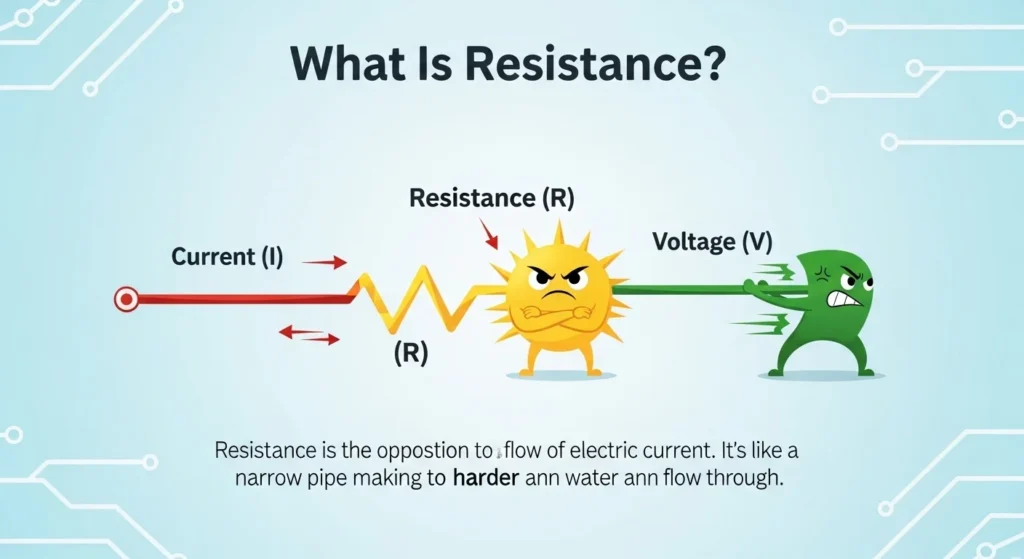
Resistance is the opposition to the flow of electric current in a conductor.
It is measured in Ohms (Ω).
Simple Explanation
When electrons move through a wire, they do not move freely. They collide with atoms inside the material. These collisions slow down the movement of electrons. This opposition to current flow is called resistance.
In simple words:
Resistance controls how much current can flow in a circuit.
Practical Example
If you connect a heater to electricity, the heating element resists the flow of current. Because of this resistance, electrical energy converts into heat.
Without resistance, there would be uncontrolled current flow, leading to damage.
Understanding this basic idea is the foundation of the resistance working principle.
3. Resistance Working Principle
To understand the resistance working principle, imagine water flowing through a pipe.
- Wide pipe → Water flows easily → Low resistance
- Narrow pipe → Water flow slows → High resistance
Electricity behaves in a similar way.
Step-by-Step Explanation
- A voltage source pushes electrons through a conductor.
- The conductor material resists the movement of electrons.
- Collisions between electrons and atoms create opposition.
- This opposition reduces current flow.
- Energy may convert into heat during this process.
Important Points
- Higher resistance → Lower current
- Lower resistance → Higher current
- Resistance depends on material, length, area, and temperature
This is why copper wires are used in wiring — they have low resistance.
4. Types / Classification
Resistance can be classified in different ways.
🔹 Fixed Resistance
The resistance value remains constant.
Examples:
- Carbon resistors
- Metal film resistors
Used in:
- Electronic circuits
- LED circuits
🔹 Variable Resistance
Resistance can be adjusted.
Examples:
- Potentiometer
- Rheostat
Used in:
- Volume control
- Speed control
🔹 Linear Resistance
Follows Ohm’s Law directly.
Current changes proportionally with voltage.
🔹 Non-Linear Resistance
Does not follow Ohm’s Law strictly.
Examples:
- Diodes
- Thermistors
Understanding different types helps in selecting the correct component for resistance applications.
5. Main Components Related to Resistance
1. Resistor
A device designed to provide specific resistance value.
Function: Controls current and voltage levels.
2. Conductor Material
Copper → Low resistance
Aluminum → Moderate resistance
Function: Carries current with minimal loss.
3. Insulator
Has very high resistance.
Examples:
- Plastic
- Rubber
Function: Prevents current flow.
4. Measuring Instrument
Ohmmeter or multimeter.
Function: Measures resistance value accurately.
Each component plays an important role in safe circuit design.
6. Resistance Advantages
Understanding resistance advantages and disadvantages is important for real-world work.
Advantages
- Controls current safely
- Protects electronic devices
- Helps in voltage division
- Produces useful heat (heaters)
- Improves circuit stability
- Essential for circuit design
- Prevents short circuits
Resistance is necessary for safe and efficient electrical systems.
7. Disadvantages / Limitations
Resistance also has practical limitations.
- Causes energy loss as heat
- Reduces system efficiency
- Voltage drop in long cables
- Overheating risk
- Increases power consumption
Engineers must manage resistance properly to reduce losses.
8. Resistance Applications
Resistance applications are found everywhere.
Home Applications
- Electric heaters
- Irons
- Water heaters
Industrial Applications
- Motor speed control
- Load banks
- Control panels
Electronics
- LED circuits
- Voltage dividers
- Signal control
Modern Technology
- Electric vehicles
- Solar inverters
- Battery management systems
Resistance plays a key role in every electrical and electronic system.
9. Comparison Section
Difference Between Resistance and Reactance
| Feature | Resistance | Reactance |
| Definition | Opposition to current | Opposition due to inductance or capacitance |
| Energy Loss | Converts to heat | Stores and releases energy |
| Present In | DC and AC circuits | AC circuits only |
| Unit | Ohm (Ω) | Ohm (Ω) |
| Cause | Material property | Magnetic or electric field effect |
Understanding the difference between resistance and reactance is important for advanced AC systems.
10. Selection Guide
How to select the correct resistance value?
Check Circuit Requirement
Use Ohm’s Law to calculate required resistance.
Consider Power Rating
Ensure resistor can handle power without overheating.
Check Tolerance
Choose appropriate accuracy level.
Tips for Beginners
- Never use underrated resistor
- Measure before installation
- Consider temperature effects
- Avoid loose connections
- Use proper insulation
Correct selection ensures safety and reliability.
11. Common Problems & Solutions
Why is resistor burning?
Cause: Excess current or low power rating.
Solution: Use higher wattage resistor.
Why is voltage dropping?
Cause: High cable resistance.
Solution: Use thicker cable.
Why is equipment heating?
Cause: High resistance at loose connection.
Solution: Tighten terminals properly.
Why is circuit not working?
Cause: Open resistance or broken conductor.
Solution: Check continuity with multimeter.
Practical troubleshooting improves professional skills.
12. Future Trends
Resistance technology is improving.
Advanced Materials
Low-loss materials reduce heat generation.
Smart Electronics
Automatic resistance control in power systems.
Electric Vehicles
Precise resistance management improves efficiency.
Renewable Energy
Optimized cable design reduces resistance losses.
Modern engineering focuses on minimizing unwanted resistance.
13. Conclusion
Understanding What is Resistance? is essential for every electrical professional. Resistance controls current flow and ensures safe operation of circuits. We explored the resistance working principle, types, applications, resistance advantages and disadvantages, and the difference between resistance and reactance.
For students and technicians, mastering resistance improves circuit design, troubleshooting ability, and safety awareness. Without proper resistance control, electrical systems become unsafe and inefficient.
Strong fundamentals in resistance help you understand advanced electrical concepts with confidence. Keep practicing calculations and always prioritize safety in real-world installations.