
Imagine you press the switch to turn on a light, but nothing happens. The bulb is fine. The wiring looks correct. Still, there is no light. Why? Because there is no voltage pushing electricity through the circuit.
This simple situation shows why understanding What is Voltage? is so important. Voltage is the driving force behind every electrical system. Without voltage, current cannot flow, motors cannot rotate, and electronic devices cannot operate.
For electrical students, engineers, and technicians, voltage is one of the most important concepts to master. It affects equipment safety, cable selection, circuit design, and troubleshooting. A wrong voltage can damage appliances, overheat wires, or cause system failure.
In this complete guide, you will learn:
- What is Voltage in simple language
- Voltage working principle
- Types of voltage
- Main components related to voltage
- Voltage applications
- Voltage advantages and disadvantages
- Difference between voltage and current
- Practical troubleshooting tips
Let’s understand voltage step by step like a senior engineer explaining to a junior in the field.
2. What Is Voltage?
Definition
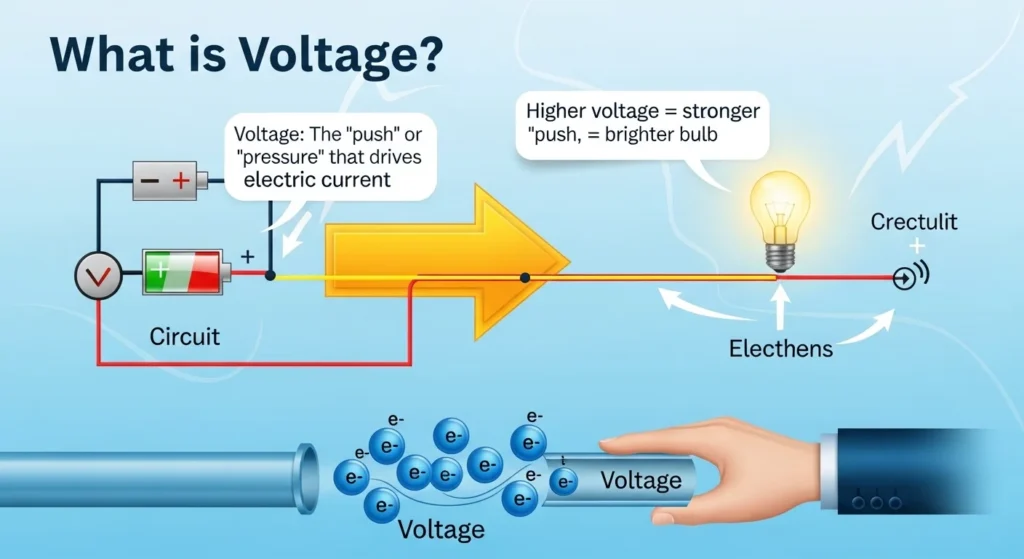
Voltage is the electrical pressure or potential difference that pushes electric current through a conductor.
It is measured in Volts (V).
Simple Explanation
In simple words, voltage is the force that moves electrons in a circuit.
Without voltage, electrons remain still.
With voltage, electrons start moving, and current flows.
Practical Example
Think about a water tank placed at a height. The height creates water pressure. When you open the tap, water flows because of that pressure.
Similarly:
- Voltage = Electrical pressure
- Current = Flow of electrons
- Wire = Pipe
If voltage is high, more pressure is available to push current through the circuit.
This basic understanding is essential when learning the voltage working principle.
3. Voltage Working Principle
To understand the voltage working principle, we need to understand how energy moves in a circuit.
Step-by-Step Explanation
- A power source (battery or generator) creates an electrical potential difference.
- This potential difference creates pressure between two points.
- When a circuit is closed, electrons move from negative to positive.
- The movement of electrons is called current.
- Electrical devices convert this energy into light, heat, or motion.
Key Points
- Voltage creates electrical pressure.
- Current flows only when a closed circuit exists.
- Higher voltage can push more current (depending on resistance).
Easy Analogy
Imagine two water tanks at different heights connected by a pipe. Water flows from the higher tank to the lower tank because of height difference.
That height difference is like voltage.
Voltage is not the flow itself. It is the reason the flow happens.
Understanding this concept helps avoid confusion between voltage and current.
4. Types / Classification
Voltage can be classified in different ways.
🔹 Direct Voltage (DC Voltage)
Direct voltage remains constant and flows in one direction.
Sources:
- Batteries
- Solar panels
- DC power supplies
Used in:
- Mobile phones
- Electronics
- LED circuits
🔹 Alternating Voltage (AC Voltage)
Alternating voltage changes direction continuously.
Source:
- Power stations
Used in:
- Homes
- Industries
- Commercial buildings
🔹 High Voltage
High voltage is used for power transmission over long distances.
Examples:
- 11kV
- 132kV
- 220kV
🔹 Low Voltage
Low voltage is used for domestic and small equipment.
Examples:
- 230V household supply
- 12V battery systems
Each type has specific voltage applications depending on system requirements.
5. Main Components Related to Voltage
Voltage exists because of certain system components.
1. Power Source
Examples:
- Battery
- Generator
- Transformer
Function: Creates voltage difference.
2. Conductors
Copper or aluminum wires.
Function: Carry voltage to the load.
3. Load
Examples:
- Bulb
- Fan
- Motor
Function: Uses electrical energy.
4. Measuring Devices
Voltmeter or multimeter.
Function: Measures voltage safely.
5. Insulation System
Function: Protects users from high voltage shock.
Each component plays a critical role in voltage control and safety.
6. Voltage Advantages
Understanding voltage advantages and disadvantages is important for safe design.
Advantages
- Enables current flow
- Powers electrical devices
- Easy to measure
- Can be stepped up or stepped down using transformers
- Supports long-distance power transmission
- Essential for modern technology
Voltage is the foundation of electrical power systems.
7. Disadvantages / Limitations
Voltage also has risks and limitations.
- High voltage can cause electric shock
- Excess voltage damages equipment
- Voltage fluctuation affects performance
- Requires insulation and safety systems
- Voltage drop occurs in long cables
Proper control and design reduce these risks.
8. Voltage Applications
Voltage applications are seen in all sectors.
Home Applications
- Lighting systems
- Fans and appliances
- Charging mobile devices
Industrial Applications
- Running motors
- Operating control panels
- Heavy machinery
Commercial Use
- Elevators
- Air conditioning systems
- Office equipment
Modern Technology
- Electric vehicles
- Solar energy systems
- Smart home systems
- Data centers
Without voltage, none of these systems would function.
9. Comparison Section
Difference Between Voltage and Current
| Feature | Voltage | Current |
| Meaning | Electrical pressure | Flow of charge |
| Unit | Volt (V) | Ampere (A) |
| Role | Pushes electrons | Moves electrons |
| Measured By | Voltmeter | Ammeter |
| Symbol | V | I |
Understanding the difference between voltage and current prevents common mistakes in circuit design.
10. Selection Guide
How to choose the correct voltage level?
Step 1: Check Equipment Rating
Always read the nameplate.
Example:
If device rating is 230V, supply must match it.
Step 2: Consider Load Type
- Small electronics → Low voltage
- Industrial motors → Higher voltage
Step 3: Safety
- Use proper insulation
- Install circuit breakers
- Ensure proper earthing
Tips for Beginners
- Never connect equipment to wrong voltage
- Use a multimeter to verify supply
- Avoid overvoltage
- Understand voltage drop in long cables
Correct selection ensures safe and efficient performance.
11. Common Problems & Solutions
Q1: Why is my device not turning ON?
Cause: No voltage supply.
Solution: Check switch, fuse, and wiring.
Q2: Why do lights dim?
Cause: Low voltage or voltage drop.
Solution: Check cable size and supply stability.
Q3: Why does equipment burn out?
Cause: Overvoltage.
Solution: Install voltage stabilizer.
Q4: Why is voltage fluctuating?
Cause: Load variation or weak supply.
Solution: Inspect distribution system.
Proper troubleshooting improves reliability and safety.
12. Future Trends
Voltage systems are improving with technology.
Smart Grids
Digital systems manage voltage automatically.
Renewable Energy
Solar inverters regulate voltage efficiently.
Energy Storage Systems
Battery management systems control voltage precisely.
Electric Vehicles
Advanced voltage control ensures safe charging.
Modern technology is making voltage systems smarter and safer.
13. Conclusion
Understanding What is Voltage? is essential for every electrical professional. Voltage is the electrical pressure that drives current through a circuit. We explored the voltage working principle, types, applications, voltage advantages and disadvantages, and the difference between voltage and current.
For students and technicians, mastering voltage concepts builds strong fundamentals. It improves safety, prevents equipment damage, and supports better troubleshooting skills.
Strong basics in voltage make advanced electrical topics easier to understand. Keep practicing measurements, follow safety standards, and continue building your electrical knowledge step by step.