
Imagine a power station located hundreds of kilometers away from your city. Yet, when you switch on a light at home, electricity is instantly available. Have you ever wondered how electrical power travels such long distances efficiently?
This is where AC vs DC transmission becomes important. Transmission systems are the backbone of modern power networks. Choosing between alternating current (AC) and direct current (DC) for power transmission affects efficiency, cost, stability, and reliability.
As an electrical student or junior engineer, you must clearly understand the difference between AC and DC transmission. This knowledge is essential for power system design, grid planning, renewable energy integration, and high-voltage systems.
In this article, I will explain the AC vs DC transmission working principle, types, components, advantages and disadvantages, applications, and a detailed comparison. By the end, you will confidently understand when to use AC transmission and when DC transmission is the better choice.
What is AC vs DC Transmission?
Definition
AC vs DC transmission refers to two different methods of transmitting electrical power from generating stations to consumers:
- AC Transmission uses alternating current.
- DC Transmission uses direct current.
Simple Explanation
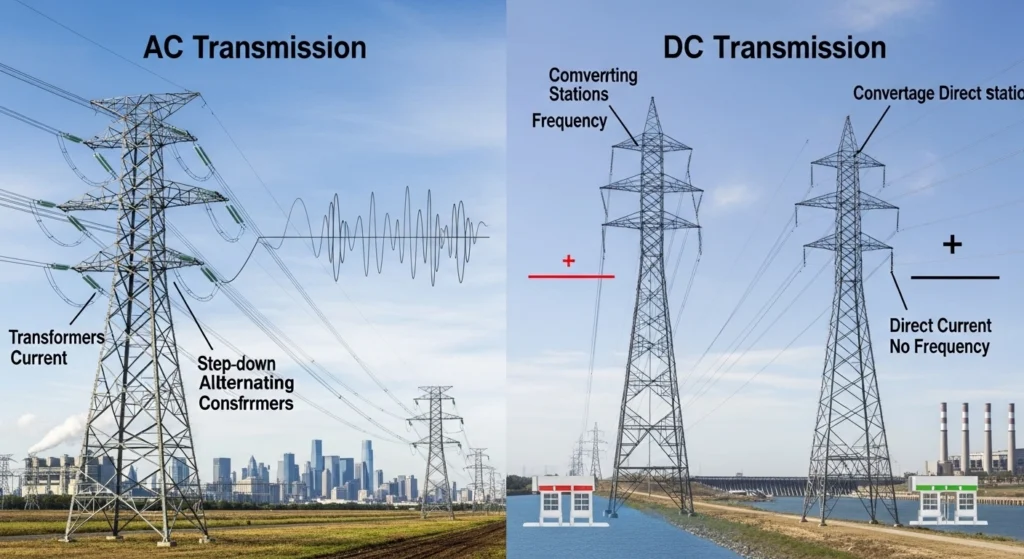
In AC transmission:
- Current changes direction periodically.
- Voltage can be easily increased or decreased using transformers.
In DC transmission:
- Current flows in one direction.
- Power is transmitted at constant voltage.
Practical Example
Most national grids use AC transmission for general power distribution. However, very long-distance and submarine cable systems often use High Voltage DC (HVDC) transmission for better efficiency.
AC vs DC Transmission Working Principle
Understanding the AC vs DC transmission working principle helps you analyze power systems correctly.
AC Transmission Working Principle
Step-by-step explanation:
- Power is generated as AC in generators.
- Voltage is increased using step-up transformer.
- High-voltage AC travels through transmission lines.
- Voltage is reduced using step-down transformer.
- Power is distributed to consumers.
Key idea:
Higher voltage → Lower current → Reduced power loss.
DC Transmission Working Principle
Step-by-step explanation:
- AC power is generated.
- Converted into DC using rectifier station.
- High-voltage DC transmitted through lines.
- At receiving end, DC converted back to AC using inverter.
- Power supplied to grid.
Easy Analogy
Think of transporting water:
- AC transmission = water flowing back and forth but controlled easily with valves (transformers).
- DC transmission = water flowing in one direction with strong pressure for long-distance transport.
Types / Classification
Types of AC Transmission
Single-Phase AC Transmission
- Rarely used for long distances.
- Mainly for small loads.
Three-Phase AC Transmission
- Most common system.
- Efficient for large power transfer.
- Used in national grids.
Types of DC Transmission
Monopolar HVDC
- Uses one conductor and ground return.
- Low cost but less reliable.
Bipolar HVDC
- Uses two conductors (positive and negative).
- More reliable and stable.
Homopolar HVDC
- Two conductors with same polarity.
- Rarely used today.
Main Components
Components of AC Transmission System
- Alternator (Generator)
- Step-up Transformer
- Transmission Lines
- Step-down Transformer
- Substations
- Circuit Breakers
Transformers are key elements in AC systems.
Components of DC Transmission System
- Rectifier Station
- Converter Transformers
- DC Transmission Lines
- Inverter Station
- Filters
- Smoothing Reactors
Converter stations are the heart of DC transmission.
Advantages
Let us examine AC vs DC transmission advantages and disadvantages clearly.
AC Transmission Advantages
- Easy voltage transformation.
- Simple design.
- Lower converter cost.
- Well-established technology.
- Suitable for short and medium distances.
DC Transmission Advantages
- Lower transmission losses over long distances.
- No reactive power issues.
- Suitable for underwater cables.
- Better stability control.
- Can connect asynchronous grids.
DC transmission is very efficient for distances above 600–800 km.
Disadvantages / Limitations
AC Transmission Disadvantages
- Reactive power losses.
- Skin effect in conductors.
- Stability issues in long-distance lines.
- Higher corona losses.
DC Transmission Disadvantages
- High converter station cost.
- Complex control systems.
- Requires conversion at both ends.
- Maintenance of power electronics equipment.
Both systems have practical limitations.
AC vs DC Transmission Applications
AC Transmission Applications
- National power grids.
- Regional power distribution.
- Industrial supply networks.
- Urban electricity systems.
DC Transmission Applications
- Long-distance bulk power transfer.
- Submarine cables.
- Interconnection between countries.
- Renewable energy (offshore wind farms).
- Desert solar power transmission.
Modern projects worldwide use HVDC for efficient bulk transfer.
Comparison Section
Difference Between AC and DC Transmission
| Feature | AC Transmission | DC Transmission |
| Current Type | Alternating | Direct |
| Voltage Conversion | Easy using transformers | Requires converters |
| Losses | Higher in long distance | Lower in long distance |
| Cost | Lower initial cost | Higher initial cost |
| Reactive Power | Present | Absent |
| Best For | Short/medium distance | Very long distance |
This table clearly explains the difference between AC and DC transmission.
Selection Guide – How to Choose the Right One
Choosing between AC and DC depends on:
Distance
- Less than 500 km → AC preferred.
- More than 800 km → DC more efficient.
Power Level
- Very high power → DC preferred.
Cable Type
- Submarine cable → DC better.
Grid Connection
- Connecting two different frequency grids → DC required.
Budget
- Lower initial budget → AC suitable.
- Long-term efficiency focus → DC better.
For beginners: Always calculate power loss and cost before deciding.
Common Problems & Solutions (FAQs Style)
Why is AC mostly used in power grids?
Because voltage transformation is simple and equipment cost is lower.
Why is DC better for long distances?
Because DC has no reactive power loss and lower line losses.
What is reactive power problem in AC?
Reactive power causes additional losses and voltage drop.
Is DC transmission more modern?
Yes, especially HVDC systems for renewable integration.
Can AC and DC grids work together?
Yes. Converter stations allow interconnection.
Future Trends
Power transmission technology is evolving rapidly.
New Developments
- Ultra High Voltage DC (UHVDC).
- Smart grid technology.
- Renewable energy integration.
- Advanced converter stations.
- Flexible AC transmission systems (FACTS).
Future grids will likely combine AC and DC systems.
Hybrid transmission networks are becoming common in modern power systems.
Engineers are focusing on:
- Higher efficiency
- Lower losses
- Grid stability
- Renewable compatibility
Conclusion
Understanding AC vs DC transmission is essential for anyone working in power systems. AC transmission is simple, cost-effective, and widely used in national grids. DC transmission is more efficient for very long distances and submarine cables.
We discussed the AC vs DC transmission working principle, types, components, applications, and AC vs DC transmission advantages and disadvantages. You also learned the difference between AC and DC transmission and how to select the right system.
As a junior engineer, always consider distance, cost, efficiency, and stability when designing transmission systems.
Strong fundamentals in transmission technology will help you build a successful career in power engineering.
keep learning and stay .