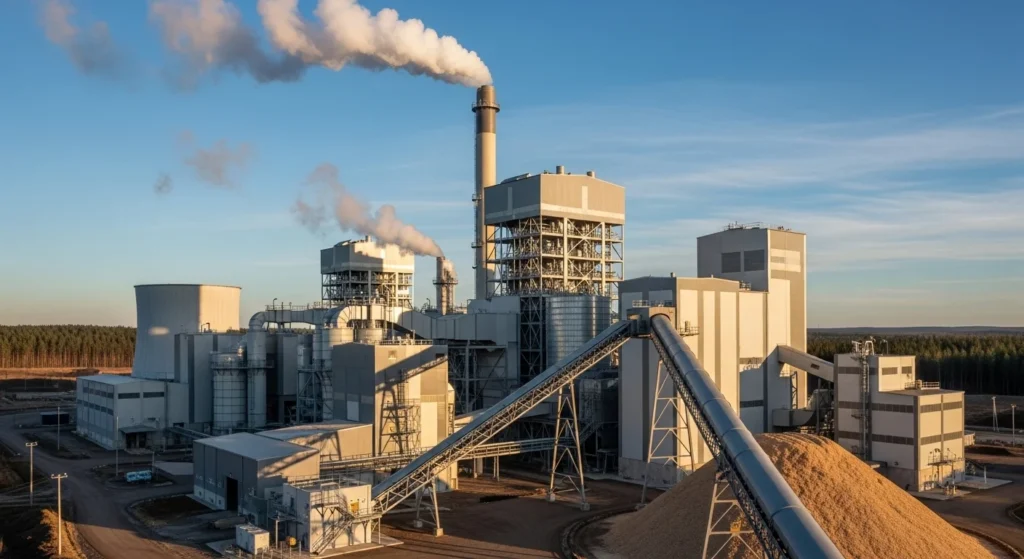

Imagine a small town surrounded by farms. After every harvest, large amounts of crop waste like rice husk and wheat straw are left behind. Instead of burning this waste and causing pollution, the town uses it to generate electricity. This is the real-world application of a Biomass Power Plant.
As electrical engineers, we must understand not only conventional power plants but also renewable energy systems. With increasing fuel prices and environmental concerns, biomass-based power generation is becoming more important worldwide.
In this article, you will learn the Biomass Power Plant working principle, its types, components, advantages and disadvantages, applications, and comparison with other power plants. I will explain everything in simple language, just like guiding a junior engineer in the field.
What is Biomass Power Plant?
A Biomass Power Plant is a power generation system that produces electricity by burning organic materials such as agricultural waste, wood chips, animal waste, and other biodegradable materials.
In simple words, it converts plant and animal waste into electrical energy.
Simple Explanation
Plants store energy from the sun through photosynthesis. When we burn plant-based materials, this stored solar energy is released as heat. That heat is used to produce steam, which rotates a turbine connected to a generator. The generator produces electricity.
Practical Example
For example, rice husk collected from mills can be used as fuel in a biomass boiler. The boiler produces steam, which drives a steam turbine to generate power for local industries.
Biomass Power Plant Working Principle
Understanding the Biomass Power Plant working principle is very important for electrical students.
The working process is similar to a thermal power plant, but the fuel is organic waste instead of coal.
Step-by-Step Working Process
Fuel Collection
- Biomass such as wood chips, crop waste, or animal waste is collected.
Fuel Feeding System
- The biomass fuel is supplied to a boiler or combustion chamber.
Combustion Process
- Biomass is burned to produce heat energy.
Steam Generation
- Heat converts water into high-pressure steam.
Turbine Rotation
- Steam rotates the steam turbine.
Electricity Generation
- The turbine drives an alternator or generator to produce electricity.
Exhaust and Ash Removal
- Flue gases are treated, and ash is removed safely.
Easy Analogy
Think of it like cooking food on a gas stove:
- Fuel burns → Heat is produced
- Heat boils water → Steam is formed
- Steam moves turbine → Electricity is generated
That is the core of the biomass system.
Types / Classification of Biomass Power Plant
There are different types of biomass power plants depending on the conversion method.
Direct Combustion Biomass Plant
This is the most common type.
- Biomass is directly burned in a boiler.
- Steam is produced.
- Steam turbine generates electricity.
It works exactly like a coal-based power plant but uses biomass instead of coal.
Gasification Biomass Plant
In this method:
- Biomass is converted into a combustible gas called producer gas.
- This gas is used in a gas engine or gas turbine.
- Electricity is generated.
Gasification is more efficient than direct combustion.
Anaerobic Digestion Plant
This method uses bacteria.
- Organic waste decomposes without oxygen.
- Biogas (mainly methane) is produced.
- Biogas runs a gas engine generator.
This type is common in dairy farms and small rural setups.
Co-firing Biomass Plant
In co-firing:
- Biomass is mixed with coal.
- Both fuels are burned together in a coal power plant.
This reduces coal consumption and carbon emissions.
Main Components of Biomass Power Plant
Let us understand the major parts and their functions.
Fuel Handling System
- Collects and stores biomass.
- Feeds fuel into the combustion chamber.
Boiler
- Burns biomass.
- Converts water into steam.
Steam Turbine
- Rotates due to high-pressure steam.
- Converts thermal energy into mechanical energy.
Generator (Alternator)
- Converts mechanical energy into electrical energy.
Condenser
- Converts used steam back into water.
Cooling System
- Maintains temperature control.
Ash Handling System
- Removes ash produced during combustion.
Each component must be properly designed for efficiency and safety.
Biomass Power Plant Advantages and Disadvantages
Advantages
- Renewable energy source
- Uses agricultural waste
- Reduces landfill waste
- Lower carbon emissions compared to coal
- Supports rural economy
- Provides stable power supply
These Biomass Power Plant advantages and disadvantages must be evaluated before installation.
Disadvantages / Limitations
- Requires large fuel storage
- Lower efficiency than fossil fuel plants
- Transportation cost of biomass
- Moisture content affects combustion
- Regular maintenance required
Proper planning can reduce these limitations.
Biomass Power Plant Applications
Understanding Biomass Power Plant applications helps in real-world implementation.
Rural Electrification
Small plants provide electricity to villages.
Industrial Power Generation
Used in sugar mills and rice mills.
Combined Heat and Power (CHP)
Provides both electricity and heat for industries.
Waste Management Projects
Converts municipal waste into energy.
Agricultural Sector
Uses farm waste to generate power locally.
Comparison Section
Difference Between Biomass Power Plant and Thermal Power Plant
| Feature | Biomass Power Plant | Coal Thermal Power Plant |
| Fuel Type | Organic waste | Coal |
| Environmental Impact | Lower | Higher |
| Carbon Emission | Relatively low | High |
| Fuel Availability | Seasonal | Continuous |
| Waste Output | Ash (less harmful) | Fly ash (more harmful) |
The difference between biomass power plant and thermal power plant mainly lies in fuel type and environmental impact.
Selection Guide
Choosing the right Biomass Power Plant depends on:
Fuel Availability
Ensure regular biomass supply.
Plant Capacity
Select based on required load demand.
Location
Near farms or waste sources reduces transport cost.
Technology Type
Gasification for higher efficiency.
Direct combustion for simple operation.
Budget
Initial investment and maintenance cost must be considered.
Beginners should start with small-scale systems for learning and training.
Common Problems & Solutions
Why is efficiency low?
Reason: High moisture in biomass.
Solution: Pre-dry the fuel.
Why does boiler clogging occur?
Reason: Poor-quality fuel.
Solution: Proper fuel screening.
Why is power output unstable?
Reason: Irregular fuel feeding.
Solution: Use automated feeding system.Q4: Excessive ash formation?
Solution: Improve combustion control and use dry fuel.
Regular inspection improves plant performance.
Future Trends
Biomass technology is improving rapidly.
Advanced Gasification
More efficient and cleaner systems.
Hybrid Systems
Combination of biomass with solar or wind.
Carbon Capture
Reduces emissions further.
Smart Automation
IoT-based monitoring for performance control.
In the future, biomass will play a major role in renewable energy systems.
Conclusion
A Biomass Power Plant is an important renewable energy system that converts organic waste into electricity. It works on a simple principle: burn biomass, produce steam, rotate a turbine, and generate power. Although it has some limitations like fuel storage and maintenance requirements, its environmental and economic benefits make it a strong alternative to fossil fuel plants.
Understanding the Biomass Power Plant working principle, types, components, applications, and the difference between biomass power plant and thermal power plant helps electrical students and engineers design better systems. As future engineers, learning renewable technologies is not optional—it is essential.
Keep exploring power generation systems to build strong technical expertise.