
Imagine receiving your electricity bill and wondering why it increased even though you did not add any new appliances. The answer often lies in how much electrical power your devices consume and how long they run. From a simple light bulb to heavy industrial machinery, every electrical device uses power, and understanding how to calculate it is essential for efficiency and cost control.
For electrical students, engineers, technicians, and beginners, learning the electric power formula is fundamental. It helps in designing circuits, selecting equipment, estimating energy consumption, improving efficiency, and ensuring safe operation. Without understanding power calculations, it becomes difficult to size wires, choose protection devices, or manage energy use effectively.
In this article, you will learn what the electric power formula is, the electric power working principle, different power equations, components involved, advantages and limitations, practical applications, and troubleshooting tips. The concepts are explained in simple, clear language to build strong technical understanding.
The electric power formula is used to calculate the rate at which electrical energy is consumed or produced in a circuit.
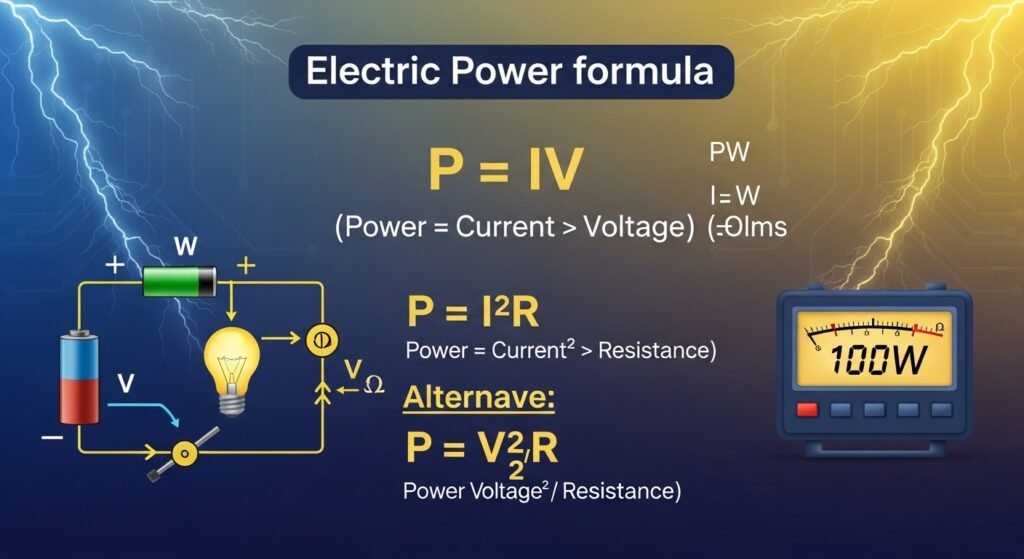
Standard Electric Power Formula
P=V×IP = V \times IP=V×I
Where:
- P = Power (Watts)
- V = Voltage (Volts)
- I = Current (Amperes)
Simple Explanation
Electric power tells us how fast electrical energy is being used. Higher power means more energy is consumed in less time.
Practical Example
If a device operates at:
- Voltage = 220 V
- Current = 2 A
Then,
P=220×2=440 wattsP = 220 \times 2 = 440 \text{ watts}P=220×2=440 watts
This means the device consumes 440 watts of power.
Electric Power Working Principle
The electric power working principle is based on how voltage pushes current through a circuit to deliver energy to a load.
Easy Analogy: Water Pump System
- Voltage = water pressure
- Current = water flow rate
- Power = strength of water flow hitting a turbine
Higher pressure and higher flow produce more power.
Step-by-Step Explanation
- A voltage source provides electrical pressure.
- Current flows through the circuit.
- The load resists the flow and uses energy.
- Energy is converted into light, heat, or motion.
- Power represents the rate of energy conversion.
Key Points
- Power increases with voltage.
- Power increases with current.
- Resistance affects current and power consumption.
Types / Classification of Electric Power Formulas
Different formulas are used depending on known values.
1. Power Using Voltage and Current
P=V×IP = V \times IP=V×I
Used when voltage and current are known.
2. Power Using Current and Resistance
P=I2×RP = I^2 \times RP=I2×R
Used when current and resistance are known.
Example: Heating elements.
3. Power Using Voltage and Resistance
P=V2RP = \frac{V^2}{R}P=RV2
Used when voltage and resistance are known.
Example: Electric heaters and bulbs.
4. Power in AC Circuits (Real Power)
P=V×I×cosϕP = V \times I \times \cos\phiP=V×I×cosϕ
Where:
- cosφ = power factor
- φ = phase difference
Used in AC systems with inductive loads like motors.
5. Apparent and Reactive Power
- Apparent Power: S=V×IS = V \times IS=V×I (VA)
- Reactive Power: Q=V×I×sinϕQ = V \times I \times \sin\phiQ=V×I×sinϕ (VAR)
These are important for industrial power systems.
Understanding the difference between real power and apparent power is essential for efficient electrical system design.
Main Components Affecting Electric Power
1. Voltage (V)
Electrical pressure that pushes current through a circuit.
2. Current (I)
Flow of electric charge.
3. Resistance (R)
Opposition to current flow.
4. Power Factor (cosφ)
Indicates efficiency in AC systems.
5. Load
Device consuming electrical power.
These components determine how much power is consumed.
Electric Power Advantages and Disadvantages
Advantages
- Helps calculate energy consumption accurately
- Essential for electrical design and load planning
- Improves energy efficiency
- Helps reduce electricity costs
- Ensures safe equipment operation
- Supports proper wire and breaker sizing
Disadvantages / Limitations
- Requires accurate measurements
- AC power calculations can be complex
- Power factor must be considered in industries
- Incorrect calculations can cause overloads
- Does not directly indicate energy cost without time factor
Electric Power Applications
The electric power formula is used in nearly every electrical field.
Home Applications
- Calculating electricity usage
- Selecting appliances
- Estimating monthly energy consumption
Industrial Applications
- Motor power calculations
- Load distribution planning
- Generator sizing
- Power factor correction
Modern Technology Applications
- Renewable energy system design
- Electric vehicle charging systems
- Smart grid load management
- Data center power planning
Understanding electric power applications helps optimize energy use and system reliability.
Comparison: Power vs Energy
| Feature | Electric Power | Electrical Energy |
| Definition | Rate of energy use | Total energy consumed |
| Unit | Watt (W) | Kilowatt-hour (kWh) |
| Time factor | Not included | Includes time |
| Example | 1000 W heater | 1 kWh energy used in 1 hour |
| Usage | Device rating | Electricity billing |
Power shows how fast energy is used, while energy shows total consumption.
Selection Guide: Choosing the Right Power Rating
Choosing correct power ratings ensures efficiency and safety.
For Household Appliances
- Check watt rating before purchase
- Ensure wiring supports the load
For Circuit Design
- Calculate total load power
- Choose proper wire size and breaker
For Industrial Systems
- Consider power factor
- Use three-phase power for heavy loads
Tips for Beginners
- Never exceed socket capacity
- Add load values before connecting devices
- Leave safety margin (20–25%)
- Use certified equipment
Common Problems & Solutions
Why do wires heat up?
Cause: excessive current or overload
Solution: reduce load and use proper wire size.
Why does a breaker trip frequently?
Cause: power demand exceeds circuit rating
Solution: calculate load and redistribute.
Why is electricity bill high?
Cause: high power appliances running long hours
Solution: reduce usage and use energy-efficient devices.
Why do motors overheat?
Cause: poor power factor or overload
Solution: check load and improve power factor.
Future Trends in Electric Power Calculation
Smart Energy Monitoring
Smart meters provide real-time power usage data.
Power Factor Optimization
Industries use automated systems to improve efficiency.
Renewable Energy Integration
Solar systems require accurate power calculations.
AI-Based Load Management
Smart systems optimize power consumption automatically.
Energy-Efficient Appliances
Modern devices consume less power while maintaining performance.
The future focuses on intelligent power management and efficiency.
Conclusion
The electric power formula is a fundamental concept that helps determine how much electrical energy is being used or delivered in a circuit. By understanding formulas such as P = V × I, I²R, and V²/R, electrical professionals can design safer systems, prevent overloads, and improve efficiency.
Knowing the electric power working principle allows students and technicians to calculate loads, select equipment, and troubleshoot problems effectively. While power calculations may appear simple, they play a crucial role in energy management, cost control, and system reliability.
As electrical systems evolve with smart grids, renewable energy, and automation, mastering power calculations becomes even more important. A strong understanding of electric power ensures better design decisions, improved safety, and efficient energy usage.