
Have you ever felt a small shock after touching a metal door handle on a dry day, or seen a balloon stick to a wall after rubbing it on your hair? That tiny shock and simple experiment are examples of electricity in action. At the same time, the electricity that powers your home, runs fans, lights rooms, and charges your phone is another form of the same phenomenon.
Understanding the types of electricity (static and current) is essential for electrical students, engineers, technicians, and beginners because these two forms form the foundation of electrical science. Static electricity explains charge buildup and electrostatic effects, while current electricity powers modern life and industrial systems.
In this article, you will learn what static and current electricity are, their working principles, key differences, components, advantages and disadvantages, and practical applications. By the end, you will clearly understand how electricity behaves and why both types are important in electrical engineering and daily life.
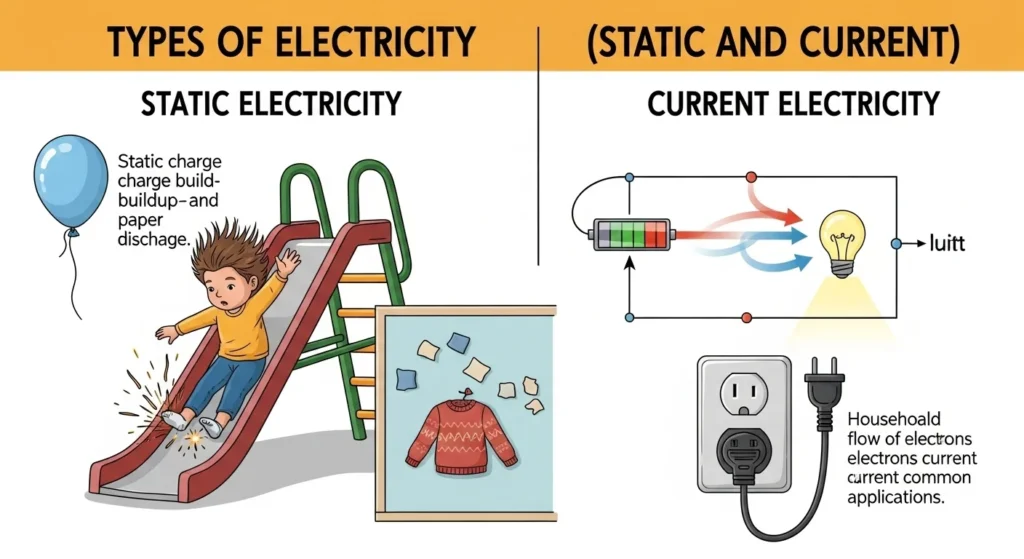
Electricity exists in two main forms: static electricity and current electricity.
Simple Definition
- Static electricity is the buildup of electric charges on a surface.
- Current electricity is the continuous flow of electric charge through a conductor.
Simple Explanation
Electric charges (electrons) can either accumulate in one place or move through a path.
- When charges gather and stay in one place → static electricity.
- When charges flow through a wire → current electricity.
Practical Example
- Shock after walking on carpet → static electricity
- Light bulb glowing when switched on → current electricity
Both forms involve electric charges, but their behavior and uses are different.
Types of Electricity Working Principle
The types of electricity working principle is based on how electrons behave — either accumulating or flowing.
Easy Analogy
Think of water:
- Water stored in a tank = static electricity
- Water flowing in a pipe = current electricity
Static Electricity Working Process
- Two materials rub together.
- Electrons transfer from one surface to another.
- One object becomes negatively charged.
- The other becomes positively charged.
- Charge remains stored until discharged.
Current Electricity Working Process
- A voltage source creates electrical pressure.
- Electrons begin to move through a conductor.
- Movement occurs in a closed circuit.
- Electrical devices use the energy.
- Current returns to the source.
Types / Classification of Electricity
1. Static Electricity
Static electricity is the accumulation of electric charge on an object’s surface.
How It Forms
It occurs when electrons transfer between materials through friction, contact, or separation.
Examples
- Lightning during storms
- Spark when removing synthetic clothes
- Balloon sticking to a wall
- Shock from touching metal after walking on carpet
Characteristics
- Charges remain stationary
- Occurs on insulating surfaces
- Discharges suddenly
2. Current Electricity
Current electricity is the continuous flow of electric charge through a conductor.
It is used to power electrical devices and systems.
Types of Current Electricity
Direct Current (DC)
- Flows in one direction
- Produced by batteries and solar panels
- Used in electronics and vehicles
Alternating Current (AC)
- Changes direction periodically
- Generated at power stations
- Used in homes and industries
Understanding the difference between AC and DC current electricity is essential for electrical system design and equipment operation.
Main Components Involved
Components in Static Electricity
1. Charged Objects
Materials that gain or lose electrons.
2. Insulating Materials
Prevent charge movement (plastic, rubber).
3. Ground Path
Allows charge discharge.
Components in Current Electricity
1. Power Source
Provides voltage (battery, generator).
2. Conductors
Allow current flow (copper wires).
3. Load
Consumes electrical energy (bulbs, motors).
4. Switch
Controls current flow.
5. Protection Devices
Provide safety (fuses, breakers, grounding).
Types of Electricity Advantages and Disadvantages
Advantages
Static Electricity
- Useful in pollution control systems
- Used in photocopiers and laser printers
- Enables electrostatic painting for smooth coating
Current Electricity
- Powers homes and industries
- Enables lighting, heating, and cooling
- Supports communication and computing
- Drives automation and machinery
Disadvantages / Limitations
Static Electricity
- Can damage electronic components
- Causes sparks in flammable environments
- Uncomfortable shocks
Current Electricity
- Risk of electric shock and fire hazards
- Requires infrastructure and maintenance
- Power outages disrupt operations
Types of Electricity Applications
Static Electricity Applications
Home & Daily Life
- Air purifiers and dust removal systems
Industrial Uses
- Electrostatic painting
- Smoke and dust precipitators
Modern Technology
- Laser printers and photocopiers
Current Electricity Applications
Home Applications
- Lighting and appliances
- Charging electronic devices
Industrial Applications
- Motors and machinery
- Welding and automation
Modern Technology
- Computers and telecommunications
- Electric vehicles and renewable energy systems
Understanding types of electricity applications helps in selecting the right technology for each purpose.
Comparison: Static vs Current Electricity
| Feature | Static Electricity | Current Electricity |
| Electron movement | Accumulated | Continuous flow |
| Path required | No | Yes |
| Duration | Sudden discharge | Continuous |
| Materials involved | Insulators | Conductors |
| Examples | Lightning, shocks | Household power |
| Practical use | Limited | Widly used |
Selection Guide: Choosing the Right Type
Choosing the correct type depends on application requirements.
Use Static Electricity When:
- Electrostatic painting is required
- Dust removal systems are used
- Printing technologies are involved
Use Current Electricity When:
- Powering electrical devices
- Running industrial machinery
- Operating lighting and appliances
Tips for Beginners
- Understand the application need
- Ensure proper grounding for safety
- Protect electronics from static discharge
- Follow safety practices when working with current electricity
Common Problems & Solutions
Why do I feel shocks when touching metal?
Cause: static charge buildup
Solution: increase humidity and use anti-static materials.
Why are electronic components damaged during handling?
Cause: electrostatic discharge (ESD)
Solution: use grounding straps and anti-static mats.
Why does electricity not flow in a circuit?
Cause: open circuit or broken wire
Solution: check continuity and connections.
Why do appliances stop working during voltage drops?
Cause: insufficient current electricity supply
Solution: use voltage stabilizers or backup systems.
Future Trends in Electricity
Electrostatic Pollution Control
Advanced static systems reduce industrial emissions.
Static Protection Technologies
Improved ESD protection for sensitive electronics.
Smart Power Distribution
Digital monitoring improves current electricity efficiency.
Renewable Energy Expansion
Solar and wind systems increase electricity sustainability.
Smart Homes & Automation
Efficient current electricity use through intelligent control.
The future combines safety, efficiency, and sustainability in electricity usage.
Conclusion
Understanding the types of electricity (static and current) is fundamental for anyone entering the electrical field. Static electricity involves the accumulation of charges and is useful in specialized industrial and technological applications. Current electricity involves the continuous flow of electrons and powers nearly every device and system in modern life.
Learning the types of electricity working principle, differences, applications, and safety considerations helps students and technicians design safer systems, protect sensitive electronics, and troubleshoot problems effectively.
Both forms of electricity play vital roles in technology and industry. Building a strong foundation in these concepts will improve your electrical knowledge and prepare you for advanced learning and real-world applications.