
Imagine you are buying a generator for your home or workshop. The supplier asks, “How many kVA do you need?” But when you check your electricity bill, it shows power in kW. Now you are confused — are kW and kVA the same? Which one should you use?
This confusion is very common among electrical students, technicians, and even junior engineers. Understanding kW vs kVA is extremely important in power systems, generator sizing, transformer rating, and load calculations.
If you choose the wrong rating, your equipment may overload or operate inefficiently. That is why knowing the difference between kW and kVA is not just theory — it is practical knowledge.
In this article, I will clearly explain the kW vs kVA working principle, types of power involved, kW vs kVA applications, and kW vs kVA advantages and disadvantages. By the end, you will confidently understand how to convert between them and how to select the correct rating for real-world systems.
What is kW vs kVA
Definition
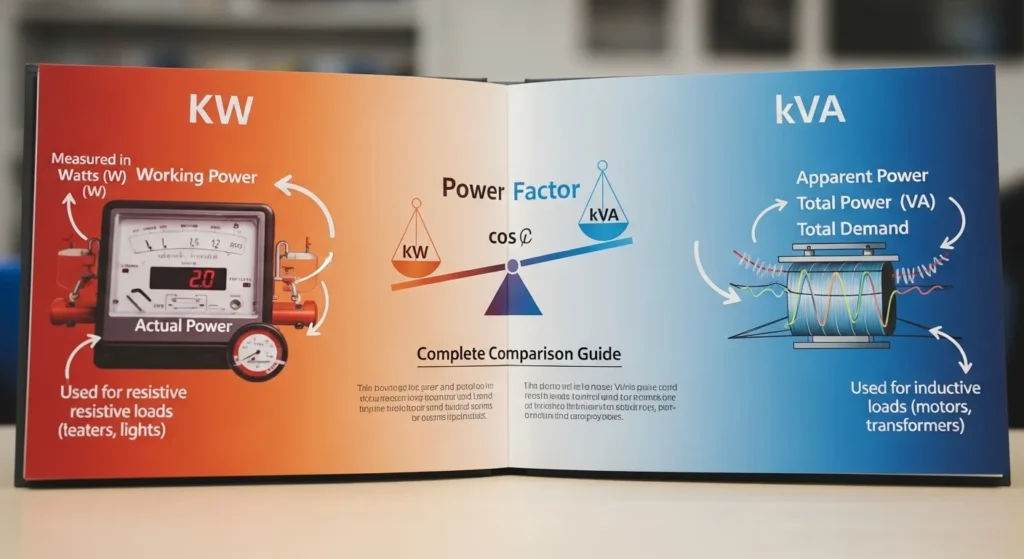
- kW (kilowatt) is the unit of real or active power. It represents the actual power that performs useful work.
- kVA (kilovolt-ampere) is the unit of apparent power. It represents the total power supplied in an electrical system.
Simple Explanation
In AC systems, not all supplied power is converted into useful work. Some power is lost due to magnetic fields and reactive components.
So:
- kW = Useful power
- kVA = Total supplied power
Practical Example
If a motor consumes 10 kW of real power and operates at 0.8 power factor:
kVA = kW / Power Factor
kVA = 10 / 0.8 = 12.5 kVA
This means the generator must supply 12.5 kVA to deliver 10 kW of useful power.
kW vs kVA Working Principle
Understanding the kW vs kVA working principle requires knowing three types of power in AC systems.
Real Power (kW)
- Performs useful work.
- Runs motors.
- Produces heat and light.
Reactive Power (kVAR)
- Does not perform useful work.
- Supports magnetic fields in motors and transformers.
- Required for AC system operation.
Apparent Power (kVA)
- Combination of real power and reactive power.
- Total power supplied by source.
Mathematically:
kVA² = kW² + kVAR²
Easy Analogy
Imagine a glass of juice with foam on top:
- Juice = kW (useful part)
- Foam = kVAR (non-working but present)
- Total glass content = kVA
That explains the difference between kW and kVA clearly.
Types / Classification
To fully understand kW vs kVA, we must classify types of power.
Active Power (kW)
- Also called real power.
- Measured in kilowatts.
- Used for actual work.
Reactive Power (kVAR)
- Measured in kilovolt-ampere reactive.
- Supports magnetic and electric fields.
- Required in inductive loads.
Apparent Power (kVA)
- Combination of kW and kVAR.
- Determines generator and transformer rating.
These three together define AC power behavior.
Main Components Involved
Several components influence kW and kVA values.
Generator
- Rated in kVA.
- Must handle total apparent power.
Transformer
- Also rated in kVA.
- Supplies both real and reactive power.
Motor
- Consumes kW.
- Requires reactive power for magnetic field.
Power Factor Correction Capacitor
- Reduces reactive power.
- Improves power factor.
- Reduces difference between kW and kVA.
Each component affects power calculation in practical systems.
kW vs kVA Advantages
Let us clearly understand kW vs kVA advantages and disadvantages.
kW Advantages
- Shows actual usable power.
- Used for billing in many systems.
- Helps calculate real energy consumption.
- Important for load calculations.
kVA Advantages
- Determines equipment capacity.
- Used for generator and transformer rating.
- Helps size electrical systems safely.
- Includes total system demand.
Both units serve important purposes.
kW vs kVA Disadvantages / Limitations
kW Limitations
- Does not show total system demand.
- Ignores reactive power.
- Cannot size generators directly.
kVA Limitations
- Does not show actual useful output.
- Can be misleading without power factor.
- Not directly used for energy billing.
Understanding these limitations avoids common mistakes.
kW vs kVA Applications
Home Applications
- Electricity bills often measured in kWh.
- Small UPS rated in kVA.
- Air conditioners rated in kW.
Industrial Applications
- Transformers rated in kVA.
- Motors rated in kW.
- Generators rated in kVA.
- Power factor correction systems.
Modern Technology
- Data centers.
- Solar inverters.
- Electric vehicle charging stations.
- Smart grid systems.
kW vs kVA applications are critical in power system planning.
Comparison Section
Difference Between kW and kVA
| Feature | kW | kVA |
| Meaning | Real Power | Apparent Power |
| Performs Work | Yes | Not fully |
| Depends on Power Factor | Yes | No |
| Used For | Load rating | Generator rating |
| Formula | kW = kVA × PF | kVA = kW / PF |
This table clearly explains the difference between kW and kVA.
Selection Guide – How to Choose the Right Rating
When selecting equipment:
For Generators
Always calculate total kW load and divide by power factor.
Generator kVA = Total kW / Power Factor
For Transformers
Choose kVA rating based on total load demand.
Improve Power Factor
Install capacitors if PF is below 0.9.
Consider Future Expansion
Add safety margin of 10–20%.
For beginners: Never size generator using only kW value without power factor.
Common Problems & Solutions (FAQs Style)
Why is generator rated in kVA and not kW?
Because generator must supply both real and reactive power.
What happens if power factor is low?
- Higher kVA required.
- Increased losses.
- Higher electricity bills.
Solution:
Install power factor correction capacitors.
How to convert kW to kVA?
kVA = kW / Power Factor
Can kW be greater than kVA?
No. kW is always equal to or less than kVA.
Why do industries monitor kVA demand?
Because utilities may charge based on maximum demand in kVA.
Future Trends
Power systems are evolving.
New Developments
- Smart meters measuring kW, kVAR, and kVA.
- Automated power factor correction panels.
- AI-based load management.
- Renewable energy integration.
- Smart grid technology.
Future systems focus on improving power factor to reduce the gap between kW and kVA.
Energy efficiency is becoming more important worldwide.
Conclusion
Understanding kW vs kVA is essential for anyone working in electrical engineering. kW represents real usable power, while kVA represents total apparent power supplied by the system.
We discussed the kW vs kVA working principle, types of power, kW vs kVA applications, and kW vs kVA advantages and disadvantages. You also learned the difference between kW and kVA and how to select the correct rating for generators and transformers.
As a junior engineer, always consider power factor before sizing equipment. Proper understanding of kW and kVA prevents overload, improves efficiency, and ensures safe operation.
Strong fundamentals in power calculations will make you confident in power system design and analysis.
Keep learning and keep practicing.