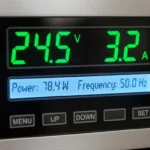
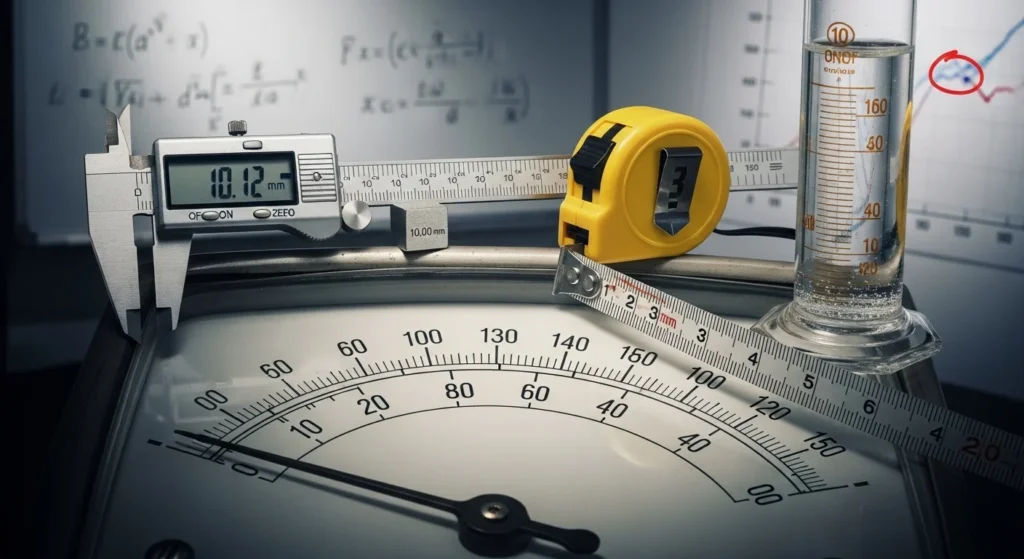

Imagine you are testing the voltage of a power supply in a laboratory. Your digital meter shows 220 V, but another engineer measures the same circuit and gets 217 V. Both instruments are working, but the readings are slightly different. This small difference is known as a measurement error.
In electrical engineering, accurate measurements are extremely important. Engineers rely on measurements to design circuits, maintain machines, and ensure electrical safety. Even a small error in measurement can lead to incorrect analysis, equipment malfunction, or poor system performance.
Measurement errors are unavoidable because no measuring instrument is perfect. Factors like instrument accuracy, environmental conditions, human observation, and electrical noise can all affect measurement results. That is why engineers must understand how measurement errors occur and how they can be minimized.
In this article, you will learn the measurement errors working principle, types of measurement errors, causes, measurement errors applications, advantages and disadvantages of error analysis, and practical solutions used in electrical systems. This guide explains the topic in simple and clear language so that students, technicians, and beginners can easily understand it.
2. What are Measurement Errors?
A measurement error is the difference between the true value of a quantity and the measured value obtained from an instrument.
Simple Definition
Measurement error is the difference between the actual value and the value shown by the measuring instrument.
Mathematical Expression
Measurement Error = True Value − Measured Value
Simple Explanation
No measuring instrument can provide a perfectly exact value. Every instrument has some level of inaccuracy. This inaccuracy creates a small difference between the real value and the measured value.
Practical Example
Suppose the actual voltage in a circuit is:
230 V
But the voltmeter shows:
228 V
The measurement error is:
Error = 230 − 228 = 2 V
This means the instrument has a 2-volt measurement error.
Understanding these errors helps engineers improve measurement accuracy and system reliability.
3. Measurement Errors Working Principle
The measurement errors working principle is based on the concept that measuring instruments interact with the system being measured, and this interaction introduces small inaccuracies.
These inaccuracies can come from different sources such as instrument design, environmental conditions, and human observation.
Step-by-Step Explanation
Measurement of Physical Quantity
An instrument measures a physical parameter such as voltage, current, resistance, or temperature.
Signal Conversion
The instrument converts the physical quantity into an electrical signal that can be displayed.
Instrument Processing
Internal circuits process the signal and generate the measurement value.
Display of Measurement
The instrument displays the result on a digital or analog scale.
Error Occurrence
During any of these stages, small inaccuracies may occur due to:
- Instrument limitations
- Environmental conditions
- Calibration issues
- Human reading mistakes
Simple Analogy
Imagine measuring water using a container that is slightly damaged. Even if you fill it carefully, the reading may not be perfectly accurate. This difference represents measurement error.
4. Types of Measurement Errors
Measurement errors are generally classified into three main categories.
Gross Errors
Gross errors occur due to human mistakes during measurement.
Examples
- Reading the meter incorrectly
- Recording wrong values
- Incorrect instrument connection
Example
If a technician reads 150 V instead of 105 V, this is a gross error.
Gross errors can be minimized through proper training and careful observation.
Systematic Errors
Systematic errors occur due to instrument or environmental factors and produce consistent errors in measurements.
Causes of Systematic Errors
- Instrument calibration issues
- Temperature changes
- Mechanical friction
- Power supply variations
Systematic errors can be corrected by proper calibration.
Random Errors
Random errors occur due to unpredictable variations in measurement.
Causes
- Electrical noise
- Environmental disturbances
- Fluctuating signals
Random errors cause small variations in readings each time a measurement is taken.
5. Main Components Related to Measurement Errors
Although measurement errors are not physical devices, they are influenced by several measurement system components.
Measuring Instrument
The quality and accuracy of the instrument directly affect measurement error.
High-quality instruments usually produce smaller errors.
Sensor or Transducer
Sensors convert physical quantities into electrical signals.
Poor sensor performance can increase measurement errors.
Signal Processing Circuit
The electronic circuits inside measuring devices process signals.
Any distortion in these circuits can introduce errors.
Display System
Errors may also occur when displaying the measurement value.
For example:
- Resolution limitations
- Display rounding errors
Environmental Conditions
External conditions like temperature, humidity, and electromagnetic interference can affect measurement accuracy.
6. Advantages of Understanding Measurement Errors
Studying measurement errors provides many benefits in electrical engineering.
• Improves measurement accuracy
• Helps engineers design better instruments
• Reduces system failures
• Improves quality control in industries
• Helps identify instrument faults
• Supports reliable electrical system operation
Understanding errors allows engineers to correct or minimize them effectively.
7. Disadvantages / Limitations
Although measurement error analysis is important, it also has some limitations.
• Eliminating errors completely is impossible
• Requires regular instrument calibration
• Advanced instruments may be expensive
• Error analysis can increase system complexity
Despite these limitations, controlling measurement errors is essential in engineering systems.
8. Measurement Errors Applications
Understanding measurement errors applications is important in many technical fields.
Electrical Power Systems
Engineers analyze measurement errors to maintain accurate voltage and current monitoring.
Laboratory Measurements
Precise experiments require error analysis to ensure correct results.
Industrial Automation
Measurement accuracy is critical for machine control and production quality.
Calibration Laboratories
Technicians study measurement errors when calibrating instruments.
Electronic Circuit Design
Engineers consider measurement errors when designing sensors and testing circuits.
9. Comparison: Accuracy vs Precision vs Measurement Error
Understanding the difference between accuracy and precision helps engineers analyze measurement errors more effectively.
| Parameter | Accuracy | Precision | Measurement Error |
| Definition | Closeness to true value | Repeatability of measurements | Difference between measured and true value |
| Example | Meter shows correct value | Same reading repeated many times | Small difference between real and measured value |
| Importance | Determines correctness | Determines consistency | Indicates measurement quality |
All three concepts are closely related in measurement systems.
10. Selection Guide: How to Reduce Measurement Errors
Engineers can reduce measurement errors by following several practical methods.
Use High-Accuracy Instruments
Select instruments with better accuracy ratings.
Regular Calibration
Calibration ensures that instruments maintain correct measurement values.
Proper Instrument Handling
Avoid mechanical damage and incorrect connections.
Environmental Control
Reduce the impact of temperature, humidity, and electromagnetic interference.
Multiple Measurements
Taking multiple readings and calculating the average reduces random errors.
11. Common Problems & Solutions
Why do instruments show different readings?
Different instruments may have different accuracy levels and calibration conditions.
Solution: Use calibrated instruments and verify measurements.
Why does measurement fluctuate?
Fluctuating signals or electrical noise may cause unstable readings.
Solution: Use filtering techniques and proper grounding.
How often should instruments be calibrated?
Calibration depends on the instrument type and usage.
Industrial instruments are typically calibrated once a year.
Can measurement errors be completely eliminated?
No. Measurement errors cannot be completely removed, but they can be minimized using proper techniques.
12. Future Trends in Measurement Technology
Measurement technology is improving rapidly with modern electronics.
Smart Measuring Instruments
Smart instruments automatically detect and compensate for errors.
Digital Calibration Systems
Automated calibration systems improve measurement accuracy.
Artificial Intelligence in Measurements
AI systems can analyze measurement data and detect abnormal errors.
Remote Monitoring
Modern instruments allow remote monitoring and data analysis through digital communication systems.
These technologies will further improve the reliability of measurement systems.
13. Conclusion
Measurement errors are an unavoidable part of every measurement system. They occur due to instrument limitations, environmental conditions, and human factors. Understanding the measurement errors working principle helps engineers analyze and reduce these inaccuracies.
Electrical engineers, technicians, and students must understand different types of errors such as gross errors, systematic errors, and random errors. By selecting accurate instruments, performing regular calibration, and controlling environmental conditions, measurement errors can be minimized significantly.
Understanding measurement errors applications is essential in laboratories, power systems, industrial automation, and electronic circuit design. Proper error analysis ensures reliable measurements and improves the overall performance of electrical systems.
For beginners in electrical engineering, learning about measurement errors is a fundamental step toward mastering accurate measurement techniques and building dependable electrical systems.