
Imagine you switch on a light at home, but it does not glow. You check the bulb, and it looks fine. Then you discover that one wire inside the switch is loose. The path of electricity is broken. This situation is called an open circuit.
For every electrical student, technician, and engineer, understanding what is an open circuit is essential. An open circuit is one of the most common electrical conditions encountered during installation, maintenance, and troubleshooting. It may not be as dangerous as a short circuit, but it can stop equipment from working completely.
In this article, I will clearly explain the open circuit working principle, its types, causes, open circuit applications, and open circuit advantages and disadvantages. You will also learn the difference between open circuit and short circuit, along with practical troubleshooting methods.
Think of this topic as a foundation for fault diagnosis in electrical systems.
What is an Open Circuit?
Definition
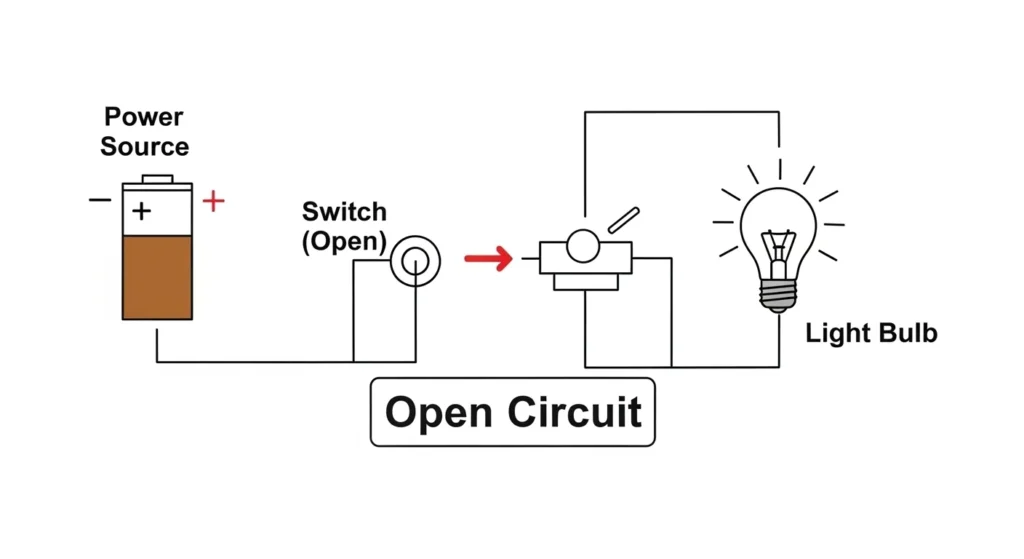
An open circuit is a condition in which the electrical path is broken, and no current flows through the circuit.
In simple words, the circuit is incomplete.
Simple Explanation
In a normal circuit:
- Current flows from the source.
- Passes through the load.
- Returns to the source.
In an open circuit:
- There is a break in the path.
- Current cannot flow.
- The load does not operate.
Even if voltage is present, no current flows because the path is disconnected.
Practical Example
If a switch is turned OFF, the circuit becomes open. Similarly, if a wire is cut or a fuse blows, an open circuit occurs.
When a bulb filament breaks, the bulb stops glowing. That is an open circuit inside the bulb.
Open Circuit Working Principle
Understanding the open circuit working principle is simple if you remember one rule:
No complete path = No current flow
Let’s explain step by step.
Step 1 is applied.
- Circuit path is complete.
- Current flows through load.
- Device operates normally.
Path Breaks
- Wire disconnects.
- Switch opens.
- Component fails.
- Fuse melts.
Now the circuit is incomplete.
Step 3: Current Stops
- Resistance becomes extremely high (almost infinite).
- According to Ohm’s Law, if resistance is very high, current becomes nearly zero.
- Load stops working.
Easy Analogy
Imagine a water pipe connected to a tap and a bucket.
- If pipe is continuous, water flows.
- If pipe is cut in the middle, water stops flowing.
An open circuit is like a broken pipe.
Types / Classification
Open circuits can be classified based on cause and location.
Intentional Open Circuit
- Created by design.
- Example: Switch in OFF position.
- Used to control circuits safely.
This is a controlled open circuit.
Unintentional Open Circuit
- Caused by fault.
- Wire breakage.
- Loose connection.
- Burnt component.
This type requires troubleshooting.
Temporary Open Circuit
- Occurs due to loose contact.
- May work sometimes.
- Common in vibrating machinery.
Permanent Open Circuit
- Wire completely broken.
- Component permanently damaged.
- Requires repair or replacement.
Understanding types helps in proper diagnosis.
Main Components Involved
Certain components can create or protect against open circuits.
Switch
- Manually opens or closes circuit.
- Controls current flow.
- Used in homes and industries.
Fuse
- Melts during overcurrent.
- Intentionally creates open circuit to protect system.
Circuit Breaker
- Trips during fault.
- Opens circuit automatically.
- Can be reset.
Connectors and Terminals
- Provide connection between wires.
- Loose terminals may cause open circuit fault.
Each component plays a role in managing open circuit conditions.
Open Circuit Advantages
It may seem surprising, but open circuit advantages and disadvantages both exist.
Advantages
- Provides safe disconnection of power.
- Prevents current flow during maintenance.
- Protects equipment when fuse blows.
- Essential for switching operations.
- Reduces shock risk when properly designed.
In safety systems, controlled open circuits are very important.
Open Circuit Disadvantages / Limitations
Unplanned open circuits create problems.
Disadvantages
- Equipment stops working.
- Production loss in industries.
- Difficult troubleshooting sometimes.
- May cause voltage buildup in some cases.
- Can damage sensitive electronics.
For example, in high-voltage systems, sudden open circuit may create voltage spikes.
Open Circuit Applications
Open circuit applications mainly involve control and safety.
Home Applications
- Light switches.
- Circuit breakers.
- Fuse protection.
- Main isolator switch.
Industrial Applications
- Emergency stop systems.
- Motor control panels.
- Maintenance isolation switches.
- Protection relay operations.
Modern Technology
- Microcontroller-based switching.
- Smart relays.
- Automated shutdown systems.
- Remote monitoring systems.
Open circuit applications are critical for safe operation of electrical systems.
Comparison Section
Difference Between Open Circuit and Short Circuit
| Feature | Open Circuit | Short Circuit |
| Path Condition | Broken path | Direct low-resistance path |
| Current Flow | No current | Very high current |
| Resistance | Very high | Very low |
| Danger Level | Low to moderate | Very high |
| Example | Switch OFF | Live and neutral touching |
Understanding the difference between open circuit and short circuit is essential for fault diagnosis.
Selection Guide – How to Handle Open Circuits
When designing systems, follow these tips:
Use Quality Components
Select reliable switches and connectors.
Proper Cable Selection
Use correct wire size and insulation.
Regular Maintenance
Check for loose terminals.
Tighten connections periodically.
Use Proper Protection Devices
Install correct fuse rating.
Use suitable circuit breakers.
Label Circuits Clearly
Helps quick troubleshooting.
For beginners: Always test continuity using a multimeter before replacing components.
Common Problems & Solutions (FAQs Style)
Why is my device not turning ON?
Possible cause:
- Open circuit in wiring.
- Blown fuse.
- Loose connection.
Solution:
- Check fuse.
- Inspect wiring.
- Test continuity.
How to detect open circuit?
- Use multimeter continuity mode.
- Measure resistance.
- Infinite resistance indicates open circuit.
Can open circuit damage equipment?
In low-voltage systems, usually no.
In high-voltage systems, sudden open circuit may cause voltage spike.
Why does fuse create open circuit?
To protect system from overcurrent by breaking the path intentionally.
Is open circuit safer than short circuit?
Yes. Because current stops flowing instead of increasing dangerously.
Future Trends
Modern electrical systems are becoming smarter.
New Developments
- Smart circuit breakers with remote monitoring.
- Automatic fault detection systems.
- IoT-based electrical panels.
- Predictive maintenance using sensors.
- Self-diagnosing industrial systems.
Future systems will detect open circuits automatically and send alerts before failure occurs.
Smart grids and automation are improving reliability and reducing downtime.
13. Conclusion
Now you clearly understand what is an open circuit and why it is important in electrical engineering. An open circuit occurs when the electrical path is broken, preventing current flow.
We discussed the open circuit working principle, types, open circuit applications, and open circuit advantages and disadvantages. You also learned the difference between open circuit and short circuit and how to troubleshoot common problems.
As a junior engineer, always remember that proper wiring, secure connections, and regular inspection prevent most open circuit faults.
Strong understanding of basic circuit conditions like open and short circuits will make you confident in troubleshooting and system design.
Keep learning and keep practicing.