
Imagine you are wiring a small house. The electrician tells you it will use single phase supply. A few days later, you visit a factory where large motors and heavy machines are running smoothly, and you hear the engineer mention three phase power.
Both systems supply electricity, but they are designed for different purposes. If you select the wrong system, you may face voltage drops, overheating, equipment failure, or unnecessary cost.
Understanding Single Phase vs Three Phase is very important for electrical students, technicians, and engineers. It helps in load calculation, motor selection, panel design, and power distribution planning.
In this article, I will explain the Single Phase vs Three Phase working principle, types, components, applications, advantages and disadvantages, and the difference between single phase and three phase in simple language. Think of this as practical site-level guidance from a senior engineer to a junior professional.
What is Single Phase vs Three Phase?
The term Single Phase vs Three Phase refers to two different methods of supplying alternating current (AC) electrical power.
What is Single Phase?
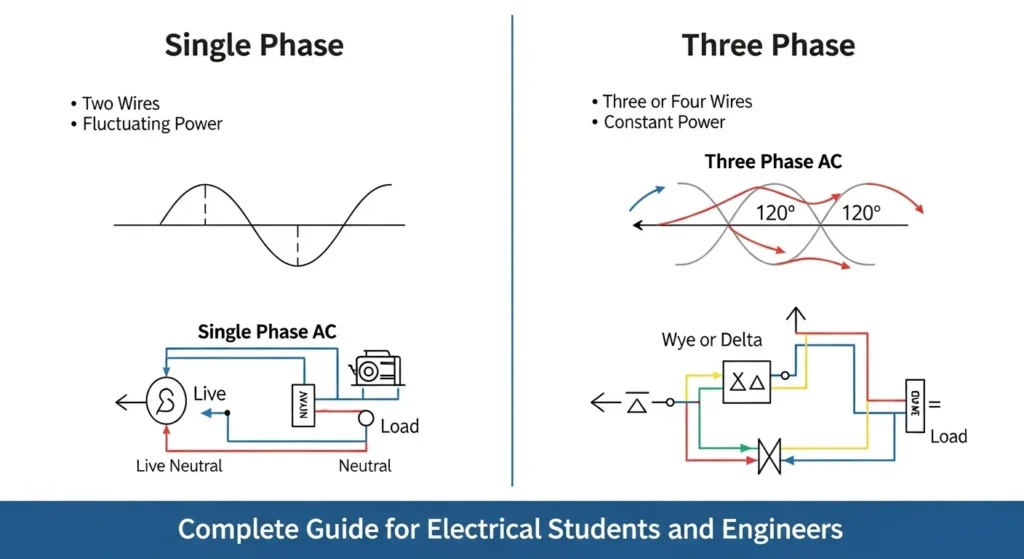
Single phase power uses one live (phase) wire and one neutral wire.
In simple words, electricity flows through one alternating wave.
Practical Example:
Most homes use single phase supply to run lights, fans, refrigerators, and televisions.
What is Three Phase?
Three phase power uses three live wires (phases) and usually one neutral wire.
Each phase carries alternating current, but the waves are separated by 120 degrees.
Practical Example:
Factories use three phase supply to operate heavy motors, compressors, and large machinery.
Single Phase vs Three Phase Working Principle
To understand the Single Phase vs Three Phase working principle, imagine pushing a swing.
If one person pushes, the swing moves but may slow down between pushes. That is similar to single phase power.
If three people push the swing at equal intervals, the motion becomes smooth and continuous. That is similar to three phase power.
Single Phase Working Principle
One AC waveform is generated.
Voltage rises and falls in one cycle.
Power reaches zero twice in each cycle.
Motors require additional starting mechanism.
Single phase supply is simple but less efficient for heavy loads.
Three Phase Working Principle
Three AC waveforms are generated.
Each wave is 120° apart.
Power delivery is continuous.
Motors self-start without extra devices.
Three phase supply provides smooth and stable power output.
Types / Classification
Types of Single Phase Systems
Two-Wire Single Phase
One phase and one neutral
Common in homes
Split Phase System
Used in some residential systems
Provides two voltage levels
Types of Three Phase Systems
Star (Wye) Connection
Neutral point available
Used in distribution systems
Delta Connection
No neutral
Used in industrial motors
Both systems serve different engineering needs.
Main Components
Components in Single Phase System
Phase Wire – Carries current
Neutral Wire – Completes circuit
Circuit Breaker – Protection
Energy Meter – Measures consumption
Components in Three Phase System
Three Phase Wires – Carry three currents
Neutral Wire – For imbalance load
Three Phase Breaker – Protection
Distribution Panel – Load management
Transformer – Voltage regulation
Understanding components helps in proper Single Phase vs Three Phase applications.
Advantages
Single Phase Advantages
Simple wiring
Low installation cost
Easy maintenance
Suitable for small loads
Three Phase Advantages
Higher power capacity
Smooth motor operation
Better efficiency
Lower transmission losses
Suitable for heavy machinery
Knowing Single Phase vs Three Phase advantages and disadvantages helps in correct system selection.
Disadvantages / Limitations
Single Phase Limitations
Not suitable for heavy loads
Voltage drop under high load
Motors need starter
Three Phase Limitations
Higher installation cost
More complex wiring
Not economical for small homes
Every system has strengths and weaknesses depending on usage.
Applications
Single Phase Applications
Residential homes
Small shops
Lighting systems
Small appliances
Three Phase Applications
Factories
Large commercial buildings
Industrial motors
Water pumping stations
Data centers
Single Phase vs Three Phase applications differ mainly based on load demand.
Difference Between Single Phase and Three Phase
The difference between single phase and three phase is important for interviews and practical work.
| Feature | Single Phase | Three Phase |
| Number of Phases | One | Three |
| Power Delivery | Pulsating | Continuous |
| Cost | Lower | Higher |
| Efficiency | Lower | Higher |
| Motor Starting | Requires starter | Self-starting |
| Applications | Homes | Industries |
This table clearly shows the difference between single phase and three phase systems.
Selection Guide
Choosing between Single Phase vs Three Phase depends on load requirements.
For Beginners
Calculate total load in watts
If load is small, choose single phase
For motors above 3 HP, consider three phase
Check local utility availability
For Engineers
Analyze peak load demand
Consider future expansion
Study voltage drop
Evaluate power factor
Follow electrical standards
Correct selection improves system performance and safety.
Common Problems & Solutions
Why lights flicker in single phase?
Possible overload or voltage drop.
Why motor vibrates in three phase?
Phase imbalance or loose connection.
Can three phase run single phase load?
Yes, using one phase and neutral.
Can single phase run three phase motor?
Yes, but using special converters.
How to detect phase imbalance?
Measure voltage between all phases and compare.
Proper testing prevents long-term damage.
Future Trends
Electrical distribution is evolving.
Smart Grids
Better load balancing between phases.
Hybrid Systems
Combination of renewable and grid supply.
Advanced Power Electronics
Improved conversion between single and three phase.
Energy Monitoring Systems
Real-time phase load tracking.
Future systems will focus on efficiency and automation.
Conclusion
Understanding Single Phase vs Three Phase is fundamental in electrical engineering. Single phase is simple, cost-effective, and suitable for residential loads. Three phase provides higher efficiency, smooth power delivery, and supports heavy industrial machinery.
We discussed the Single Phase vs Three Phase working principle, types, components, applications, advantages and disadvantages, and clearly explained the difference between single phase and three phase systems.
As a junior engineer, always analyze load requirements before choosing a supply system. Correct planning ensures safety, efficiency, and long-term reliability. Mastering these basics will strengthen your foundation in power distribution and electrical system design.